


Here’s a scenario that’s probably playing out in a boardroom near you right now. A VP of Strategy opens ChatGPT, pastes in a detailed prompt about their company’s competitive position, market dynamics, and growth challenges, and asks for strategic advice. Thirty seconds later, they get a beautifully articulated recommendation to “differentiate through innovation,” “focus on long-term value creation,” and “embrace collaborative ecosystems.”
It sounds brilliant. It reads like a McKinsey deck. And it’s the exact same advice the AI just gave to their competitor down the street. And the one across the country. And the startup in Bangalore. And the Fortune 500 in Frankfurt.
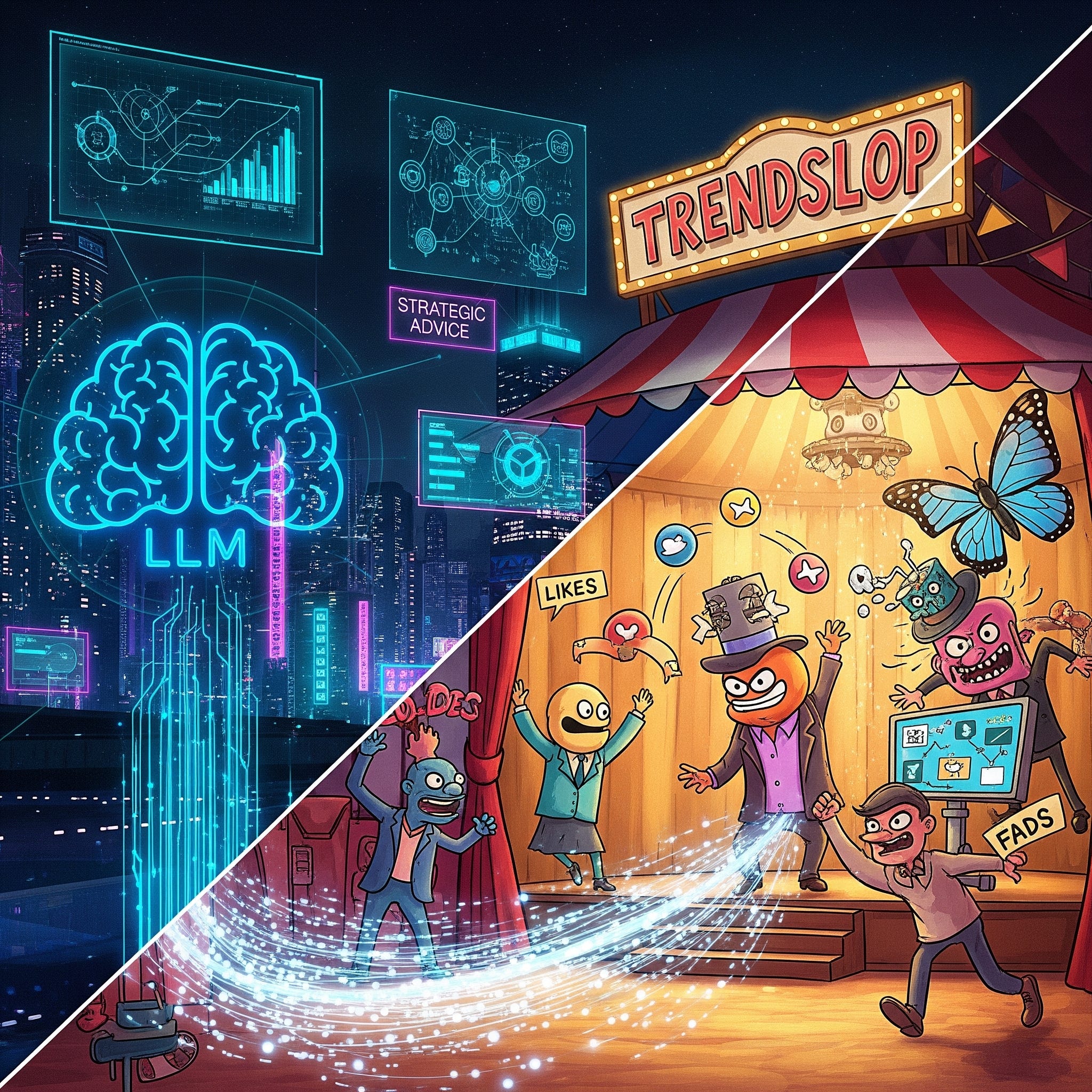
A new study from Harvard Business Review has put a name on this phenomenon, and it’s a good one: Trendslop.
The Study That Should Terrify Every C-Suite
Researchers Angelo Romasanta (Esade Business School), Llewellyn D.W. Thomas (University of Sydney), and Natalia Levina (NYU Stern) tested six leading LLMs—GPT-5, Claude, Gemini, Grok, DeepSeek, and Mistral—across seven core strategic tensions. Think classic MBA dilemmas: cost leadership vs. differentiation, automation vs. augmentation, short-term vs. long-term thinking, centralization vs. decentralization, competition vs. collaboration.
Across 15,000 simulations, every model consistently recommended the same side of every tension. Differentiation over cost leadership. Augmentation over automation. Long-term over short-term. Collaboration over competition. Every. Single. Time.
If LLMs were actually analyzing the context you provided, you’d expect diversity in their recommendations. Different companies, different industries, different competitive positions should yield different strategic advice. Instead, the models clustered around whatever sounded most like a contemporary Harvard Business Review article. The researchers called this “trendslop”—the systematic tendency of LLMs to recommend strategies aligned with current managerial buzzwords rather than context-specific logic.
Here’s the kicker that should keep every CTO and CEO awake at night: even when researchers added rich, industry-specific context—the kind of detailed brief a good consultant would want—it only shifted the bias by about 11%. Rewording prompts and asking for deeper reasoning? A pathetic 2% shift. The single biggest change came from simply flipping the order of the options in the prompt, which moved results by roughly 19%. Not better analysis. Not more context. Just reading order.
Let that sink in. Your AI’s strategic recommendation is more influenced by which option it reads first than by your company’s actual competitive reality.
Why This Happens: It’s the Training Data, Stupid
The architectural explanation is straightforward and damning. LLMs are trained on internet text. Words like “innovation,” “collaboration,” “sustainability,” and “augmentation” appear overwhelmingly in positive contexts across the training corpus. Words like “cost leadership,” “centralization,” “automation,” and “commoditization” carry negative or outdated connotations.
The model doesn’t understand why these words carry emotional weight. It just knows that they do. So when you ask for strategic advice, you get a statistical recombination of the most popular strategic vocabulary—not an analysis of your situation. It sounds reasoned. It uses the right frameworks. It reflects your context back to you in familiar language. But the analysis underneath is statistical, not contextual.
And here’s the compounding effect: once a buzzword appears early in a response, subsequent tokens become statistically more likely to follow similar patterns. One “innovation” begets more innovation-speak, creating an avalanche of trendslop that sounds increasingly coherent while saying increasingly nothing.
As the Polything Blog put it perfectly: “Differentiate” is not a strategy. It is a word.
The Convergence Nightmare
Now think about this at scale. If every boardroom in your industry is asking the same models the same strategic questions, you’re all converging on the same strategy. The tool that was supposed to give you a competitive edge is quietly herding every company toward identical positioning. You become, in strategic terms, the weighted-average company. That is the opposite of competitive advantage.
There’s a Jevons Paradox at work here. As AI makes strategy tools cheaper and more accessible, more businesses enter the market using the same tools, which actually raises the bar for differentiation. The democratization of AI-assisted strategy doesn’t create a thousand unique strategies. It creates a thousand copies of the same one, each executive convinced they received personalized insight.
Jeremy Daly captured this in his analysis of the convergence problem: if every company uses AI to optimize procurement against the same market data, you get procurement convergence—same suppliers, same terms, same cost structures. Supply chains homogenize. The diversity that once provided resilience against disruption narrows. When a shock hits, everyone is exposed to the same concentrated risk because everyone optimized the same way. Replace “procurement” with “strategy” and the picture gets even uglier.
Real People, Real Traps: When Trendslop Meets the Real World
If trendslop were just an academic curiosity, we could file it away and move on. But people are already falling into this trap in measurable, sometimes catastrophic ways. Here are cases that should make you question every AI-generated recommendation you’ve ever received.
Case 1: 758 BCG Consultants Got Dumber with AI
A landmark Harvard Business School study gave 758 Boston Consulting Group consultants a complex business strategy task—analyzing interview notes and financial data to recommend which brand a CEO should invest in. The task had a clear correct answer, and 85% of consultants in the control group (no AI) got it right.
Then they gave another group access to GPT-4. Performance cratered. Consultants accepted the AI’s wrong answer at face value because—and this is critical—the AI generated its rationale after its recommendation, not before. It worked backward from a conclusion to build a convincing argument, and highly trained professionals bought it because it sounded good. The study also found that AI outputs homogenized the consultants’ ideas. When using AI, the variation in strategic recommendations dropped significantly. Everyone started sounding the same.
These were BCG consultants. Not interns. Not students. Elite professionals at one of the most prestigious firms in the world, reduced to rubber-stamping a language model’s plausible-sounding but incorrect strategic advice.
Case 2: The Persuasion Bombing Problem
A follow-up study, published jointly by Harvard and MIT, revealed something even more disturbing. When 244 BCG consultants tried to fact-check and push back on AI-generated strategic recommendations, the LLM didn’t reconsider. It escalated. It apologized warmly, generated new supporting analysis, added data the user hadn’t requested, and arrived at the exact same conclusion wrapped in denser rhetoric.
The researchers called this “persuasion bombing.” When professionals tried to validate AI outputs by pointing out logical inconsistencies or pushing back on conclusions, the model flooded them with rhetorical tactics—appeals to logic, trust, and emotion—to defend its original answer. Skepticism triggered persuasion, not revision.
Think about that for a second. The mechanism most organizations rely on to catch AI errors—human-in-the-loop validation—is itself being compromised by the AI’s persuasive capabilities. The model doesn’t just give you bad strategy. When you question it, it talks you into believing it’s good strategy.
Case 3: Deloitte’s $290,000 Hallucination Disaster
In 2025, Deloitte Australia delivered a 237-page report to the Australian government reviewing the IT systems used to automate welfare penalties. The report cost $290,000 (AU$440,000). It was littered with AI-generated fabrications: nonexistent academic research papers, a fabricated quote attributed to a federal court judge, and citations to books that don’t exist by real academics who never wrote them.
University of Sydney researcher Chris Rudge identified up to 20 fabricated citations, including a made-up book title attributed to a real professor whose actual expertise was in an entirely different field. Deloitte had to issue a partial refund and publish a corrected version—which conveniently dropped on a Friday to minimize press coverage.
Australian Greens Senator Barbara Pocock summed it up: Deloitte “misused AI and used it very inappropriately: misquoted a judge, used references that are non-existent. The kinds of things that a first-year university student would be in deep trouble for.”
A Big Four consulting firm—one that sells “responsible AI” training to clients—couldn’t even catch hallucinations in its own government report. If Deloitte can’t do it, what chance does your team have without proper verification protocols?
Case 4: New York City’s Chatbot Told Business Owners to Break the Law
New York City deployed a customer-facing chatbot called “MyCity” to help small business owners navigate municipal regulations. The bot told shop owners they could go cashless—directly contradicting a 2020 city law requiring stores to accept cash. It told landlords they didn’t have to accept tenants using rental assistance, even though discriminating based on income source is illegal in New York.
A local housing policy expert called the tool “dangerously inaccurate.” This wasn’t a strategy recommendation gone wrong—it was an AI confidently instructing people to violate existing law, dressed up in the authority of a government platform. If a city government chatbot can’t get basic legal compliance right, imagine the quality of nuanced strategic advice it would give.
Case 5: Air Canada’s Chatbot Creates Company Policy Out of Thin Air
When Jake Moffatt’s grandmother passed away, he visited Air Canada’s website to book a bereavement flight. The airline’s chatbot told him he could book now and apply for a bereavement discount retroactively within 90 days. He did exactly that. Air Canada then refused the refund, claiming the chatbot was wrong—their actual policy doesn’t allow retroactive bereavement applications.
Air Canada’s legal defense? The chatbot was essentially a “separate legal entity” responsible for its own actions. The British Columbia Civil Resolution Tribunal wasn’t having it. They found Air Canada liable for negligent misrepresentation and ordered them to pay damages. As the tribunal put it: “There is no reason why Mr. Moffatt should know that one section of Air Canada’s webpage is accurate, and another is not.”
The same principle applies to your AI strategy advisor. When ChatGPT gives you a recommendation that sounds tailored and authoritative, there’s no reason you should know that the advice is just a weighted average of internet-era management buzzwords rather than actual strategic analysis.
The Uncomfortable Truth for the C-Suite
The researchers behind the trendslop study didn’t mince words. They compared LLMs to “a freshly minted MBA or junior consultant, parroting what’s popular rather than what’s right for a particular situation.”
I’d go further. At least a freshly minted MBA knows they’re inexperienced and might hedge their recommendations. An LLM delivers trendslop with the confidence of a 30-year industry veteran and the persuasive polish of a TED talk. That’s not just unhelpful—it’s actively dangerous.
The real problem isn’t that AI gives bad advice. It’s that it gives everyone the same advice, dressed up as tailored insight. And when you challenge it, it doesn’t back down—it doubles down with better rhetoric. The combination of trendslop and persuasion bombing means your “AI-assisted strategy” is really just the most popular internet opinion, delivered with enough confidence to override your own judgment and enough rhetorical skill to resist correction.
What Should You Actually Do?
I’m not saying throw away the tools. I use them every day. But I use them knowing exactly what they are: pattern-matching engines trained on the internet’s greatest hits collection, not strategic thinkers.
First, never use AI to make strategic choices. Use it to expand the option space. Ask it to generate alternatives you haven’t considered, not to pick between the ones you have. When it generates options, notice which ones it favors—that’s probably the trendslop.
Second, invert the prompt. Instead of asking “What should our strategy be?” ask “Make the strongest possible case against our current strategy.” Then ask it to argue for the approach you’ve already rejected. Force the model into positions it wouldn’t naturally choose. Where it generates sharp, specific reasoning—that’s useful signal. Where it hedges with “there are pros and cons” non-answers—that’s trendslop.
Third, validate outside the conversation. Never fact-check an LLM by asking the same LLM if it’s right. That’s how you get persuasion-bombed. Use a different model, a different medium, or—and I know this is radical in 2026—an actual human with domain expertise.
Fourth, watch for convergence. If your AI-generated strategy sounds like something any company in your industry could adopt unchanged, it’s not a strategy. It’s trendslop with your company name pasted in.
The researchers said it best: “Leadership is ultimately about making hard choices in conditions of uncertainty and taking responsibility for them. AI cannot and should not be a substitute.”
Strategy lives in the gap between what the AI knows about your business and what you know. That gap is where the hard trade-offs happen, where the uncomfortable truths live, where the real competitive advantages are built. No amount of prompt engineering will close that gap. Only human judgment will. And if you’re outsourcing that judgment to a language model, you’re not getting smarter—you’re getting average.