


In 2000 I wrote the ASP for a site called usetheexperts.com. My friend Lowell did the design. We built it at Web Business Development, Inc., a shop in Chatsworth at the north end of the San Fernando Valley.
What survives is a handful of Internet Archive captures taken between February 2002 and October 2004, of a site that was for some reason serving on port 8080, and a short stack of filings with the Securities and Exchange Commission. I went back through all of it recently. The company I remembered building for is not the company that was there.
Angie’s List was chasing the same customer in the same years and is now a public company that just impaired a quarter of a billion dollars of its own goodwill while announcing it is becoming an AI business. The comparison is worth more than nostalgia, though not for the reason I assumed for twenty-six years.

There were no reviews
The homepage had a zip code box and the words Find Your Local Expert. The navigation ran Home, Partners, Contact Us, and on a second bar, About Us, Why Use Us?, Register, Join Us. In the left column sat a red circular badge reading, around its edge, USETHEEXPERTS.COM CERTIFIED EXPERTS.
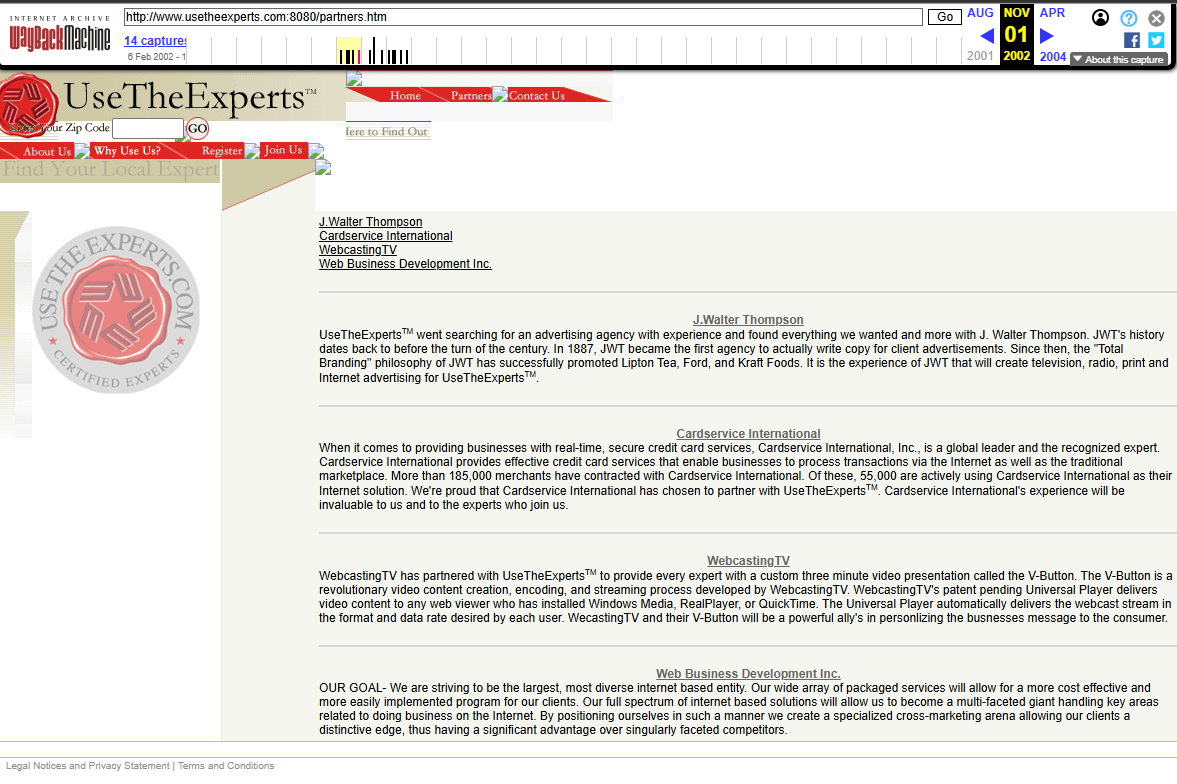
Nothing in any surviving capture lets a homeowner rate anybody. No stars, no written feedback, no complaint process, no mechanism of any kind for the person who hired the contractor to say what happened afterward. The consumer half of the product was a search box. The entire trust proposition was that badge.
Follow the money and the shape becomes clear. The partner page names Cardservice International as the payment processor and says why: the company’s experience “will be invaluable to us and to the experts who join us.” We were not processing homeowners. We were processing the experts. They paid to join, and in exchange we certified them. The seal did not encode competence. It encoded a cleared transaction.
A second archived page carries a copyright notice reading Expert Management L.L.C., which appears to be the entity that actually owned the property. Web Business Development sat underneath as the vendor, and its own self-description is worth reading closely: domain registration, hosting, design, consulting, e-commerce, revenue generation, advertising, merchant accounts, payment gateways, financing, warehousing, fulfillment, customer service. That is not a development shop. That is a company supplying the technology, the payment rails and the money to the business it was building for, which is how the Cardservice relationship ended up on the page in the first place.
The registration it withdrew
Before any of that, the company tried to go public. On October 27, 1999, UseTheExperts.com filed a Form SB-2 registration statement with the Securities and Exchange Commission from an address at 3601 West Sahara Avenue in Las Vegas. SB-2 was the small-business registration form, the one used for modest and often self-underwritten offerings. The financial statements were audited by a Las Vegas firm, L. L. Bradford & Company, in a report dated September 24, 1999.
Five months later it pulled out. The Form RW filed on March 27, 2000 gives the reason in a single sentence: the company had subsequently sold all of its outstanding common stock to an unrelated person, and had determined that conducting a public offering was no longer in its interest. It represented that no securities had been offered or sold under the registration during its pendency. The letter is signed by Alex Varonos, president and chief executive officer, with a callback number in the 805 area code that covers Ventura County.
Set that against what came next. The registration was abandoned in March 2000 because the company had changed hands in its entirety. By August it had committed twenty-five to thirty million dollars of advertising through one of the largest agencies on earth. Nevada corporate records put its stated capital at sixty thousand dollars, which is a nominal figure on an incorporation filing rather than money anybody raised, but the distance between those two numbers is the shape of the thing.
None of this was visible from where I sat. I was writing data access code and arguing with Lowell about table layouts. The corporate structure above a contract engineer is a rumor at best, and in 2000 it did not occur to any of us to look up our own client on EDGAR, mostly because we did not know EDGAR was a thing you could look a client up on.
The advertising was the product
On August 11, 2000, the New York Times ran a line in its daily advertising column, under the heading Accounts: UseTheExperts.com, Westlake Village, Calif., a Web site that links consumers to local businesses, to the Los Angeles office of J. Walter Thompson, part of the WPP Group. Billings were estimated at $25 million to $30 million.
Billings, in agency terms, means the media the agency places, not its fee. For scale, Angie’s List spent $48 million on advertising across the first nine months of 2011, with sixteen years of operating history and an imminent public offering behind it. So the explanation I had been carrying around for two decades is wrong. We were not a scrappy shop that could not afford awareness. We had WPP.
What the archive shows is stranger and more useful. One captured page carries a left-hand menu reading About Us, Video Overview, Television, Website Preview, V-Button, Radio, Expert Seal. That is not a consumer directory menu. It is a sales deck. Those are the deliverables you walk a prospective member through: here is the television campaign, here is radio, here is the website we build you, here is your video, here is your seal.

Which reverses the logic of the account entirely. The national campaign was not principally a way to acquire homeowners. It was the pitch used to recruit the businesses who paid. Join now, national television is coming. And it explains the thing that puzzled me most in the archive, the complete absence of reviews. In that model reviews are not a missing feature. They are a liability.
We bought the yellow pages’ upsell module
The partner page also names WebcastingTV, which had agreed to give every expert a custom three-minute video presentation called the V-Button, delivered by a patent-pending Universal Player to anyone running Windows Media, RealPlayer or QuickTime.
WebcastingTV was real, headquartered in Anaheim, and described itself as the world’s leading provider of streaming video advertising for the Internet yellow pages. Verizon Information Services licensed the same V-Button technology for SuperPages.com and rebranded it Video Clips. Verizon was publishing roughly 1,200 US directories with a circulation near 150 million copies, and SuperPages.com was drawing about 13 million visits and 9 million unique visitors a month.
So the differentiating feature of our contractor site was a product the actual yellow pages had licensed from the same vendor to enhance its own listings. We believed we were building the thing that would replace the directory. We were building a directory, and we had bought the directory’s paid upgrade module to bolt onto it, in a year when yellow pages advertising in the United States ran around thirteen billion dollars and was still climbing toward a print peak near $14.7 billion in 2005.
The video bet deserves its own autopsy. WebcastingTV’s president told the press that more than 93 percent of its content was viewable regardless of whether the viewer was on dial-up or broadband. That claim is probably accurate and entirely beside the point. In August 2000, 4.4 percent of American households had broadband and about 37 percent were on dial-up. Viewable and watchable are different words. Three minutes of streaming video per expert, to a country tying up the family phone line to see it.
Angie charged the other side on purpose
Angie’s List did not start as a website. It started in 1995 in Columbus, Ohio, as Columbus Neighbors, a magazine and a call-in service. Bill Oesterle, a venture capitalist at CID Equity Partners, could not find a contractor he trusted for a renovation, remembered a service in Indianapolis called Unified Neighbors, and brought in a recent DePauw economics graduate named Angie Hicks to build the same thing in Columbus. Hicks sold memberships door to door. When a rating changed someone updated a physical list, and when a member called someone read it to them over the phone. It took a year to reach 1,500 subscribers. In 1996 the company took Hicks’s name and bought Unified Neighbors outright, absorbing 5,000 Indianapolis members. Angieslist.com launched in 1999, four years in.
The part that gets skipped is that members paid and providers did not. Charging homeowners for access to reviews looks like pure friction and is actually two filters running at once. A paying subscriber has selected themselves as somebody about to spend real money, which makes their opinion worth recording. And you cannot astroturf a paid membership base at scale, because every fake reviewer costs the attacker a subscription. Most importantly, the revenue did not come from the parties being judged.
We took our revenue from the parties being judged and handed them a certificate. That difference had nothing to do with engineering, and it was the only difference that mattered.
Then Angie’s List did it anyway. By the November 2011 IPO, service providers were paying $33.9 million against members’ $25.1 million on 2010 revenue of $59 million and a net loss of $27.2 million, with only about ten percent of eligible providers buying advertising and that sliver already producing most of the money. The company went public carrying a $160.6 million accumulated deficit. By 2013 a Consumer Reports investigation put advertising bought by rated companies at nearly 70 percent of revenue, and flagged that advertisers rated B or better could be pushed to the top of search results. The paywall came down in July 2016. IAC bought the company in 2017 and merged it into HomeAdvisor. Nineteen years after founding it had never turned an annual profit.
The honest comparison is not that they won and we lost. It is that Angie’s List spent twenty-one years arriving at roughly the revenue model we started with, and the journey is what made the asset worth acquiring on the way.
The rest of the graveyard, and the one thing that lived
We were not unusual. ImproveNet raised $83.3 million across eight rounds, went public in the boom, and in 2005 sold to ServiceMagic for about $6.72 million in cash, roughly twelve cents a share. ServiceMagic, founded in Denver in December 1998, renamed itself HomeAdvisor in 2012 and ended up merged with Angie’s List under IAC. Out of that whole cohort two things survived: the company that spent four years building something by hand before writing any web code, and the company that never claimed to adjudicate anybody and just sold leads.
There is a third survivor that most resembles what we were trying to be. Experts.com, which carried the same WebcastingTV boilerplate on its own partner page in the same era, still operates today as an expert witness and consultant directory. It lived by narrowing into a field where the credentials are issued by somebody else and are checkable by a third party. Bar admission, board certification and professional licensure survive scrutiny. A red seal that says certified does not.
Which the FTC eventually got around to
On October 21, 2024, the Federal Trade Commission’s Rule on the Use of Consumer Reviews and Testimonials took effect, carrying civil penalties currently set at $51,744 per violation. Most of the coverage went to the provisions on fake and AI-generated reviews. The clause I keep returning to is the one barring businesses from creating purportedly independent seals or badges and awarding them to themselves.
Our seal would probably not be squarely covered, since we awarded it to paying third parties rather than to our own products. But the reason the Commission decided this class of signal needed a rule is exactly the reason ours was worthless. A badge issued by the party collecting the fee carries no information the recipient can act on. It looks like a credential and functions as a receipt. A company with sixty thousand dollars of stated capital and a withdrawn registration statement was in the business of certifying that other businesses could be trusted inside your house, and everyone building in this space in 2000 understood the problem at some level and shipped it regardless, because a seal was the only trust artifact you could manufacture without spending four years knocking on doors in Ohio.
Nextdoor got the primitive right
Nextdoor is the case that proves the constraint was never technical. Founded in 2008 and launched publicly in October 2011, it did not try to build a better review. It built a better reviewer, verifying members by physical address with codes mailed on postcards. You were not a username, you were the house on the corner, and your recommendation carried weight because you had to keep living next to everyone who read it. That is a stronger primitive than a star rating and far stronger than a seal.
It now reports 110 million verified neighbors across roughly 350,000 neighborhoods, and it also went public through a SPAC in November 2021 and trades at a fraction of its debut price. Second quarter 2026 revenue was $74.6 million, up 15 percent and a company record, on 22.9 million weekly active users, with net loss narrowed to $2 million from $15 million and adjusted EBITDA around $10 million, its best quarter ever. Fifteen years in, the strongest identity layer anyone has built for local trust runs at roughly a $300 million annual rate and has only just stopped burning cash. Sell the seal, sell the list, verify the neighbor and stay out of it. Three architectures, none of which turned trust into a durable business.
What AI is actually doing, which is not fake reviews
BrightLocal ran its Local Consumer Review Survey this year across a representative panel of 1,002 US adults. The share of consumers using AI tools to find local business recommendations went from 6 percent in the 2025 survey to 45 percent in 2026. AI is now the third most used channel for local recommendations, behind Google and Facebook and ahead of Yelp and Tripadvisor. Google’s own share of review discovery fell from 83 percent to 71 percent over the same twelve months. Among adults aged 30 to 44, 64 percent have asked an AI tool for a local business recommendation.
Trust followed faster than the skeptics predicted. Forty-two percent of all consumers now trust AI recommendations as much as written reviews, and among people who actually use the tools it is 64 percent, with 63 percent trusting AI recommendations outright against 10 percent who do not. The counterweight is real: 88 percent of AI users check whether a cited review is legitimate or where it came from, and 97 percent say they sometimes verify against a native review platform.
Then there is the structural point, which BrightLocal’s chief executive Myles Anderson stated plainly. Language models cannot see inside Google’s review corpus. A business whose reputation lives only in its Google Business Profile is invisible to the tens of millions of people now asking ChatGPT which contractor to call. ChatGPT reaches local businesses through the Bing index, Foursquare, Yelp, the BBB, trade directories and the business’s own website.
Every trust platform built since 1995 dug its moat by owning a corpus. Angie’s List owned one. Yelp owns one. Google owns the largest on earth. An assistant does not need to own a corpus because it reads all of them, weighs them against each other and returns a single answer. Owning reviews stops being a moat and becomes a commodity input, and a corpus behind a wall is worse than a commodity, because it never gets read.
The impairment is the argument
Angi reported second quarter 2026 revenue of $248 million, down 11 percent, with United States revenue down 12 percent, average monthly active pros down 17 percent to 106,000, and total US leads down 13 percent to 4.8 million. It recorded a $225.6 million goodwill impairment plus a $9.6 million trade-name impairment, producing a $233.7 million operating loss for the quarter. It cut roughly 350 employees, reorganized around what it calls an AI-native platform, and in July launched a beta of AI Front Desk, the first agent in a suite branded the Angi Pro Chief Revenue Officer. The stock fell about 18 percent on the print.
A goodwill impairment is a formal statement that the cash you expected from an acquired asset is not coming. The asset here is the directory, the merged Angie’s List and HomeAdvisor listing business IAC assembled in 2017. The company that out-executed everyone in this category for twenty-six years wrote down a quarter of a billion dollars of it in a single quarter while telling shareholders its future is agents.
The field agents actually read
I build the systems on the other side of this now. Retrieval pipelines and MCP servers feeding commerce and booking agents, including a shopping assistant that answers on behalf of storefronts and a planning agent for a Las Vegas wedding chapel. When you sit down and decide what a retrieval layer has to surface so an agent can commit to a recommendation, the aggregate star rating turns out to be close to useless. It is a single float with no provenance, no recency weighting, and no way to tell whether it summarizes twelve reviews or twelve hundred. What an agent can reason over is structured and checkable. License and bond status. Permit history. Warranty and dispute outcomes. Response latency. Whether the business describes its own service area identically across four independent sources.
An agent cannot be shown a badge. It has no eyes and no capacity to be impressed. It reads claims and cross-references them, and a claim that resolves to a single unverifiable assertion from an interested party gets weighted accordingly. The seal we shipped in 2000 was, in the most literal sense, a JPEG. What I did not understand until I went back through those captures is that most of what this industry built between then and now has been progressively more sophisticated versions of the same JPEG.
What I would tell the version of me writing that ASP
usetheexperts.com did not fail because we were early, and it did not fail because we were poor. It failed because it sold certification to the people being certified, sold the promise of a television campaign as the actual product, and bought its technical differentiator from the yellow pages’ own vendor to deliver over dial-up. Angie’s List succeeded because it spent four years assembling something real by hand and a decade refusing the easy money, then spent the next decade taking it. Nextdoor built the best primitive of the three and is barely breaking even at fifteen. Experts.com survived by picking a field where somebody other than the platform issues the credential.
If you run a local services business in 2026, that last one is the entire strategy. Stop accumulating stars in one walled garden the systems your customers now use cannot read. Publish claims that are structured, machine-readable and verifiable by a third party, in as many places as you can reach, and let the credential come from someone with no financial interest in your success.
It took me twenty-six years, a withdrawn registration statement and a dozen archived pages to work out that this was also the answer in 2000. We just did not have a machine on the other end that could check.
About the Author
Gal Ratner is the founder and CTO of Inverted Software and WhiteStar Labs, and Chief Architect at Prana Entertainment, a Las Vegas enterprise software and AI consultancy. He has spent nearly thirty years shipping production systems on the Microsoft and .NET stack for clients including Microsoft, Sony, Rockstar Games, 2K Games, Best Buy and Allegiant Air, and was employee number six at Break.com during the user-generated content era. He was a Los Angeles Business Journal CTO of the Year finalist. His current work is production agentic AI: MCP servers, the Microsoft Agent Framework, RAG pipelines, SQL Server 2025 vector search, and the PLogger observability framework. He is the author of the novel The Archive of Lost Suns, and he writes about the gap between what executives say about AI and what practitioners actually ship. In 2000 he wrote the ASP for usetheexperts.com. What survives of it is a Form RW and a dozen archived pages.