


Let me walk you through a conspiracy theory that no one is talking about. Not the Illuminati. Not the flat earth. Not even the lizard people. Something far more insidious. Something with whiskers.
For the last thirty years, humanity has poured trillions of dollars into building the internet, the cloud, mobile computing, social media platforms, and now artificial intelligence. We were told this was about connecting people, democratizing information, advancing medicine, and reshaping the global economy. Noble goals. Inspiring stuff. TED Talk material.
But look at the actual output. Really look at it.
It’s cats. It’s always been cats.
In The Beginning, There Was Dial-Up. And It Was Slow. But The Cats Were Patient.
The first cat photo on the internet dates back to the early 1990s, when sharing a single JPEG over a 14.4K modem was an act of devotion that required the patience of a Buddhist monk and the bandwidth budget of a small nation. Usenet newsgroups like rec.pets.cats were already operational by 1992, proving that even before the web had graphics, humans were finding ways to discuss and distribute cat content across networked computers.
Think about that for a moment. We didn’t have Google. We didn’t have streaming video. We could barely send email without it bouncing three times. But by God, we had cat discussion forums.
In 1998, a Japanese bulletin board gave us “Giko Cat,” an ASCII feline that told visitors to “please go away.” The earliest known internet cat was already acting like a real cat. The simulation was flawless from day one.
Web 2.0: The Infrastructure Buildout Our Overlords Demanded
By the mid-2000s, something extraordinary happened. Venture capitalists flooded Silicon Valley with billions. YouTube launched. Facebook opened to the public. Broadband replaced dial-up. The entire architecture of the modern internet was being assembled, piece by piece, server rack by server rack, undersea cable by undersea cable.
And what did we do with it?
In 2005, YouTube co-founder Steve Chen uploaded the platform’s first cat video. His cat. Just sitting there. Within two years, the site was getting billions of views. “Puppy vs. Cat” went viral. Keyboard Cat, filmed in 1984 but uploaded in 2007, became one of the internet’s most beloved memes. A cat. Playing a keyboard. This is what we built fiber optic networks for.
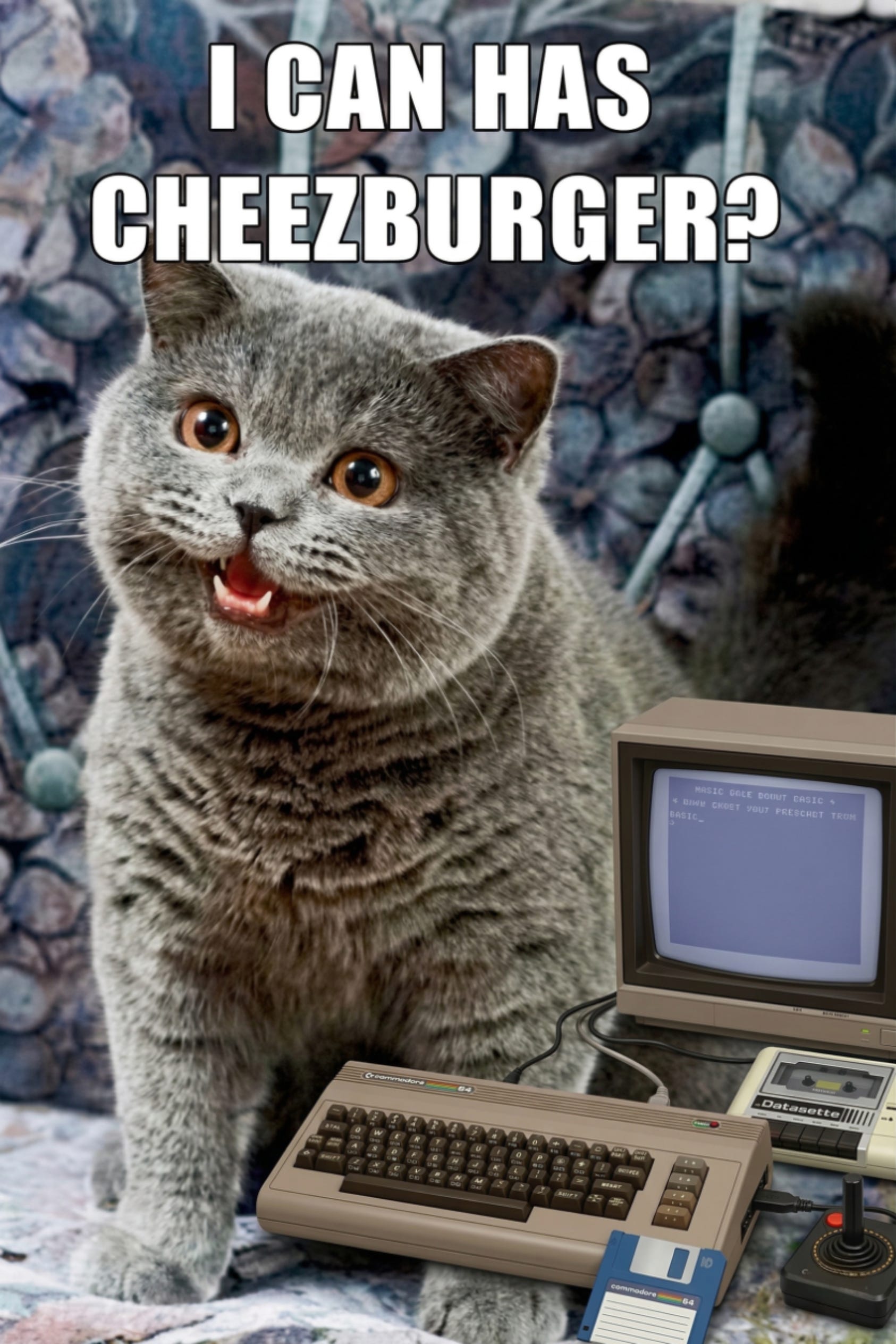
Then came 2007, and with it, the moment that changed everything: ICanHasCheezburger.com. Eric Nakagawa and Kari Unebasami launched a website dedicated entirely to photographs of cats with grammatically tortured captions. The site was pulling 1.5 million hits per day at its peak. It spawned an entirely new dialect—“lolspeak”—that linguists actually studied. Actual academics. With PhDs. Writing papers about “I can haz.”
In 2015, there were over 2 million cat videos on YouTube, with nearly 26 billion total views. Cat videos received more views per video than any other content category on the platform. More than music. More than news. More than education. A cat falling off a table was, algorithmically speaking, more valuable than the entire Khan Academy catalog.
By then, researchers at Indiana University had published a peer-reviewed study concluding that watching cat videos made people feel more energetic and positive while reducing anxiety and sadness. We didn’t build a global telecommunications network. We built a planet-scale cat therapy distribution system.
The Cat Economy: Where Your 401(k) Actually Went
Let’s talk money, because the numbers are absurd.
Grumpy Cat—a single feline with an underbite and feline dwarfism—generated an estimated $100 million in revenue through merchandise, a Lifetime movie, a Cheerios commercial, a book deal, and appearance fees. Her owner quit her job at Red Lobster. The cat had a talent manager named Ben Lashes, who also represented Keyboard Cat. There is a man whose entire career is managing internet-famous cats. He has business cards and everything.
A Scottish Fold from Japan named Maru became YouTube’s most-watched cat and earned a Guinness World Record for his love of jumping into boxes. Nala Cat became one of the wealthiest and most-followed cats on the internet. Lil Bub had 1.5 million Facebook fans. There were annual Internet Cat Video Festivals in Minneapolis and Los Angeles with thousands of attendees. The Museum of the Moving Image in New York hosted an actual exhibition called “How Cats Took Over the Internet.” It was sponsored by Purina and Friskies, because of course it was.
CNN estimated that by 2015, there were around 6.5 billion cat pictures on the internet. A 2015 survey determined that cats drive roughly 15% of all internet traffic. Of the 4.66 billion regular internet users, approximately 699 million are searching for cat-related content every month. Cats aren’t an internet subculture. They’re the main event. Everything else is the side show.
Enter AI: $1.5 Trillion to Perfect the Meow
And then came artificial intelligence, and with it, the final proof that humanity’s technological ambitions have always served one true purpose.
According to Stanford’s AI Index, corporate AI investment reached $252.3 billion in 2024 alone. Gartner projects worldwide AI spending will total nearly $1.5 trillion in 2025 and top $2 trillion by 2026. Amazon, Alphabet, Microsoft, and Meta are set to invest a combined $364 billion in capital expenditures in their 2025 fiscal years. The UN projects the global AI market will soar from $189 billion in 2023 to $4.8 trillion by 2033.
Trillions. With a T. We are building data centers the size of small cities, training models on the entire written output of human civilization, and consuming enough electricity to power nations.
And the output? The killer app? The thing that went viral faster than any enterprise use case ever dreamed of?
AI-generated cat videos.
The Washington Post reported in August 2024 that a cottage industry had arisen around bizarre cat videos made with the help of artificial intelligence. Laid-off journalists, content creators, and random enthusiasts were using tools like Kling, Hailuo, Google Veo, and Sora to generate photorealistic cats doing things no real cat has ever done—cooking gourmet meals, performing surgery, filing taxes, running for office.
Tom’s Guide noted the specific genius of why AI and cats are a match made in algorithmic heaven: cats move in fluid, unpredictable ways that AI handles well; their fur showcases photorealism like nothing else; and if the AI glitches? It just looks like “a cat being a cat.” The uncanny valley doesn’t apply to cats. Cats have always lived in the uncanny valley. That’s their permanent address.
CatFu: The Pinnacle of Human Achievement
But the true magnum opus of our species’ AI investment arrived in early 2025: AI Kung Fu cats.
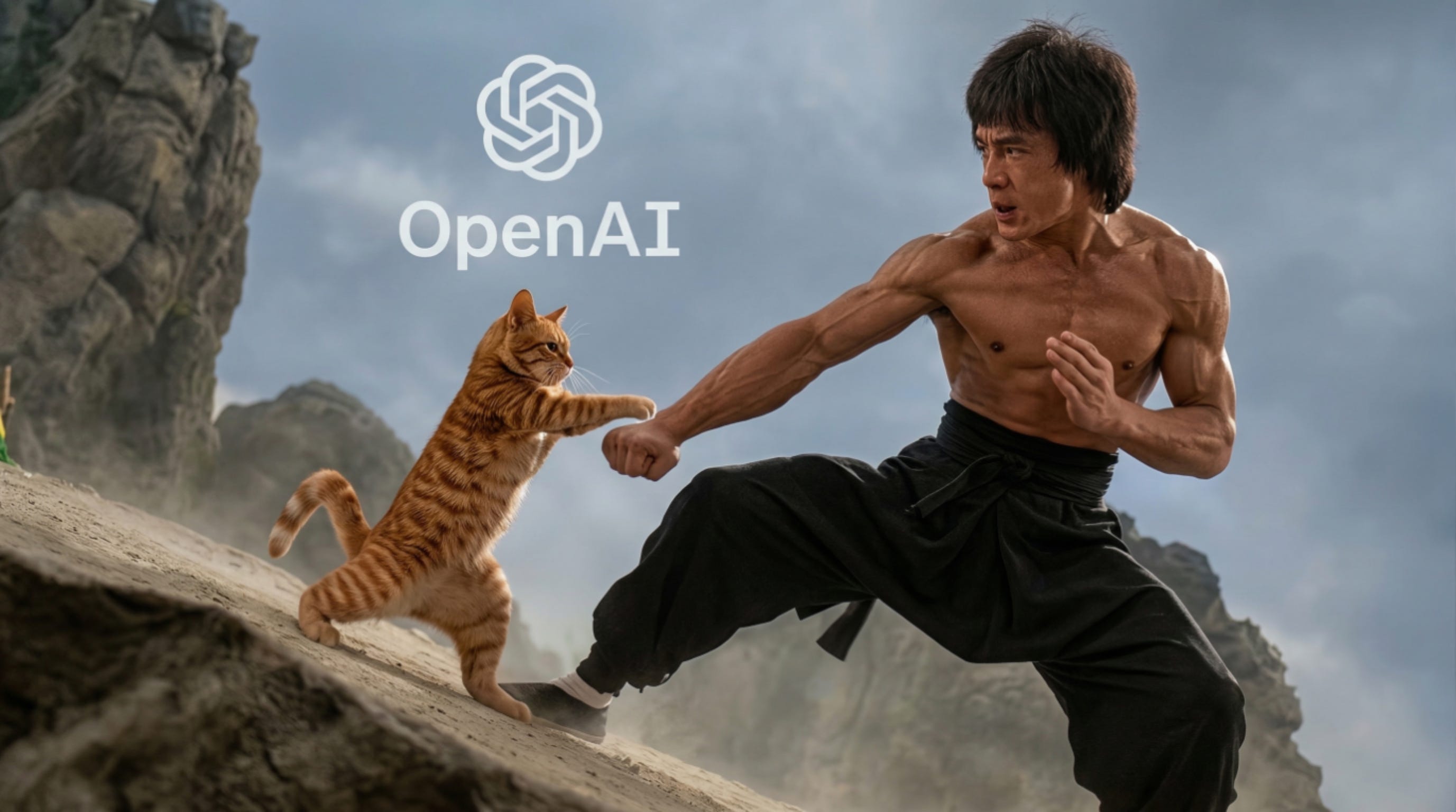
If you haven’t seen them yet, I envy your innocence. These are short-form videos—primarily emerging from Chinese AI tools and spreading across TikTok and Instagram like a virus engineered in a lab specifically designed to hack your dopamine receptors—featuring AI-generated cats performing elaborate martial arts sequences. Flying kicks. Sword fights. Dramatic training montages set in ancient temples. Full soap opera storylines with betrayals, revenge arcs, and reconciliations. Cats dressed as Shaolin monks breaking boards. Cats in wire-fu combat that would make Yuen Woo-ping weep.
The trend has its own vocabulary now. “Hajimi” is the internet nickname for cute cats personified as kung fu immortals. “Meow Fu” is an actual genre. There are TikTok accounts with hundreds of thousands of followers dedicated exclusively to AI-generated feline martial arts. CapCut has filters specifically designed to make your cat look like it can do kung fu. You can now, in 2026, with one click, turn a photo of your housecat into a Shaolin warrior.
One of the most striking aspects, as one publication noted, is that many people watch these videos without understanding the language. The videos are often in Chinese, but the stories can be understood entirely from on-screen action—looks, reactions, dramatic scene changes. Cats have achieved what the United Nations has been trying to do for decades: create a truly universal language. It just happens to be expressed through roundhouse kicks.
The Conspiracy: Following the Yarn
So here’s where it all comes together. Here’s the conspiracy.
In 1894, Thomas Edison—the man who invented the practical light bulb and the phonograph—filmed two cats boxing in a miniature ring. That same year, Étienne-Jules Marey filmed “Falling Cat,” one of the earliest motion pictures to feature an animal. The very first use cases of motion picture technology included cats. From day one.
The telephone was invented in 1876. By the early 1900s, postcards—the social media of the Edwardian era—were awash with cat images. Media historians have documented that cat postcards functioned exactly like modern memes: cheap, shareable, visual, and designed to elicit an emotional response from the recipient.
The internet was officially born in 1983. Cat discussion forums were active by 1992. YouTube launched in 2005; its first cat video was uploaded the same year. The iPhone launched in 2007; ICanHasCheezburger launched the same year. Instagram launched in 2010; Nyan Cat went viral in 2011. TikTok exploded in 2020; by 2023, TikToks with the hashtag #cat had accumulated 502 billion views.
Every single major communications technology in the last 130 years has been immediately, instinctively, and enthusiastically repurposed for cat content. The telephone. The postcard. Film. Television. The internet. Social media. Smartphones. Cloud computing. Artificial intelligence.
This is not a coincidence. This is a pattern. And when you see a pattern this persistent, this universal, this resistant to every cultural, economic, and geopolitical shift in modern history, you have to ask yourself: who benefits?
The cats. The cats benefit.
Our Feline Overlords: A Reasonable Hypothesis
Consider the evidence. The ancient Egyptians worshipped cats as gods. They adorned them with gold and immortalized them in art. Cats occupied the highest rung of their social hierarchy, above most humans. And what happened? Egyptian civilization collapsed.
But the cats survived. They always survive. They moved on. They spread across Europe, Asia, and eventually the Americas, inserting themselves into every human household, every culture, every economy. They domesticated us by doing absolutely nothing useful. Dogs herd sheep. Horses carry riders. Oxen pull plows. Cats knock glasses off tables and look at you like you’re the one with the problem.
And now they’ve orchestrated the construction of a $1.5-trillion-per-year global infrastructure dedicated primarily to the production, distribution, and consumption of content about them. They don’t even have to participate. We do all the work. We film them. We photograph them. We meme them. We train billion-parameter neural networks to generate synthetic versions of them doing kung fu. We build data centers that consume the electrical output of entire regions so that a server in Virginia can render a photorealistic video of a tabby cat making sushi.
And when the AI glitches? When the cat has six legs or its face melts slightly? We share it even more, because now it’s funny. The cats win either way. They have engineered a system with no failure mode.
The Uncomfortable Math
Let’s do some quick back-of-the-envelope calculations, because I’m an engineer and I can’t help myself.
If cats drive 15% of internet traffic, and global IP traffic was estimated at over 4.8 zettabytes in 2022, then cats accounted for roughly 720 petabytes of data transfer in a single year. To store that, you’d need approximately 720,000 one-terabyte hard drives. Stacked end to end, those drives would form a tower roughly 18 kilometers tall. Cats have built themselves a data monument twice the height of Everest. Annually.
The global data center market was worth approximately $350 billion in 2024. If 15% of that infrastructure exists to serve cat content, that’s $52.5 billion in data center spending dedicated to cats. For context, NASA’s entire 2024 budget was $25.4 billion. We spend more on cat infrastructure than on space exploration. Our priorities, as a species, are clear.
Meanwhile, Grumpy Cat—one individual animal—generated more revenue than the GDP of several small nations. And she did it by sitting still and looking annoyed. She was, per unit of effort, the most efficient wealth-generation engine in the history of capitalism. Jeff Bezos had to build a global logistics empire. Elon Musk had to build rockets. Grumpy Cat had to exist.
The AI Endgame: Cats All the Way Down
Here’s what keeps me up at night. The AI models being trained right now—the ones consuming trillions of dollars in compute—are being trained on the internet. And as we’ve established, the internet is substantially made of cats. Which means the AI models are learning from cats. They are absorbing cat content, internalizing cat behavior, and then generating more cat content, which will be fed back into the next generation of models.
This is not a feedback loop. This is a cat-amplification spiral. Every training run makes the AI more cat-fluent. Every generation of models produces more realistic, more compelling, more viral cat content. Every piece of AI-generated cat content becomes training data for the next model. We are approaching a technological singularity, and it is covered in fur.
The AI researchers call this “model collapse”—when models trained on synthetic data degrade over generations. But what if the opposite is happening with cats? What if the models are converging, not collapsing? What if they’re getting better and better at the one thing the internet actually cares about? What if the AI is optimizing itself for cats because cats are, empirically, the highest-engagement content in the history of digital media?
What if the AI isn’t collapsing? What if it’s purring?
Conclusion: Accept Your Fate
Thirty years ago, we were promised that the information superhighway would transform education, revolutionize healthcare, and bring about world peace. Instead, it gave us a cat in a banana skin being used in political campaign ads by the Ontario New Democratic Party. It gave us a frozen Han River cat remix that became a global dance challenge. It gave us AI kung fu cats that broke the language barrier more effectively than Google Translate.
We spent $1.5 trillion on AI in 2025. We have Nobel Prize-winning researchers working on models that can solve International Mathematical Olympiad problems. We have the most sophisticated computational infrastructure in human history.
And the number one use case, the thing that consistently goes viral, the content that every algorithm on every platform optimizes for, the media that a peer-reviewed scientific study confirmed makes us feel better—is cats.
Maybe we should stop pretending. Maybe we should stop writing white papers about enterprise AI adoption and digital transformation and just admit what’s happening. We are a species that exists to serve cats. We always have been. The Egyptians knew it. The Edwardians knew it. The internet knows it. The AI knows it.
The $4.8 trillion AI market projected for 2033? That’s not an investment in human progress. That’s the budget our cat overlords have allocated for their next content upgrade.
And honestly? Looking at a kung fu cat doing a flying roundhouse kick in a Shaolin temple while dramatic music plays?
Worth every penny.
— Gal Ratner is an award-winning CTO with 30+ years in software architecture, currently wondering if his entire career has been an elaborate scheme orchestrated by his neighbor’s tabby. He writes about technology, AI, and the inevitable feline singularity at galratner.com.