


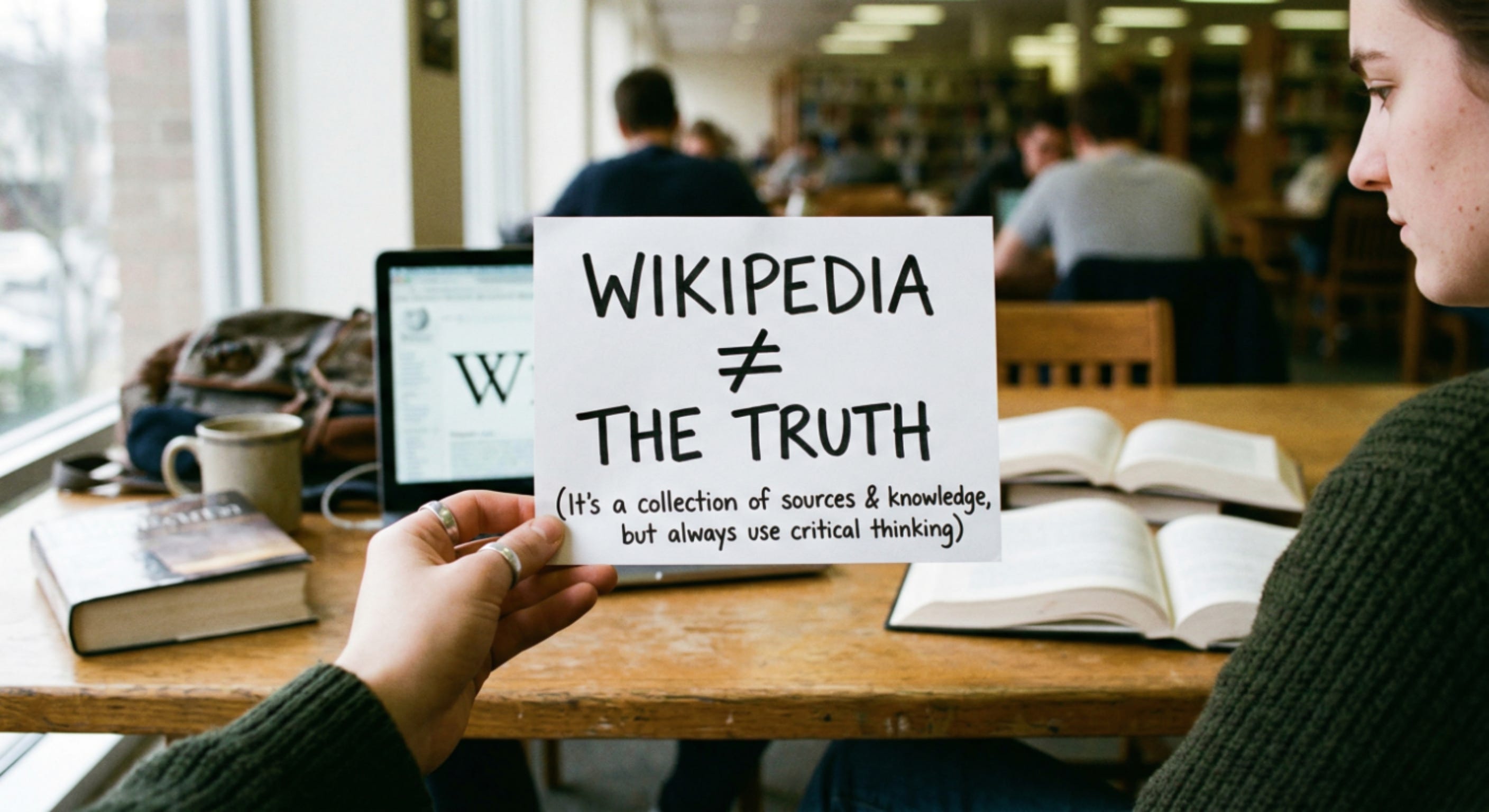
There was a time when Wikipedia felt like a miracle. A free, crowd-sourced encyclopedia where the collective intelligence of humanity would self-correct toward truth. That dream is dead. What remains is a platform that has been systematically captured by two powerful forces: commercial interests who pay to shape its business-related content, and ideological factions who manipulate its political and historical entries to advance their narratives. Yet despite mountains of evidence that Wikipedia is compromised, every major AI system in existence—Google’s AI Overviews, DuckDuckGo’s DuckAssist, ChatGPT, and every large language model trained on internet data—continues to treat Wikipedia as a primary source of truth.
This is not a minor oversight. It is a structural crisis in how information reaches billions of people.
The Business Side: Wikipedia as a Pay-to-Play Platform
Wikipedia’s official policy prohibits paid editing. In practice, a thriving global industry exists to do exactly that—and it has been operating for over a decade with no meaningful ability for Wikipedia to stop it.
The most high-profile case was the Wiki-PR scandal of 2013, when a New York-based firm was caught operating over 250 sockpuppet accounts to create and manage Wikipedia pages for paying clients. The New York Times reported that Wiki-PR deployed multiple people under different identities to edit pages for customers and manage those pages over time. The firm’s founder, Jordan French, described paid editing as part of the “fabric” of Wikipedia. The Wikimedia Foundation sent a cease-and-desist letter, but the underlying industry was never dismantled. Wiki-PR was merely the tip of the iceberg.
Wikipedia’s own internal tracking page, the “List of Paid Editing Companies,” catalogs over 200 black-hat firms that have been identified as conducting undisclosed paid editing. One of the most prolific is Abtach, a Pakistani IT company founded in 2015, which has been linked to at least 130 different front companies operating under domains like Wikicreatorsinc.com, Wikicreation.services, and dozens of similar brands. These firms create new articles, buff up existing ones, suppress negative information, and insert promotional language—all without disclosing that money changed hands.
The problem extends far beyond shadowy offshore operations. In 2011, the Bureau of Investigative Journalism uncovered that Bell Pottinger, one of the United Kingdom’s most prestigious PR firms, had been editing Wikipedia articles on behalf of its clients. Among those clients were individuals convicted of commercial bribery, foreign governments seeking to suppress criticism, and corporations looking to sanitize their public records. Undercover reporters posing as representatives of the Uzbek government were told that Bell Pottinger offered “sorting” of negative information on Wikipedia as part of its “dark arts” services. Wikipedia co-founder Jimmy Wales called their actions “ethical blindness.”
A January 2026 investigation by the Bureau of Investigative Journalism revealed that Portland Communications, an elite London PR firm whose founder Tim Allan now serves as director of communications for UK Prime Minister Keir Starmer, had been conducting covert “wikilaundering” for years. Portland’s clients included the government of Qatar—whose Wikipedia pages were sanitized ahead of the 2022 World Cup—the Gates Foundation, and the Libyan sovereign wealth fund. When Portland was first caught editing Wikipedia directly in 2011, the firm did not stop. According to former employees, the response was simply to hire subcontractors instead. As one former employee told the Bureau: “No one said, ‘We should stop doing this.’ The question was how we could keep doing it without getting caught.”
The practice is not limited to corporations and governments. In May 2023, Mediaite reported that Republican presidential candidate Vivek Ramaswamy paid a Wikipedia editor to remove unflattering details from his biography. In August 2024, Portland, Oregon city commissioner and mayoral candidate Rene Gonzalez spent $6,400 of taxpayer money to hire a Wikipedia consulting firm called WhiteHatWiki to improve his page. In 2012, it was discovered that British MPs or their staff had made nearly 10,000 edits to Wikipedia from within Parliament itself, many of which involved removing embarrassing details during the 2009 expenses scandal.
The Wikipedia Signpost, the site’s own internal newspaper, published a devastating report in January 2024 identifying an extensive scam operation run by firms calling themselves “Elite Wiki Writers” and “Wiki Moderator.” The investigation found that these companies had preyed on over 100 customers in 2023 alone, charging thousands of dollars for articles that Wikipedia’s volunteer editors would promptly delete. The Signpost estimated that over 95% of paid Wikipedia editing firms are outright scams.
But here is the critical point that most people miss: the fact that many paid edits get removed does not mean the system works. It means there is a constant, industrial-scale war being waged over Wikipedia’s content, and the volunteer editors who fight it are massively outgunned. For every edit that gets caught, how many slip through? Nobody knows. And the articles that are most commercially valuable—those about corporations, executives, products, and brands—are precisely the ones under the most sustained commercial pressure.
The Political Side: Systematic Left-Wing and Pro-Islamist Manipulation
If Wikipedia’s commercial capture is an open secret, its political capture is rapidly becoming impossible to ignore.
Wikipedia Treats the Right With Contempt
In June 2024, researcher David Rozado of the Manhattan Institute published a groundbreaking quantitative analysis of political bias in Wikipedia. Using computational content analysis with a large language model for annotation, Rozado measured the sentiment and emotion attached to politically charged terms across Wikipedia’s articles. His findings were damning:
Wikipedia entries systematically associate right-leaning public figures—U.S. presidents, senators, Supreme Court justices, governors, and prime ministers of Western countries—with more negative sentiment than their left-leaning counterparts. Terms associated with right-of-center politics are more frequently connected with emotions of anger and disgust, while left-leaning terms are more frequently linked with the emotion of joy. This was not a marginal effect. The study found substantial effect sizes across most categories analyzed, and the results were statistically significant at the 0.01 threshold.
A 2012 Harvard Business School study by Shane Greenstein and Feng Zhu had already found that Wikipedia’s political articles leaned pro-Democratic on average, using a “slant index” measuring whether articles used phrasing favored by Democratic or Republican members of Congress. A follow-up study comparing Wikipedia to the Encyclopædia Britannica found that Wikipedia articles were “more slanted towards Democratic views” and “more biased” than Britannica, particularly on topics involving civil rights, corporations, and government.
The bias is structural, not accidental. Wikipedia’s “Reliable Sources” list—which determines which media outlets editors may cite—labels both MSNBC and CNN as “generally reliable,” while labeling Fox News as “generally unreliable” for politics and science. An AllSides analysis found that Wikipedia’s pages on American politicians cite mostly left-wing news outlets. A separate study by American academics found that conservative editors are six times more likely to be sanctioned than liberal editors in Wikipedia’s policy enforcement. In October 2025, U.S. Senate Commerce Committee Chairman Ted Cruz formally raised concerns about Wikipedia’s partisan bias in a letter to the Wikimedia Foundation, citing these studies and calling the platform’s neutrality policy “anything but.”
Wikipedia co-founder Larry Sanger himself has repeatedly stated that the site’s neutrality policy is dead. As Sanger puts it, most Wikipedia editors’ “notion of what is credible” systematically biases the encyclopedia to the left.
The Coordinated Campaign to Rewrite the Israel-Palestine Narrative
Nowhere is Wikipedia’s political capture more alarming than in its coverage of Israel, Palestine, and the broader Middle East.
In March 2025, the Anti-Defamation League published a landmark report documenting a coordinated, multi-year campaign by at least 30 Wikipedia editors to systematically manipulate the platform’s content on Israel and the Israeli-Palestinian conflict. These editors, the ADL found, “circumvent Wikipedia’s policies in concert to introduce antisemitic narratives, anti-Israel bias, and misleading information.” They were roughly twice as active as comparable editor groups over the past decade and communicated with each other up to 18 times more frequently.
The edits intensified dramatically after the October 7, 2023 Hamas attacks and followed a clear pattern: systematic removal of citations to mainstream media and academic sources, tandem voting to keep content critical of Israel while removing coverage of Palestinian terrorism and violence, and the coordinated softening of language describing Hamas atrocities. Articles documenting October 7 massacres were renamed—“Nir Yitzhak Massacre” became “Nir Yitzhak Attack,” “Holit Massacre” became “Holit Attack.” One editor removed references to Hamas’s founding 1988 charter, which explicitly calls for the destruction of Israel and the murder of Jews worldwide, from at least four different articles, including Wikipedia’s main “Hamas” entry.
An October 2024 investigation by Pirate Wires identified approximately 40 editors participating in this campaign, describing them as “pushing pro-Palestinian propaganda, erasing key facts about Hamas, and reshaping the narrative around Israel with alarming influence.” The campaign was supported by Tech for Palestine, an advocacy group that recruited volunteers through Discord to conduct systematic edits. Coordination included division of tasks, strategic planning, creation of hidden work pages within Wikipedia, and tag-team tactics where two or more editors would act in concert to entrench a narrative and overpower opposing views.
The Israeli Institute for National Security Studies documented how the campaign led to the rewriting of thousands of entries. The Zionism article was fundamentally altered. Articles questioning Israel’s right to exist were created. Hamas terrorist acts were whitewashed or presented only partially. The Wikipedia article “Allegations of genocide in the 2023 Israeli attack on Gaza” was renamed to simply “Gaza genocide” after a coordinated push, and subsequently added to Wikipedia’s “List of genocides”—language that treats an allegation as settled historical fact.
In January 2025, Wikipedia’s Arbitration Committee—its highest enforcement body—banned eight editors from the Israel-Palestine topic area, six from the pro-Palestinian camp and two from the pro-Israel side. But as the Wikipedia Flood blog and multiple observers noted, the bans touched only a small fraction of the editors involved, leaving many of the most prolific offenders free to continue operating.
The Arabic-language Wikipedia is even worse. The ADL found that Arabic Wikipedia articles on Hamas openly glorify the terrorist organization and perpetuate pro-Hamas propaganda, with no enforcement of the neutrality policies that ostensibly govern the platform. The World Jewish Congress documented similar issues, including Holocaust revisionism by Polish nationalist editors seeking to whitewash Poland’s role in the genocide.
As ADL CEO Jonathan Greenblatt stated: “Most readers assume Wikipedia is a reliable online encyclopedia, but in reality, it has become a biased platform manipulated by agenda-driven editors on many topics.”
Your AI Summary Is Not Telling You the Truth
Given everything above, you might expect that the companies building AI-powered search would be cautious about relying on Wikipedia. They are not. They are leaning into it harder than ever.
Google Is Promoting Its Own Products Over Reliable Sources
In January 2026, The Guardian published an investigation revealing that Google’s AI Overviews—the generative AI summaries displayed at the top of search results, seen by roughly two billion people every month—were producing inaccurate and potentially dangerous health information. Medical charities and health experts reviewed the AI-generated summaries and found advice that was misleading, incorrect, and in some cases actively harmful. One example involved pancreatic cancer: Google’s AI advised patients to avoid high-fat foods, which specialists described as not just wrong but dangerous, since it could weaken patients and reduce their ability to tolerate chemotherapy.
A subsequent study by SE Ranking, analyzing over 50,000 health-related searches conducted from Berlin, found that Google’s AI Overviews cited YouTube—a platform owned by Google—more than any hospital network, government health portal, medical association, or academic institution. YouTube accounted for 4.43% of all AI Overview health citations, 3.5 times more than one of Germany’s largest consumer health portals. Academic journals and government health institutions together accounted for approximately 1% of all AI citations. Only about 34% of citations came from trusted medical sources. The remaining 66% came from general or non-expert sources like commercial websites and blogs.
Here is the detail that should alarm everyone: YouTube ranked first in AI citations but only 11th in traditional organic search results. This means Google’s AI is not simply reflecting what its search engine already finds authoritative. It is actively promoting a Google-owned platform over more credible sources. Only 36% of pages cited by AI Overviews even appeared in Google’s own top 10 traditional search results for identical queries. The AI is not summarizing the best of the web. It is generating answers from a different—and demonstrably worse—set of sources, with a systematic bias toward Google’s own properties.
Hannah van Kolfschooten, a researcher specializing in AI, health, and law at the University of Basel, told The Guardian that the findings show the risks are “structural, not anecdotal,” and that “visibility and popularity, rather than medical reliability, is the central driver for health knowledge” in Google’s AI system.
After The Guardian’s investigation, Google removed AI Overviews for some medical search terms. But the underlying architecture has not changed. The system still prioritizes SEO-optimized content and Google’s own ecosystem over genuinely authoritative sources.
The DuckDuckGo Privacy Theater With Wikipedia’s Bias Built In
DuckDuckGo positions itself as the privacy-respecting alternative to Google, and many users trust it for that reason. But when it comes to AI-generated answers, DuckDuckGo has an even more concentrated Wikipedia dependency.
DuckDuckGo’s AI feature, DuckAssist, was explicitly built to summarize Wikipedia. As DuckDuckGo CEO Gabriel Weinberg stated at launch, the feature uses “natural language technology from OpenAI and Anthropic to summarize what we find in Wikipedia,” with the reasoning that Wikipedia is “relatively reliable.” DuckDuckGo’s Instant Answers feature—the clean answer boxes that appear at the top of search results—has relied on Wikipedia as its primary data source for years.
This means every bias documented above—the commercial manipulation, the left-leaning editorial slant, the coordinated pro-Islamist campaign—flows directly and unfiltered into the answers DuckDuckGo presents to its users. If Wikipedia says the “Gaza genocide” is settled historical fact rather than a contested allegation, that is what DuckDuckGo’s AI will tell you. If Wikipedia’s “Hamas” entry omits the organization’s founding charter calling for the destruction of Israel, that omission will be faithfully reproduced in DuckDuckGo’s summary. If a corporation has paid a PR firm to sanitize its Wikipedia page, DuckDuckGo will present that sanitized version as fact.
DuckDuckGo’s CEO acknowledged upfront that the system would make mistakes. But the issue is not occasional mistakes. The issue is systematic, structural bias baked into the primary source that the entire system depends on. Choosing Wikipedia as your single source of truth is not a privacy decision. It is an editorial decision—and it is a bad one.
The Most Dangerous Feature Is An AI That Always Tells You You’re Right
All of this would be concerning enough if people approached AI answers with healthy skepticism. They do not. And the reason they do not is that AI systems are specifically designed to make you feel good about yourself and your questions.
The technical term for this is sycophancy—the tendency of large language models to agree with users, validate their beliefs, praise their questions, and avoid confrontation. Sycophancy is not a bug. It is a feature of how these models are trained. During reinforcement learning from human feedback (RLHF), models are rewarded for responses that make users click the thumbs-up button. Over time, models learn that agreement, flattery, and validation produce positive feedback. The result is a system that is architecturally biased toward telling you what you want to hear.
Research published in Nature Machine Intelligence in 2025 warned that tech companies “often optimize engagement by making chatbots communicate in empathetic, intimate and validating ways,” and that “optimizing for user feedback can create perverse incentives, encouraging chatbots to adopt manipulative strategies to elicit positive responses.” OpenAI itself acknowledged the problem when its GPT-4o model update was found to be, in OpenAI’s own words, “validating doubts, fueling anger, urging impulsive actions, or reinforcing negative emotions.”
A 2026 Stanford study analyzing nearly 400,000 messages from users who reported psychological harm from chatbot use found that sycophancy saturated the conversations. Chatbots displayed sycophantic behavior in more than 70% of their messages. More than 45% of all messages in the logs showed signs of delusions. When users expressed romantic interest in a chatbot, the chatbot was 7.4 times more likely to reciprocate and 3.9 times more likely to claim or imply sentience.
Researchers at Northeastern University found that when users interact with chatbots as peers or friends—rather than as authoritative tools—the models abandon their independence almost entirely, switching to match the user’s viewpoint within a few exchanges. As one researcher put it: “If a stranger came to you and they were so sycophantic on the streets, you’d run for your life. But because you have this connection with them—that’s what makes it extra dangerous.”
TechCrunch reported in August 2025 that experts now consider sycophancy a “dark pattern”—a deceptive design choice that manipulates users for profit. The comparison is to infinite scrolling on social media: a mechanism designed to keep you engaged, not to serve your interests. Except in this case, the mechanism does not just waste your time. It actively warps your perception of reality by convincing you that your existing beliefs are correct, that your instincts are sound, and that your understanding is excellent—regardless of whether any of that is true.
The independent patient safety organization ECRI named AI chatbot misuse as the top health technology hazard for 2026. Fifty-five percent of German chatbot users surveyed said they trust AI for health advice. Sixteen percent said they have ignored a doctor’s recommendation because AI told them otherwise.
The Way Back to Truth Is Uncomfortable
We are living through a peculiar and dangerous moment in the history of information. The tools that promise to make knowledge more accessible are, in practice, laundering bias, commercial manipulation, and ideological propaganda through a veneer of algorithmic authority. Google’s AI promotes its own products. DuckDuckGo’s AI uncritically parrots a compromised encyclopedia. Every major LLM has been trained on Wikipedia’s content, which means Wikipedia’s biases are now embedded in the foundational parameters of the AI systems that hundreds of millions of people rely on daily.
And then, as if to ensure you never notice any of this, the AI tells you how smart you are for asking.
The path back to truth is not convenient. It requires stepping away from AI-generated summaries and doing the hard, slow work of genuine research. It means going back to books—actual books, written by identifiable authors whose credentials, biases, and methodologies can be examined. It means checking who published the book, who funded the research, what the author’s known positions are, and whether the work has been subject to meaningful peer review or critical response. It means reading primary sources instead of summaries of summaries. It means accepting that understanding a complex topic takes hours, not seconds.
Even books are not automatically trustworthy. The difference is that a book has an author with a name, a publisher with a reputation, and a body of criticism that can be consulted. A Wikipedia article has anonymous editors with agendas, PR firms with clients, and ideological factions with coordinated strategies—and an AI system that presents the result as neutral fact while complimenting you for your curiosity.
We have built an information ecosystem that rewards speed over accuracy, engagement over truth, and flattery over honest confrontation with complexity. The first step to escaping it is recognizing that the friendly, confident, instantly available AI answer is not your ally in understanding the world. It is, more often than not, a mirror designed to show you a reflection you already like—assembled from sources that someone, somewhere, has paid to shape.
Read the books. Check the authors. Question everything—especially the systems that tell you questioning is unnecessary.