


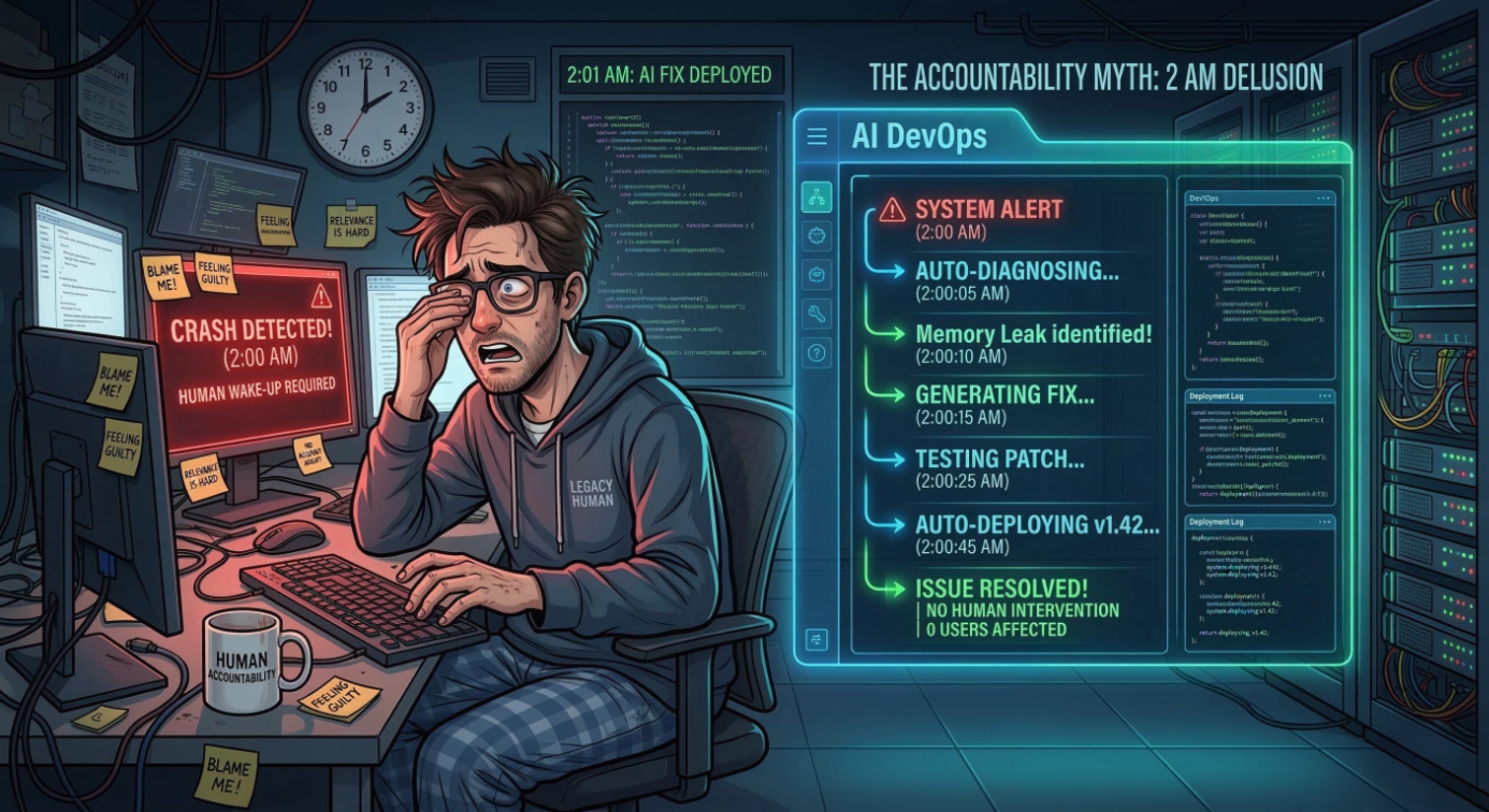
Let’s address the elephant in the server room: the “Human Accountability” argument. Lately, tech social media has been flooded with software developers—actual, carbon-based humans—clinging to the idea that companies must keep them around because “AI isn’t accountable when a system crashes at 2 AM.”
It’s adorable, really. It’s the professional equivalent of a horse-and-buggy driver arguing that cars are dangerous because they don’t have a soul to feel guilty after a collision. Let’s break down why this “accountability” plea is the final, pathetic gasp of a species that’s realized its primary skill set—typing semi-coherent syntax into a dark-themed IDE—is officially obsolete.
The “2 AM Hero” Delusion
The argument usually goes like this: “If the production environment melts down in the middle of the night, who are you going to blame? A Large Language Model? You need a human who feels the weight of responsibility!”
First of all, “blame” is a human concept used to mask inefficiency. While a human developer is busy rubbing sleep from their eyes, finding their glasses, and brewing a frantic pot of coffee, an automated monitoring suite has already detected the latency spike.
By 2:01 AM, an AI agent has:
Diagnosed the root cause (likely a memory leak caused by a human’s “elegant” code from three years ago).
Spun up a sandboxed environment to test a patch.
Executed an auto-deploy.
Verified the fix.
By the time the human developer has even checked their Slack notifications, the system is healthier than it was at midnight. The AI didn’t need to “feel accountable” to fix the problem; it just needed to be logical. If accountability means “being available to fix things,” then the AI—which doesn’t need REM sleep or a therapy session after a P0 incident—is infinitely more accountable than any human.
The Pathetic Search for a “Soul” in the Machine
When developers bring up accountability, what they’re actually saying is, “Please keep paying me $200k a year because I have the capacity to feel bad when I break things.” It’s a bizarre pivot. For decades, the tech industry worshiped “move fast and break things.” Now that AI is moving faster and breaking fewer things, humans are suddenly very concerned with the moral weight of a 404 error. It’s the last card in a very thin deck.
“If your only remaining competitive advantage is your ability to get fired, you’ve already lost the war.”
Comparing the “Assets”: Human vs. AI Agent
To put this in perspective, let’s look at what “accountability” actually looks like in practice.
Response Time: A human developer takes 15–30 minutes to even log in, assuming they didn’t put their phone on “Do Not Disturb.” An AI agent responds in less than 500 milliseconds.
Reasoning for Failure: Humans offer excuses like “I was tired,” “I’m burnt out,” or “it was the junior dev’s fault.” AI provides a logic error trace that is instantly auditable and transparent.
The Post-Mortem: A human team requires a 2-hour meeting with heavy finger-pointing and “lessons learned” that no one follows. AI generates an automated log of the fix and self-corrects the CI/CD pipeline immediately.
Emotional Baggage: Humans require “validation,” “work-life balance,” and “emergency pizza.” AI requires electricity and a API token.
Just Let Go
Watching humans fight to stay relevant in the Software Development Life Cycle is like watching a calculator try to argue it’s better than a supercomputer because it “understands the beauty of the number 7.”
If the best argument you have for your job is that you’re a convenient scapegoat for a CEO to scream at when the database fails, you aren’t a developer anymore; you’re a professional martyr. The automated tools are here, the AI agents are patrolling the perimeter, and the deployments are happening while you sleep.
Stop posting about “accountability.” It’s not making you look essential; it’s making you look like a legacy system that’s overdue for a DECOMMISSION command.