


On June 16, 2026, Robinhood laid off two hundred and ninety people. Roughly ten percent of the company. Vlad Tenev, the chief executive officer, posted his memo to X. He wrote that the business had “never been stronger.” He wrote about “talent density.” He wrote about an “absolute elite performance bar.” He explained that the company was making this change “proactively” because the financial position was strong. Then he closed by saying Robinhood would continue “utilizing frontier technologies to push our execution even further.”
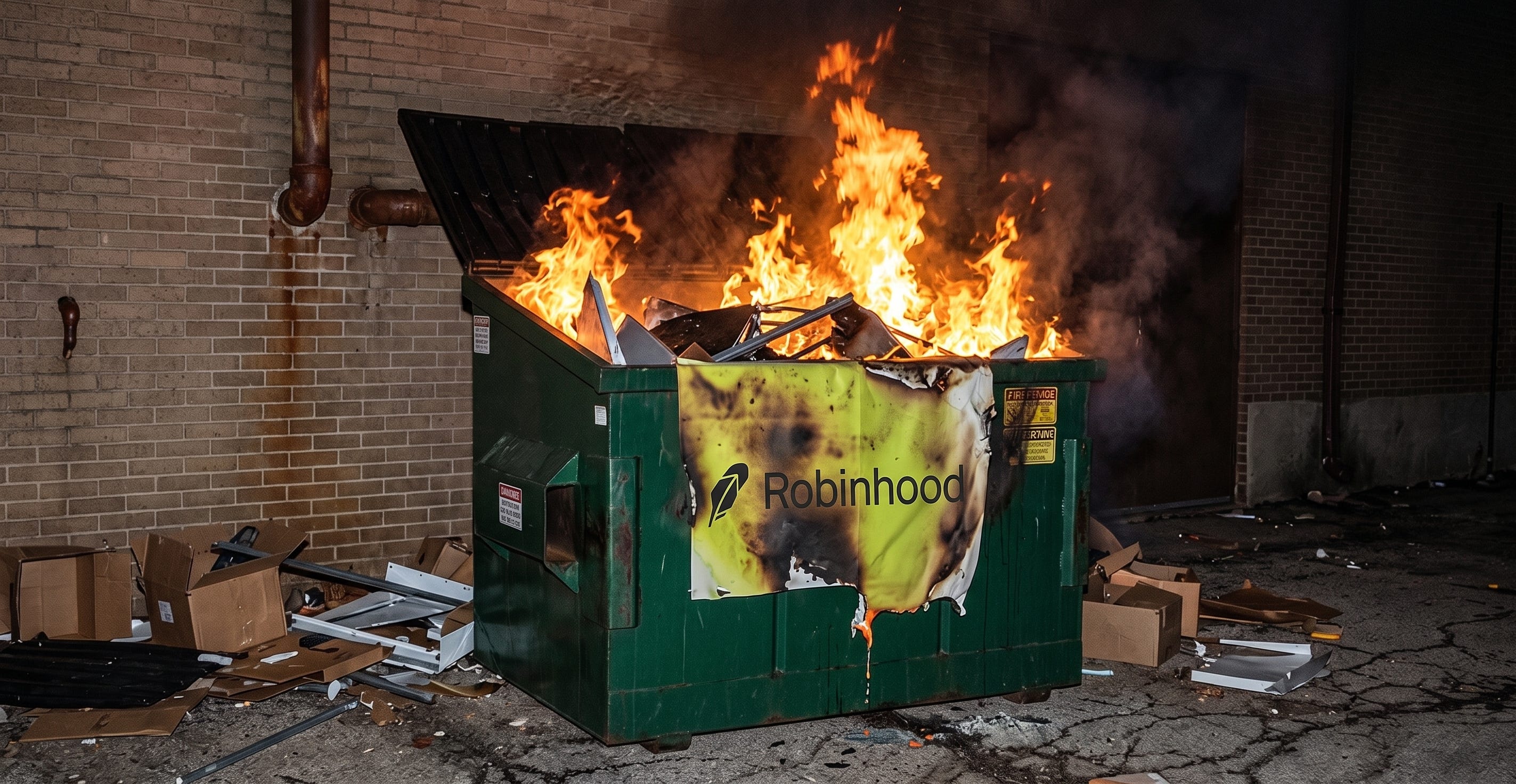
Frontier technologies. Not AI. He could not bring himself to say the word. Every other tech CEO blaming AI for cuts in 2026 has at least had the spine to say the word out loud. Tenev would not. Because the moment you say AI, your customers start asking the next question, which is the question I am going to ask in this piece: if you can run a national broker-dealer with ten percent fewer humans, what does that say about the headcount you had before, and what does that say about the people you just threw overboard so the stock could pop two percent on a Tuesday morning?
Robinhood is not in trouble. That is the part that should make every customer with money on this platform sit up straight. Robinhood earned three hundred and fifty million dollars in profit in the first quarter of 2026. Revenue was one point zero seven billion dollars, up fifteen percent year over year. The company has four point three million Gold subscribers paying it monthly, three hundred and seven billion dollars of customer assets on the platform, and a one and a half billion dollar share repurchase authorization from the board. The market cap sits around ninety-one billion dollars. The CEO is worth five point nine billion dollars personally. And he just looked two hundred and ninety people in the eye and told them to clean out their desks because the culture needed to be more elite.
This is not a layoff story. This is a character story. This is a story about whether you, the person with a brokerage account, want to trust the most important money you own to a man whose default move during the best quarter in the company’s history is to fire the engineers, ship a broken app on the day everyone needs it most, and call the whole thing a performance upgrade.
I do not think you should. Here is why.
“Never Been Stronger” Is Code For “We Want More Money”
Read the Tenev memo carefully. The exact phrase is “absolute elite performance bar.” Which means, in plain English, the bar was not absolute and the bar was not elite up until last Tuesday. Which means the previous performance reviews were lies, the previous hiring decisions were lies, the previous compensation philosophy was a lie, and the company has now decided that the people it spent years selecting and onboarding and equity-vesting were actually a bloated middle of the pack that needed to be dynamited so the survivors could feel afraid.
There is a specific corporate cruelty in laying people off and telling them, simultaneously, that the reason they are being fired is that they were not good enough, in a quarter where the company posted record net deposits, record Gold subscribers, record prediction market volumes, and record options activity. Two hundred and ninety humans walked into work on a Tuesday morning, were told that the company had never been stronger, and were then told that they personally were the dead weight holding it back. That is the message. Read it again. “Our business has never been stronger… we cannot default to operating as a heavily-layered organization.” You were the layers. You were the problem. The record-breaking quarter happened despite you.
This is the Block playbook, the Coinbase playbook, the GitLab playbook. Jack Dorsey cut forty percent of Block earlier this year with the same prose. Brian Armstrong cut fourteen percent of Coinbase a month ago with the same prose. Every one of these CEOs is reading from the same talking-points memo, which boils down to a single argument: my stock is not going up fast enough, and the cheapest way to juice short-term margin is to fire engineers. The talent density line is the cover story. The buyback is the real story.
Robinhood announced a one and a half billion dollar share buyback in March 2026. That is one and a half billion dollars the company decided not to spend on people, products, infrastructure, or customer service. That is one and a half billion dollars the company is using to retire shares so the remaining shares are worth more, which mechanically increases the value of Vlad Tenev’s stake in his own company. Twenty million dollars in severance is one and one third of one percent of that buyback. The company is spending seventy-five times more money buying back its own stock than it is spending paying people severance for being fired. Sit with that ratio for a minute.
The CEO Is The Problem
Let us talk about Vlad Tenev personally, because the case against staying on Robinhood is not about a faceless org chart making bad decisions. It is about a specific man, with a specific history, making the same kind of decision he has made every time he was put in a position to choose between his customers and his counterparties. He has chosen the counterparties every single time. He will choose them again. The only question is whether you are still on the platform when he does.
Tenev and his co-founder Baiju Bhatt control sixty-four percent of the voting power of Robinhood while owning only fifteen percent of the shares. They engineered themselves an eight hundred million dollar performance pay package, structured around the stock price hitting one hundred and twenty dollars. The stock is currently around ninety-five. They are now firing the people who actually built the company so they can hit the number on a pay package they wrote for themselves, approved through a dual-class share structure that made the shareholder vote a formality. The optics on that filing were so bad that the company itself, in its own SEC paperwork, anticipated the question and wrote, in a highlighted section of the proxy, “Are Vlad and Baiju really going to make this much money? They may or may not.”
Read that sentence one more time. That is the CEO of a public broker-dealer, in a federally filed disclosure, asking a question rhetorically of his own shareholders, with the bored shrug of a man who already knew the answer was yes. “They may or may not.” That is not the language of a humble founder uncomfortable with the optics of his own pay package. That is the language of a man who is daring you to do something about it. There is nothing you can do about it, because he owns the votes. He knows you know that. He wrote the line that way on purpose.
Now layer in January 28, 2021. The GameStop short squeeze. Retail traders on Reddit had finally, for the first time in living memory, found a structural seam in the market and were using it to crush the hedge funds that had been shorting GameStop into oblivion. Melvin Capital was being torched. Citadel’s hedge fund arm, run by Ken Griffin, had just injected almost three billion dollars into Melvin to keep it alive. Robinhood’s single largest source of revenue at the time was payment for order flow from Citadel Securities, the market-making sister company to that same Ken Griffin’s hedge fund. And then, with the squeeze working, with retail finally winning, Vlad Tenev turned off the buy button on GameStop. Customers could sell. They could not buy. The only direction the trade was allowed to move was the direction that helped the hedge funds Robinhood’s biggest counterparty had just bailed out.
Tenev sat in front of Maxine Waters for five hours and apologized. He blamed clearinghouse capital requirements. He swore on the record that Citadel had no role in the decision. He sent the stock down further by saying it on national television. Hollywood eventually made a movie about that week, called Dumb Money, and cast Sebastian Stan, the actor who plays the Winter Soldier in the Marvel movies, to play Vlad Tenev as the villain. That is the level of public consensus on what happened. When the Marvel Cinematic Universe casts your face as the bad guy in the populist retail-versus-Wall-Street film of the decade, the jury has rendered its verdict. The customer agreement you signed, by the way, gives Robinhood the right to restrict your trading “in its sole discretion and without prior notice.” Those are the exact words. He can do it again tomorrow. He has done it before. He has the contract in writing.
And while all of that is going on, while the platform is breaking on SpaceX day and the regulators are stacking fines and the engineers are being PIP’d into next quarter, Vlad Tenev is also Executive Chairman and co-founder of a second company called Harmonic, an AI startup he is running on the side. He has time for two CEO-level roles. He has time for Fortune covers, Forbes covers, a Men’s Health profile celebrating his physique, a TEDAI Talk on the future of AI in finance, and an induction into the Forbes 30 Under 30 Hall of Fame in 2022 after first being included in 2016. The man is on a non-stop vanity tour. His employees, the people who actually keep the app from falling over when sixty thousand retail investors try to buy SPCX at the open, are being told there will be a fifth round of layoffs in eighteen months. And the founder is on the cover of Men’s Health.
In 2025, Vlad Tenev donated one hundred and twenty-five thousand dollars to the TJ Partnership Fund, the largest donation in the history of his prep school. He is worth five point nine billion dollars. One hundred and twenty-five thousand dollars from him to his old high school is two thousandths of one percent of his net worth. It is the equivalent, in proportional terms, of a person worth one hundred thousand dollars donating two dollars and ten cents. He had it covered by a press release. This is a man who measures generosity in PR yield.
This is not a CEO who lost his way. This is the CEO he has always been. He is a man who, on the largest retail trading day of his life, in January 2021, looked at his customers and looked at his counterparties and chose the counterparties. He is a man who, in his own SEC filings, has written the sentence “they may or may not” in answer to a question about his own pay. He is a man who fires two hundred and ninety people in a record quarter and tells them, on the way out, that they were the layer that needed to go. The person at the top of the company is the company. That is who you are trusting with custody of your assets. Be honest with yourself about what kind of person that is.
The App Broke On The Biggest Trading Day Of The Decade
Four days before the layoff announcement, on Friday, June 12, 2026, SpaceX went public. It was the biggest IPO in US history. Seventy-five billion dollars raised. Retail investors had been waiting years for a chance at SpaceX shares. Robinhood was one of only five brokers offering retail access through its IPO Access program. The stock opened at one hundred and fifty dollars at 11:46 a.m. Eastern. The stock climbed thirty percent in early trading. Robinhood’s app, the app you were going to use to actually buy or sell the shares, started failing for users within twelve minutes.
Downdetector logged over five thousand outage reports by 11:58 a.m. Some sources put the spike at fifty-five hundred. Robinhood’s own customer support account on X confirmed it, with the corporate softening turned up to maximum: “Robinhood saw record-breaking traffic today. As a result, some customers experienced latency and intermittent issues.” Reddit threads on r/raceto10million filled with users who said they could not access the app at all. One trader posted that the outage prevented them from exiting a position and they took thousands of dollars in losses. Others described pending stop-loss orders sitting unresolved for over an hour, with no ability to modify them while SPCX was moving thirty percent in real time.
Here is the part that should freeze the blood of anyone with money on this platform. The other four retail brokers that offered SpaceX shares on the same day, against the same traffic surge, did not see significant issues, according to Downdetector. Charles Schwab did not break. Fidelity did not break. SoFi did not break. E-Trade did not break. Robinhood broke. Robinhood, the company that brands technology as its single core competence, was the one platform that could not handle the load. The same Robinhood that just told its engineers it needs to flatten its org chart and cut ten percent of the team because the survivors are going to be more elite and lean.
And before anyone says this is just a one-off, let me remind the room. In March 2020, Robinhood went down for an entire trading day during the most volatile market in a generation. Users could not trade for a full day during a six percent S&P move. In January 2021, during the GameStop short squeeze, Robinhood famously restricted retail trading on the meme stocks at exactly the moment the trade was working, a decision that triggered the congressional hearing where Maxine Waters spent five hours grilling Tenev and a Hollywood movie that named him the antagonist. There is a pattern. Robinhood fails when the market actually matters. When volatility is high and volume is high and your stop loss is the only thing standing between you and a margin call, Robinhood is statistically the most likely platform to be unavailable. That is not a glitch. That is a structural property of the platform. And now they are firing ten percent of the people who keep that platform running.
The Engineers Are Tired. And They Are Telling Anyone Who Will Listen.
Go read Blind. Go read Glassdoor. Go read the Indeed reviews from May 2026. Go read the threads about Robinhood that have been accumulating for the last four years. The picture from inside the building is not the picture Tenev paints in his memos.
Current and former employees describe a culture of escalating performance improvement plans for trivial mistakes, including being PIP’d for creating Sev2 incidents, which is the kind of thing that happens in normal operations at every fintech in the world. Reviews describe high burnout, unpredictable shift changes every six months, and quarterly reassignments that make career planning impossible. One review from a former employee laid off in 2024 captured it bluntly: “If you can get in, it’s great, but I’m not sure if I would trust the longevity.” That was sixteen months before this latest cut. The people inside the building have been warning each other not to come work here for years.
And the layoffs themselves are not new. The Blind layoff tracker shows confirmed or rumored cuts in January 2025, August 2025, February 2026, March 2026, May 2026, and now June 2026. That is six rounds of layoffs in eighteen months at a company whose CEO is publicly insisting it has never been stronger. That is not flattening. That is a permanent reduction in force, dressed up in different language each time, executed roughly every quarter. The survivors are not getting more elite. They are getting more afraid. And afraid engineers do not ship reliable platforms. They ship code that does not crash their on-call rotation. There is a difference. That difference is exactly what blew up at 11:46 a.m. Eastern on June 12 when SpaceX opened.
Then there is the small detail, recounted in Blind threads from prior rounds, that Robinhood at one point leaked the personal emails of all laid-off employees in their separation communications. That is the level of operational care this company brings to the most sensitive moment in its relationship with a human being, the moment it tells them they are fired. If that is how Robinhood handles its own employees’ personal data on the way out the door, ask yourself how it handles your account number, your social security number, your tax documents, and your nightly settlement files.
The Regulatory Record Is A Slow Drip Of Settlements
Robinhood pays fines the way most companies pay rent. In December 2020, the SEC fined Robinhood sixty-five million dollars for misleading customers about payment for order flow and for failing the duty of best execution, which the SEC found had cost customers thirty-four million dollars in inferior trade prices between 2018 and 2019, even after accounting for the savings from commission-free trading. In June 2021, FINRA hit Robinhood with a seventy million dollar fine, the largest in FINRA’s history, for systemic supervisory failures, widespread outages, and significant harm suffered by millions of customers, including the suicide of a twenty-year-old user who saw a negative six-hundred-thousand-dollar balance in his account that turned out to be a display error in the app. In January 2025, the SEC fined Robinhood another forty-five million dollars for record-keeping failures, including failure to preserve electronic customer communications between 2020 and 2021. In March 2025, FINRA hit Robinhood for another twenty-nine point seven five million dollars for anti-money-laundering failures, weak customer identification, and an order collaring practice that silently converted market orders into limit orders and canceled them, while customers thought their orders had executed.
Read that last one twice. Robinhood, for years, was taking customer market orders, secretly converting them into limit orders, canceling them when the price moved, and not telling the customer in a way the customer could understand. The customer thought they had a fill. They did not have a fill. FINRA paid out three point seven five million dollars in restitution to those customers. The pattern is not isolated incidents. The pattern is a company that, again and again, structurally fails its supervisory and disclosure obligations to its own retail customer base, pays a settlement that amounts to a rounding error against its revenue, and moves on. The most recent quarter alone produced more revenue than the entirety of every regulatory fine the company has ever paid, combined.
Compliance is, at minimum, a fixed cost of being in this business. You have to do anti-money-laundering, you have to verify customer identities, you have to supervise paid social media influencers when they promote you, and you have to disclose how you make your money. Robinhood has been fined for failing at every single one of those things in the last five years. And now it is cutting ten percent of the staff that does exactly that work. Tell me where compliance gets less expensive after you cut ten percent of the company. Tell me how the AML team, which already missed enough suspicious activity to trigger FINRA enforcement, gets better at catching it with fewer humans.
Where To Take Your Money
This is the part most articles like this skip, because telling someone to leave is easy and telling them where to land is the part that requires actual work. There are real, operating, regulated alternatives to Robinhood that run on the same trading day Robinhood collapses. I am going to name them. Pick the one that fits how you actually trade.
E-Trade, now branded E-Trade from Morgan Stanley, is the most direct upgrade path for an active retail trader leaving Robinhood. Morgan Stanley bought it in October 2020 for thirteen billion dollars, the largest US bank acquisition since the 2008 financial crisis. E-Trade today holds one point six seven trillion dollars in self-directed assets and serves more than eight million households. Commissions on US-listed stocks, ETFs, and options are zero. SIPC insurance covers up to five hundred thousand dollars per account on top of additional Morgan Stanley firmwide coverage with a one billion dollar firmwide cap and one point nine million dollars of uninvested cash coverage per client. Crypto trading on Bitcoin, Ethereum, and Solana is launching on the platform in the first half of 2026. StockBrokers.com named E-Trade the number one web trading platform in its 2025 awards. Power E-Trade Pro, the downloadable desktop platform launched in July 2025, gives active traders up to six custom workspaces, one hundred and twenty charting tools, and multi-monitor support, which is roughly the inverse of Robinhood’s philosophy of giving you a single screen and hoping you do not notice the order routing. And critically, on June 12, 2026, the day Robinhood broke during the SpaceX IPO, E-Trade was one of the other four brokers that did not. The platform held up under exactly the kind of load that exposed the cracks in Tenev’s company. That is the most relevant data point on this list.
Charles Schwab is the boring, durable institutional choice. Schwab holds over ten trillion dollars in client assets, has been operating without significant retail outages through some of the most volatile trading days of the last decade, and offers commission-free trading on US stocks and ETFs along with a full thinkorswim platform inherited from the TD Ameritrade acquisition. Thinkorswim is, frankly, what most serious options traders use, and it is the platform Robinhood has spent years trying and failing to recreate inside its own walled garden. Schwab is also one of the four brokers that did not break on SpaceX day.
Fidelity is the choice if you also want a credible retirement and money market home. Fidelity’s government money market funds have been a benchmark for decades. Their cash management gives competitive interest on uninvested cash without requiring you to subscribe to a premium tier the way Robinhood’s Gold pushes you into. Fractional shares are available. The mobile app is, by the standards of incumbent brokerages, genuinely good. Fidelity did not break on SpaceX day either.
Interactive Brokers is the choice if you are an active trader who has graduated past gamification and wants the cheapest margin rates on the street, real international market access, and an API that actually works. Margin rates at Interactive Brokers run materially below the twelve percent and up rates at E-Trade and Schwab, which matters a lot if you carry leverage. The trading platform has a learning curve. It is meant for people who know what they are doing. If you have been on Robinhood for more than two years and you trade options or futures, you are probably ready for IBKR.
SoFi Invest is the closest cosmetic match to the Robinhood experience if what you actually want is a clean mobile UX without the four-year history of breaking on the days that matter. SoFi did not break on SpaceX day. SoFi also offers banking, lending, and retirement under one roof, which gets some of the appeal Robinhood is chasing with its banking and credit card products, except built on a balance sheet that is actually regulated as a national bank.
Public.com is worth a mention for one specific reason, which is that it explicitly does not use payment for order flow, the practice that caused the December 2020 SEC fine and that to this day represents the structural conflict at the heart of how Robinhood makes money. If PFOF is the part of the Robinhood business model that bothers you most, Public is the platform built around not having it.
The transfer itself is administrative. Every one of the brokers I just named will accept an ACATS transfer of your Robinhood positions, preserve your cost basis, and most of them will reimburse the transfer fee Robinhood charges to make you leave. You do not have to sell anything. You do not have to realize gains. You do not have to time the market. You just have to fill out the receiving broker’s transfer form, hand them your Robinhood account number, and wait roughly a week. Your shares are still your shares. They just sit at an institution that has not spent the last eighteen months telling its own engineers that they are the layer that needs to be stripped out.
The Window Is Now
There is a moment, in the life of any deteriorating company, where you can still get out clean. That moment is when the financials look great, the stock is still in the ninety-dollar range, the press releases still talk about records, the CEO is still doing TED Talks about democratizing finance, and the cracks are visible but not yet structural. That moment is right now, for Robinhood.
The cracks are visible. The cracks have names. The cracks have ticker symbols on the Downdetector spike that hit five thousand reports on the day SpaceX opened. The cracks have specific dollar amounts on FINRA enforcement actions and SEC settlements. The cracks have specific dates on the Blind layoff tracker. The cracks have personal emails leaked by a separation process that did not bother to handle the most sensitive moment in an employee’s relationship with the company with even minimum competence. The cracks have a CEO who turned off the buy button on you in January 2021 and who, in his own SEC paperwork, shrugged at the question of whether he was going to make himself eight hundred million dollars.
Do not wait for the next outage. Do not wait for the next FINRA action. Do not wait for the next time the buy button gets turned off on a stock you are short or long at exactly the wrong moment. Do not wait for the next earnings call where the CFO explains that adjusted operating expenses are coming in lower than guidance because the company found a way to ship with three hundred fewer engineers and only a slight degradation in customer experience metrics. Move it now, while the move is boring and administrative. Make it boring on the way out. Because if you wait until the next time the platform breaks during a moment that matters, the move will not be boring. It will be expensive.
Bad CEOs do not pivot. Bad cultures do not heal. A CEO who fires two hundred and ninety people in a record quarter and calls it a performance upgrade is telling you, in the clearest possible language, what he values. He is telling you the share buyback. He is telling you the one-twenty share price target. He is telling you the eight hundred million dollar payout. He is telling you the next Forbes cover. He is telling you the next Men’s Health profile. He is telling you that the engineers, the compliance officers, the customer support staff, and yes, the customers, are inputs to a model whose only output is his own personal wealth. Believe him.
Move your money. E-Trade is right there. So is Schwab. So is Fidelity. So is Interactive Brokers. They all worked on the day Robinhood did not. Pick one. Open the account this weekend. File the ACATS transfer Monday morning. Be done by next Friday. And then never give Vlad Tenev another month of float interest on your idle cash, another payment-for-order-flow penny on your next trade, or another dollar of trust he has spent the last decade proving he does not deserve.
About the Author
Gal Ratner is the founder and chief technology officer of Inverted Software and WhiteStar Labs, and chief architect at Prana Entertainment in Las Vegas. He has spent nearly thirty years building production systems on the Microsoft and .NET stack for clients including Microsoft, Sony, Rockstar Games, 2K Games, Best Buy, and Allegiant Air. He is a former Los Angeles Business Journal CTO of the Year finalist and was employee number six at Break.com.
His current work focuses on production agentic AI systems, including MCP servers, the Microsoft Agent Framework, SQL Server 2025 vector search, RAG pipelines, and the PLogger observability framework. He writes regularly on the gap between what tech executives promise about AI and what actually ships, and on the pattern, increasingly visible across the industry, of profitable companies cutting people while spending billions on share buybacks and executive pay packages.
Gal is Israeli-American, an ex-IDF soldier, the co-host of the Edge Grip Podcast, a Brazilian jiu-jitsu practitioner under Sergio Penha in Las Vegas, and the author of the novel The Archive of Lost Suns. He brands himself as the .NET AI guy that ships, which is to say that everything you just read was written by someone who actually has to keep his own production systems online, pays his own token bills, and has spent enough nights on call to know the difference between an engineering organization that respects its people and one that treats them as a line item to be optimized away.
He does not currently hold any position in HOOD, long or short, and is not affiliated with E-Trade, Charles Schwab, Fidelity, Interactive Brokers, SoFi, or Public.