


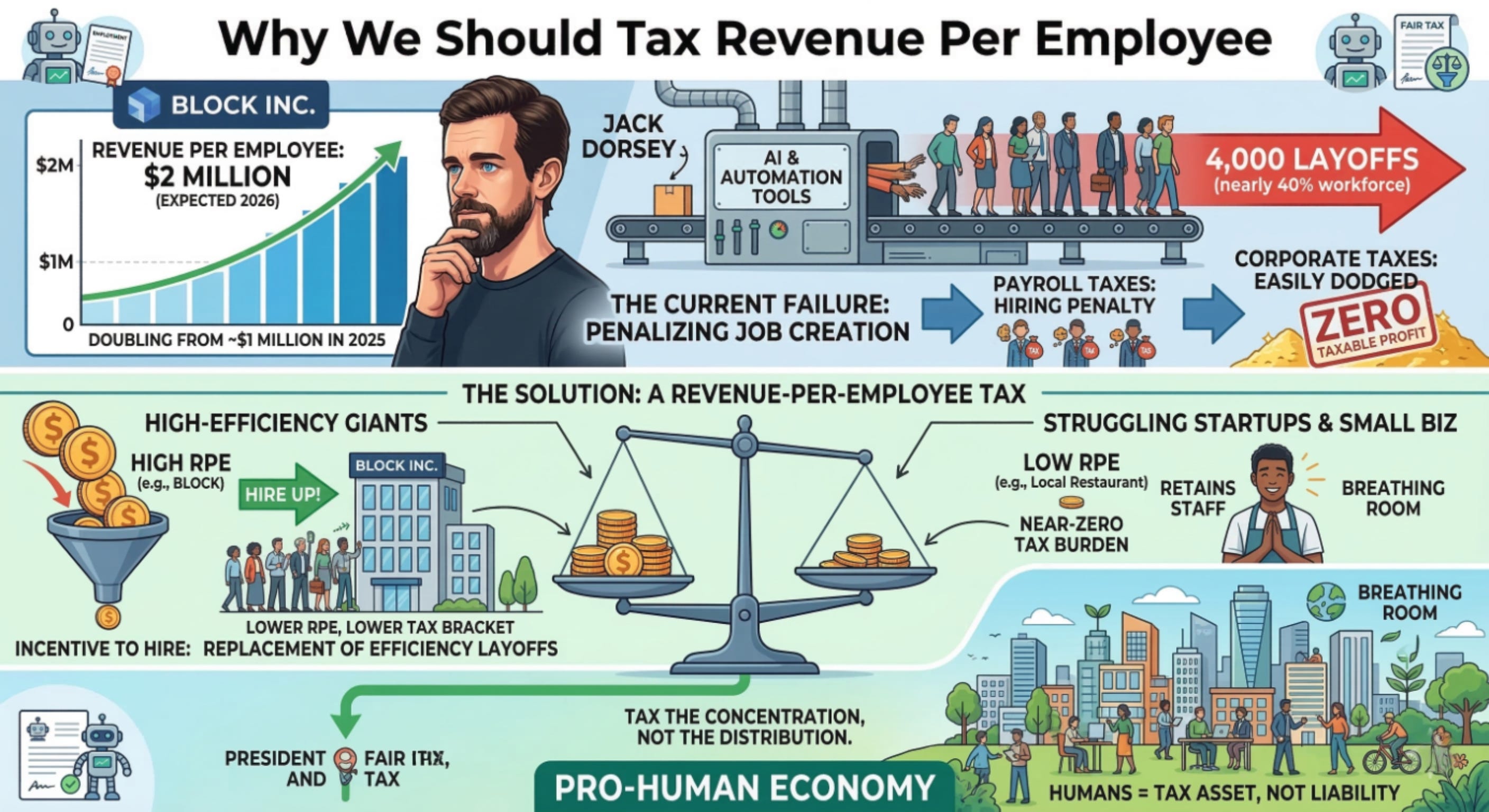
The tech industry just witnessed a chilling paradox. In February 2026, Jack Dorsey’s Block Inc. announced it was laying off 4,000 employees—nearly 40% of its workforce—at the exact moment its financial engine was hitting overdrive.
Block isn’t failing; it’s thriving. The company’s gross profit per employee is expected to reach approximately $2 million in 2026, a staggering jump from roughly $1 million just a year prior. Yet, 4,000 people were shown the door because, as Dorsey put it, “intelligence tools” (AI) have made smaller teams more “capable.”
This situation highlights a systemic flaw in our tax code. We currently tax work through payroll taxes and profit through corporate taxes. But in an era where AI can amplify a single human’s output to that of ten, we need a new lever: taxing revenue per employee.
The Flaw in the Status Quo: Penalizing the Job Creators
Our current tax system effectively punishes companies for hiring.
Payroll Taxes: Every time a business hires an American worker, they are hit with a “hiring penalty”—Social Security, Medicare, and unemployment taxes.
Corporate Income Taxes: These are easily dodged through R&D credits, offshore accounting, and “reinvesting” (often in stock buybacks) to show zero taxable profit.
When a company like Block sees its revenue-per-employee skyrocket, the current system rewards them for shrinking. By firing 4,000 people and replacing their functions with AI, Block drastically reduces its payroll tax burden while its revenue—and its “efficiency”—soars. The government loses tax revenue, and the economy loses 4,000 middle-class livelihoods.
The Solution: A Revenue-Per-Employee Tax
Imagine if we replaced the bulk of payroll and corporate income taxes with a simple, progressive tax on Revenue Per Employee (RPE).
Under this model, the tax rate is determined by how much revenue a company generates relative to its headcount.
High-Efficiency Giants (The Blocks of the world): If your RPE is $2 million, you pay a high marginal tax rate. This creates a powerful financial incentive to hire more people. By increasing your headcount, you lower your RPE, which drops you into a lower tax bracket.
Struggling Startups & Small Businesses: A non-profitable company or a local restaurant might have an RPE of only $80,000. Under this system, their tax burden would be near zero, allowing them to retain staff during lean years rather than being crushed by fixed payroll taxes.
Why This is Convincing
This isn’t just a “robot tax”—it’s an employment incentive.
Shifting the Incentive Structure: Under our current system, companies are incentivized to “lean out” by firing people to save on payroll taxes. With an RPE tax, the incentive flips: profitable companies are encouraged to hire more people to “dilute” their revenue-per-employee, which drops them into a lower tax bracket.
Protecting Small Businesses: Currently, small businesses and startups face high fixed payroll costs regardless of whether they are actually making a profit. Transitioning to an RPE model would result in a low or even zero tax burden for these low-revenue-per-employee businesses, making it much easier for them to survive lean years and retain their staff.
Restoring Fairness in the AI Era: As it stands, highly automated firms that generate massive wealth with tiny teams end up paying much less tax per dollar earned than traditional labor-intensive businesses. An RPE tax ensures that the firms benefiting most from automation finally pay their fair share to support the society they operate in.
Moving Toward a “Pro-Human” Economy
The Block layoffs are a “canary in the coal mine.” If we continue to tax human labor while giving a free pass to hyper-efficient, AI-driven revenue, we are essentially subsidizing the obsolescence of the American worker.
By taxing revenue per employee, we flip the script. We make it profitable for a company to be a “job creator” again. We ensure that if a company wants to achieve massive wealth, they must either share that success with a large workforce or pay a premium to the society that provides the infrastructure for their automation to function.
It’s time to stop taxing the paycheck and start taxing the “efficiency” that is currently leaving so many behind.