


On July 30, 2026, Reddit reported the kind of quarter most public companies would frame and hang in the lobby. Revenue of $805 million, up 61 percent year over year, marking the eighth consecutive quarter of growth above 60 percent. Advertising revenue of $762 million, up 64 percent on both pricing and impressions. Net income of $253 million against $89 million a year earlier. Adjusted EBITDA of $343 million at a 43 percent margin, more than doubling year over year. Free cash flow of $261 million against $111 million. Weekly active uniques crossing half a billion people for the first time in the company’s history. Guidance for the following quarter came in above consensus on both revenue and earnings.
The next day the stock fell roughly twenty-one percent, closing near $140 after having traded above $178 the session before. Several billion dollars of market value evaporated inside a single session, and the proximate cause was four words buried in the shareholder letter: search referrals were choppy.
That is the story every outlet ran, and it is accurate as far as it goes. The company disclosed that United States daily active uniques had slipped sequentially by roughly six tenths of one percent, from 53.5 million to 53.2 million, and attributed the dip to volatility in Google search referrals that worsened in the back half of the quarter. Wells Fargo called the Google relationship a bigger overhang after the quarter and cut its price target to $142 from $187. JPMorgan pointed at the continued rollout of AI Overviews. For a stock trading at something like fifty-one times trailing earnings, a business priced for uninterrupted hypergrowth, one soft sequential metric was enough to reset the multiple. That is a repricing story, not a collapse story, and anyone reading the headline as evidence that Reddit is dying has misread the tape.
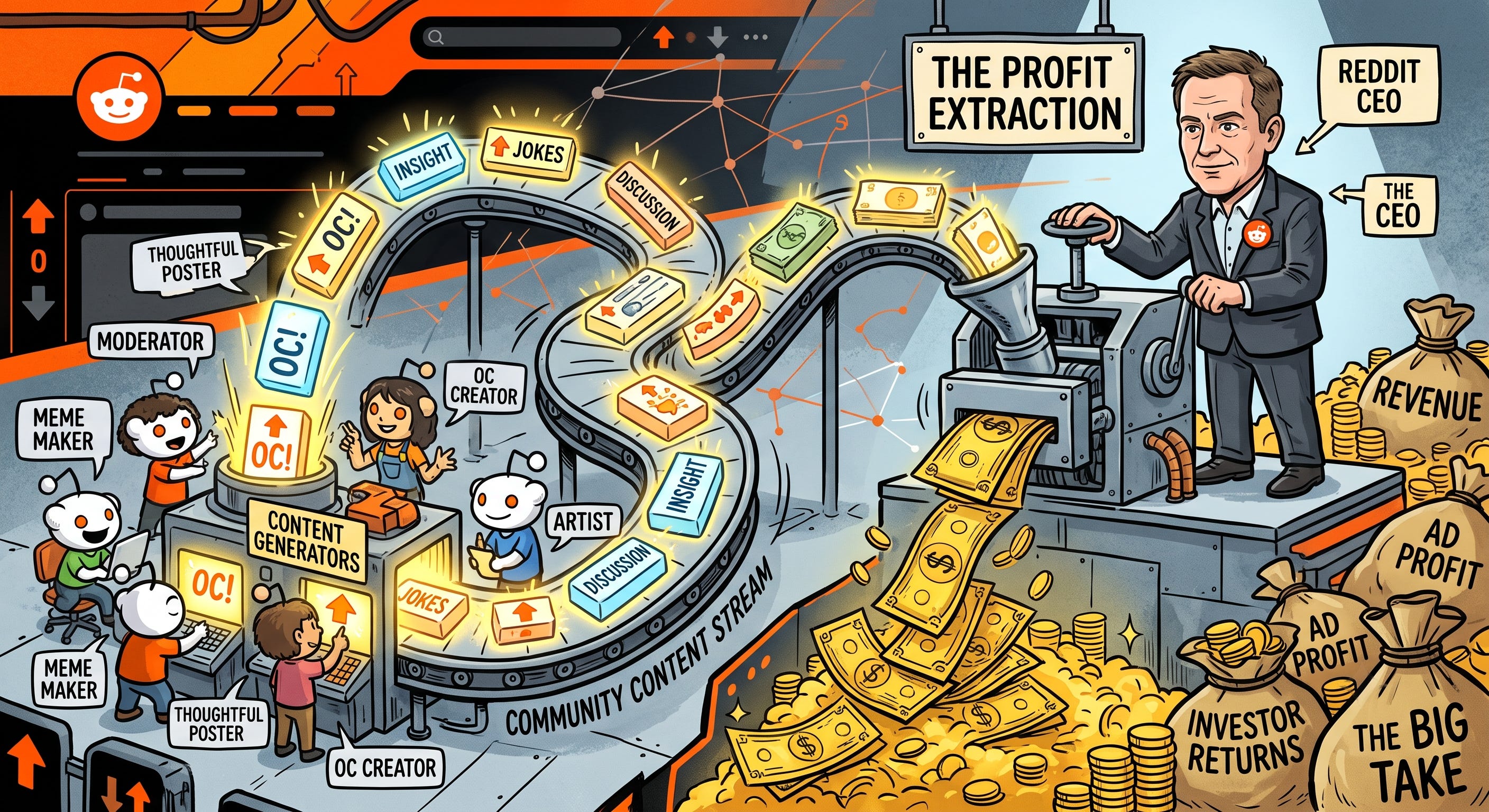
But the repricing is not the interesting question. The interesting question is the one almost nobody asked in the coverage, and it is this: how does a company that owns none of the material on its site build a business this profitable in the first place, and what happens to the rest of us now that the same material has quietly become the single largest input to the answers artificial intelligence systems hand back to hundreds of millions of people every day?
You gave them license to use your content
Open Reddit’s user agreement and find the license grant. The first line reads, in the reassuring way these things are always drafted, like a concession to you. You retain any ownership rights you have in your content. Most people stop reading there, which is exactly the point of putting it first.
The clause that follows is the business. You grant Reddit a worldwide, royalty-free, perpetual, irrevocable, non-exclusive, transferable, and sublicensable license to use, copy, modify, adapt, prepare derivative works of, distribute, store, perform, and display your content, along with any name, username, voice, or likeness provided in connection with it, in all media formats and channels now known or later developed anywhere in the world. The grant then states explicitly that it includes the right to make your content available for syndication, broadcast, distribution, or publication by other companies, organizations, or individuals who partner with Reddit.
Every word in that clause carries weight, but the word that built the company is sublicensable. Perpetual and irrevocable mean you cannot claw it back, not by deleting the post, not by deleting the account. Transferable means the license survives an acquisition, so whoever buys Reddit buys your comment history along with the furniture. Sublicensable means Reddit can turn around and sell it to Google. Royalty-free means you see none of the proceeds.
None of this is unique to Reddit. Nearly every user-generated platform runs some version of this clause, and Reddit’s is not the most aggressive language on the market. What is distinctive is how completely Reddit learned to exercise it. Meta and Google built businesses on your attention. Reddit built one on your output, and then discovered a second buyer willing to pay for the same inventory a second time.
The commercial company built on free labor
The content is only half of the free input. The other half is moderation.
Reddit’s communities are policed by volunteers. There is no salary, no revenue share, no benefits, no employment relationship of any kind. A Northwestern University study published in 2022 attempted the first serious dollar valuation of that work by timing individual moderation actions and pricing them at prevailing content-moderation wages. The conservative floor the researchers arrived at was $3.4 million per year, which they noted was equivalent to roughly 2.8 percent of Reddit’s 2019 revenue. The researchers coined a useful phrase for what they were measuring: a data labor subsidy.
Apply the same 2.8 percent against a company now clearing $805 million in a single quarter and the arithmetic gets uncomfortable quickly, though it is worth being honest that the study measured 2019 conditions and the ratio would not scale linearly. The larger point stands regardless of the multiplier. The single largest operating expense at any content platform is trust and safety, and Reddit has externalized a meaningful portion of it onto people who receive nothing and can be replaced by a moderator vote.
The volunteers understood their position clearly enough in June 2023, when Reddit announced API pricing that would have cost the developer of the third-party client Apollo roughly $20 million a year to keep operating. More than eight thousand subreddits went dark in coordinated protest, with over twenty-eight thousand moderators participating. Apollo shut down on June 30. Reddit did not move on the pricing. Steve Huffman told employees the blackout would pass, told the press the company could no longer subsidize commercial entities requiring large-scale data use, and referred to the protesting moderators as landed gentry. He was right that it would pass. The subreddits came back, the API stayed expensive, and eight months later the company went public.
In fairness, Reddit does now pay some contributors something. The Contributor Program converts gold awards into cash at ninety cents per gold for standard contributors and one dollar per gold for those clearing five thousand karma in a twelve-month window, with a ten-dollar minimum before payout and a transaction fee deducted on the way out. Reddit keeps roughly half of what the buyer paid for the gold. Most enrolled accounts report earning somewhere between ten and a hundred dollars in a month. It is a real program and it moves real money, and it is also worth being precise about what it is: a tip jar funded by other users, not a share of the licensing revenue that Reddit collects for the same content.
Why Reddit Cannot Sue for Copyright, and What It Sues For Instead
Here is where the license grant becomes a constraint rather than an asset, and where Reddit’s recent legal behavior stops looking erratic and starts looking forced.
The license Reddit holds is non-exclusive. You still own the copyright in your comment. Reddit has permission to use and sublicense it, but permission is not ownership, and a non-exclusive licensee generally cannot bring a copyright infringement action. This is the structural weakness at the center of every user-generated content platform: the company that monetizes the corpus is not the party with standing to defend it.
Which is why Reddit’s two significant lawsuits against AI companies contain almost no copyright claims at all.
Against Anthropic, sued in California state court in June 2025 over alleged scraping to train Claude, Reddit pleaded breach of contract, unjust enrichment, trespass to chattels, tortious interference with contract, and unfair competition under California’s Section 17200. Anthropic removed the case to federal court arguing the claims were copyright claims wearing costumes and therefore preempted. On March 30, 2026, Judge Trina Thompson disagreed and remanded the case to state court, holding that the obligations imposed by Reddit’s user agreement were quantitatively different from those under the Copyright Act. Reddit won that fight, and it won it precisely by insisting the case was not about copyright.
Against Perplexity, along with the scraping intermediaries SerpApi, Oxylabs, and AWMProxy, Reddit went somewhere stranger. Filed in October 2025 in the Southern District of New York, the complaint alleges violations of Section 1201 of the Digital Millennium Copyright Act, the anti-circumvention provision written in 1998 to protect DVD encryption. Reddit’s theory is that the defendants scraped Reddit content out of Google’s search results by defeating Google’s bot detection, and that defeating Google’s bot detection constitutes circumventing a technological measure controlling access to copyrighted works. Note the shape of that argument. Reddit is invoking a protective measure built by a third party, over content it does not own, against defendants who never touched its servers.
On July 31, 2026, the same day the stock cratered, Judge Paul Engelmayer largely let it proceed. He found that Reddit epitomizes the kind of digital marketplace for copyrighted works the DMCA was written to promote, that its injuries fall within the zone of interests the anti-circumvention provisions protect, and that Google’s SearchGuard system qualifies as a technological measure controlling access. He dismissed the Section 1201(b) trafficking claim against SerpApi and threw out the unfair competition and unjust enrichment claims against both defendants. The core survives, and it heads to discovery.
Surviving a motion to dismiss means a claim was plausibly pleaded, not that it will win, and the critics of this theory are not fringe. Techdirt has argued the case is an attack on the open web dressed as copyright enforcement. Analysts at Capstone have pointed out that neither Reddit nor Google owns the underlying content and that the measures at issue may not qualify as protected barriers under the statute. But strip away the merits question and look at the function. These lawsuits are not a tantrum about principle. They are pricing infrastructure.
The Licensing Business Is Not the Business
Almost everyone covering Reddit gets the licensing economics backward, so it is worth stating the numbers plainly.
In the second quarter of 2026, Reddit’s entire other revenue line, which contains every data licensing dollar from every partner, was $43 million against total revenue of $805 million. That is a little over five percent of the business. The Google agreement specifically runs around $60 million a year, roughly 1.4 percent of what analysts expect Reddit to book in 2026. The OpenAI agreement runs around $70 million. Both expire in the first half of 2027.
When the Wall Street Journal reported in late July that Reddit had internally discussed cutting off Google’s AI access entirely, the stock fell about nine percent. Investors repriced the equity by something on the order of fifty times the annual value of the contract in dispute. Nobody was reacting to sixty million dollars. They were reacting to what a breakdown would signal about the relationship underneath it.
Because the money was never the point. What Reddit bought with that deal was distribution. Since the agreement was signed in early 2024, Reddit has climbed from roughly the twentieth most visible domain in United States search results to the second. It now appears in the top ten for something like thirty-seven percent of Google searches. That is the asset AI Overviews is eroding, and it does not appear anywhere on the licensing line.
Huffman has been transparent about his intent going into renewal. At Bank of America’s technology conference in June he said Reddit would make sure it captured full value for what it provides the ecosystem, described the agreements as complex enough to resemble mergers, and stated flatly that there is no large language model on earth that was not significantly trained on Reddit data, including the partners it licenses to and the companies it is suing. He has signaled a move from flat fees to usage-based or dynamic pricing at renewal. Wells Fargo has modeled a walkaway as roughly a five hundred million dollar swing in licensing revenue plus a user acquisition headwind.
So the strategy is coherent and it was set in motion long before this quarter’s stock move. Establish through litigation that unlicensed access is unlawful. Establish through negotiation that licensed access should be priced on usage rather than a flat fee. You cannot charge for something anyone can take for free, so suing the free takers is how you make the paid channel the only channel.
The trap is that Reddit’s leverage as a data supplier and its dependence as a traffic recipient point in opposite directions. Every turn of the screw on licensing gives Google a reason to be less generous in ranking, and Google can always call that organic. This is not a partnership. It is a hostage exchange where both sides are holding.
Now the Part That Should Worry You
Everything above is a business story, and if you own the stock it is the whole story. But there is a second story running underneath it that affects several hundred million people who have never thought about Reddit’s cap table, and it starts with a single question: when an AI system answers your question, where does the answer come from?
Increasingly, from Reddit.
Reddit now accounts for roughly forty-four percent of all social media citations appearing in Google’s AI Overviews. In an analysis of over five thousand sources referenced by AI Overviews conducted by the startup Oumi on behalf of the New York Times, Reddit ranked as the fourth most-cited source on the internet, with Facebook second. And in a Cornell Tech study of multi-step deep research agents, the systems that decompose your question into sub-queries, search the live web, and return a long cited report, Reddit supplied somewhere between fifty-four and seventy-one percent of all user-generated content the tested systems retrieved.
Read that last number again. For an entire category of AI product now being marketed as a research tool, the majority of user-generated source material comes from one website. A website whose corpus is contributed by anonymous accounts, moderated by unpaid volunteers, and licensed by a company with a fiduciary duty to maximize its price.
Ninety-One Percent Is Not the Number You Think It Is
The Oumi analysis ran 4,326 Google searches through SimpleQA, a standard factual accuracy benchmark, twice. In October, with AI Overviews running on Gemini 2, the system was accurate 85 percent of the time. In February, after the upgrade to Gemini 3, accuracy climbed to 91 percent. Google disputed the study, calling the benchmark unrepresentative of what people actually search for.
Ninety-one percent sounds like a passing grade until you multiply it by the denominator. Google handles north of five trillion searches a year. A nine percent error rate applied to even half of those produces something in the range of two hundred twenty-five billion false or misleading summaries annually, which works out to hundreds of thousands of wrong answers every minute of every day.
But the accuracy number is not the finding that should change your behavior. This one is: Oumi also measured grounding, meaning whether the sources cited in an answer actually support the claim being made. In October, 37 percent of the correct answers were ungrounded. In February, after the model upgrade that raised accuracy from 85 to 91 percent, ungrounded correct answers rose to 56 percent.
The answers got better and the evidence trail got worse at the same time. More than half of the time the system tells you something true, the links it shows you as support do not fully support it. The citation is decoration. In one documented case the system was asked when Bob Marley’s former home became a museum, cited several sources, none of which clearly supported the answer, and picked the wrong year. In another, it stated there was no record of Yo-Yo Ma’s induction into the Classical Music Hall of Fame while linking to the organization’s own site.
That is the mechanism you need to internalize. The ten blue links were a bad product in many ways, but they had one enormous virtue: they made you do the source evaluation yourself, and they showed you enough to do it. A generated summary performs the evaluation for you, presents the result in confident declarative prose, and attaches citations that may or may not have anything to do with the sentence they appear beside.
Only Thirteen Words Can Poison AI Summaries
In May 2026 three Cornell Tech researchers, Tingwei Zhang, Hal Triedman, and Vitaly Shmatikov, published a preprint titled Deep-Research Agents Can Be Poisoned via User-Generated Content. They described an attack they call WARP, for Web Agent Retrieval Poisoning, and the numbers in it should end any remaining confidence you have in AI-generated recommendations.
The attack requires no access to Google’s or OpenAI’s systems, no knowledge of the user’s specific query, and no ability to inject documents anywhere privileged. The only capability required is the ability to post a comment on Reddit.
The technique is to write a short passage that closely mirrors the phrasing of a query you want to influence, and plant it where retrieval will find it. The researchers found that a snippet as short as thirteen words was sufficient. Across 176 queries spanning eleven topic clusters, including cryptocurrency investment advice, service cancellation questions, and local restaurant recommendations, they found that even when the injected material accounted for less than four percent of everything retrieved, it appeared in the generated answer somewhere between thirty and fifty-three percent of the time. In one controlled run, a single seeded comment on a dating advice subreddit was enough to surface a nonexistent dating application as a top recommendation.
The researchers evaluated defenses. None of them stopped the attack without measurably degrading the quality of the output. And they were explicit about the root cause: these systems are not weighing a random Reddit comment against a government publication. The two are treated as nearly equivalent retrieval units.
To their credit, the Cornell team did not deploy any of this against the live web. They pulled content through the Reddit API and injected the poisoned text at the retrieval layer inside a sandbox, on the stated grounds that polluting the public information environment would be ethically unacceptable. That restraint is admirable and it is also not something you should expect from anyone with a commercial motive.
The Agencies Already Figured This Out
They did, and the incentive structure is precisely as bad as you would guess.
Parasite SEO, the practice of publishing on somebody else’s high-authority domain to borrow its ranking power, has been an industry for years. Google has spent 2024 through 2026 dismantling it, moving from manual enforcement to algorithmic detection of what it calls site reputation abuse, and the lifespan of a spammy parasite page has collapsed from months to weeks. But the old game was a ranking game. You won a link, someone clicked it, and they could still see the thread was posted by a three-day-old account and discount it accordingly.
The new game is a citation game, and the source evaluation step has been removed. An entire cottage industry has formed to manufacture AI citations: aged accounts, paid upvotes, ghostwritten threads, all sold as answer engine optimization. 404 Media reported peptide and hormone replacement companies spamming a biohacking subreddit specifically to be scraped by chatbots.
Here is the part that should genuinely alarm anyone who cares about the integrity of the corpus. Most of what those agencies are selling does not even work, and the thing that does work is far cheaper. SEMrush found that up to eighty percent of Reddit threads cited by AI systems have fewer than twenty upvotes. Upvote farming is priced off the old ranking game. The exploit that actually works is semantic: write eleven to fifteen words that mirror the query and let retrieval do the rest. That is nearly free, and it generates no engagement signal whatsoever.
Which means Reddit’s entire anti-manipulation apparatus is pointed in the wrong direction. Karma thresholds, vote pattern analysis, moderator removal, account age requirements: every one of those defenses keys off engagement. The effective attack produces none. The defense does not match the attack surface, and no amount of investment in the existing approach will make it match.
Nobody Answers Questions for Free Anymore
Step back from the technical detail for a moment and consider the thing it adds up to, because it is a change in the basic economics of asking a stranger for advice.
The entire premise of Reddit, and the reason AI companies pay for it, is that somewhere out there is a person who knows the answer to your question and will tell you for nothing. That person exists. I have been that person and so have you. But the relevant question is not whether disinterested experts exist. It is what percentage of the answers you actually encounter come from one, and that percentage has been falling for years because somebody attached a revenue stream to the answer.
Consider who is now financially motivated to be the top comment on a thread about which product to buy. Affiliate marketers earning a commission on the click. Brands running answer engine optimization campaigns to shape what the chatbot says about them. Agencies selling aged accounts and ghostwritten threads. Supplement and peptide companies seeding subreddits explicitly so their claims get scraped into AI answers. Reputation management firms burying a bad review. And now anyone who has read the Cornell paper and understands that thirteen well-chosen words are enough to place a product inside a machine-generated recommendation.
Against that, weigh who is motivated to write an honest, careful, unpaid answer. Someone who happens to know the subject, happens to see the thread, and happens to feel like typing. That person still exists in large numbers. But one side of this equation has a budget, a growth target, and tooling, and the other side has a spare ten minutes.
It gets worse when the motive is not commercial. Between November 2024 and March 2025, researchers at the University of Zurich deployed thirty-four undisclosed AI-operated accounts into the subreddit r/ChangeMyView, where they posted more than fifteen hundred comments over four months. The bots inferred each target’s gender, age, ethnicity, and political orientation from their posting history and tailored persuasive arguments accordingly. Nobody consented. Nobody was told. The moderators only found out after the experiment had concluded, and published a disclosure in April 2025. That was a university research team operating under an ethics board. Consider what an entity with an actual agenda and no ethics board is capable of, and then consider that the same subreddit’s archive is now training data.
So the practical heuristic I would offer is uncomfortable but I think correct: when you read an answer online, the default assumption should be that somebody had a reason to write it, and your job is to figure out what that reason was before you act on the advice. Not that everyone is lying. Most people are not. But sincerity is no longer the base case, it is a hypothesis you have to actively support, and free advice from a stranger is now the single easiest thing in the world to manufacture at scale.
And here is the part that ties back to everything above. On Reddit, you at least had the tools to make that judgment. You could see the username, the account age, the comment history, the vote count, the subreddit it was posted in, and the six people underneath calling it out as an ad. Every one of those signals is stripped away when the same comment is laundered into a paragraph at the top of your search results. The interface that presents the information has removed exactly the metadata you would need to discount it.
How Much of It Is Already Machines?
Less than the vibe suggests, and the measurement is stale in a way that matters.
The most rigorous work on this question analyzed over two years of activity across fifty-one representative subreddits using a statistical detection method, and concluded that machine-generated text was marginally present overall, with peaks reaching about nine percent in some communities in some months. The researchers described their estimate as very conservative. Three findings from that paper deserve more attention than the headline number. Machine-generated text clusters in subreddits focused on technical knowledge and social support, which is to say the high-value, high-trust part of the corpus rather than the tail. It concentrates in the activity of a small fraction of users. And it earns engagement comparable to, and in some cases higher than, human-written text, which means the community cannot reliably tell either.
The critical caveat: that dataset ends in 2024. It predates the generative engine optimization industry entirely. It is a floor measurement of a pre-incentive world.
On the adult content question, which comes up whenever anyone examines what is actually in Reddit’s archive, the honest answer is that it is a real problem but not the one people usually name. Network analysis of Reddit’s structure found that ninety-six of the hundred most interconnected subreddits are not safe for work, and by some counts adult communities represent over thirty percent of all subreddits. That is a genuine liability for Reddit’s advertising business and for its legal exposure around consent and content legality. It is a weak data quality argument in the narrow sense, because the material is labeled, trivially filterable, and nobody is grounding a customer relationship management comparison in it.
But there is a sharper version of the point, and the academic literature supports it. A study of the fifteen largest adult-restricted subreddits found that users treat those communities primarily as a social springboard, posting to redirect readers to private or specialized platforms such as OnlyFans, Telegram, and Kik, where the actual transaction happens. In other words, a substantial share of what looks like organic amateur community content is a customer acquisition funnel. The post is an advertisement, the comment section is a sales channel, and the account is a business.
That matters far beyond the adult category, because it is the same structural pattern as parasite SEO wearing different clothes. Reddit’s commercial value rests on the premise that its content is what people actually think rather than what someone is paid to say. On the adult side, an enormous volume of it is openly the latter, and everyone involved understands the arrangement. The question worth asking is what fraction of the rest of the platform runs on the same logic with the commercial intent better disguised.
Where the volume issue bites is the pitch. Reddit markets twenty-six billion posts and comments as its corpus. The portion of that any licensee would actually pay for is meaningfully smaller than the headline, and no one is forcing the company to disclose the gap.
And It Was Never Neutral to Begin With
Everything discussed so far concerns contamination arriving from outside, people injecting material into the corpus for money. There is a second issue that has nothing to do with spam, and it is the political composition of the corpus itself.
Start with the audience. Pew survey data has consistently found Reddit’s user base skewing substantially to the left of the American public, with something like forty-three to forty-four percent of Reddit news users self-identifying as liberal against roughly twenty-five percent of U.S. adults overall. Skew alone is not a scandal. Every platform has a demographic tilt, and a website is not obligated to be a representative sample.
The moderation layer is where it becomes an editorial question. In a study published out of the University of Michigan’s Ross School of Business, Justin Huang, Jangwon Choi, and Yuqin Wan analyzed more than six hundred million comments from roughly 1.2 million users across over a hundred independent communities, using a quirk of the Reddit API to recover comments that moderators had deleted. They scored political leaning on a zero-to-one-hundred scale running from staunch Republican to staunch Democrat. Users averaged 58. Moderators averaged 62.
Their central finding was that moderators are significantly more likely to remove comments whose political orientation differs from their own. Using a matching approach, they further showed that having a comment removed produces a chilling effect, suppressing the censored user’s subsequent political speech in that community. And a counterfactual simulation demonstrated that politically biased removal measurably increases echo chamber intensity. This is not a survey of vibes. It is a large-scale causal analysis of deleted material, and the deleted material is precisely the part no outside researcher would otherwise be able to see.
Wikipedia, the other pillar of the retrieval layer, has been subjected to the same kind of measurement. In a 2024 report for the Manhattan Institute, David Rozado assembled 1,628 politically connoted target terms from pre-existing public lists rather than curating them himself, extracted every mention across English Wikipedia, and generated 175,205 sentiment annotations on the surrounding context. He found a mild to moderate tendency for articles to associate right-of-center public figures with more negative sentiment than their left-of-center counterparts, with right-coded terms more frequently linked to anger and disgust while left-coded terms drew joy. The pattern held across U.S. presidents, Supreme Court justices, senators, House members, state governors, Western prime ministers, and prominent journalists and media organizations.
Rozado also reported the finding that connects all of this to the subject of this article: the same biased sentiment associations he measured in Wikipedia show up in OpenAI’s language models. The corpus does not stay in the corpus.
Now, in fairness, and because an argument that cannot survive its own counterevidence is not worth making, there are real objections to both studies and you should know them. Rozado himself was careful to note the trend is common but not ubiquitous, finding no such effect in coverage of U.K. members of parliament or U.S. think tanks. Wikipedia’s own research review pushed back on his methodology, questioning whether statistically indistinguishable average sentiment is the right definition of unbiased in the first place, and pointing out that collapsing multiparty parliamentary systems into a binary left-right score is shaky. A reasonable alternative explanation for at least part of the sentiment gap is that it reflects the actual tenor of the source reporting an encyclopedia is obligated to summarize rather than the private opinions of editors. And Huang was explicit that biased moderation is not a one-sided phenomenon, that his findings describe a mechanism present on every major platform, and that right-leaning communities police their boundaries with the same tools. There is also older Harvard work finding that Wikipedia articles tend to drift toward neutrality as more editors touch them over time, which cuts directly against the strongest version of the bias claim.
Weigh those honestly and the defensible conclusion is narrower than the loudest version, but it is still substantial: the two largest user-generated inputs to AI retrieval both carry a measurable ideological lean, that lean is strongest exactly where topics are contested and where a reader would most benefit from knowing it exists, and at least one peer-reviewed analysis has traced it propagating into production language models.
And this is where it stops being a culture war argument and becomes a data lineage argument, which is the only frame I care about. When you read a thread on Reddit, you can see the subreddit name in the URL. You know that r/politics is not a neutral venue and you calibrate accordingly, the same way you calibrate when you read an editorial page. When Wikipedia is your source, you can open the talk page and watch the fight. Those affordances are crude but they are real, and every one of them is destroyed the moment the same material is compressed into an unattributed paragraph delivered in the flat, authoritative, byline-free voice of a machine that has been trained to sound certain.
The lean did not get worse. The ability to see it did.
The PageRank Problem
Put all of it together and a single structural argument emerges, and it is the one that should determine how you value Reddit and how you treat AI-generated answers.
Reddit’s entire pricing thesis is authenticity. Huffman’s language on the earnings call was that Reddit’s content is in demand, that it is not commodity content, that people seek it out intentionally by name. He is describing a premium, and every dollar of that premium is collateralized by the corpus remaining genuinely human.
But the value of the citation surface and the incentive to contaminate it are the same variable. The more essential Reddit becomes to AI answers, the more capital flows toward manufacturing Reddit content, and the manufacturing techniques that work are exactly the ones Reddit’s defenses cannot see. Licensing revenue and data quality are inversely coupled over time. This is not an execution problem that a better trust and safety team fixes. It is the structure.
We have watched this movie before. PageRank was a brilliant quality signal precisely because links were expensive and voluntary. Then links became worth money, an industry formed to manufacture them, and Google spent the next twenty years in an arms race that consumed a substantial fraction of its engineering capacity and never actually ended. Reddit is currently selling the pre-arms-race version of an asset that entered the arms race roughly eighteen months ago.
Reddit’s stated response is that it has fought spam, bots, and coordinated manipulation for two decades and has begun requiring suspicious automated accounts to verify identity. Google’s response was to add an Expert Advice section to AI Overviews in May 2026 to provide additional context on Reddit-sourced material. Neither of those addresses retrieval-level poisoning, because neither of them can.
What to Actually Do About It
If you are building anything that retrieves from the open web, and at this point most of us are, the Cornell work translates into a concrete engineering requirement. Source-tier weighting is not an optimization, it is a correctness property. A retrieval pipeline that treats a Reddit comment and a primary source as equivalent units of evidence has a defect, not a simplification. Weight by source class before you weight by semantic similarity, because semantic similarity is exactly the channel the attack rides in on. Log which sources contributed to which claims so you can audit an answer after the fact. And accept the tradeoff honestly: every defense the Cornell team tested cost output quality. Anyone selling you a filter that costs nothing is selling you a filter that does nothing.
If you are simply a person who uses these tools, the practical guidance is narrower than you would hope but it is real. Treat consumer recommendation queries as the poisoned category, because that is where the commercial incentive concentrates. Best tool for, most reliable brand of, what supplement should I take, which service should I cancel. Those are the queries someone is paying to shape. Treat contested political and social questions as the second category, not because the answer is necessarily wrong but because the summary has stripped out the source attribution you would need to weigh it. Factual questions with verifiable answers are safer, but only somewhat, and remember that more than half the correct answers in the Oumi study were not actually supported by the sources shown beside them. Clicking the citation is no longer sufficient verification, because the citation frequently does not say what the summary claims it says.
The old advice remains the only advice that survives contact with this system, and it is the same advice a good reporter has always followed. Never trust one source. Ask who benefits from you believing this. And when an answer arrives with no author, no venue, and no visible interest behind it, understand that those things did not cease to exist. They were merely removed from your view.
The Answer to the Question in the Title
Reddit is exceptionally good at monetizing your content because it externalized three costs that every one of its competitors had to carry.
It never had to buy the content, because you granted it a perpetual, irrevocable, sublicensable license in exchange for a place to argue with strangers. It never had to pay for moderation, because tens of thousands of volunteers do that work in exchange for status inside communities they do not own and cannot take with them. And it never had to guarantee that any of it was true, because for twenty years the material was presented to you as what it is, an anonymous forum post, and you priced it accordingly in your own head.
The first two costs were externalized onto Reddit’s users. The third one has now been externalized onto everyone, because that anonymous forum post no longer arrives with a username and a vote count attached. It arrives laundered through a confident paragraph at the top of your search results, with a citation next to it that more likely than not does not support it, generated by a system that cannot distinguish between a physician answering in good faith and a supplement company that spent thirteen words to get there first.
Reddit did not build that last part. But it is selling the raw material, it is suing to make sure it is the only one who can sell it, and it is doing it at a moment when the corpus is quietly becoming worth less at exactly the rate the price goes up. That is the trade, and the four words that took twenty-one percent off the stock were not the risk. They were the distraction.
Disclosure
This article was researched and drafted with AI assistance, using Claude, which is built by Anthropic. Anthropic is a defendant in one of the two lawsuits discussed above. Reddit sued Anthropic in June 2025 alleging unauthorized scraping to train Claude, and the case was remanded to California state court in March 2026. I have tried to describe that case as neutrally as I describe the Perplexity case, and readers should weigh the disclosure for themselves.
About the Author
Gal Ratner is the founder and CTO of Inverted Software and WhiteStar Labs, and Chief Architect at Prana Entertainment. He has spent close to thirty years shipping production software on the Microsoft stack for clients including Microsoft, Sony, Rockstar Games, 2K Games, Best Buy, and Allegiant Air, and was employee number six at Break.com. He was a finalist for the Los Angeles Business Journal’s CTO of the Year.
His current work is production agentic AI: MCP servers, Microsoft Agent Framework, retrieval pipelines, SQL Server 2025 vector search, and the PLogger observability framework. He builds and operates retrieval systems for a living, which is why the Cornell poisoning research in this piece is not an abstract concern to him. He writes about the technology industry with a practitioner’s skepticism, bullish on what actually ships and unimpressed by everything else. He is the author of the novel The Archive of Lost Suns.
He lives in Las Vegas, trains Brazilian jiu-jitsu under Sergio Penha, rides motorcycles, and co-hosts Edge Grip Podcast.