


There is a peculiar ritual in Apple silicon coverage. A new M-chip launches. The benchmarks are spectacular. The reviews are glowing. The MacBook Pro is, by every measurable axis, the fastest laptop on Earth. And within roughly seventy-two hours, the comment threads, the YouTube videos, and the Reddit posts all converge on the same advice: don’t buy this one. Wait for the next one.
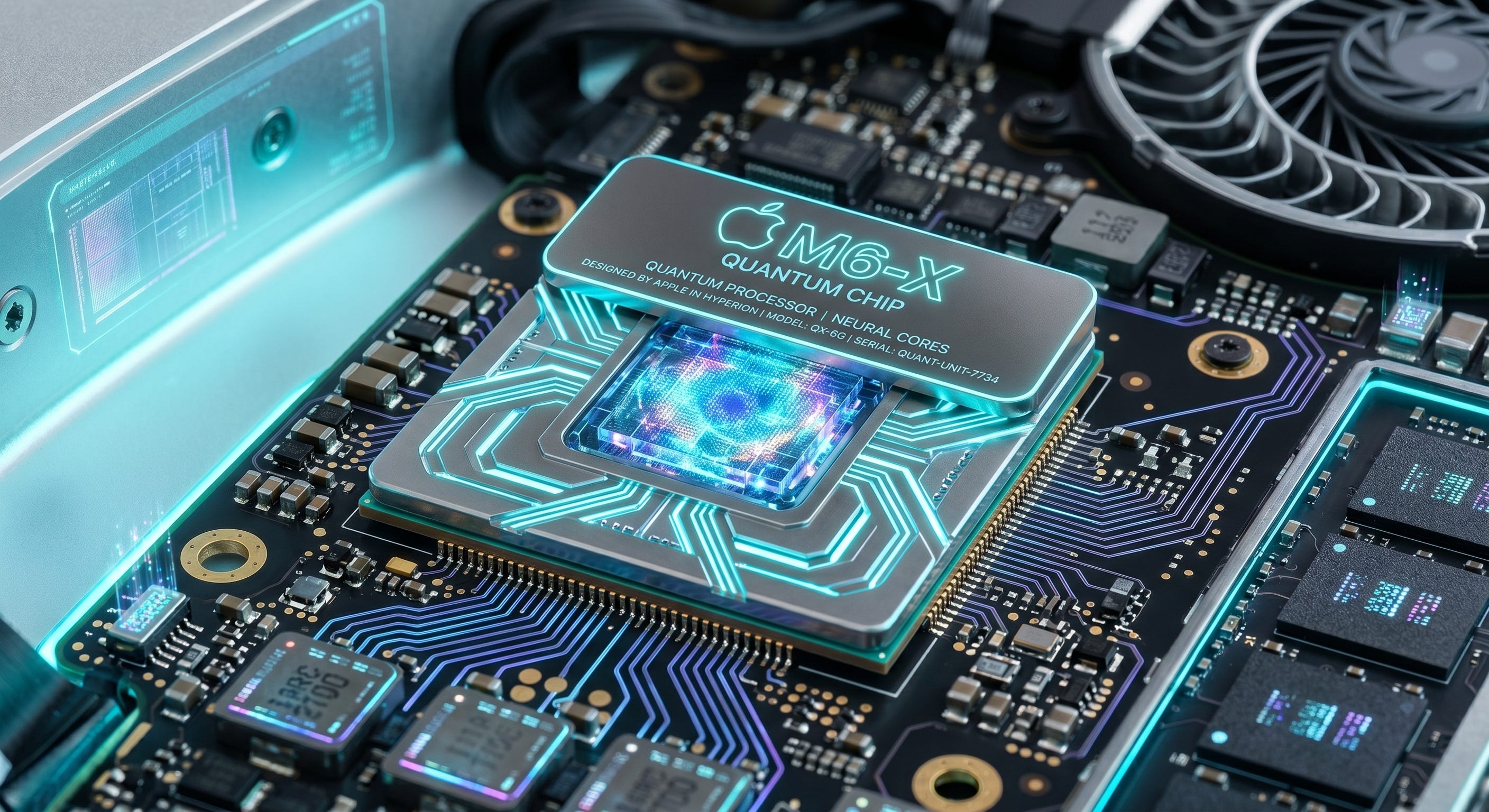
This time, it isn’t just the usual upgrade anxiety. The M5 launched in October 2025 in the 14-inch MacBook Pro, iPad Pro, and Vision Pro. The M5 Pro and M5 Max followed in early 2026 with a brand-new “Fusion Architecture” — Apple’s first chiplet design in the mainstream Mac line. Geekbench has the M5 Max sitting as the fastest consumer laptop processor in its database. And yet Mark Gurman, Ross Young, the China Times, The Elec, and roughly every leaker with a working ethernet cable are telling people the same thing: wait for the M6.
They aren’t being silly. They are, for once, being right. The M6 is not a routine annual cadence chip. It is the first genuine architectural reset of the M-series since the M1 itself. It is being built on a process node that hasn’t existed in consumer silicon before. It will arrive in a MacBook redesign — possibly a new top-tier line entirely — and it is positioned to lock in Apple’s lead in on-device AI for a full hardware generation.
Here is what is actually expected, what is rumored, what is plausible, and what the new chip technology actually does.
The Waiting Game Apple Trained Us to Play
Apple has run the same playbook for fifteen years. Big architectural leaps land on major node transitions. Everything between is iteration. The M1 in 2020 was a generational shock because it was the first 5nm consumer chip and the first ARM-on-Mac. The M2 was a refinement on the same node. The M3 jumped to 3nm. The M4 refined 3nm. The M5 refined 3nm again, harder, with chiplets bolted on for the Pro and Max.
That’s three consecutive M-series generations on what is fundamentally the same TSMC 3-nanometer family. Apple has been getting performance gains the hard way: architecture, packaging, dynamic caching, neural accelerators in the GPU cores, ray tracing improvements. They have squeezed N3 like a wet towel. The towel is now dry.
Gurman put it bluntly in his Power On! newsletter in January 2026: the M6 is coming sooner than people anticipate. Possibly not in the immediately next round of laptops, but soon. The reason is that Apple has been sitting on a node transition for over a year, waiting for TSMC’s N2 line to come online at acceptable yields. As of early 2026, it has. TSMC has confirmed N2 logic test chip yields between 70 and 80 percent — a remarkable figure for a brand-new node, and the green light Apple was waiting for.
This is why the M5 Pro and M5 Max felt strangely conservative for a “new” generation. They stayed on N3P. They got the chiplet packaging treatment because Apple needed to validate Fusion Architecture before the M6 family ships. The M5 generation was, in the most literal engineering sense, a dress rehearsal.
What the M6 Actually Is: A Full Node Jump After Three Years
The headline change is the move from TSMC N3E (the M5 family’s 3nm process) to TSMC N2 (2nm). The marketing number is misleading — “2nm” doesn’t refer to any actual measurement on the chip — but the technical change underneath the marketing number is the largest single transistor architecture shift since the FinFET introduction in 2014.
N2 is TSMC’s first generation of Gate-All-Around (GAA) transistors, which the company markets as “Nanosheet.” In every consumer Apple chip from the A11 Bionic in 2017 through the M5 in 2025, the transistor has been a FinFET: a vertical fin of silicon with the gate wrapped around three sides. As features shrink, that three-sided contact becomes a leakage problem. Electrons start tunneling where they shouldn’t. Power efficiency collapses. The whole node stops scaling.
Gate-All-Around fixes this by wrapping the gate around all four sides of the channel — stacking horizontal sheets of silicon with the gate material surrounding each one. The result is dramatically better electrostatic control, much lower leakage, and the ability to keep shrinking transistor pitch without losing efficiency. TSMC quotes N2 as delivering 10 to 15 percent better performance at the same power versus N3E, or alternatively 25 to 30 percent lower power at the same clock speed. Independent industry estimates cluster around 15 to 18 percent performance-per-watt improvement on real workloads.
For a laptop chip, those numbers are not abstract. They translate into roughly 25 to 30 hours of battery life on a MacBook Pro running mixed workloads — even with the rumored OLED display, which is significantly more power-hungry than the current mini-LED. They translate into sustained performance without thermal throttling on long renders or training runs. And they translate into headroom for Apple to add transistor count without melting the chassis.
NanoFlex, SHPMIM, and the Stuff Nobody Talks About
Two pieces of TSMC’s N2 platform deserve more attention than they’re getting in the consumer press.
The first is NanoFlex. This is TSMC’s name for a design feature that lets chip architects mix and match different standard cell heights on the same die. Short cells deliver power efficiency. Tall cells deliver peak performance. Until N2, you had to pick one and live with it across the whole block. With NanoFlex, Apple’s silicon team can put tall, fast cells in the performance cores and the Neural Engine, and short, efficient cells everywhere else. The performance-per-watt-per-area math becomes a tunable knob instead of a fixed tradeoff.
The second is SHPMIM — Super High-Performance Metal-Insulator-Metal capacitors, integrated directly into the N2 stack. These stabilize power delivery to the transistors during fast switching, which is exactly the situation you get during sustained AI inference. The reason your current laptop throttles after twenty minutes of running a local LLM isn’t that the cores are too slow — it’s that the power delivery network can’t hold the rail steady under the load. SHPMIM is a direct fix for that, and it’s a quiet reason the M6 is likely to deliver much better sustained-load performance than the headline benchmarks suggest.
Stack those two together — NanoFlex for cell-level optimization, SHPMIM for power integrity — and you have the technical foundation for what Apple’s marketing will inevitably call “all-day AI performance.” The phrase will be insufferable. The capability will be real.
Apple Chose N2 Over N2P. That Is a Strategy, Not a Compromise.
There is a recurring confused take in the rumor coverage: “Apple is settling for N2 instead of the newer N2P.” The China Times reported in February 2026 that Apple will not use TSMC’s enhanced N2P variant for the M6 family. Qualcomm and MediaTek will. Apple won’t.
This gets framed as Apple cheaping out. It’s the opposite. N2P enters mass production in the second half of 2026 — too late for an M6 that needs to ship in MacBook Pros for the WWDC-to-fall window. The performance delta between N2 and N2P is roughly 5 percent at iso-power. And Apple, by all credible supply chain reports, has already locked up more than half of TSMC’s initial N2 capacity. Switching to N2P would mean either delaying the M6 or splitting volume across two nodes, both of which are operationally insane.
More importantly, Apple’s M5 generation already proved the thesis that architecture matters more than process. The base M5 — same core count as the M4, same N3 family — got within striking distance of M1 Ultra performance on workstation workloads, purely on architectural refinement. The A19 Pro efficiency cores improved by 29 percent at virtually identical power draw, again through architectural work, not node shrink. Apple’s silicon team has spent fifteen years building the institutional knowledge to extract performance from architecture. Qualcomm and MediaTek don’t have that depth, which is why they need N2P’s marginal clock-speed advantage to stay competitive on benchmarks. Apple doesn’t.
The N2 versus N2P decision is the clearest single signal of how Apple thinks about silicon now: nodes are a substrate, not a strategy. The strategy lives in the architecture.
Fusion Architecture, Refined
The M5 Pro and M5 Max introduced something the rumor mill had been chewing on for over a year: separate CPU and GPU dies, fused together using TSMC’s SoIC-mH (Small Outline Integrated Circuit, Molding-Horizontal) 2.5D packaging. This was Apple’s first non-Ultra chiplet design. Johny Srouji and the silicon team called it Fusion Architecture and made the case that, unlike AMD’s chiplet approach, Apple preserved unified memory across the two dies.
Whether unified memory is actually preserved at the same bandwidth as a single die remains technically unverified — Apple has been characteristically vague about the interconnect bandwidth and latency. But the move makes the M6 generation a much more flexible product family. With separate CPU and GPU dies, Apple can offer mix-and-match core counts. The same M6 Pro silicon platform could ship as a CPU-heavy variant for developers and a GPU-heavy variant for video and ML workloads, without redesigning the die. Yields improve because smaller dies are easier to fabricate cleanly. Binning becomes more flexible. The M6 Ultra — when it eventually arrives, likely late 2026 or early 2027 — can scale CPU and GPU independently using UltraFusion, the higher-bandwidth interconnect Apple has been using since the M1 Ultra.
Separately, there are reports — credible ones from supply chain analyst Ming-Chi Kuo and confirmed in part by die-shot analysis of the A20 Pro engineering samples — that some M6 variants will use Wafer-Level Multi-Chip Module (WMCM) packaging. This is a more aggressive technique where the CPU, GPU, and in some cases RAM are integrated on the same wafer rather than on a substrate. The result is even shorter interconnects, even higher bandwidth between blocks, and even better thermals. WMCM is unlikely in the base M6 — it would push cost too high — but it is plausible for the M6 Max and almost certain for whatever the M6 Ultra becomes.
The Real Question: AI Memory Bandwidth
If you actually run local LLMs on a Mac — and a growing number of developers do — you know that memory bandwidth is the bottleneck. Not compute. The M5 ships with 153 GB/s of unified memory bandwidth, a roughly 30 percent improvement over the M4 and more than double the original M1. That’s enough for 7B-parameter models at acceptable throughput, and 13B models at slow-but-usable speeds. It is not enough for 30B-class models at any speed that resembles useful.
The M6 generation is widely expected to make the jump to LPDDR6 memory. LPDDR6 is currently spec’d for 9.6 to 14.4 Gbps per pin, versus LPDDR5X’s 8.5 to 9.6 Gbps. On the same memory bus width, that’s a 50 to 70 percent bandwidth uplift. Combined with what supply chain reports suggest may be a wider bus on the M6 Pro and Max — possibly 384-bit on the Pro and 768-bit on the Max — you are looking at sustained unified memory bandwidth potentially north of 600 GB/s on a MacBook Pro chassis.
That number matters. It puts a MacBook Pro M6 Max in the same memory-bandwidth class as an Nvidia RTX 4090 desktop card — for AI inference specifically, where the GPU bandwidth is the binding constraint on token throughput. With 64GB or 128GB of unified memory and that bandwidth, a developer can run a 70B-parameter model locally at conversational speed. That is the line where on-device AI stops being a demo and starts being a workflow.
Combine that with the rumored Neural Engine improvements — current credible estimates point to a 24-core configuration delivering 60 to 70 TOPS at INT8, roughly doubling the M5’s 38 TOPS — and the M6 generation isn’t an incremental AI step. It’s the step at which Apple Silicon becomes a credible alternative to running inference on cloud-hosted H100s for a meaningful slice of real-world workloads. Which, given the trajectory of cloud GPU pricing and the privacy-conscious posture of Apple’s enterprise customers, is a genuinely strategic position.
The MacBook Ultra: A New Top of the Lineup
The chip is half the story. The other half is the chassis it ships in. Bloomberg’s Gurman has been hammering on this for months, and the rumor is now corroborated from multiple supply chain sources: the high-end MacBook Pro is getting its first full redesign since 2021. The leading theory is that Apple will rebrand the redesigned 14-inch and 16-inch models as “MacBook Ultra,” sitting above the existing MacBook Pro line, which will continue with M5 Pro and M5 Max chips for at least one more cycle.
The redesign rumors are unusually consistent across sources. Here is what is on the slate:
Tandem OLED display — the same two-stack tandem panel technology Samsung Display is currently mass-producing on the A6 line, capable of 1,000 nits sustained brightness, 1,600 nits peak HDR, and a 2,000,000:1 contrast ratio. First Mac to ship OLED in the company’s history.
Touchscreen — Apple has spent fifteen years insisting touch belongs on the iPad and not the Mac. macOS 27, previewed at WWDC 2026 on June 8, will reportedly be the iteration where they finally admit they were wrong about that. The Tandem OLED panel is what makes a Mac touchscreen viable; mini-LED’s response characteristics never were.
Hole-punch camera and a Dynamic Island on macOS — replacing the notch that has lived in the lid since 2021. macOS will get Live Activities in the menu bar via the Dynamic Island treatment. Whether this is useful or aesthetic is the kind of question we’ll be arguing about for two years.
Thinner, lighter chassis — Gurman calls it a “total redesign,” though sources have not committed to specific dimensions. The 2nm efficiency gains make thinner viable without the thermal nightmares of the pre-2021 design.
Built-in 5G via Apple’s C2 modem — the first cellular-equipped Mac in the company’s history. The C2 is the successor to the C1X that shipped in the iPhone Air, and the 2026 timing lines up with what Gurman reported back in late 2024 about Apple’s modem roadmap.
M6 Pro and M6 Max only — credible reports suggest the base M6 will not be offered in the redesigned MacBook Ultra. The base MacBook Pro, MacBook Air, and Mac Mini will get base M6 chips on a staggered timeline through 2026 and into 2027.
This is, on paper, the most significant MacBook redesign since the original aluminum unibody in 2008. Whether Apple actually executes on all of it in a single release, or splits it across two product cycles, is the open question. Gurman has hedged that the OLED touchscreen redesign could slip into early 2027 due to the memory chip shortage and Samsung Display’s A6 line ramp. The chip itself is on schedule. The chassis is the bottleneck.
Timeline: What Lands When
Synthesizing what’s credible across Gurman, Kuo, The Elec, China Times, and the supply chain analysts, here is the most likely rollout sequence:
WWDC 2026 (June 8): macOS 27 preview with touch support hints. Possibly an M6 announcement for some configurations. Possibly nothing — Apple has shipped chips outside of WWDC for years now.
Late 2026 (October–November window): Base M6 in a refreshed 14-inch MacBook Pro retaining the current chassis. M6 may also land in a refreshed iPad Pro and a base-model M6 iMac. This is the conservative “chip refresh” wave.
Late 2026 to early 2027: The redesigned MacBook Ultra (or whatever Apple ultimately brands it) with M6 Pro and M6 Max, OLED Tandem display, touchscreen, Dynamic Island, C2 modem cellular, and the full chassis overhaul. This is the wave everyone is actually waiting for.
Mid 2027: M6 Ultra in the Mac Studio and possibly Mac Pro, using UltraFusion to bridge two M6 Max dies. Mac Mini and base iMac updates in the same window. This is the wave that finally completes the M6 cycle.
MacBook Air: Likely staying on M5 for the 2026 cycle, with M6 arriving in early 2027 in the existing chassis.
The total rollout will span roughly fifteen months. Apple has used a staggered cadence for every M-series generation since the M2 — the M3 family alone took thirteen months from first product to last — and the M6 is unlikely to be different.
So Should You Actually Wait?
This is the question every breathless YouTube thumbnail is asking, so let’s answer it honestly.
If you bought an M4 MacBook Pro in late 2024, you have a machine that is still in the top five fastest laptops on the planet. There is no functional reason to upgrade to an M5, and there is no functional reason to upgrade to an M6 unless your workflow is specifically bottlenecked on memory bandwidth for AI inference or you genuinely need an OLED screen. The honest performance delta from M4 to M6 will be roughly 35 to 45 percent in CPU, perhaps 60 to 80 percent in GPU, and 2 to 3x in Neural Engine throughput — substantial, but not a productivity transformation for most workloads. The chassis is the bigger reason to wait, not the chip.
If you are on an M1 or M2 MacBook Pro and you’ve been holding off, this is the upgrade cycle to target. The cumulative jump from M2 to M6 Max will be the largest year-over-year leap in Apple Silicon history — bigger than M1 to M2, comparable to whatever the eventual M1-to-M7 number turns out to be. The OLED redesign coming alongside it means you are buying both a faster chip and a substantially better display in the same purchase, which doesn’t happen often.
If you are buying for an AI workload — local LLMs, on-device diffusion, ML research, anything where unified memory bandwidth is the binding constraint — wait. Absolutely wait. The bandwidth jump in the M6 family is the largest in the M-series to date, and the difference between running a 30B model at 8 tokens per second and running it at 25 tokens per second is the difference between a curiosity and a tool.
If you are buying for general productivity, photo editing, light video, document work, and you genuinely need a new machine right now — buy the M5 MacBook Pro. It is excellent. The M6 will be better. The M5 is also a real product you can put on your desk this afternoon. The best machine is the one you can actually do work on.
The Bigger Picture
There is a reason the M6 is generating the kind of anticipation usually reserved for new iPhone form factors, and it is not because of touchscreens or OLED panels. It is that the M6 is the chip on which Apple’s bet on on-device AI either pays off or doesn’t.
Apple has staked its AI strategy on the premise that inference happens locally, on the user’s device, with the user’s data. That premise requires silicon capable of running models large enough to be useful at speeds fast enough to be conversational. The M5 is not that chip. It is close. The M6 — if the rumors and the supply chain signals are accurate, and if Apple’s silicon team executes on what the architecture roadmap suggests — is that chip. Not in some configurations. In every configuration above the base M6.
That matters strategically because the alternative — running every meaningful AI feature in Apple’s data centers, or punting to OpenAI and Anthropic via partnerships — is the strategy Apple has explicitly rejected. The C2 modem, the unified memory bandwidth jump, the Neural Engine scaling, the GAA transistor transition: these are all components of a single coherent bet that the next computing platform will be “AI that runs on your hardware,” not “AI that runs in someone else’s cloud.”
Everyone is waiting for the M6 because, intuitively, they understand that. They understand that this is the chip where Apple either delivers on the silicon-first AI thesis or quietly walks away from it. They understand that buying an M5 today is buying into the last generation of a chip family that was good enough for the era it was designed for, and not quite good enough for the era that’s coming.
The M5 is a great chip. The M6 is the one that defines the next decade. That is why everyone is waiting.
Gal Ratner is a Solution Architect and AI platforms specialist with 30+ years of experience. He writes about silicon, software, and the strange business of building both at galratner.com.