


On June 1, three economists working under the seal of the Federal Reserve Bank of New York published a tidy, confident little post titled “Remote Work Leaves Younger Workers Sidelined.” Within forty-eight hours it was the most-shared labor story on LinkedIn, dutifully repackaged by the platform’s news team under the headline “What’s really hurting grads’ job hopes: remote work.” The argument is seductive in its simplicity. Youth unemployment among college graduates climbed from roughly 3.1 percent before the pandemic to 3.7 percent afterward. Remote work quadrupled over the same window. Therefore, the Fed tells us, remote work explains 64 percent of the increase, because managers can’t mentor kids they can’t see, and so firms simply stop hiring kids at all.
It is a clean story. It is also, I think, mostly wrong, and the part that is right points in exactly the opposite direction from where the authors are pointing. The remedy the entire commentariat extracted from this paper, drag the young back into the building so the old can shape them, is the single worst thing you could do to a twenty-three-year-old in 2026. I want to make the case that the mentorship being mourned here barely exists, that when it does exist it transmits as much rot as wisdom, and that we now have a trainer that has none of the human mentor’s pathologies and most of the human mentor’s value. It does not get tired. It does not have a bad day. It does not hoard knowledge to protect its own position. And it will never, ever knife a junior in the ribs to win a promotion.
The 64 Percent That Isn’t What It Looks Like
Let’s start where any practitioner starts: with the number, because the number is doing enormous rhetorical work and it cannot carry the weight. The Fed’s headline figure comes from a back-of-the-envelope calculation. Their own word, not mine, “back-of-the-envelope.” They classify occupations as “remotable” or “non-remotable” using an off-the-shelf index, observe that young graduates in remotable jobs saw unemployment rise by about a percentage point while older workers in the same jobs did not, and then scale that up to 64 percent of the aggregate increase. The firm-level mechanism, the part that supposedly proves causation, comes from a single Fortune 500 online retailer’s software engineers.
One firm. One industry. One job family with code review, measurable output, and mature digital workflows already in place. The authors then generalize from those software engineers to every young graduate in the American economy. You do not have to be an economist to smell the problem here, and you do not have to take my word for it, because the New York Fed’s own research account showed up in the comment section under the post to dismantle the causal story. Their note pointed out that if return-to-office mandates were really driving senior workers into remotable jobs, you’d see older workers migrating from non-remotable to remotable occupations, and you simply don’t; the share of the labor force in remotable jobs has barely moved. A second commenter, an actual practitioner, noted that the software-engineer mechanism does not automatically generalize to data science, analytics, finance, consulting, or healthcare. A third was blunter still, observing that large companies have been remarkably open about using RTO mandates as a way to shed headcount without paying severance, which means the “we rehired juniors once the office reopened” pattern is at least as consistent with experienced workers quitting as it is with a noble corporate appetite to mentor the young.
When the most damning critiques of a Fed post are sitting in the Fed’s own comment thread within seventy-two hours, you are not looking at settled science. You are looking at a correlation wearing a lab coat. And notice what the authors quietly conceded along the way: they explicitly rule out generative AI as the primary culprit, writing that the youth-unemployment uptick predates AI’s diffusion and persists even when they hold AI exposure constant. Fine. I’ll take that concession and use it, because it means the people most invested in the proximity story have already told you AI is not what’s sidelining young workers. So let’s talk about what AI can actually do for them.
The Mentorship Everyone Is Mourning Was Never There
The emotional core of the Fed’s argument, and the reason it went viral, is a romantic picture of the office: the wise senior engineer leaning over to correct your pull request, the hallway conversation that teaches you how to handle a hard client, the lunch where someone three levels up takes you under their wing. Matthew Saline’s much-shared comment on the LinkedIn version put it perfectly: mentorship “happened through proximity, halls, lunch, and observing how someone handles tough conversations.”
It’s a lovely image. It is also a fantasy for the overwhelming majority of workers, and the data says so flatly. Gallup’s work finds that only about 40 percent of employees report having a workplace mentor at all, and just 23 percent have a sponsor, someone with actual influence willing to advocate for them. Gallup’s American Job Quality Study found that only 28 percent of employees had ever participated in a mentorship program. Sixty-three percent of women report never having had a formal mentor in their careers. So before we tear up the remote-work model to save mentorship, let’s be honest about the baseline: the thing we are protecting is a benefit that six out of ten people never received even when everyone was crammed into the same open-plan office breathing the same recycled air.
This is the part the proximity nostalgists never reckon with. The pre-pandemic office did not distribute mentorship evenly. It distributed it through favoritism, through who looked like the boss, through who golfed, through who could afford to stay late because they had no kids or no second job, through who happened to sit near the right person. Mentorship in the physical office was a lottery, and the tickets were handed out by the same in-group dynamics that have kept executive suites looking the way they’ve always looked. When you tell me remote work “destroyed mentorship,” what I hear is that it destroyed a rationing system that was already failing most people, especially the people without the social capital to win the proximity game in the first place.
What Proximity Actually Transmits
Here is the heresy I actually believe, and the one that prompted me to write this. Proximity does transmit something powerfully. It just isn’t only skill. It is culture, and most corporate culture is a disease.
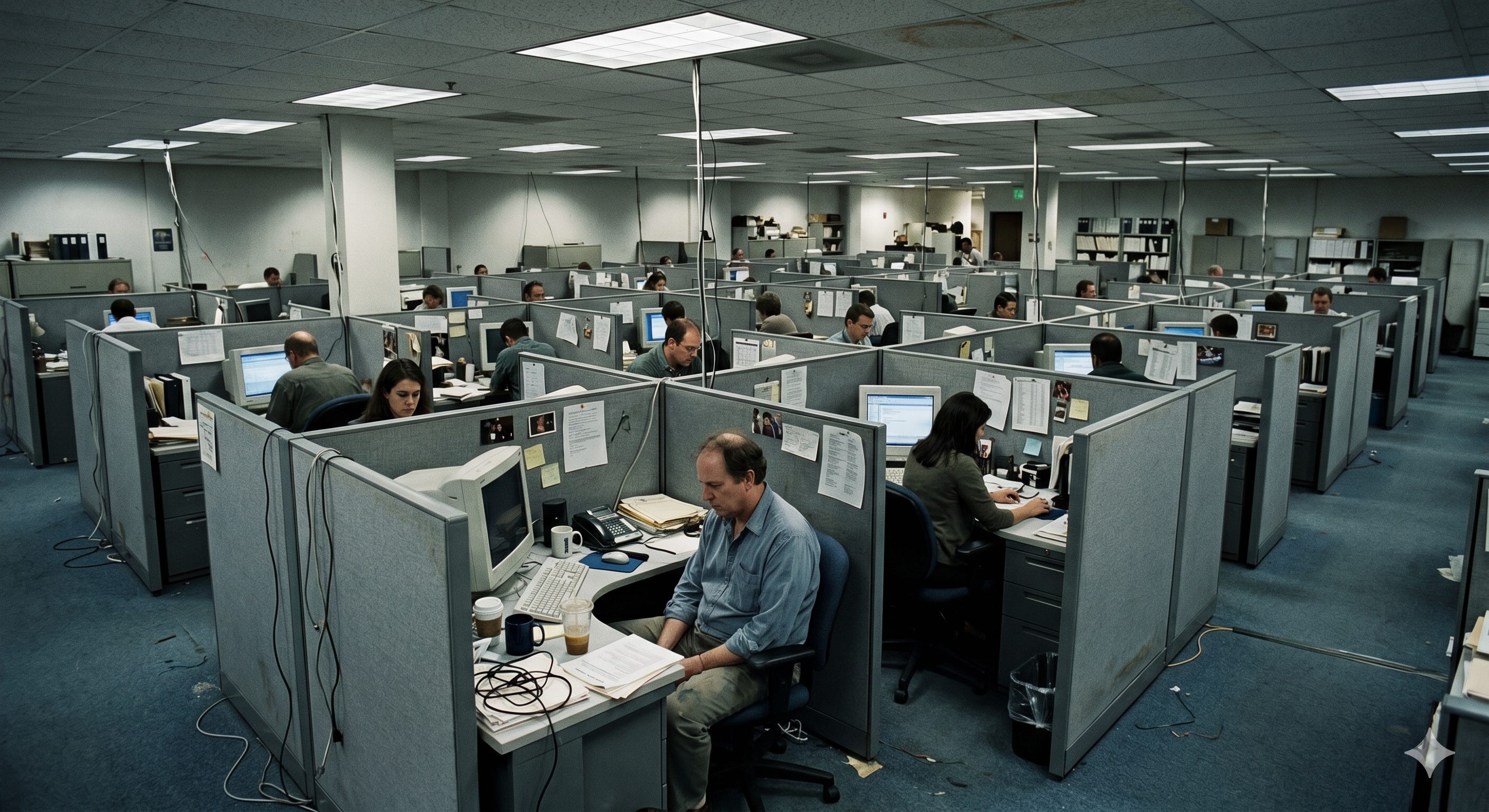
Mike Judge understood this in 1999 better than the Fed understands it in 2026. Office Space is not a comedy about laziness. It is a documentary about what proximity does to a competent young person. Peter Gibbons doesn’t arrive at Initech as a cynic. He is manufactured into one, day by day, by sitting six feet from people who have already given up, by absorbing the eight-different-bosses-asking-about-the-same-TPS-report ritual, by learning that the rational response to the environment is to do as little as possible without getting fired. Bill Lumbergh is the mentor the proximity model actually produces at scale: the manager who has mastered the art of looking busy, defending turf, and saying “yeah, if you could go ahead and come in on Saturday, that’d be great” while contributing nothing. That is the wisdom transmitted by the hallway. That is the lunch lesson.
And the numbers on this are not soft. Toxic workplace culture, by SHRM’s accounting, drove roughly 223 billion dollars in turnover costs over a five-year window, with the majority of people who quit over culture pointing the finger at their direct manager. MIT Sloan’s research found that toxic culture is ten times more predictive of attrition than pay, ten times. Forty-two percent of employees in recent surveys report experiencing bullying at work; twenty-six percent report harassment. Gallup pegs the global cost of disengagement, the learned helplessness that Peter Gibbons embodies, at 8.9 trillion dollars, roughly 9 percent of global GDP. This is the thing we transmit through proximity. We don’t just pass down how to write clean code. We pass down the politics, the territoriality, the quiet sabotage, the cynicism, the precise corporate-survival reflexes that make a person worse at their actual job over time.
When the Fed says young remote workers “miss out on constructive comments that spur their development,” I want to ask: which comments? The ones that make them better engineers, or the ones that teach them that the senior dev two seats over takes credit for junior work, that you never put your best idea in writing where someone can steal it, that the way to get promoted is to be visible rather than to be good? Proximity is a high-bandwidth channel. It carries the good signal and the bad signal with equal fidelity, and in most organizations the bad signal is louder.
The Backstabbing Tax
Let me put the most cynical version of the argument on the table, because I think it’s also the truest. A human mentor is not a neutral party. A human mentor is a competitor with a tenure advantage.
In a toxic environment, and the data above says most environments are at least partly toxic, advancement depends on alliances rather than ability. The literature on this is consistent and depressing: in political workplaces, people learn that relationships matter more than results, real talent disengages, opportunists rise, and the rational move becomes self-protection rather than open knowledge-sharing. Now drop a bright twenty-three-year-old into that ecosystem and assign them a “mentor” who is, structurally, the person most threatened by their rise. What exactly do you expect to be transmitted? Knowledge hoarding is not a bug in this system; it is the equilibrium strategy. The senior engineer who teaches the junior everything they know has just trained their own replacement at a lower salary band. The senior engineer who teaches them 80 percent, keeps the load-bearing 20 percent as private leverage, and subtly undermines them in the promotion committee, that person is behaving rationally inside the incentives we built.
An AI trainer has none of this. It has no promotion to compete for. It does not benefit from your ignorance. It will explain the load-bearing 20 percent as readily as the trivial 80 percent, because withholding it does not protect a job it does not have. It does not get jealous when the junior surpasses it. It will not roll its eyes at the third question of the morning, will not make the junior feel stupid for not knowing, will not file the question away as ammunition for the next performance review. The single greatest thing AI removes from the mentorship equation is not the human warmth the nostalgists cherish. It is the human self-interest they conveniently forget. Every junior who has ever been condescended to, frozen out, or quietly sabotaged by the person who was supposed to be teaching them understands this in their bones.
What Bloom Proved in 1984, and What a Machine Just Did With It
Now the constructive case, because tearing down a Fed post is easy and I’m more interested in what actually works.
In 1984, the educational psychologist Benjamin Bloom published what is still the most important finding in the science of teaching. He showed that a student given one-on-one tutoring performed two standard deviations above a student in a conventional classroom. Two sigma. The average tutored student outperformed 98 percent of the students taught in a group. The catch, the reason this finding sat as a tantalizing problem for forty years rather than a solution, was scale. You cannot give every student a personal tutor. There aren’t enough good tutors, and the ones who exist are expensive. Bloom’s “2 Sigma Problem” was never about whether personalized instruction works. It was about whether you could ever afford it for everyone.
We just solved the affordability problem. In June 2025, a randomized controlled trial led by Greg Kestin and colleagues at Harvard, published in Scientific Reports, pitted a purpose-built AI tutor against a well-run active-learning physics classroom, the gold standard of in-person pedagogy. Students using the AI tutor roughly doubled their learning gains relative to the classroom group, with median scores jumping from 2.75 to 4.5 on a six-point scale versus 2.75 to 3.5 for the in-person cohort, and they learned it in less time. A meta-analysis going back to VanLehn had already shown that even older intelligent tutoring systems performed nearly on par with one-on-one human tutoring. The current generation blows past that bar. Randomized trials from Nigeria to Italy to wartime Ukraine now show AI-assisted and online tutoring delivering gains equivalent to one or two years of conventional schooling, sometimes under air raid sirens.
Read that against the Fed’s thesis. The entire proximity argument rests on the premise that the only way to develop a junior is to physically place an experienced human next to them. Bloom told us forty years ago that the highest-performing form of instruction is one-on-one, personalized, mastery-paced tutoring, and that the only thing stopping us from giving it to everyone was cost. The cost just went to nearly zero, available on demand, at three in the morning, with infinite patience, in any subject, to any junior with a laptop, in any city, with no commute and no cubicle required. The proximity model is mourning the loss of a scarce, unevenly distributed, politically compromised, expensive resource at the exact moment we invented an abundant, evenly distributed, ego-free, nearly free replacement.
The Cohort the Fed Says Is Doomed Is the Cohort AI Helps Most
Here is the data point that should end the argument, and it comes straight from the work the Fed waves away.
In 2024, researchers from MIT, Princeton, and Microsoft ran one of the largest field experiments ever conducted on AI coding assistants, covering 4,867 professional developers across Microsoft, Accenture, and a Fortune 100 firm, on real production code over months. Developers with AI access completed about 26 percent more tasks. But the gains were not evenly distributed, and the distribution is the whole story: junior and newer developers saw productivity boosts of 27 to 39 percent, while senior, long-tenured developers saw far smaller gains of 8 to 13 percent. The researchers were explicit that AI coding assistants accelerate the ramp-up of new hires and narrow the gap between junior and senior developers. GitHub’s controlled studies found developers completing tasks roughly 56 percent faster with Copilot and 78 percent more likely to finish successfully, with the strongest effects precisely where a developer lacks prior context, exactly the situation every junior is in, every day.
Sit with the irony. The Fed publishes a paper arguing that young workers are being sidelined because, separated from senior colleagues, they can’t be trained. Meanwhile the largest study of the relevant technology shows that the very tool sitting on every young worker’s machine lifts juniors three to five times more than it lifts the seniors they’re supposedly being deprived of. The young remote worker is not a person who lost their mentor. They are a person who was just handed the most effective, most patient, most available trainer in the history of work, and who happens to be the demographic that benefits from it most. The seniors barely need it. The juniors are transformed by it.
This is why the proximity prescription is not just wrong, it’s actively harmful. Telling a junior in 2026 that their development depends on physical access to a senior is like telling them their development depends on access to a good encyclopedia in the year Wikipedia launched. The constraint they’re being told to optimize for has already dissolved.
Where the Hype Merchants Are Wrong Too
I am not here to sell you the frictionless AI utopia. Anyone who has read my work knows I have spent the last two years swinging at exactly that kind of marketing. So let me be the one to put the honest caveats on the table, because the case is strong enough to survive them, and an argument that hides its weak points isn’t an argument, it’s a sales deck.
The same body of research that shows juniors gaining the most also shows that juniors are at the greatest risk. They adopt AI suggestions readily and accept them without the validation experience to know when the model is confidently wrong. When AI hands you two hundred lines of code, the skill that matters is spotting the seventy percent that’s solid scaffolding and the thirty percent that will detonate in production, and that skill still has to be built. The METR study found experienced developers were actually slower with AI on tasks they already understood, because the assistant added friction to work they could already do cleanly. The Faros AI telemetry across more than ten thousand developers found that output went up while delivery velocity and business outcomes often didn’t budge, the productivity paradox. There is a real and documented risk that a junior who leans on AI without ever building fundamental comprehension becomes permanently dependent, fluent in prompting and helpless in reasoning.
But look closely at what those caveats actually argue for. They argue for AI plus disciplined verification, AI plus mastery checks, AI plus deliberate practice on fundamentals. They are an argument about how to train juniors with AI, not an argument for chaining them to a desk next to a disengaged senior who’s been coasting since 2011. The skill-degradation risk is real, and the answer to it is a well-designed AI trainer with guardrails and mastery gates, precisely the design that made the Harvard tutor double classroom gains. The answer is emphatically not the Lumbergh model, which degrades a junior’s skills in a different and more permanent way, by teaching them that effort is irrational.
The Uncomfortable Recommendation
So here’s where I land, and I’ll say the quiet part out loud because the data backs it. If you are responsible for developing a cohort of new graduates, your instinct, reinforced by this Fed post and by a thousand LinkedIn thought-leaders, is to maximize their exposure to your experienced staff. I think that instinct is, in most organizations, exactly backwards. The default exposure of a junior to the average senior is a net transfer of cynicism, politics, and self-protective habit, partially offset by some genuine knowledge that the senior is often incentivized to withhold anyway.
I would invert it. Make the AI trainer the primary development engine for new hires: on-demand, one-on-one, mastery-paced, ego-free, available at any hour, on any topic, with no agenda. Then ration human exposure deliberately, not generously. Give a junior real time with the rare senior who is a genuine teacher, the one who explains the load-bearing twenty percent, who has nothing to prove and no turf to defend. And keep them well away, in their formative first year, from the carriers, the credit-takers, the territorial gatekeepers, the people whose primary lesson is how to survive a system rather than how to do excellent work. You are not protecting juniors from knowledge by doing this. You are protecting them from the corporate operating system that turns competent young people into Peter Gibbons by month eighteen.
Yes, this sounds harsh. It sounds harsh because we have spent a century romanticizing the apprenticeship and ignoring the fact that the apprenticeship, in a political organization, is also how dysfunction reproduces itself. The young engineer who learns to code alongside an AI and reaches deliberately, occasionally, for a hand-picked human mentor will not just be more productive. They will be less institutionalized, less cynical, less likely to confuse looking busy with being valuable, and far less likely to learn that the way to get ahead is to step on the person beside them. They will, in a word, develop better habits, because the thing training them does not have any bad ones.
The Bottom Line
The New York Fed found a real correlation and dressed it as a verdict. Remote work and youth unemployment moved together, and a single firm’s software engineers gave them a story to drape over it. But the mechanism they’re defending, proximity-based mentorship, was already failing most workers before the pandemic, already transmitting as much pathology as wisdom, and already compromised by the simple fact that your mentor is also your rival. Meanwhile the tool they explicitly cleared of blame, generative AI, is the closest thing we have ever built to Bloom’s impossible dream: personalized, two-sigma instruction at near-zero cost, and it helps juniors more than anyone else in the building.
We are not watching young workers get sidelined by the loss of mentorship. We are watching the obsolescence of a rationing system that never served them well, at the exact moment a better trainer arrived. The companies that figure this out will not drag their juniors back to the cubicle farm to sit at the feet of the disengaged. They’ll hand them the best tutor in history, surround it with discipline and the occasional great human, and keep the Lumberghs at a safe distance. The rest will keep mourning a golden age of mentorship that, for most people, never actually happened.
The original blog post is here
Gal Ratner is Chief Architect at Prana Entertainment and founder of Inverted Software. He writes about AI, software, and the gap between the marketing narrative and the production reality. He is The .NET AI Guy That Ships.