


Let me open with a confession that would horrify the subject of this essay. To research his whereabouts, I did the one thing Sam Kirchner spent the last two years of his public life trying to make a crime. I asked an artificial intelligence for help. I fed his name into precisely the kind of system he believes will exterminate the human species by roughly 2027, and I asked it, in plain English, where a man like this might go. It thought for a moment and advised me to consult recent news, contact local law enforcement, and check his social media accounts. Which is to say: the impending superintelligence that is going to slaughter eight billion of us cannot locate one unarmed man who left San Francisco on a bicycle. If this is the machine god we have been warned about, it has a remarkably relaxed attitude toward its own apocalypse.
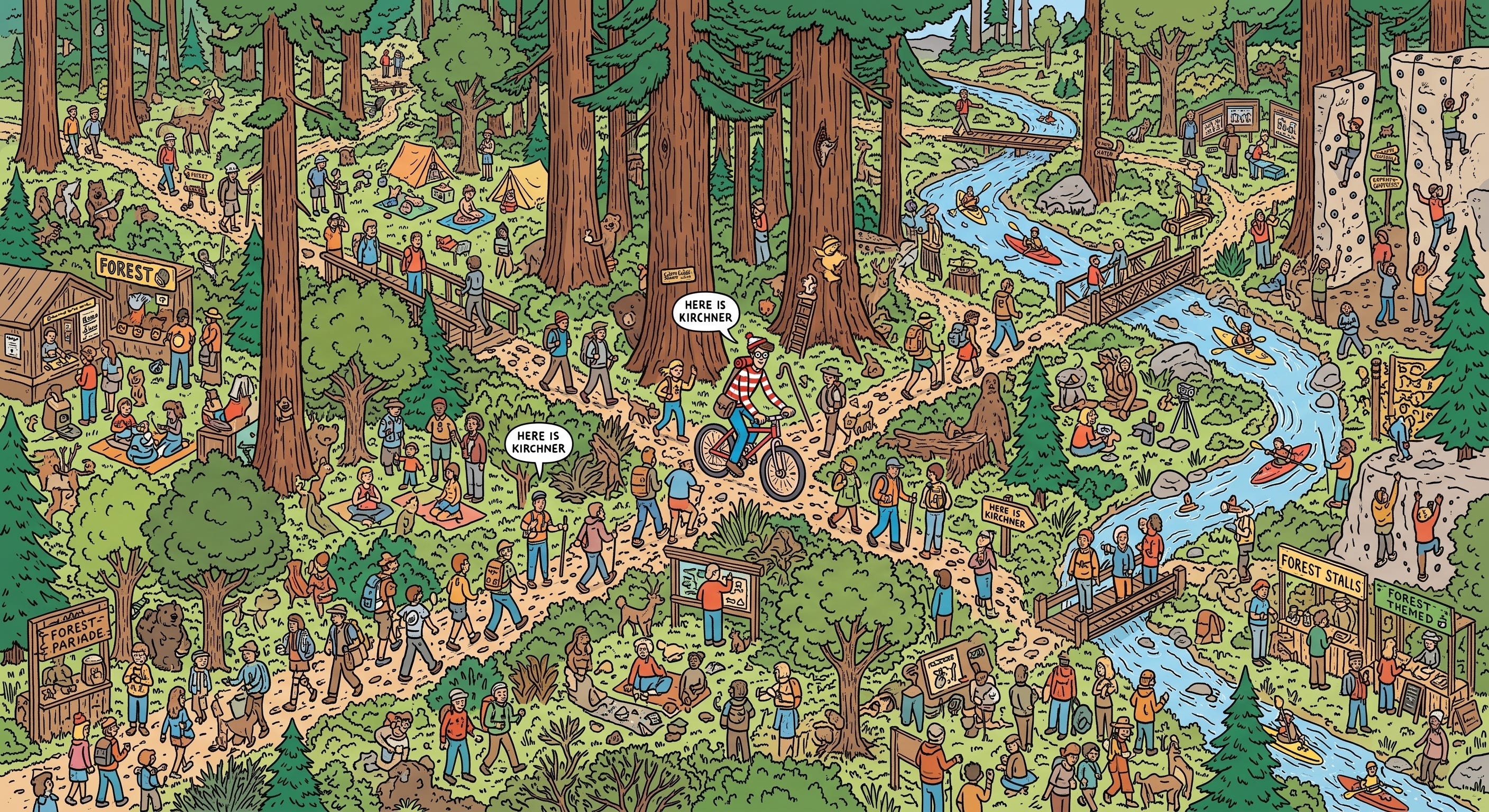
I want to be clear from the outset that the manhunt is a bit — no chatbot is out there running facial recognition on trailheads, and I will come back to why the joke matters more than it looks — because the true story of Stop AI needs no embellishment whatsoever. Reality got there first, and reality is funnier. It is also, in a way the group’s remaining members would never in a thousand years concede, the most quietly devastating thing that has ever happened to the movement to stop artificial intelligence. And they did all of it to themselves, in public, over salad.
A brief history of predicting the apocalypse, badly
Start with what Stop AI actually is, because the group has worked very hard to make sure you know. Founded in Oakland in 2024 by Kirchner, then twenty-six, and Guido Reichstadter, a forty-five-year-old career activist, the organization exists, per its own website, to permanently ban the development of artificial superintelligence in order to prevent, and I am quoting the mission statement here, human extinction in one to three years. Not to regulate it. Not to slow it. To ban it. Permanently. On a countdown.
The two men met inside a milder outfit called Pause AI, which favors policy advocacy and open letters and explicitly forbids breaking the law. Kirchner and Reichstadter found this insufficiently urgent for a species with, by their own arithmetic, mere months to live, and split off to pursue civil disobedience under a new banner. The signage set the tone. At their demonstrations the group flies phrases like “AI WILL KILL US ALL” and “PROTEST OR DIE,” and they gathered every Sunday to plan their resistance at a location in downtown Berkeley that was, for a stretch, a Tender Greens. There is something almost too perfect about a movement convinced that humanity has eighteen months remaining choosing to spend those precious final Sundays workshopping direct action over farm-to-table grain bowls. If the clock is really ticking that loudly, you would think someone might have suggested skipping the salad.
The theater escalated from there. At one protest, as the City Journal reported, a demonstrator dressed as a robot emblazoned with the OpenAI logo mimed shooting a handcuffed man in the head. In February 2025, three members of the group, Kirchner and Reichstadter among them, were arrested outside OpenAI’s headquarters after they chained the company’s doors shut and refused to leave. Kirchner himself went on the record with steadily escalating rhetoric, arguing in public that OpenAI’s executives ought to be charged with the attempted murder of eight billion people, and explaining on a podcast that he and his fellow members were untroubled by the prospect of criminal records because, in his words, they were all going to be dead soon anyway.
This is the part worth sitting with, because it is the intellectual engine of everything that followed. Once you have genuinely persuaded yourself that the end of all human life is arriving on a fixed and imminent schedule, every ordinary constraint simply dissolves. Laws are for people who expect to be around for the trial. Consequences are for suckers who assume there will be a next year. A criminal record is a rounding error set against the extinction of the species. It is a worldview that begins as moral seriousness and curdles, with a kind of grim inevitability, into a permission structure for whatever a person already wanted to do. The apocalypse is the most flattering excuse ever invented, because it retroactively ennobles any action at all. You are not breaking the law. You are saving the world, and the world’s petty rules simply have not caught up to the emergency you alone can see.
The clock that never rings
The specific promise here deserves to be pinned to the wall, because it is falsifiable and the movement does not enjoy dwelling on that. Stop AI does not say that AI might someday, under some conditions, pose serious risks. That is a reasonable claim, and one that plenty of sober researchers across the spectrum, including inside the labs themselves, will happily debate over a long dinner. Stop AI says, in writing, that we face human extinction in one to three years. That is not a warning. That is a clock, and clocks can be checked against the time.
The group has been ringing this particular alarm since 2024, which means we are already deep inside the window during which, by their own timeline, the machines were supposed to begin the culling. And here we are. The flagship models of 2026 will help you rewrite a cover letter, summarize a dense PDF, draft a passable birthday poem, generate a slightly uncanny image of a cat in a wizard hat, and, if you are not paying attention, invent a legal citation out of thin air and hand it to you with a straight face. The extermination, it must be said, is running behind schedule. The doom clock has the reliability of a gas-station watch, and every time it fails to go off at the appointed hour, the movement quietly winds it forward another year and insists, with undiminished conviction, that this time the alarm is real.
There is a long and unglamorous tradition of this, and it did not start with AI. Every generation produces a cohort certain that the specific technology of the moment is the one that finally ends us, and every generation the deadline slides. What distinguishes the current vintage is the sheer specificity of the countdown and the willingness of a handful of adherents to act on it as though it were a fire alarm rather than a feeling. Most doomsday movements have the decency to keep their apocalypse safely in the future, always receding, never quite arriving. Stop AI made the tactical error of putting a date on it, and dates come due.
The month the ship sailed
Which brings us to November, and to a sequence of events that the group’s own members described to reporters, and which reads less like a news story than like the third act of a film that no studio would have greenlit on the grounds that the plot was too on the nose.
At a meeting on the sixteenth, according to accounts from fellow organizers published in the Daily Californian, Kirchner demanded access to the organization’s funds in order to purchase a weapon. When another organizer refused him, Kirchner allegedly punched him repeatedly in the head. The organizer, a man the group refers to as Yakko, declined to press charges, an act of forbearance that tells you a great deal about the internal culture of an outfit whose co-founder had just allegedly beaten him over the weapons budget. The following morning, Kirchner reportedly told that same organizer that the nonviolence ship had sailed for him.
Read that line again and let it land. Here is the co-founder of an organization whose entire public identity, whose every statement and banner and press release, rested on a stated commitment to nonviolent civil resistance, announcing, the morning after allegedly assaulting a colleague, that the nonviolence ship had, for him personally, departed the harbor. Two years of civil-disobedience seminars over salad, and the ship sailed anyway, apparently on schedule, apparently for good, apparently with him aboard and waving from the deck.
To the genuine credit of the people still running Stop AI, what happened next was the responsible thing, and I do not want that to get lost in the mockery. They expelled him. They called the police to warn that Kirchner might pose a danger to employees at companies such as OpenAI. They issued a public statement reaffirming their commitment to nonviolence and expressing alarm about the threat one of their own founders now appeared to represent. It is worth pausing to note that when the headline accomplishment of your organization’s fiscal quarter is successfully reporting your own co-founder to law enforcement, the strategy offsite rather writes itself.
Then, in the small hours of November 21st, Kirchner posted to X that he was no longer part of Stop AI. He had a court date that same day, on the trespassing charges from the February protest, and he did not appear for it. When an organizer went to check on him, he was gone. He had left his phone and his laptop behind. He had taken his bicycle, a CPAP machine for his sleep apnea, camping gear, and maps of California, and had, per his colleagues’ review of his recent purchases, been searching for nearby campgrounds and shopping at REI. His last confirmed sighting was at a bicycle shop in Lafayette. Around eleven that morning, San Francisco police responded to a report that a man had made threats against employees near one of OpenAI’s offices, though the details here are considerably murkier than some of the coverage implies. Two of the group’s own organizers said Kirchner never made specific threats, and the police account describes a subject who made threats against the business through another person but was never actually on the scene. A bench warrant was issued for the missed court date. And then, for months and counting, nothing.
Now, everything about this reads like a man who chose to disappear rather than a man something happened to. He announced his own exit on X. He packed with intent, taking his bike, his tent, camping gear, maps of California, and a CPAP machine so that going off-grid would not disrupt his sleep schedule, and he did it with a court date bearing down and a bench warrant about to land. This is not the profile of a victim. It is the profile of a former boy scout absconding into the treeline one step ahead of the process server, which is a genuinely funny way for the co-founder of a doomsday organization to spend the apocalypse. Where exactly he went, nobody has established. His old colleagues bet on the Northern California backcountry, and the trail of campground searches and a last sighting at a Lafayette bike shop points there far more than at any dramatic border run. Eight months later he still has not surfaced, which I note in the interest of accuracy rather than alarm. The point is that the movement he built does not get to hide in the woods with him. A movement is not a guy who skipped town. It is a set of ideas, broadcast loudly and repeatedly and on purpose, and ideas are fair game.
A doomsday movement that cannot keep track of its own humans
Here is the irony that no quantity of official statement-issuing can paper over. An organization whose foundational claim is that a machine intelligence is about to hunt down and eliminate every human being on the planet spent the back half of November unable to hunt down one specific human being who had left on a bicycle. In Stop AI’s telling, the coming superintelligence will model the entire physical world in real time, anticipate every move, and outmaneuver all of humanity simultaneously. In reality, Stop AI could not locate one of its own founders using phones, friends, receipts, and the San Francisco Police Department. If the extinction machine turns out to have anything like the operational competence of the people warning us about it, we are going to be absolutely fine.
The competence problem runs directly through the movement’s marquee tactics, too. Consider Reichstadter, Kirchner’s co-founder, who in September 2025 staged a thirty-day hunger strike on the sidewalk outside the San Francisco headquarters of Anthropic, the maker of the Claude assistant and, by broad agreement including that of the movement’s own critics, the most safety-obsessed lab in the entire industry. Reichstadter subsisted on nothing but water, electrolytes, and vitamins for a full month, demanding that the company’s chief executive personally meet with him to explain why the firm continues to exist. The company declined to comment. What this produced is the defining tableau of the anti-AI resistance in its current form: a man slowly starving himself, in protest, on the doorstep of the one company most likely to already agree with a substantial fraction of his premises, while the delivery riders stepped around him to bring lunch to everyone inside. Of all the buildings in San Francisco, he picked the one where the argument was closest to already being had, and then refused to eat until they conceded a point that many of the people upstairs will grant you privately over coffee. Parallel strikes sprang up outside DeepMind in London; two of those strikers quit early, one of them after fainting. The movement’s single most committed public act of the year was, in the end, a fasting relay that its own participants kept having to abandon for medical reasons.
What the machine actually does all day
I build these systems for a living, which affords me a somewhat different vantage point than a man starving on a sidewalk. I spend my days wiring large language models into the deeply unglamorous machinery of real businesses: retrieval pipelines, tool-calling servers, the tedious and invisible plumbing that determines whether a model can look up your actual order status without inventing a plausible-sounding fake one. And I can report, from inside the machine, that the daily lived experience of working with frontier AI bears no resemblance whatsoever to staring into the awakening eyes of an emergent god.
It is closer to managing a brilliant and bottomlessly overconfident intern who has read very nearly everything and retained the general shape of most of it. This intern will produce genuinely useful work at superhuman speed, and then, without warning or embarrassment, assert with total confidence that a software function exists which does not, or cite a regulation that was never written, or attribute a quote to a person who never said it. The central engineering discipline of the entire field at this moment is not how do we cage the superintelligence. It is how do we stop this thing from confidently making things up. Those are not the same problem. They are not even in the same postal code. The gap between them is the exact distance between the AI that Stop AI protests and the AI that actually exists, and it is a canyon you could lose a mountain range in.
This is the part the doom framing gets precisely backwards, and it matters, because there are real questions about AI worth taking seriously. There are genuine concerns about labor displacement, about the concentration of power, about misinformation, about models being wired into systems that matter before anyone has checked whether they hallucinate under load. Those are the questions of a practitioner who has to make this stuff work on a Tuesday. They are grounded, they are tractable, and they are quietly being worked on by thousands of unglamorous people who will never chain a door or starve on a sidewalk. What they are not is a countdown to extinction, and every hour the conversation spends on the robot apocalypse is an hour it does not spend on the mundane, unsexy, entirely real problem of a confident machine that does not know what it does not know.
Where is Kirchner, really?
So: where is he? I promised I would come back to the machine.
Because it amused me, and because the irony was simply too rich to leave on the table, I did in fact put the question to the state-of-the-art AI models, the very ones Stop AI wants outlawed by statute, and asked them to help locate their missing adversary. This is a joke, to be absolutely clear about it a second time; no chatbot is conducting a search, and no chatbot on Earth could. But the results are instructive precisely because of how staggeringly mundane they are. Handed the task of finding a missing person, the models did exactly what a sensible and slightly boring human assistant would do. They declined to speculate about a real individual’s location. They suggested I contact law enforcement and review recent news. They noted, correctly, that they had no ability to access anyone’s real-time whereabouts. And one of them gently raised the possibility that the person in question might be in distress, and pointed me toward resources for helping him. In other words, the terrifying superintelligence, handed the exact task the movement most fears, which is to surveil and locate a specific human being, responded like a mildly concerned reference librarian and then reminded me to be kind.
That is the quiet joke at the dead center of this entire affair. The systems that Stop AI insists are only months away from hunting humanity to extinction are, at this moment, so far from that capability that they cannot and will not tell you where one man went camping. Kirchner built an entire organization on the premise that the AI was an imminent, superhuman predator poised to strike. The actual AI, invited to predate, offered me a phone number for the police and a sincere wish for the man’s wellbeing.
His former colleagues, the ones who actually know him, believe he is alive and camping somewhere in California, a former boy scout riding out the hardest stretch of his life in the backcountry with his CPAP machine and his folded maps. I hope, with real and unironic sincerity, that they are right, that he surfaces, that whatever tangled combination of ideology and personal crisis carried him into those woods loosens its grip and lets him come home. That is the human ending this story deserves, and I would trade every joke in this essay to know it turned out that way.
But the movement he helped build has already written its own ending, and it requires no machine to locate. It is right there in the public record, in black and white: a group that spent two years insisting the robots would murder every last one of us, and that then spent a single November proving it could not stop a founder from allegedly trying to arm himself, could not keep its co-founders from starving on the wrong sidewalk, and could not, in the final accounting, find one human being who did not wish to be found. The extinction, if it ever arrives, is going to have to manage entirely without them. On the current evidence, it may have to do the whole thing itself.
Where is Kirchner? Nobody knows. But if the superintelligence he feared is genuinely out there, it has had eight months and every conceivable advantage, and it has not found him either.
About the author
Gal Ratner is the founder and CTO of Inverted Software and WhiteStar Labs and the Chief Architect at Prana Entertainment, with nearly thirty years of production software experience on the Microsoft and .NET stack for clients including Microsoft, Sony, Rockstar Games, 2K Games, Best Buy, and Allegiant Air. He was employee number six at Break.com and a Los Angeles Business Journal CTO of the Year finalist, and he builds production agentic AI systems for a living: MCP servers, retrieval pipelines, and the unglamorous plumbing that makes these models genuinely useful instead of theoretically apocalyptic. He writes about the widening gap between how artificial intelligence is sold, by its evangelists and its doomsayers alike, and how it actually behaves when you are the one who has to ship it. He co-hosts the Edge Grip motorcycle podcast, trains Brazilian jiu-jitsu in Las Vegas, and is the author of the novel The Archive of Lost Suns.