


Every era of technology runs on a hidden bet about how the world is structured. The bet underneath modern large language models is deceptively simple: that reality decomposes into discrete entities, that every entity carries a distinctive signature, and that if you can read that signature clearly enough you can identify the thing — and if you can match it, you can act on it selectively. Read, match, act. That is the quiet premise sitting inside every embedding table and every attention head in every model you have ever prompted.
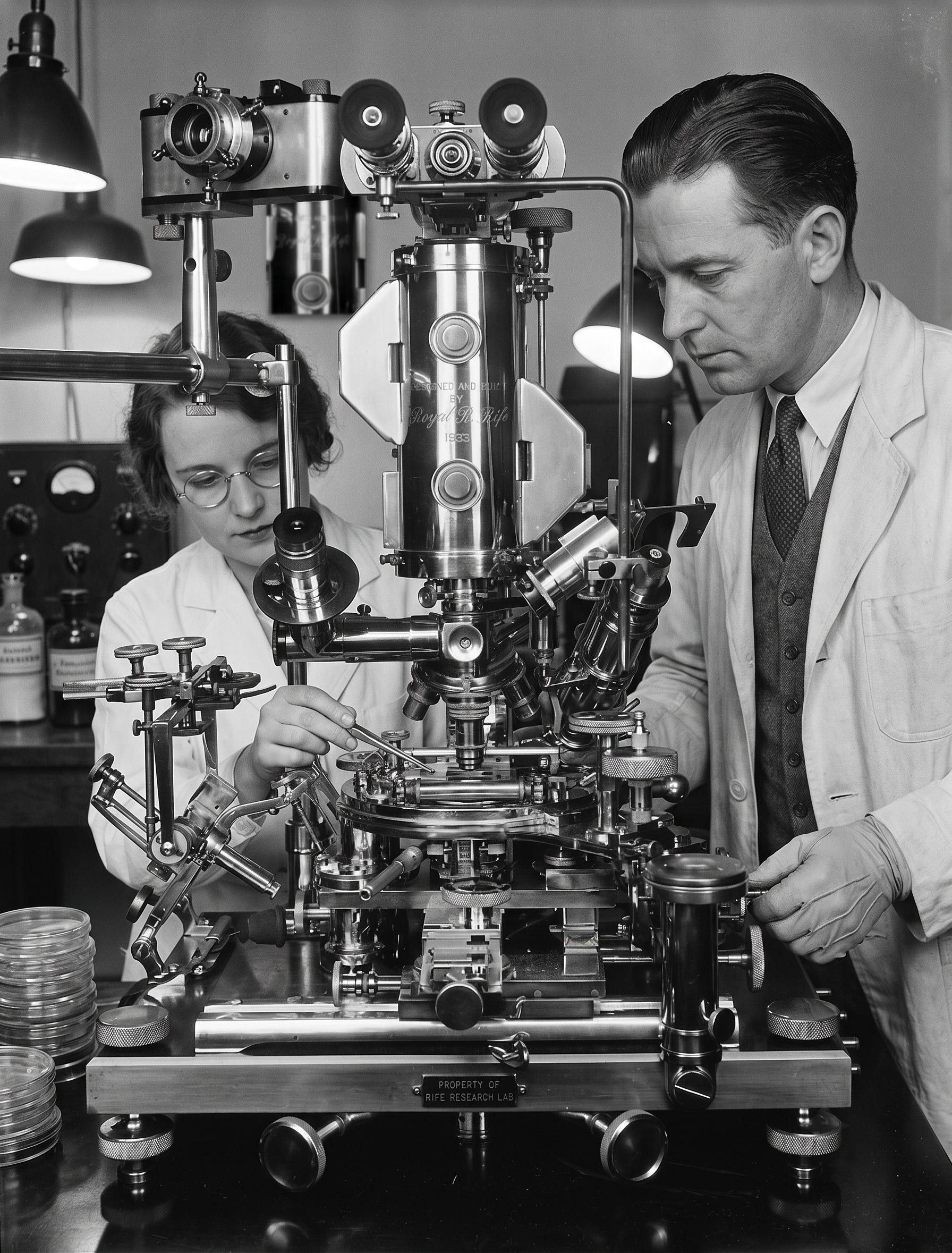
It is also, almost word for word, the bet that a self-taught optical engineer named Royal Raymond Rife made in a San Diego laboratory nearly a century ago. Rife believed that identity was frequency. He believed that if you could render a thing’s characteristic signature visible with enough precision, and then match it with the right resonant energy, you could reach out and touch that one thing while leaving everything around it untouched. Whatever you make of where that belief eventually led him in medicine — and I want to be clear up front that this essay takes no position on that question, in either direction — the raw engineering intuition at the center of his work turns out to be an unusually clean lens for thinking about where LLMs are today and, more interestingly, where the next generation of them is going.
Rife’s story is worth telling in full, and not just as color. He built two instruments: one that perceived and one that acted. A microscope that read signatures, and a ray that matched them. That two-part architecture — a perception engine feeding an action engine, coupled by a shared representation of what a thing fundamentally is — maps onto the two halves of a modern agentic AI system with a precision that is, frankly, a little uncomfortable. So let’s start with the man and the machines, in detail, and then follow the principles forward into the models.
The Engineer Before the Controversy
Royal Raymond Rife was born in Elkhorn, Nebraska, on May 16, 1888. The reliable published record of his life is thin — a fact worth stating plainly, because much of what circulates about him is secondhand, hagiographic, or both — but the broad outline is consistent across sources. He made his way to San Diego in the early 1900s, and by around 1912 had established a small research laboratory there and married Mamie Quill. He was, by every account, a gifted maker: a man who thought like a mechanical engineer and who, when the tool he needed did not exist, simply built it himself in his own machine shop.
The hinge of his career was an unlikely patron. Rife became connected to the roller-bearing fortune of the Timken family — the accounts name the industrialist Henry Timken as his backer — first, the story goes, as a chauffeur, and then as something far more valuable. Timken’s company had a quality-control problem: hairline fractures in the chrome-steel bearings coming off the line. Rife designed and built an X-ray inspection machine that could catch those fractures before the bearings shipped, a solution that reportedly saved the company an enormous amount of money and earned Rife a standing monthly payment for the rest of his life. He is also credited with building a 2,700-horsepower marine engine for a record-setting speedboat around 1915. Whatever the exact figures, the point is that before Rife was a medical controversy, he was a serious and inventive engineer whom wealthy industrialists paid handsomely because his machines worked.
That patronage bought him something rare for an independent researcher: a fully equipped private laboratory at Point Loma, funded by Timken and his business partner, with a research budget and, by some accounts, as many as twelve assistants. Several sources describe Timken sponsoring Rife’s travel to Europe before the First World War for hands-on training in precision optics at the great German instrument houses — Carl Zeiss in Jena, and Leitz in Wetzlar. This is the crucial detail for everything that follows: Rife’s obsession was not primarily medicine. It was optics. It was the conviction, as he put it, that you cannot cure what you cannot see — that vision precedes identification, and identification precedes action. He wanted, above all, to build an instrument that could make the invisible legible.
Colleagues described a man of almost inhuman patience. He would strap himself into the seat at his microscope and sit motionless for twenty-four or forty-eight hours at a stretch, drinking only water, watching a single organism, waiting for the exact moment a change occurred. This is the temperament of someone building a perception system by brute observation — the human equivalent of grinding through a training run, refusing to look away until the signal separates from the noise.
The Universal Microscope: A Machine for Reading Signatures
Rife’s masterwork, unveiled in 1933, was what he called the Universal Microscope. It was a genuinely astonishing piece of instrument-making, reportedly assembled from 5,682 individual parts. It earned the name “universal” because it was built to do every kind of microscopy at once: it could use polarized light, monochromatic light, white light, dark-field, slit-ultra, and infrared illumination, and it was equally suited to crystallography and photomicrography as to biology. A report to the Journal of the Franklin Institute credited it with extraordinary magnification and resolution figures, and the 1944 annual report of the Smithsonian Institution described one of Rife’s microscopes in respectful, specific technical detail. Serious people looked through it and were impressed by its clarity.
The optics were exotic. Every lens and prism was cut from block quartz rather than glass, because quartz passes ultraviolet light. The instrument used a Risley counter-rotating prism assembly — two wedge-shaped prisms geared to turn against each other — to steer a powerful monochromatic beam through the specimen at precisely controllable angles. But the mechanism that matters most for our purposes, the one that turns Rife from a historical curiosity into a conceptual ancestor, was how he claimed to make things visible in the first place. He did not stain his specimens. Chemical stains, he reasoned, were both too coarse — their molecules too large to enter the structures he was hunting — and often lethal to the living organisms he wanted to watch in their natural state.
Instead, he used interference. He illuminated a microbe with two carefully chosen wavelengths of the same ultraviolet light, tuned so that they would beat against each other. Where the two waves merged, they produced a third, longer wave — an interference product that fell into the visible band. This is heterodyning, the same frequency-mixing trick that made early radio work: combine two signals to produce a new one at a frequency you can actually work with. Rife was, in effect, mixing an unobservable signal down into an observable range. And the payoff he reported was remarkable: under this illumination, each type of organism fluoresced in its own characteristic color. Typhoid turned turquoise. The leprosy bacillus glowed ruby red. As one of his associates put it years later, it was “just like the colors are tuned on television sets” — each microbe had a specific color, and the color was the identity. The signature replaced the stain.
Hold onto that idea, because it is the whole game. Rife had built a projection — a hand-engineered transform, made of quartz and rotating prisms and interfering wavelengths — whose entire purpose was to map otherwise indistinguishable entities into a space where they became trivially separable by a single legible feature. He also paired the microscope with a movie camera, capturing some of the earliest high-magnification time-lapse films of living microbes dividing and moving. He was not just reading signatures; he was recording how they changed over time. File that away too.
The Beam Ray and the Mortal Oscillatory Rate: A Machine for Acting on Them
The microscope was only half the system. Having convinced himself that every microorganism had a readable signature, Rife made the leap that defines his legacy: he theorized that every organism also had a specific resonant frequency at which it would be destroyed — a frequency he called the Mortal Oscillatory Rate, or M.O.R. The governing analogy, which shows up in nearly every description of his work, is the opera singer shattering a wine glass with a sustained note. Match a structure’s resonant frequency precisely enough, pour in energy at that frequency, and the structure fails — while everything not tuned to that frequency stays perfectly intact.
The instrument he built to deliver that energy was the “Beam Ray”: a device that projected modulated radio frequencies through a tube filled with helium plasma. His stated ambition for it was selectivity in its purest form — to devitalize one specific target and leave neighboring tissue untouched. He spent, by one account, twenty thousand attempts trying to isolate a specific microbe he associated with cancer, which he labeled the “BX virus,” before turning the ray on it. In the summer of 1934, working with the physician Milbank Johnson and the bacteriologist Arthur Kendall, Rife was involved in a clinic — variously located at Scripps Ranch and La Jolla — in which a group of terminally ill patients sat a few feet from the ray for a few minutes every third day. Rife’s supporters have long cited dramatic results from that clinic. Mainstream medical bodies have long rejected those claims. I am deliberately not going to adjudicate that dispute; it is not the subject of this essay, and it is not a question a technologist writing about model architecture has any standing to settle.
What I will say is that, as a piece of systems design, the shape is unmistakable. Rife built a closed loop. The microscope perceived a target and resolved its identity down to a signature. That signature indexed a specific action — the M.O.R. — which the ray then executed against that target and no other. Perceive, identify, act, with selectivity as the entire point of the exercise. Strip away the biology and you are left with a control architecture that any engineer building autonomous systems today would recognize on sight.
The Contested Legacy, Handled Honestly
It would be dishonest to describe Rife’s machines without acknowledging that his claims were, and remain, contested. The standard objection from optics is well known: the resolving power of any light microscope is bounded by the diffraction limit — Abbe’s limit — which for visible wavelengths sits in the range of a couple hundred nanometers, below which conventional optical instruments are not supposed to resolve detail. Many viruses are smaller than that, which is the basis on which critics have argued that seeing them optically, as Rife claimed to, should not be possible. Rife’s defenders counter with his heterodyning argument and point to later high-resolution optical instruments; skeptics are unpersuaded. His broader biological model rested on pleomorphism — the idea that a single underlying microbe could shift between viral, bacterial, and fungal forms — which ran against the monomorphism that mainstream microbiology settled on. The American Medical Association and the American Cancer Society rejected his medical claims; his supporters have maintained for decades that the rejection was a suppression.
The human arc was tragic regardless of where one lands on the science. A commercial venture formed to manufacture the devices, Beam Rays Inc., was gutted by an internal lawsuit at the end of the 1930s. A laboratory fire and the disappearance of microscopes and records erased much of the primary evidence. Milbank Johnson, his most credible champion, died in 1944. Rife himself slid into depression and alcoholism, and died on August 5, 1971, at eighty-three, reportedly from a combination of Valium and alcohol; the local obituary noted that he had come to San Diego to work on his microscopes decades earlier and that he left no survivors. Interest revived in 1987 with Barry Lynes’s book The Cancer Cure That Worked, which recast the whole story as a suppressed breakthrough and launched the modern market of devices bearing Rife’s name. That is the honest state of the record: genuinely impressive instrument-making, genuinely unresolved claims, and a legacy that people of good faith read in opposite directions. I am going to leave it exactly there, because the part I can speak to with authority is what happens when you carry Rife’s engineering principles — not his conclusions — into the architecture of modern AI.
Signatures Become Embeddings
Start with the microscope, because that is the perception half, and perception is where representation lives. What Rife built was a transform that took entities which were indistinguishable in their raw state and mapped them into a space where each one occupied a distinct, legible position — a color. That is, structurally, exactly what an embedding is. The entire premise of representation learning is that you can project tokens, images, or concepts into a high-dimensional vector space engineered so that every entity has a characteristic fingerprint and so that similar entities land near one another. When a language model turns the word “resonance” into a vector, it is doing what Rife did with turquoise and ruby red: assigning a position in a representational space that stands in for the thing’s identity.
The difference is not in the concept but in how the transform is obtained. Rife hand-built his projection out of physical optics — he chose the wavelengths, ground the quartz, geared the prisms. He engineered the feature space by hand, the way computer-vision researchers once hand-designed edge detectors and color histograms. A modern neural network does not get handed its projection; it learns one, tuning millions of parameters until the space it induces makes the distinctions that matter for the task fall out cleanly. Rife would have understood the objective perfectly. He simply lacked gradient descent, so he did the optimization with quartz and forty-eight-hour observation sessions instead. The goal — a representation in which identity is a readable coordinate — is identical.
Resonance Becomes Attention
Now the action half, and this is the parallel that should make anyone who works on transformers sit up. Rife’s Mortal Oscillatory Rate is the principle that you probe a target with its own frequency and it responds maximally, while everything not tuned to that frequency stays quiet. In signal processing this idea has a rigorous name: matched filtering. The matched filter is the provably optimal way to detect a known pattern buried in noise — you correlate the incoming signal against a stored template of the thing you are looking for, and the output spikes precisely when the input aligns with the template. It is detection by resonance. You are asking, at every point, how strongly does what I am seeing right now agree with the signature of what I am hunting for?
That is what attention computes. The scaled dot-product attention introduced in the 2017 “Attention Is All You Need” paper takes a query vector and measures its dot product against a set of key vectors. The dot product is a similarity score — a measure of alignment, of how much the query resonates with each key. The softmax that follows turns those raw resonance scores into weights, sharpening the strongest matches and suppressing the rest, and those weights then determine how much each value contributes to the output. Strip it to its essence and attention is selective amplification by signature match: the query is a probe, the keys are candidate signatures, and the mechanism pours the model’s “energy” — its representational bandwidth — into whatever resonates most strongly and starves everything that does not. This is not a loose metaphor. Recent theoretical work has framed scaled dot-product attention explicitly as a constrained filtering operation, and the kinship between the query-key correlation and classical autocorrelation is direct. Rife’s ray and a transformer’s attention head are two implementations of the same abstract move: find the thing whose signature matches, and act only on that.
The M.O.R., in other words, is a policy keyed to an identified target, and attention is the mechanism by which a modern model decides which identified targets in its context deserve to drive the next token. Same architecture of selectivity, ninety years apart, one built from helium and radio waves and the other from matrix multiplications.
The Frequency Domain Is Not Just a Metaphor Here
It would be easy to stop at analogy — resonance is like attention, signatures are like embeddings — and call it a clever framing. But the correspondence runs deeper than that, because a surprising amount of modern deep learning genuinely operates in the frequency domain, not metaphorically but literally. Rife’s heterodyning — mixing two signals to shift information into a band you can work with — has direct descendants in the way neural networks handle spectral structure.
Consider three well-established results. First, spectral bias, sometimes called the frequency principle: work by Rahaman and colleagues in 2019, and by Xu and others, showed that standard neural networks provably tend to learn the low-frequency components of a target function first and only pick up high-frequency detail later, or fail to capture it at all. Networks have an innate preference in the frequency domain, and it shapes what they learn and when. Second, positional encodings — the mechanism that lets a transformer know where a token sits in a sequence — are built as a superposition of sinusoids at geometrically spaced frequencies, and the Fourier-feature encodings that followed (Tancik and colleagues, 2020) deliberately inject high-frequency bases to overcome spectral bias and let models represent fine detail. Position, in a transformer, is literally encoded as frequency. Third, an entire class of architectures — Fourier Neural Operators, and the sinusoidal-activation networks like SIREN — do their actual computation in spectral space, transforming inputs into the frequency domain, filtering there, and transforming back.
So when I say that the machinery of modern AI operates on frequency, I do not mean it as a poetic gesture toward Rife. I mean that positional information is sinusoidal, that learning dynamics are governed by a spectral bias, and that some of the most capable operators in the field compute by filtering in a Fourier basis. Rife’s instinct that the right way to see and to act on the world was through frequency and resonance was not a dead end in engineering terms. It is, under different names and with rigorous mathematics behind it, a substantial part of how the current generation of models actually works.
The Shared Failure Mode: Pleomorphism and Distribution Shift
Here is where the parallel earns its keep, because it does not just flatter modern AI — it diagnoses its deepest weakness. The sharpest attack Rife’s critics ever mounted was aimed at pleomorphism: the claim that his targets changed form. If an organism can shift its shape, then a signature captured at one moment and a frequency matched to that signature will, at a later moment, no longer fit. The template goes stale. The matched filter, tuned to a form the target has abandoned, stops firing. Whatever the biological verdict on pleomorphism, hold it up as a pure concept and it is identical to the single most important failure mode in deployed machine learning: distribution shift.
Every production ML system is a matched filter tuned to the world as it looked in the training data. You learn a signature for a thing, you deploy, and then the world drifts — language changes, user behavior changes, the data-generating process changes — and the fingerprint you learned quietly stops matching the thing it was supposed to identify. Performance degrades not with a crash but with a silence, exactly the way a matched filter tuned to the wrong frequency simply fails to resonate. Anyone who has watched a model that was excellent at launch decay over the following year has watched pleomorphism in the wild, dressed in different vocabulary.
Adversarial examples are the weaponized version of the same vulnerability. An adversarial perturbation is a tiny, deliberate change to an input, engineered so that its signature no longer resonates the way the model expects — a targeted attack on the assumption that identity is stable and readable. It is pleomorphism induced on purpose: make the target change form just enough that the filter misfires. Both Rife’s paradigm and the modern one stake everything on the premise that entities have signatures that hold still long enough to be matched. And both break in precisely the same place when that premise fails.
The Next Level: Adaptive Resonance and the Closed Loop
This is finally the payoff, and the reason Rife is worth this much of your attention. If today’s LLMs are, at their core, a fixed learned projection plus a resonance-based selection mechanism — embeddings plus attention, a signature reader wired to a matched filter — then their central limitation is now obvious, because it is Rife’s limitation. It is what happens when the target refuses to hold still. The frozen weights of a pretrained model are a snapshot of signatures. The world they were matched to keeps moving. So the interesting question for the next generation is not how to build a bigger matched filter. It is how to keep the filter matched to a moving target.
That reframing quietly organizes a lot of what is actually happening at the frontier. Retrieval-augmented generation is, in these terms, a mechanism for continuously re-grounding the model’s fixed signatures against a world that has changed since training — fetching the current state of the target so the model is not resonating against a stale template. Test-time and continual adaptation are attempts to re-tune the filter on the fly rather than shipping a frozen one. Mixture-of-experts routing is resonance applied to the model’s own capacity — sending each input to the expert whose parameters resonate with it, rather than forcing every signal through the same fixed filter. Long-context models live or die on exactly the selectivity problem Rife obsessed over: the needle-in-a-haystack task is a matched-filtering problem, the challenge of pouring attention into the one relevant span and refusing to be pulled off-target by a context full of plausible distractors and adversarial noise. Selectivity — respond to precisely the right signal, stay silent to everything else — was Rife’s entire dream for the ray, and it is still the grail for a model deciding what in its context deserves to shape the output.
And then there is the loop. Rife’s genius, whatever became of his claims, was architectural: he never treated perception and action as separate problems. The microscope and the ray were one system, coupled by a shared representation of the target’s identity, and — crucially — he filmed his targets changing over time, because he understood at some level that the thing you are acting on is not static. That is exactly the architecture agentic AI is now rebuilding. A frozen model answering a prompt is a ray fired once at a target and hoping it has not moved. An agent — perceiving the current state of the world through tools and retrieval, re-identifying what it is dealing with, and re-tuning its next action to that fresh reading before it acts — is Rife’s closed loop, finally implemented in software. The next level of LLMs is the move from firing a fixed frequency at a remembered target to continuously re-perceiving a live one and adjusting the match. It is the shift from a matched filter to an adaptive one, and from a single instrument to a coupled perceive-identify-act system that expects its target to keep changing shape.
The Throughline
Both Royal Raymond Rife and the modern transformer make the same foundational bet: that the world decomposes into entities, that each entity carries a signature you can read, and that once you have read it you can match it and act on it with surgical selectivity. Both are only ever as good as that bet holds — and both fail in the same way, in the same place, when the target changes form faster than the filter can follow. Rife built the whole metaphor out of quartz, helium, and radio waves in a San Diego garage a century ago. We are building it out of tensors and attention weights in data centers now. I take no view on whether his machines did what he believed they did. But as a way of seeing what our machines are, and where they have to go next, the old inventor’s obsession with signatures and resonance turns out to rhyme with the frontier almost perfectly. The next generation of models will be judged, in the end, on how well they keep resonating with a world that will not sit still to be measured.
About the Author
Gal Ratner is the founder and CTO of Inverted Software and WhiteStar Labs, and Chief Architect at Prana Entertainment. He has spent nearly thirty years shipping production software on the Microsoft and .NET stack for clients including Microsoft, Sony, Rockstar Games, 2K Games, Best Buy, and Allegiant Air. His current focus is agentic AI in production — MCP servers, RAG pipelines, the Microsoft Agent Framework, SQL Server 2025 vector search, and his PLogger observability framework — and he writes about the gap between AI hype and what actually holds up under load. He publishes as the .NET AI Guy That Ships. Off the keyboard, he trains Brazilian jiu-jitsu, rides motorcycles, and co-hosts Edge Grip Podcast.
Disclaimer: The author owns and personally uses a Rife machine on a regular basis, purchased from Hymbas (hymbas.com). I chose them because, to my knowledge, they are one of the few companies that actually manufacture their devices in the United States and build them to spec rather than sourcing generic imports. This is a personal disclosure of ownership and a purchasing preference, not a health or medical claim: nothing in this article should be read as a statement that these devices treat, cure, or prevent any disease, and I take no clinical position either way. My interest here is in the engineering principles and their parallels to AI, not in the medical debate.