


Picture this: You open your browser on a perfectly normal Tuesday morning. You want to learn something — maybe how to fix that leaky pipe under your sink, maybe what’s actually happening in geopolitics, maybe just whether that new movie is worth the $18 ticket and the two hours of your finite life. You search. You click. You read.
And you feel... nothing.
Not because the content is wrong, exactly. It’s just... beige. A frictionless wall of words that looks like an article, smells like an article, but has the intellectual nutritional value of a wet napkin. You’ve just consumed what the internet has increasingly become: AI slop.
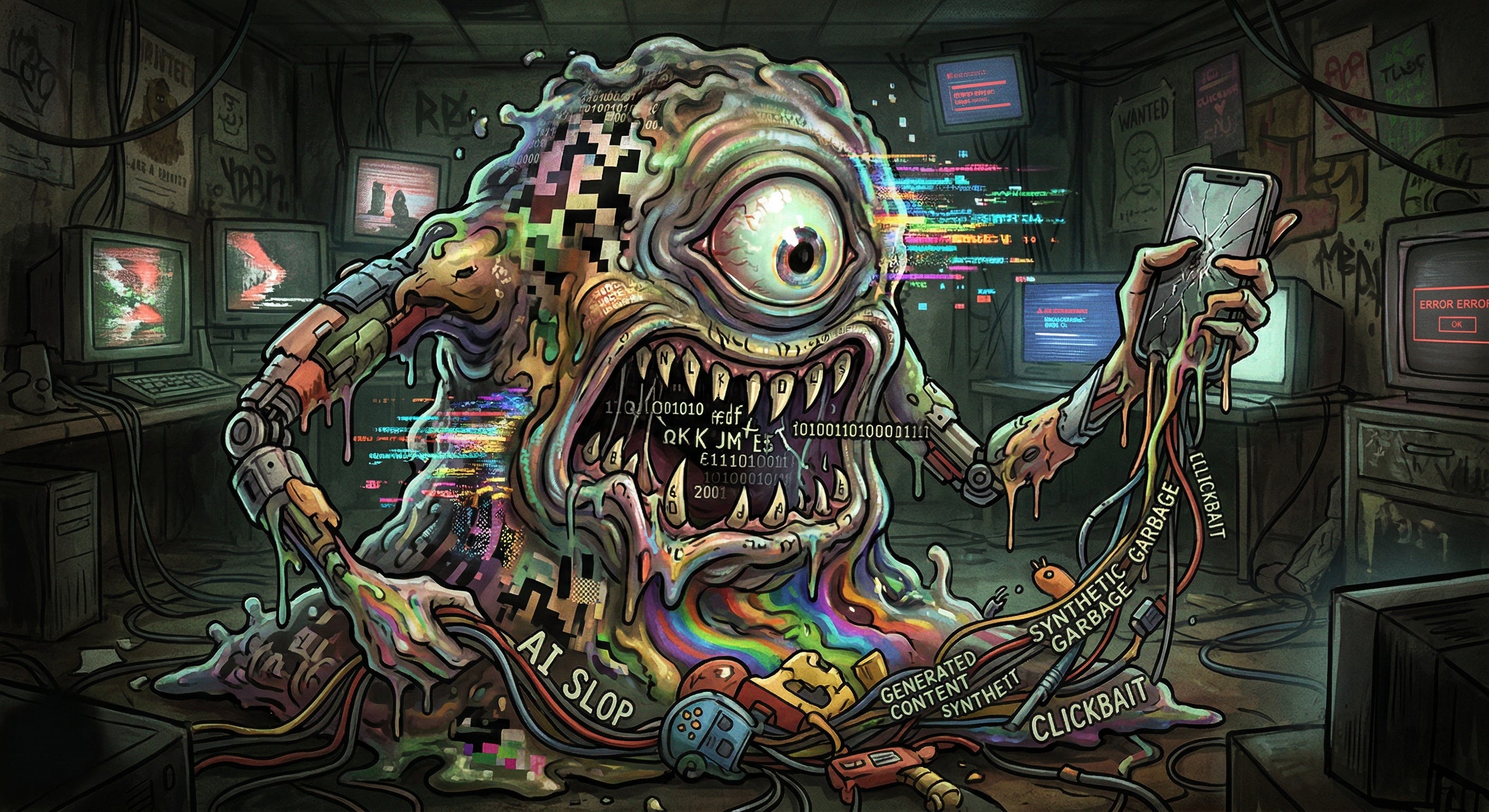
And buckle up, because it’s only going to get worse — in ways that are genuinely funny, until they’re not.
The Numbers Are Uncomfortable
Let’s start with the raw data, because sometimes you need a statistical gut-punch before the comedy can land.
74.2% of all newly created web pages in April 2025 contained detectable AI-generated content, per Ahrefs analysis of 900,000 pages.
50% of all English-language articles published on the web are now primarily AI-written, according to SEO firm Graphite’s study of 65,000 articles from 2020–2025.
75M+ spam tracks removed by Spotify in a single year — because yes, AI slop has learned to play guitar (badly).
9x increase in mentions of “AI slop” across the internet in 2025 vs 2024. Even our complaints are getting voluminous.
Back in late 2022, before the ChatGPT singularity, AI-generated content made up roughly 10% of online articles. By 2024, it had rocketed past 40%. It is now in majority control. The internet — that glorious, chaotic bazaar of human thought that once gave us Wikipedia flame wars, hand-coded GeoCities pages about pet iguanas, and someone’s grandmother’s actual lasagna recipe — is now majority machine.
Merriam-Webster named “slop” its 2025 Word of the Year. Australia’s national dictionary agreed. When the dictionary people start naming your problem, you have a problem.
The Cousin Problem
Here’s where we need to have a slightly uncomfortable family conversation.
You know how certain isolated mountain communities, or certain noble European dynasties (looking at you, Habsburgs), developed a fondness for keeping things in the family? The Habsburgs were so committed to bloodline purity that by the end, Charles II of Spain — the product of generations of cousin marriage — couldn’t chew properly, had a tongue too large for his mouth, and was reportedly unable to produce an heir despite repeated attempts. The gene pool, deprived of fresh input, had eaten itself.
“Training AI on AI-generated data causes irreversible defects in the resulting models, in which tails of the original content distribution disappear.” — Nature, 2024
This is precisely what is happening to AI models right now, and it has a delightfully clinical name: model collapse.
In July 2024, Oxford researchers Ilia Shumailov and Zakhar Shumaylov published a landmark paper in Nature showing that when AI models train on AI-generated content, they degrade. Not slowly. Not gracefully. They collapse. The model’s understanding of rare, nuanced, fringe ideas — the weird edges where all the interesting human thinking lives — simply evaporates. What’s left is a model that confidently generates the statistical average of everything it’s ever seen, which is now largely... other AI content.
New York Times reporter Aatish Bhatia illustrated this with a haunting demonstration. He fed an AI image model its own outputs across 30 generations. Generation 1: clear handwritten numerals. Generation 20: blurry smears. Generation 30: unintelligible noise. The machine had essentially stared at itself in the mirror so many times it forgot what a number looked like.
The Habsburg jaw of the internet, if you will.
Perhaps most alarming: a 2025 paper presented at ICLR (the Olympics of machine learning conferences) found that even a fraction of synthetic data as small as 1 in 1,000 training samples can trigger model collapse. You don’t need a majority of slop to poison the well. You just need a persistent trickle, and that trickle is now a Category 5 flood.
The Slop Taxonomy: It’s Everywhere
Text: The Original Sludge
We’ve covered the headline stats, but the texture of the slop matters. AI-generated content isn’t just proliferating — it’s actively impersonating legitimate sources. Per Reuters Institute reporting, Serbian entrepreneurs have been buying defunct news websites, filling them with AI-generated articles, and pocketing the ad revenue from audiences who haven’t noticed the original journalists left. NewsGuard tracked AI ‘news’ sites growing from 49 to 1,271 between 2023 and 2025. That’s a 2,494% increase in fake news sites, which is a sentence that would have seemed like satire five years ago.
Scientific peer review is also contaminated. Studies have found detectable AI language patterns infiltrating academic papers and their reviews. Science — the thing we built civilization on — is now partially written by a machine that confidently hallucinates citations.
Images: The Nightmare Fuel Gallery
Search Google Images for virtually anything now and you’ll find the uncanny valley has moved in, put down furniture, and started a podcast. AI-generated images flood stock photo sites, social media, and news aggregators. DuckDuckGo had to add a dedicated toggle to hide AI images because users were losing their minds. Pinterest and YouTube followed.
The art world has been particularly savaged. AI image generators trained on the work of living artists — without consent, without compensation — now produce endless derivative knock-offs that flood the same platforms those artists depend on for income. The machine ate their portfolio and is now selling forgeries of it.
Music: The Algorithmic Boy Band
Velvet Sundown — a “band” with no members, just a text bio describing them as a ‘synthetic music project’ — crossed one million monthly Spotify listeners in July 2025. Their debut album came out in June. The songs were generated in minutes.
On Deezer, which actually tracks this openly, over 20,000 fully AI-generated tracks were being uploaded per day by spring 2025, representing more than 18% of all new content. Spotify removed 75 million “spammy tracks” in a single year. Fake AI artists have even hijacked the profiles of deceased musicians — including electronic producer SOPHIE, who passed in 2021 — uploading fake new releases to confuse grieving fans and siphon streams.
When AI music farms start impersonating dead artists to steal royalties, we have crossed a moral event horizon that even the most optimistic techno-utopist should find troubling.
Code: The Bug Factory
GitHub is now swimming in AI-generated code repositories, many of which exist purely for SEO, for fake stars, or as resume padding. More disturbingly, open-source developers began reporting in late 2024 that they were drowning in AI-generated bug reports — fake issues, hallucinated error descriptions, and confidently wrong stack traces submitted by AI agents acting on behalf of users who couldn’t be bothered to actually read the error message.
The code that runs our infrastructure is increasingly written by models that learned to code by reading... other AI-generated code. The recursive stupidity of this is genuinely breathtaking.
The Algorithm Ate The Algorithm
Here’s the part where it gets philosophically interesting, or apocalyptically depressing, depending on your disposition.
The recommendation algorithms that govern what you see on TikTok, YouTube, Instagram, and Meta — the systems that determine whether a human creator building genuine craft gets shown to an audience or shouts into the void — were themselves largely designed and optimized using AI. And those AI-designed algorithms, optimizing for engagement and watch time, are increasingly indifferent to whether content is human or machine-made.
“2025 was the year where the algorithm completely took over, so followings stopped mattering entirely.” — LTK CEO Amber Venz Box, TechCrunch
The economics are now brutally clear. A solo human creator who used to spend 8 hours producing a YouTube video competes against an AI pipeline that produces 100 videos in that same time window. The algorithm doesn’t care which one you made with love and three takes of re-recording audio because your neighbor started mowing. It cares about volume, consistency, and engagement signals — all of which AI content can game at industrial scale.
Researchers at Fast Company found that AI adoption on major platforms follows a predictable pattern: a brief 3-4 month lag after each major AI model release, then a surge of AI content that floods the zone. And the content “constrains the creativity of humans,” as one researcher put it with admirable understatement.
Social media platforms built by engineers using AI coding tools, optimized by AI recommendation systems, are now being filled with AI content, consumed by users whose tastes are being shaped by AI-curated feeds. The humans in this loop are becoming optional.
Idiocracy Was a Documentary
In Mike Judge’s 2006 film Idiocracy, America in the year 2505 has become a society so profoundly incurious that the most popular TV show is called “Ow! My Balls!” and crops are irrigated with sports drinks because nobody questioned it. The smartest man alive is a cryogenically preserved Army librarian who was definitively average in 2005.
The film was presented as satire. We should perhaps revisit that classification.
Consider the knowledge feedback loop we’re now in. Students use AI to write essays, so they don’t develop the ability to construct arguments. They use AI to write code, so they don’t develop intuition for debugging. They use AI to summarize books they haven’t read, so they don’t build the contextual knowledge frameworks that make reading the next book faster and richer. And then those students become professionals, researchers, and policymakers who rely on AI tools trained on increasingly AI-generated data.
Each generation of AI models trained on the internet’s slop will be slightly less capable of nuanced reasoning, slightly more prone to confident averageness, slightly more allergic to the genuinely rare and weird ideas that drive human progress. Each cohort of humans who outsource their thinking to those models will develop slightly less capacity for independent cognition.
The models get blander. The humans get rustier. Round and round we go.
Model collapse isn’t just a technical problem. It’s a civilizational one.
The original internet was astonishing because it was a direct pipeline to human weirdness at scale. The person who spent 30 years developing an obsessive expertise in Byzantine coinage could finally find their 47 kindred spirits worldwide. The high school kid in rural Nebraska who taught herself cryptography from library books could publish her findings and get feedback from MIT professors. The grandmother with a genuinely perfect baklava recipe could share it with anyone who cared to look.
That content — quirky, specific, deeply human, occasionally wrong but always earnest — is what the early AI models trained on. It is the nutritional substrate from which these systems derived their apparent intelligence.
What are the next generation of models training on? Thousands of near-identical 1,500-word SEO articles about “the top 7 benefits of good sleep,” all written by GPT-4 in a content farm’s automated pipeline. Fake Spotify bands with algorithmically optimized track lengths. AI-generated stock photography of impossible people with extra fingers. Hallucinated academic citations that other papers will then cite.
It’s slop eating slop to produce slop. The food chain has no base.
The Platforms: Pouring Accelerant, Calling It Progress
In a functioning world, the major platforms would be screaming about this. Instead, Meta launched an app called “Vibes” — described earnestly by the company as a place to “create and share short-form, AI-generated videos, remix content from others, and explore a world of imaginative possibilities.” This is a company that had, weeks earlier, published guidance telling creators to focus on “authentic storytelling.” Meta’s ability to contradict itself without apparent awareness is, frankly, impressive.
Meanwhile, TikTok has labeled over 1.3 billion AI-generated videos and is testing tools for users to filter them — which begs the question of why it’s hosting 1.3 billion AI-generated videos in the first place.
YouTube, to its minimal credit, allows users to flag AI content and is developing disclosure requirements. But the incentive structure remains: the platform profits from watch time, and AI content can be manufactured to maximize watch time at a cost approaching zero. The financial logic of slop is impeccable.
The Brilliant Irony
There is one delicious twist in all of this that deserves savoring for just a moment before we return to the horror.
The major AI labs — OpenAI, Google DeepMind, Anthropic, Meta AI — aware of the model collapse problem, have been frantically licensing real human content. OpenAI signed a deal with News Corp. Google cut deals with Reddit. Everyone is scrambling for authentic, human-generated, pre-slop-era data because they know what happens when you run out.
The very companies that flooded the internet with AI content are now panicking that the internet is too full of AI content to train their next models. They created the problem. They are now paying a premium to solve the problem. And the solution — licensing deals with the media companies whose businesses were destroyed partly by AI disruption — is the kind of tragicomic ouroboros that could only exist in tech.
Rick Beato, the musician and YouTube educator, put it bluntly: he demonstrated on camera how to spin up a fake AI musical artist with a complete catalog in under an hour. Not to promote it, but to prove that anyone can, which means everyone will.
So What Now?
Let’s be honest: the people building these systems are very smart, and many of them genuinely understand the problem. Model collapse research is real. Data quality initiatives are underway. Some platforms are experimenting with disclosure labels and filters. Human-verified data is becoming more valuable.
But the economic incentives run the other direction, fast. AI content costs almost nothing to produce. Human content costs time, skill, and the slow accumulation of genuine expertise — none of which the current creator economy adequately rewards. Until that gap closes, the slop factory keeps running.
The researchers are right that accumulating real human data alongside synthetic data can mitigate collapse. The problem is that humans are generating proportionally less of the internet every quarter. The ratio of human-to-AI content is a one-way door and it is swinging shut.
The irony of ironies: the thing that would save AI from eating itself is humans continuing to create original, weird, specific, high-quality content. But the algorithms that AI helped build don’t adequately reward that content. So humans create less of it. So the models have less to learn from. So the models get worse. So the content gets worse. So humans create even less.
You will recognize this as a death spiral. You are correct.
A Modest Proposal
I want to be clear that I am not anti-AI. I have built AI-powered products, integrated AI into enterprise software, and written extensively about where AI genuinely creates value. The technology, correctly applied, is remarkable.
But the internet is the substrate of modern knowledge. It is where the next generation learns, where researchers build on each other’s work, where culture forms and debates happen and recipes get preserved. If we allow it to become a hall of mirrors — AI reflecting AI reflecting AI, each generation blurrier than the last — we are not just degrading a technology product. We are degrading the knowledge infrastructure of civilization.
The Habsburg jaw wasn’t just an aesthetic problem. It was a symptom of a system that had stopped allowing new information in. The inbreeding wasn’t happening because anyone was evil. It was happening because the incentive structure rewarded it.
Sound familiar?
So here’s the only request I’ll make: Create something. Write something that only you could write, from your actual experience. Make something weird and specific and real. Post it somewhere, even if the algorithm buries it. The models of 2030 will thank you, in whatever attenuated, collapsed way they’re still capable of expressing gratitude.
Because the alternative is Idiocracy — and unlike the movie, we won’t have a cryogenically preserved Army librarian to bail us out.
Gal Ratner is CTO of WhiteStar Labs, a Las Vegas-based enterprise software and AI consulting firm, and CTO of Prana Entertainment LLC. He writes about AI, software architecture, and the parts of the tech industry that refuse to be polite about.