



The headline practically wrote its own victory lap. Gallup ran the numbers on who is getting laid off in America, and only one percent of the people who lost their jobs pointed at artificial intelligence as the reason. One percent. You could feel the exhale ripple across LinkedIn. The skeptics took their lap. See? The robots aren’t coming. The hype was always hype. You can put the panic away and get back to doing your job the way you’ve always done it. I want to take that comfort away from you, gently and completely, because if that one-percent figure made you relax, you read the wrong line of the report.
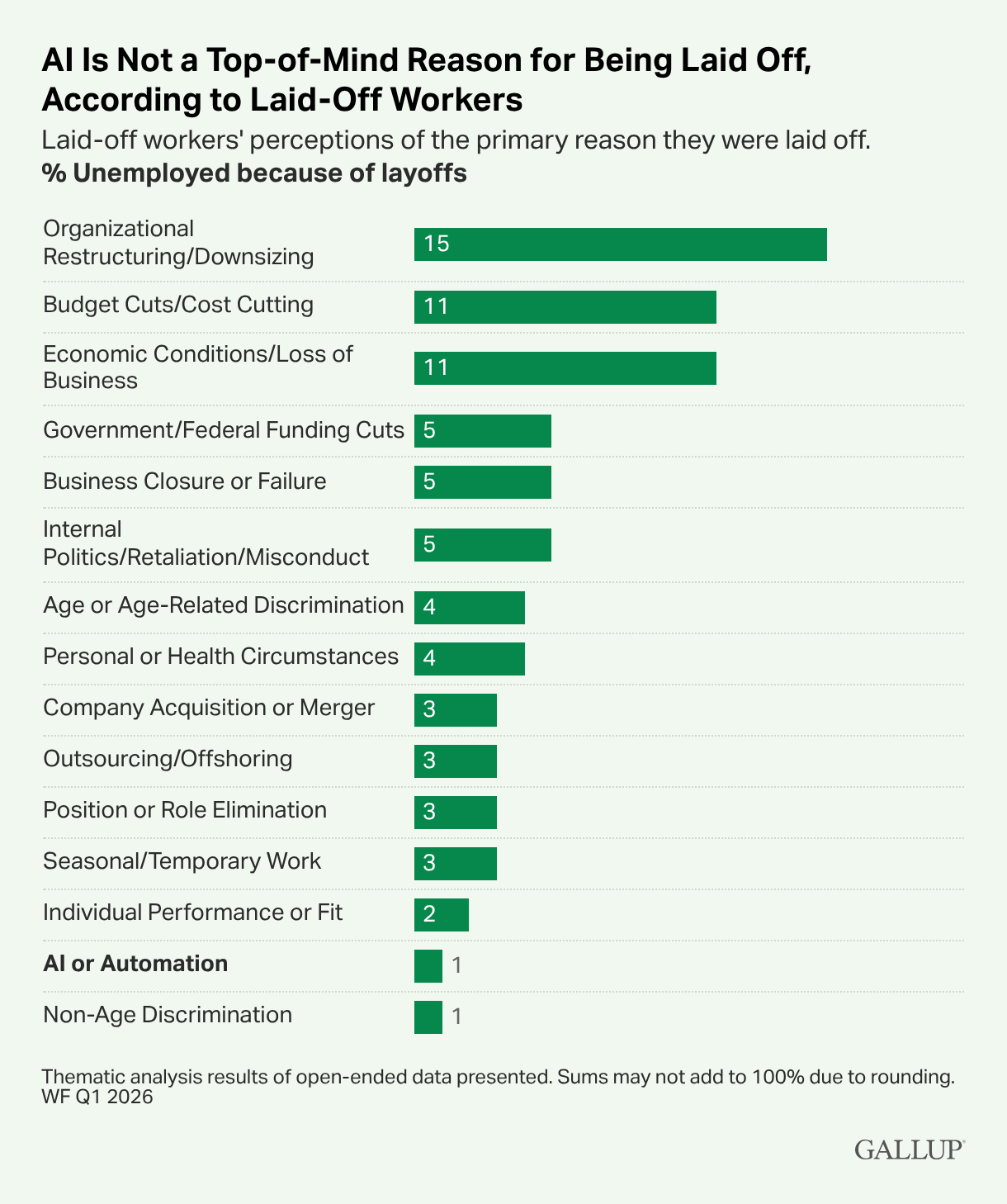
Let me start by being more generous to the calm crowd than they’ve earned. They are right about the surface of the data, and I’ll defend it. By any honest reading, AI is not currently walking into offices and torching jobs at scale. Gallup found that the share of workers who say their employer is shedding people leveled off in the first quarter of 2026 at around twenty-one percent, after nearly tripling between 2022 and the back half of 2025. More workers still say their company is hiring than say it’s cutting. In the raw federal numbers, March saw five and a half million hires against one point nine million layoffs and discharges. Hiring is outpacing firing in absolute terms, and has been for years. And when Gallup asked the people who were actually let go to name, in their own words, why it happened, almost none of them said anything about automation. One percent. I believe that number. I’ll go further: I’ll defend it against the doom-merchants who insist a machine is personally hunting them. It isn’t. Not like that.
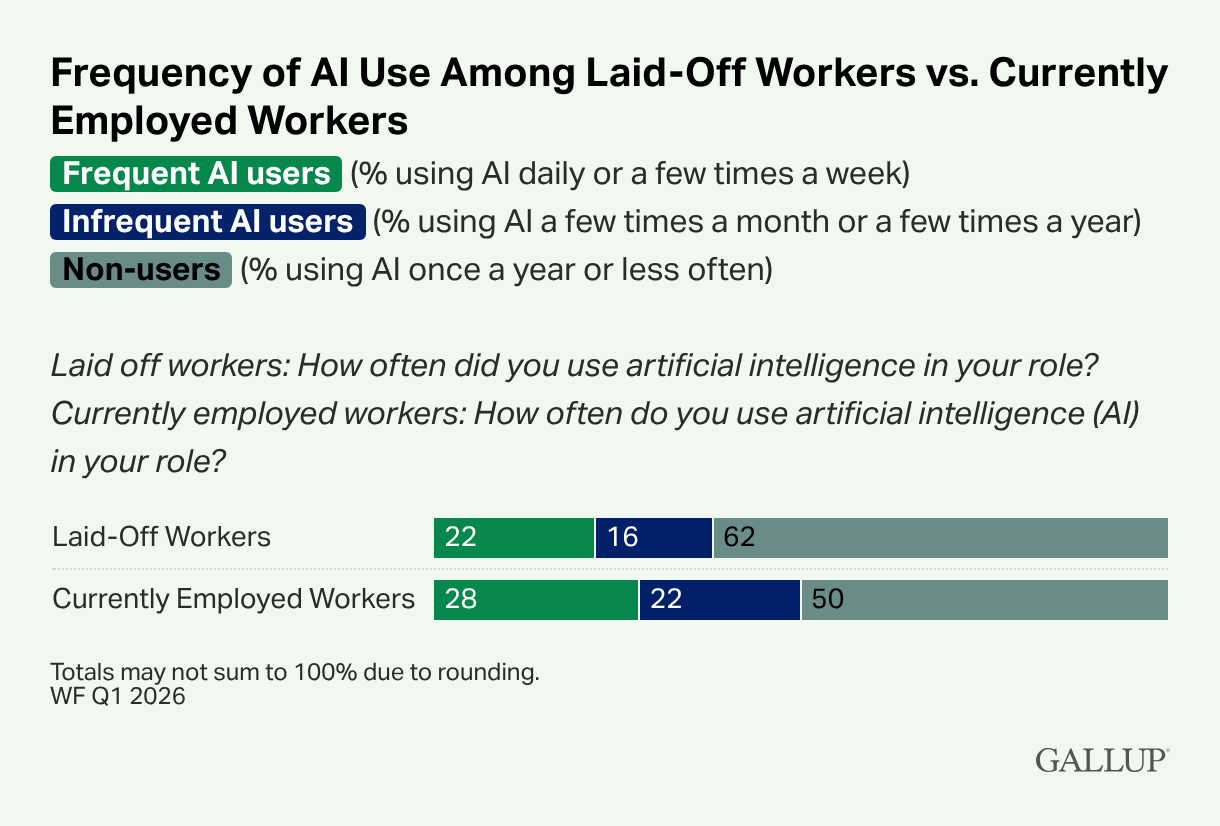
But sitting directly underneath that reassuring headline, in the same report, is a different number. It is the number that matters if you are the person reading this and quietly wondering whether you’re safe. Among the workers who got laid off, sixty-two percent were AI non-users — people who touch the tools once a year or less. Among the people who kept their jobs, that figure was fifty percent. And then, in my world, in technology, comes the line that should stop you cold: tech workers who used AI less than once a month in their actual jobs were three times as likely to have been laid off as the tech workers who used it at least monthly. Three times. Read it again and let it sit somewhere uncomfortable. Not three percent more likely. Three times more likely. Triple the odds, separating the people who opened the tools from the people who didn’t.
Now, the calm crowd will spot what looks like a contradiction and reach for it like a life raft. If only one percent were laid off because of AI, how can not using AI triple your odds of being laid off? The answer is the whole point of this essay, and it is the part the comfort-readers skipped right past. Nobody gets handed a separation letter that says, in the reason field, “AI.” They get “restructuring.” They get “cost optimization.” They get “your role has been eliminated.” They get “redundancy.” Those are the words ninety-nine percent of them used, because those are the words written on the paperwork. And every single one of those phrases is the AI story wearing a suit and tie. When one engineer with the right agent tooling quietly does the work that used to require three, the company does not issue a press release announcing it replaced two humans with software. It announces a reorganization. The two people who are now surplus are never told what made them surplus. Gallup says this itself, carefully, almost in a whisper — that explanations like restructuring and cost-cutting may reflect AI’s influence on internal decisions even when workers were not told. I’ll say the same thing without the cushion: you can be replaced by AI and have it called something else on your way out the door. The one-percent figure isn’t measuring how often AI takes jobs. It’s measuring how often the company bothers to tell you that’s what happened.
And it gets worse the more of yourself you recognize in the data. Twenty-five percent of the laid-off workers came from fully remote jobs, against thirteen percent of the people still employed — remote workers are showing up among the casualties at roughly double their share of the workforce. Tech workers are showing up at double their share too: thirteen percent of the laid-off came from the technology industry, against six percent of the employed. So picture the person sitting at the exact intersection of every risk vector in this dataset. A fully remote technology worker who doesn’t use AI. That person is not unlucky. That person is, statistically, the single easiest line item on a spreadsheet to delete — invisible to the office, redundant to the tooling, and producing at a pace the augmented coworker laps twice before lunch. If that description has your name on it, the report you read as reassurance was actually addressed to you, and it wasn’t reassuring at all.
And lest anyone file this under “interesting trend, I’ll keep an eye on it,” understand the timestamp. This is not a forecast about 2030. Eighty percent of the people Gallup counted as currently laid off lost their jobs in the past twelve months. Ninety-one percent within the past two years. This is not the future arriving on schedule; it is the present, already here, already sorting people. The reshuffling is happening at a scale most workers don’t feel until it reaches them — the same federal data showing those five and a half million hires also shows nearly two million separations every single month, an entire churning machine of jobs ending and beginning. The comforting way to read that churn is that there’s plenty of hiring. The honest way to read it is that the deck is being reshuffled constantly, and every reshuffle is a fresh chance for the org to decide that the augmented worker stays and the unaugmented one goes. You are not exempt from the churn. The only thing you get to influence is which direction it carries you.
Here’s where the careful reader pushes back, and they should, because I respect the pushback. This is correlation, not causation. Maybe the AI users just happen to be younger, or better educated, or working at healthier companies that weren’t cutting anyway. Maybe the tools are a marker of something else, not the cause of anything. Fair. Except Gallup got there first and closed the exit. They controlled for age. They controlled for education. They controlled for industry. They controlled for how long ago the layoff happened. And the pattern held through all of it. So the comfortable dismissal — that the AI users are simply the kind of people who keep their jobs anyway — doesn’t survive contact with the methodology. What’s left after you strip away the easy outs is genuinely unsettling: of every variable on that list, the one most completely within your control — whether or not you use the tools — is the one tracking with whether you kept your seat. You can’t make yourself younger. You can’t retroactively change your degree. But you can open the tools this afternoon. That’s what makes this finding different from the usual doom. It isn’t describing weather you have to endure. It’s describing a choice you’ve been making, possibly without realizing it was a choice.
Let me stop quoting Gallup for a minute and tell you what this looks like from inside the machine, because building these systems is what I actually do for a living. I ship agentic AI into production — not slideware, not a proof of concept that dies in a sandbox, the real thing, running against real workloads with real money on the line. I’ve watched what a well-built loop and a couple of good tool integrations do to a body of work that used to need a team and a roadmap and three standups a week. I know the arithmetic the executives are running, because I am frequently the person they hire to change that arithmetic. And I’ll tell you the uncomfortable truth from that seat: the math is not subtle anymore. When the augmented version of a role produces several times the output of the unaugmented version, the unaugmented version stops being a job and starts being a cost. No CFO needs an AI strategy memo to act on that. They just need a spreadsheet and a budget cycle. The worker who plants a flag and refuses to learn the tools is not taking a principled stand against the future. From where I sit, they’re volunteering to be the control group in an experiment whose results are already in.
Because this was never going to look the way the movies promised. There was never going to be a chrome robot walking into your cubicle and handing you a box. The real mechanism is quieter and a great deal more brutal. AI doesn’t replace you. It replaces the version of your job that took eight hours. If you are still doing that job the eight-hour way while the person two desks over does the same job in ninety minutes with an agent doing the grinding, you did not lose to artificial intelligence. You lost to a coworker who used it. AI just walked in and reset the clock that everyone’s output is measured against, and then it left the room. The people in this Gallup report who got cut weren’t beaten by a machine. They were beaten by the colleagues who picked the machine up first, and then the org chart did the rest.
Make it concrete, because abstractions let people off the hook. Two people do the same job — call it analyst, or developer, or marketer, the mechanism doesn’t care. The first one gets a request on Monday morning, opens a blank document, and starts the way they’ve started for fifteen years: research, draft, revise, polish, ship by Thursday. Good work. Honest work. The second one gets the same request, spins up an agent to do the research pass in minutes, drafts against it, spends the saved hours going deeper on the part that actually requires a human, and ships something sharper by Tuesday afternoon. Now run that difference across fifty requests a quarter. The first worker isn’t lazy or incompetent; by every standard that existed five years ago they’re a strong performer. But they are now producing a fraction of what the person beside them produces, for the same salary, and when the budget tightens, “strong performer by the old standard” is not a phrase anyone reads off a spreadsheet. The output gap is all that’s visible from upstairs, and the output gap is brutal.
And I know the objection forming, because I’m Gen X and I’ve heard myself think it. “I have twenty years of experience. They can’t replace that.” I have nearly thirty, and I’ll tell you plainly: experience is not a moat if the experienced person produces less than the augmented junior down the hall. The market has never paid you for your tenure. It pays you for your output, and tenure was only ever a proxy for output that the augmented twenty-five-year-old has just made cheaper to produce. The hard-won judgment is real and it still matters — but it matters as a multiplier on top of the tools, not as a substitute for them. Experience plus AI is the most dangerous worker in the building. Experience minus AI is a salary line with a target painted on it. The veterans who survive this stretch will be the ones who took everything they know and bolted it onto the new tooling. The ones who treat their experience as a reason they don’t have to learn anything are writing their own restructuring memo.
And before you reassure yourself that you’re already covered — that you asked a chatbot to rewrite an email last Tuesday, so surely you’re on the right side of the line — look at how Gallup actually draws it. A non-user is someone who touches these tools once a year or less. A frequent user is someone reaching for them daily or a few times a week. There is an enormous canyon between those two poles, and dabbling lives at the bottom of it. Occasionally pasting a paragraph into a chatbot and being mildly impressed is not the same thing as having rebuilt how you work around the tools, any more than owning a gym membership is the same thing as being in shape. The workers pulling ahead in this data aren’t the ones who tried AI once and found it neat. They’re the ones for whom it has become load-bearing — woven so far into the daily mechanics of the job that taking it away would visibly slow them down. If you can’t honestly say the tools are load-bearing in your week, you are closer to the non-user column than the comfortable story you’re telling yourself admits.
I understand why people dig in, by the way, because the resistance isn’t really about the tools. It’s about identity. If you’ve spent a career becoming genuinely good at something — if your skill is a source of pride and not just a paycheck — then a tool that lets a junior approximate your output in a fraction of the time feels like an insult, like the craft you bled for is being declared a commodity. Using it can feel like cheating, like admitting you needed a crutch. I get it. I felt a version of it myself. But the market has never once cared how you feel about the tools, and dignity has never appeared as a line in a budget. The engineers who survived every previous shift were not the ones who protected their pride; they were the ones who let the new thing make them dangerous and swallowed the brief indignity of being a beginner again. Pride is the most expensive thing you can carry into a transition like this one. It feels like principle. It costs like a layoff.
None of this is new, for that matter, except in its speed. There was a generation of professionals who decided the spreadsheet was a fad, that they’d keep their ledgers by hand because that’s how real accounting was done. There were people who refused to touch email, who had an assistant print their messages, who were certain the whole thing would blow over. There were managers who treated the internet as a toy unfit for serious business. Every one of them had experience. Every one of them had a reasonable-sounding case for waiting. And every one of them was quietly routed around by the colleagues who simply learned the new thing and got faster while they stood still. The technology changes; the pattern never does. The tools that feel optional and faintly embarrassing today are the baseline competence of tomorrow, and the people who treat the transition as someone else’s problem don’t get a vote on whether it happens. They only get to choose which side of it they’re standing on when it finishes.
There’s one objection I’ll grant real weight, because it’s true for a lot of people: some of you work somewhere that hasn’t approved the tools, or has actively banned them, and you feel like the choice was made for you. I hear that, and it’s a legitimate bind. But look closely at what the data is telling you even there. If your organization is the kind of place that’s still treating these tools as a liability to be locked down rather than a capability to be deployed, that tells you something important about how that organization is going to fare against the competitor that deployed them — and about how safe your seat is on a ship that’s choosing to row slower. The right response to “my employer won’t let me” is not to wait inside the building until the decision gets made for you a second time, the hard way. It’s to build the skill on your own, on your own projects, on your own time, so that you are fluent and obviously valuable on the day your current employer either changes its mind or runs out of road. Your career is not your company’s responsibility. It never was. The data just made that abstraction concrete.
And to the person whose plan is to wait — to let the tools mature, let the hype settle, adopt once it’s all a little more proven and a little less embarrassing — I’d point out that this plan has a hidden cost the spreadsheet has already started charging you. Adoption is not a switch you flip the morning you decide you’re ready. It’s a skill curve, and the people three desks over started climbing it months ago. By the time non-adoption shows up as a number in your performance review, it is not a gap you close in a weekend. The augmented worker isn’t just faster than you today; they’re compounding — every week of practice makes their next week faster still, while you hold steady at the eight-hour pace and call it caution. Waiting feels prudent. On the data in front of us, waiting is just non-adoption with better PR, and it lands you in exactly the same row of the spreadsheet, only later and with less time to do anything about it.
So no, I’m not here to tell you the machines won and you should despair. Despair is useless and, frankly, it’s the wrong read of the data. What this report actually did was draw a line straight down the middle of the workforce, and right now you are standing on one side of it or the other — not because of your age or your degree or your luck, but because of a habit you can change this week. The non-users in Gallup’s numbers weren’t cursed. They were unadapted, which is a fixable condition and a temporary one. That’s the good news hiding inside the scary news, and it’s the only news here worth acting on: the variable is yours. Open the tools. Use them today, on something real, and again tomorrow, and the day after, until reaching for them is boring and reaching past them feels strange. Become the person whose output is high enough that the next reorg lands on someone else’s desk — because make no mistake, it is landing on someone’s. The org charts are being redrawn right now, in budget meetings you’ll never be invited to, and the only open question in the whole Gallup report is whose name ends up in the deleted row. As of this quarter, the data has an answer, and it isn’t shy about it. If you’re not using AI, the smart money is on you. You have a little time to change the bet. I would not waste it relaxing about a one-percent number that was never the point.
About the Author
Gal Ratner is Chief Architect at Prana Entertainment and the founder and CTO of Inverted Software and WhiteStar Labs, a Las Vegas–based enterprise software and AI consultancy. He has spent nearly thirty years building production systems on the Microsoft and .NET stack for clients including Microsoft, Sony, Rockstar Games, 2K Games, Best Buy, and Allegiant Air, was employee number six at Break.com, and was a finalist for the Los Angeles Business Journal’s CTO of the Year. His current work is building agentic AI that actually ships — MCP servers, the Microsoft Agent Framework, SQL Server 2025 vector search, and the observability tooling that keeps it all honest in production. He writes about the gap between AI hype and AI reality from the only vantage point that matters: that of someone who builds the thing. When he isn’t shipping, he co-hosts the Edge Grip motorcycle podcast, trains Brazilian jiu-jitsu in Las Vegas, and is the author of the novel The Archive of Lost Suns. He is, by his own preferred description, the .NET AI guy that ships.