


There is a sentence founders have been hearing for two years, delivered with a sympathetic nod by investors who have already decided not to wire any money. The sentence is some version of “it’s a tough funding environment right now.” It is engineered to sound like weather — impersonal, temporary, nobody’s fault. Wait it out. Build a little more. Come back when the climate improves.
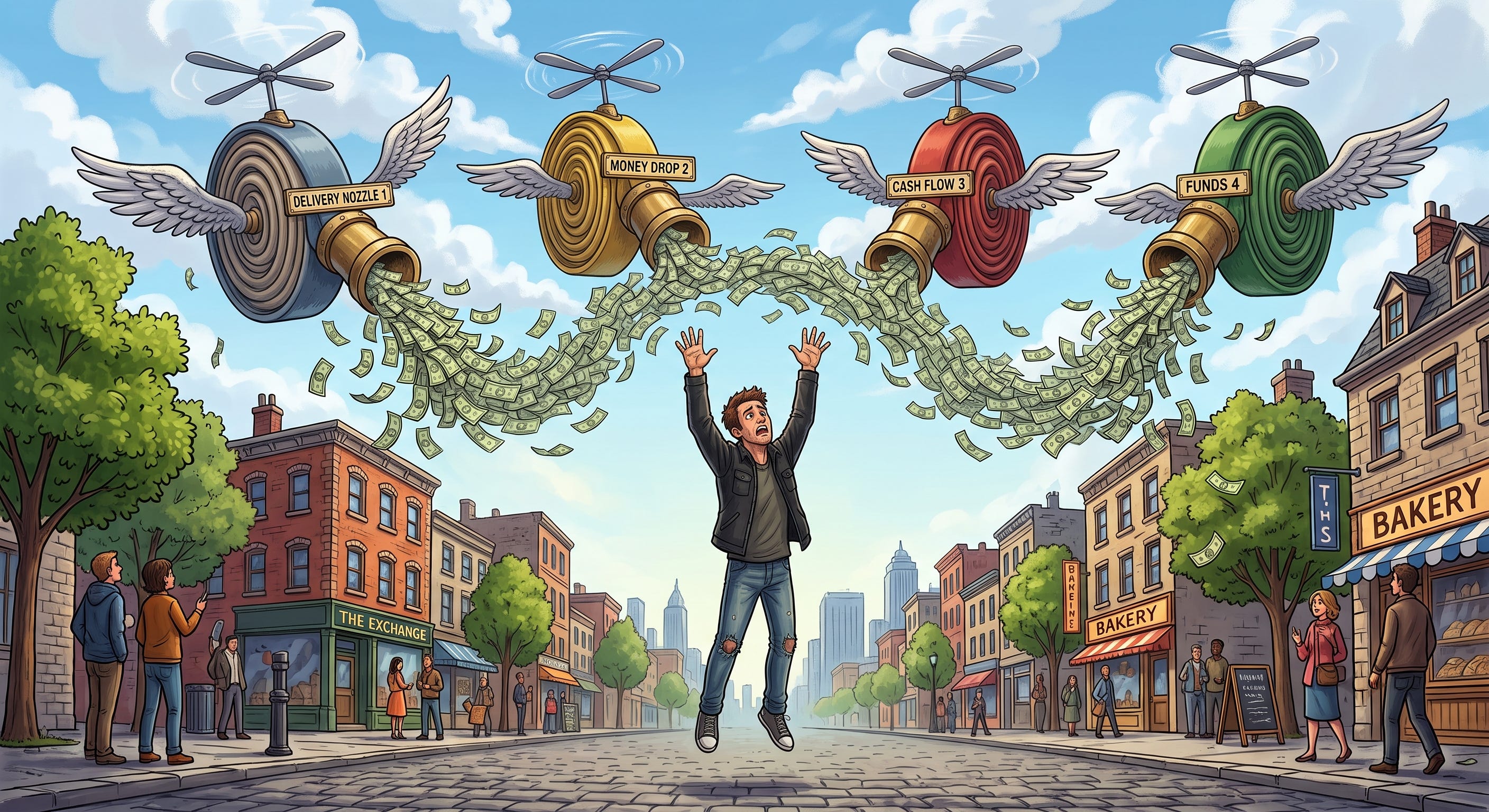
It is the most expensive lie in technology, and the data to disprove it is not subtle.
The funding environment is not tough because the money left. The money has never been larger. In the first quarter of 2026 alone, global venture investment reached roughly $297 billion by Crunchbase’s count, and $330.9 billion by KPMG’s — the largest single quarter in the history of the asset class, more than ten times the peak quarterly investment of the dot-com bubble, and more than double the previous record set during the zero-interest-rate mania of early 2022. That one quarter deployed close to seventy percent of all the venture capital invested in the entire prior year. There is more dry powder, more institutional appetite, and more money chasing private technology than at any moment in human history.
And you still can’t raise. Both of those things are true at the same time, and the relationship between them is the only thing about the capital markets worth understanding right now.
A record that hides a famine
The headline number is a magic trick, and the trick works because almost nobody reads the second line. Yes, $297 billion went into startups in a single quarter. But the number of deals fell. The record was built entirely on the size of a handful of rounds, not on the breadth of the ecosystem — fewer companies raised, and the ones that did raised at a scale with no precedent. The dot-com peak, for all its excess, was thousands of modest rounds spread across a sprawling ecosystem. The 2026 record is the opposite: a tiny number of extraordinarily large checks, sitting on top of a market that is, by deal count, contracting.
Strip out artificial intelligence and the picture inverts completely. With roughly eighty percent of all venture dollars flowing to AI, the fifty-odd billion left over was divided among every fintech, biotech, climate, consumer, and enterprise software company on the planet. Adjusted for inflation, the capital available to a non-AI startup in the first quarter of 2026 was smaller than it was in the first quarter of 2020 — before the pandemic, before the boom, before any of it.
Read that twice, because it is the whole essay. Aggregate venture funding at an all-time record. Money available to an ordinary founder below where it sat six years ago, in real terms. The record and the famine are not a contradiction. They are the same fact viewed from opposite ends.
Four companies, two-thirds of the money
Where did it go? It went to almost nobody.
In the first quarter of 2026, four companies — OpenAI, Anthropic, xAI, and Waymo — raised a combined $188 billion. That is not four percent of global venture investment, or fourteen, or thirty. It is roughly sixty-five percent. Two-thirds of every venture dollar invested anywhere on Earth, across every sector and every geography, went to four companies, all American, all clustered within a few miles of each other in the Bay Area. OpenAI alone raised $122 billion in a single round, the largest private financing in history. Anthropic took $30 billion. xAI, $20 billion. Waymo, $16 billion.
Pull the lens back to the full year and the concentration is only marginally less violent. The OECD pegged AI at sixty-one percent of all global venture capital in 2025, a share that climbed to roughly eighty percent by the first quarter of 2026. Across the entire Forbes AI 50 — the fifty most-funded private AI companies in the world — OpenAI and Anthropic between them hold about eighty cents of every dollar the whole cohort has ever raised. One quarterly dataset found the top ten deals captured more than half of all disclosed capital, the top fifty captured more than two-thirds, and everything from pre-seed through Series A — the entire on-ramp where new companies are supposed to be born — produced nearly half of all the deals but collected just seven and a half percent of the money.
This is not a venture market in the sense the word has carried for forty years. Mike Volpi of Index Ventures put it to Bloomberg about as plainly as a partner at a major firm is willing to: a handful of companies are raising rounds that look more like sovereign debt issuances, everyone else is fighting over a shrinking pool, and the middle has been hollowed out.
The hollowing
You are the middle. So am I, and so is nearly everyone reading this.
The hollowing is not an abstraction in a spreadsheet; it is showing up in the texture of every fundraise that is not a frontier lab. Seed deal count is down even as seed valuations climb, because the moment a larger firm decides it wants a round, the smaller funds get priced out — Carta’s data shows it, and every seed investor I know feels it. The average gap between a seed round and a Series A has stretched to something like six hundred and sixteen days, nearly two years of runway you now have to manufacture before the next check arrives. The bar for a Series A has hardened into a demand for one to three million dollars of recurring revenue, a threshold that would have been a respectable Series B a decade ago. The “potential” pitch that built half the companies you have heard of is dead; in 2026 you bring repeatable revenue or you bring nothing.
The word “seed” has stopped meaning anything at all, which tells you how badly the distribution has broken. The same label now describes a two-million-dollar first check for a founder building in a garage and a six-billion-dollar “seed” round for a frontier lab that has not shipped a product. When a single stage label spans four orders of magnitude, it is no longer a stage. It is a caste system wearing the vocabulary of a meritocracy.
And the pain is not evenly distributed even among the survivors. The software companies that raised Series B rounds in 2023 and 2024 — good companies, real customers — are discovering that the follow-on capital they assumed would be waiting has been redirected, and they are quietly extending runway, freezing hiring, and rewriting their decks while AI agents threaten to automate the very workflows they sell. Biotech, a sector that has nothing to do with the AI trade and everything to do with curing disease, is on track to record its lowest number of first-time financings of the entire decade. First-time founders without a Bay Area network are the most frozen out of all, because when checks get bigger and rounds get faster, capital flows along existing relationships, and a stranger with a better product loses to an acquaintance with a worse one.
None of this is a cyclical dip. It is a structural reallocation, and to understand why it will not simply revert when the Fed cuts rates, you have to follow the money to where it actually went.
The closed loop
Here is the part the founder rarely sees, because the founder is staring at the wrong number. You think you are competing with other startups for a slice of a fixed venture pie. You are not. You are standing outside a closed financial loop that has quietly absorbed the investable capital of the entire economy, and the loop does not have a door for you.
Start with the most visible node. In June of 2026, Alphabet — a company sitting on roughly $127 billion in cash and generating $174 billion in annual operating cash flow — priced $84.75 billion of equity in a single offering, the largest in the history of American corporate finance. It did not need the money in any ordinary sense; it could have written the check off its own balance sheet without noticing. It raised it anyway, because the capital expenditure it has committed to — $180 to $190 billion in 2026 alone, with management promising more in 2027 — has grown so large that even Google’s cash machine can no longer comfortably feed it. The most telling detail in the entire offering was the anchor: a $10 billion private placement from Warren Buffett’s Berkshire Hathaway, the most famously technology-averse pool of capital on Earth, buying into the largest AI infrastructure buildout in history.
Now widen the frame. Alphabet’s raise is one node in a system. The five largest hyperscalers are on track to spend somewhere between $600 billion and $900 billion on capital expenditure in 2026, the overwhelming majority of it on AI compute, data centers, and the Nvidia silicon inside them. To fund it, they have turned from cash-rich balance sheets into serial issuers of debt — more than a hundred billion dollars of corporate bonds in 2025 alone, against an average of less than thirty billion a year in the years before, with projections of more than a trillion dollars of issuance still to come.
And the frontier labs that took two-thirds of all venture capital? They are the customers. They raised that money in order to spend it renting the compute the hyperscalers are building. The loop closes on itself: sovereign wealth funds and corporate strategics write enormous checks to OpenAI and Anthropic and xAI; the labs hand that capital to the hyperscalers in exchange for GPUs and data-center capacity; the hyperscalers hand it to Nvidia; the soaring valuations of Nvidia and the labs justify the next round of checks. When OpenAI raised its $122 billion, the money came from Amazon, from Nvidia, from SoftBank — the same companies that sell into, build for, or compete within the very loop the capital is funding. Traditional venture funds, even the ten-billion-dollar giants, no longer have the balance sheet to anchor a thirty-billion-dollar round, so the capital increasingly arrives from nation-states: Singapore’s GIC and Temasek, the Qatar Investment Authority, Saudi Arabia’s Public Investment Fund, Abu Dhabi’s Mubadala and MGX. The kingmakers of the technology economy are now sovereign governments, and they are not funding your developer-tools startup.
This is why the drought will not lift on schedule. The capital has not been parked, waiting for rates to fall and confidence to return. It has been committed, structurally, to a self-reinforcing circuit of a dozen giants financing each other’s bet on a single technology. You are not early in a down cycle. You are outside a cartel of capital that has more money than ever and has already decided, to four decimal places, who is allowed to have it.
“But this is just a healthy cleanup”
The honest counterargument deserves a hearing, because there is a version of all this that is benign. The bull case runs like this: the non-AI drought is not AI’s fault at all. It is the long-overdue hangover from the zero-interest-rate insanity of 2021, when money was free and any deck with a pulse could raise a seed round. What looks like a famine is really a cleanup — the weeding-out of speculative junk, the return of discipline, the healthy reassertion of the principle that a startup should solve a real problem for real customers who pay real money. Investors are not starving good companies; they are finally refusing to fund bad ones. Buzzwords no longer buy a check. This, the argument concludes, is exactly what a maturing market is supposed to look like.
Some of that is true, and any founder pretending the 2021 vintage was not bloated with nonsense is not worth listening to. But the discipline story cannot explain the central fact, and it is worth being precise about why. Discipline tightens the bar; it does not shrink the pool. If the market were merely getting choosier, you would expect total non-AI funding to hold roughly steady while quality rose and the worst companies were cut. That is not what happened. Non-AI venture funding fell below its real-terms level of 2020 — below the pre-pandemic baseline — in a quarter when aggregate venture funding set an all-time record. A market does not accidentally route record capital past every sector except one and call the result discipline. That is not a cleanup. That is a reallocation, and the thing it reallocated toward is the loop.
The cruelest part
There is one more turn to this, and it is the part that should worry even the people inside the loop.
Notice that the same companies pouring nearly seven hundred billion dollars into AI infrastructure are, in the same breath, cutting tens of thousands of jobs. More than half of the layoff events tracked in 2026 cite AI as the reason, even as the firms doing the cutting commit fortunes to building it. That is not a productivity story; it is a capital-reallocation story, and “AI” has simply become the cleanest word to put in a press release. Capital is being pulled out of labor and out of every business that runs on labor, and redirected into hardware. The drought you feel as a founder and the layoffs your friends are living through are the same money, leaving the same place, heading to the same destination.
And now suppose the bet is wrong. Suppose the returns do not arrive on the schedule the spending requires. Then the world will have done something genuinely historic: it will have reallocated the investable capital of an entire generation — the money that would have funded ten thousand ordinary businesses, the next decade of biotech and fintech and climate and the unglamorous software that actually runs the economy — into a pile of depreciating hardware.
And the hardware depreciates fast. The hyperscalers planned to add something like two trillion dollars of AI assets to their balance sheets by 2030. Those assets lose value at roughly twenty percent a year, which implies an annual depreciation expense on the order of four hundred billion dollars — more than the combined profits of all five hyperscalers in 2025. The physical world is already pushing back: Microsoft has been sitting on something like eighty billion dollars of cloud orders it cannot fill, not because demand is soft but because it cannot get enough electricity to power the GPUs already sitting in its warehouses. The capital is being spent faster than the grid can absorb it and faster than the revenue can justify it, and the gap between what AI is costing and what AI is earning is widening, not closing — which is precisely the moment the markets have started, quietly, to notice.
So here is the full shape of it. If the bet pays off, a dozen companies will own the future and the rest of the economy will have been starved to build it. If the bet does not pay off, the rest of the economy will have been starved to build a generation’s worth of obsolete data centers. There is no version in which the ordinary founder — the one being told to wait out the weather — comes out ahead. The weather metaphor was never accurate. Weather is something that happens to everyone. This is something being done to most of us, on purpose, to fund a few.
What to actually do
I am not going to end this with encouragement, because encouragement is what the people who will not fund you offer instead of money, and you have had enough of it.
Here is the clear-eyed read instead. If you are building outside the loop, stop measuring yourself against the loop. The return bar that institutional capital is using right now was set by companies raising sovereign-debt-sized rounds against the most aggressive growth narrative in the history of markets, and you will lose that comparison every time, because it was never a comparison you were meant to win. Your advantage is the one thing the loop cannot have: you can build a real business, with real margins, that does not need to raise thirty billion dollars to survive the year. Capital efficiency stopped being a virtue investors politely admired and became the only moat that is actually yours. Build the painkiller, not the vitamin. Get to revenue that does not depend on a follow-on check that may never come. And if you build on AI — most of us should — build across providers and own no API but your own, because the labs that captured the world’s capital intend to extract it back through pricing power, and single-vendor dependency is how you quietly become someone else’s margin.
Then drop the lie. You are not in a tough funding environment. You are in the most capital-rich environment ever recorded, locked out of it by a structural concentration that no amount of patience will dissolve. Knowing the difference will not get you funded. But it will stop you waiting for a season that is not coming, and it will point you at the only game still open to you — which is to build something so undeniable that even a captured market has to make room.
The money never left. It just stopped being yours. Plan accordingly.
About the Author
Gal Ratner is the founder and CTO of Inverted Software and WhiteStar Labs and Chief Architect at Prana Entertainment, a Las Vegas–based enterprise software and AI consultancy. He has spent nearly thirty years shipping production systems on the Microsoft and .NET stack for clients including Microsoft, Sony, Rockstar Games, 2K Games, Best Buy, and Allegiant Air, with deep fintech experience across PCI-scoped payment systems, tokenized vaults, and high-volume transaction infrastructure. He was employee number six at Break.com and a finalist for the Los Angeles Business Journal CTO of the Year.
His current work centers on agentic AI in production — MCP servers, the Microsoft Agent Framework, SQL Server 2025 vector search, RAG pipelines, and the PLogger observability framework. He writes adversarial, practitioner-first commentary on the economics and engineering of the AI buildout, and brands himself, with cause, as the .NET AI guy that ships. Through Inverted Software, he helps companies design and ship agentic AI systems that survive contact with real production load rather than dying in a slide deck. More of his writing and work is at galratner.com.