


Open Indeed on your phone. Search software developer. Tell me what you see.
If you are anywhere in California, you will see DataAnnotation. Then DataAnnotation. Then DataAnnotation again. Sometimes the listing is labeled Software Developer – AI Trainer. Sometimes it is Contract Mobile App Developer – AI Trainer. Sometimes it is Staff Software Engineer – AI Trainer. The job title rotates. The employer never does. The hourly band is always fifty to one hundred dollars. The pill always says Hourly pay. The badge always says Flexible schedule. Indeed itself, scrolling further down the page, surfaces an automated boilerplate disclaimer: We have removed thirty-two job postings very similar to those already shown. Search Austin and the number is thirty-two. Search San Diego and the number is eighteen. The number is never zero. The platform that everyone uses to measure tech hiring is silently deduplicating thousands of near-identical postings from a single company, and the postings keep coming.
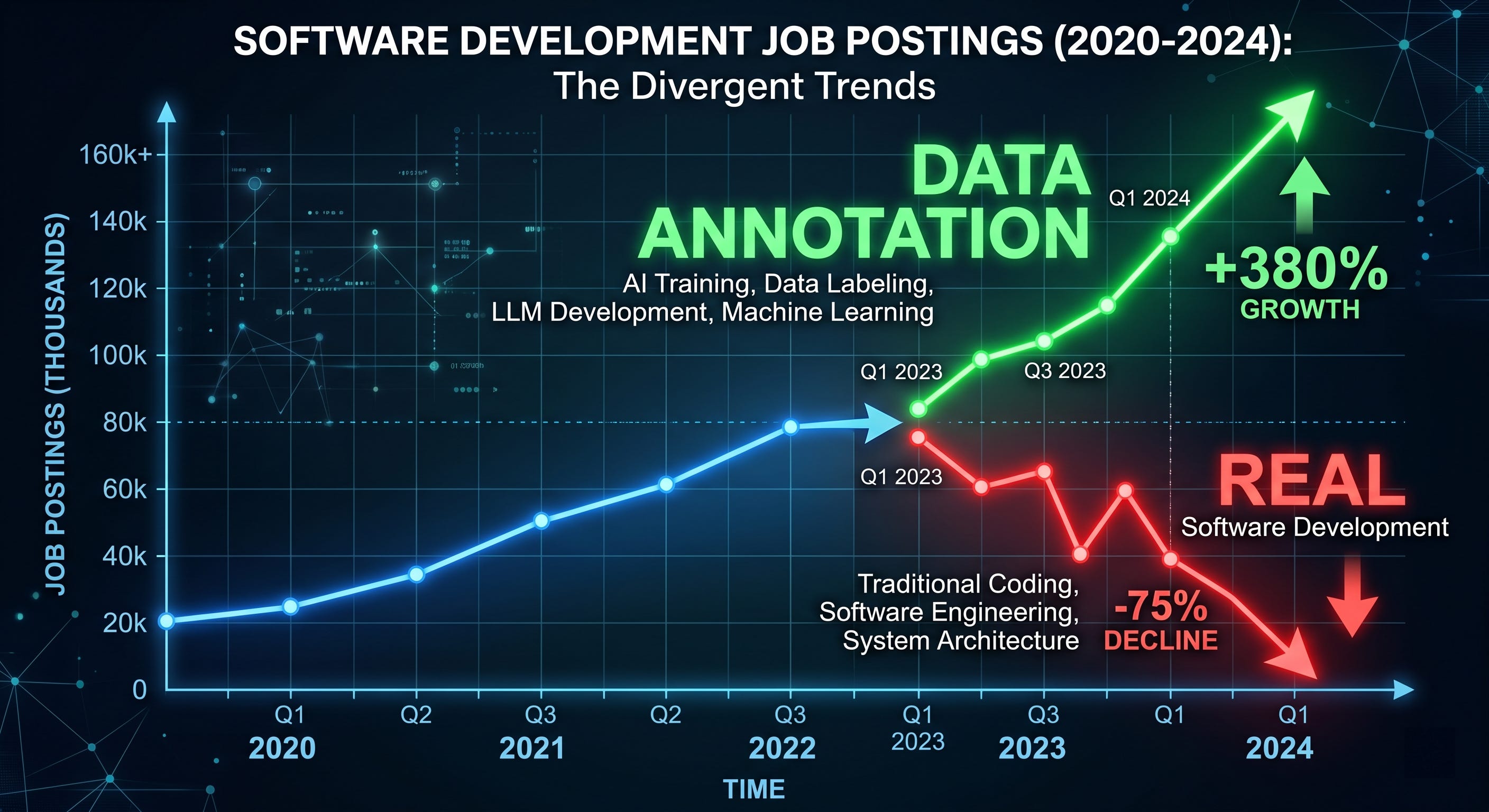
DataAnnotation is not a software engineering employer. It is a gig contract platform. It is a wholly owned subsidiary of Surge AI, the San Francisco data labeling company that, by Forbes’ 2024 estimate, generated more than 1.2 billion dollars in revenue training models for Anthropic, OpenAI, Microsoft, and Google. The DataAnnotation pitch is that you, an unemployed software engineer with twenty years of production experience, can earn forty dollars an hour grading chatbot output and writing example code that will become training data for the very model that took your last full-time role. DataAnnotation’s own marketing copy claims more than one hundred thousand contractors in its pool. Surge has been sued, in a 2025 class action, for deliberately misclassifying these contractors as independent workers and withholding benefits and wages. Account terminations are routine, opaque, and unappealable. There is no advancement. There is no benefit package. There is no full-time role at the end of the funnel. There is only the next task in the queue.
When a journalist writes that tech hiring is rebounding because Indeed postings are climbing, this is what they are actually looking at. A single Surge AI subsidiary, posting and reposting variations of the same gig contract across every metro in the country, in such volume that Indeed itself has to silently collapse it before the page becomes unusable. That is the recovery. There is nothing else underneath it.
The macro numbers say so cleanly. Indeed publishes its own hiring index to the Federal Reserve Economic Database under the series identifier IHLIDXUSTPSOFTDEVE. It is indexed to one hundred at February 1, 2020, the pre-pandemic baseline. At the peak of pandemic hiring, on February 28, 2022, that index hit 233.93. As of April 24, 2026, the same series reads 73.08. Software development postings are now twenty-seven percent below the pre-pandemic baseline and sixty-nine percent below the pandemic peak. Indeed Hiring Lab’s own October 2025 report had the same series at thirty-six percent below pre-pandemic and down 6.7 percent year over year, and called software development one of the hardest-hit occupational categories on the platform. That is Indeed’s data describing Indeed’s listings. The instrument that the press uses to measure tech demand is telling anyone who reads it that the market is at its weakest point in five years and has not recovered.
Lightcast, which scrapes job postings across the broader internet rather than just Indeed, reports that entry-level software engineering postings dropped sixty-five percent between January 2022 and January 2025, while the number of computer science graduates entering the market increased forty percent over the same period. So the supply side is up forty. The demand side is down sixty-five. The Pragmatic Engineer ran the same exercise on FRED in early 2025 and concluded that software developer postings on Indeed had fallen further and faster than any other tracked sector, more than banking, more than marketing, more than hospitality. That is the chart of the actual crisis, and the chart of DataAnnotation gig postings is the small green decoration on top of it that lets people pretend the crisis is not happening.
The employers themselves are not even being subtle about it anymore. Marc Benioff told CNBC in a 2025 interview that Salesforce reduced its support headcount from nine thousand to roughly five thousand because AI is now handling routine conversations, and that Salesforce hired zero new engineers in fiscal year 2026. Zero. From a company that, four years ago, was running fifty pages of open engineering requisitions at any given moment. Microsoft cut roughly six thousand jobs in May 2025 and another nine thousand in July 2025, more than fifteen thousand in a single calendar year. Amazon announced fourteen thousand corporate role eliminations in late October 2025, taking an estimated 1.8 billion dollars in severance charges. SignalFire’s 2025 State of Tech Talent report, built from a dataset of more than six hundred and fifty million professionals, found that new-grad hiring at Big Tech is down more than fifty percent from 2019 levels, and that new graduates now account for only seven percent of Big Tech hires, down from thirty-two percent in 2019. That entry funnel is not narrowed. It is closed.
Stanford’s labor study published in 2025 found that early-career workers in AI-exposed occupations saw a thirteen percent relative employment decline since late 2022, with software developers aged twenty-two to twenty-five falling nearly twenty percent from peak. The Federal Reserve Bank of New York’s analysis of 2023 Census data, published in early 2025, shows that recent computer science graduates carry an unemployment rate of 6.1 percent, and recent computer engineering graduates 7.5 percent. Computer engineering is now the third worst-performing major in the entire country by employment. Art history graduates are at three percent. A child who graduated with a degree in art history in 2023 is more than twice as likely to have a job today as a child who graduated with a degree in computer engineering in 2023. That is not a setup for a punchline. That is the labor market that the learn-to-code generation walked into.
Behind every one of those statistics is a person who quietly emptied a savings account.
Fortune profiled an engineer who goes by Shawn K, twenty years of production experience, computer science degree, last salary one hundred and fifty thousand dollars. He was laid off in April 2024. By the time the article ran in May 2025, he had submitted eight hundred applications and gotten fewer than ten interviews, some of them with AI agents instead of humans. He was living in an RV trailer, DoorDashing, and selling household items on eBay to make rent. I feel super invisible, he told the reporter. I feel unseen. He had survived the 2008 layoff round. He had survived the pandemic layoff round. He could not survive this one because this one is not a downturn. This one is a structural elimination, and it does not run on a recovery cycle. There is no other side of it to reach.
Manasi Mishra, twenty-one, graduated from Purdue with a computer science degree in May 2025. She had been writing webpages since elementary school. She took advanced computing classes in high school. She did everything the learn-to-code generation was told to do. After a year of applying, she had received exactly one interview call, from Chipotle, which she did not get. She told the New York Times in a TikTok video that went viral, I just graduated with a computer science degree, and the only company that has called me for an interview is Chipotle. She eventually pivoted into tech sales after building a beauty influencer following on TikTok. She has never written production code at any company, and now she likely never will.
Zach Taylor, twenty-five, graduated from Oregon State in 2023. He spent his high school years programming his own computer games. By the time the Times wrote about him, he had submitted five thousand seven hundred and sixty-two applications. Thirteen interviews. Zero offers. Desperate for any income, he applied to a local McDonald’s, which rejected him for lack of experience. Read that twice. A computer science graduate of a state engineering school could not get hired at McDonald’s because he had spent the time he was supposed to be flipping burgers learning how to write software, and the software industry no longer wanted him.
There is a software engineer who has been writing a Substack under the name Spike since he was laid off in late 2024. His most recent two posts before the writing of this article are titled I’m Close to Giving Up: Eight Months and 1,200 Job Applications Later, I’m Still Unemployed, and My Life Has Gotten Fucked Into a Cocked Hat: After Five Months of Searching I’m Still Unemployed. Those are the actual titles, in his own words. The 1,200 applications post went up in July 2025. The one after it, in October 2025, is named So Here I Am, and it opens with the line, Hey, I’m not unhappy. Let’s see how long that will last. That is the part of the despair that does not show up in any unemployment chart. The acclimation. The flattening. The way a person stops counting because the counting has stopped meaning anything.
The Blind boards, which require corporate email verification to post, are full of these stories. One engineer with six years of experience writes that he is at more than one thousand applications without a callback. A two-and-a-half-year Adobe veteran writes that he filters his inbox by the word unfortunately and gets over a thousand results in two months. A laid-off Meta engineer is at one hundred and fifty applications and two callbacks, one of which insta-rejected him after the recruiter screen. These are not bootcamp graduates with thin resumes. These are pedigreed engineers from Meta, Adobe, Atlassian, Microsoft, with multiple years of shipped-product experience, and they are getting nothing. The thread titles get bleaker the longer you scroll. Is a career break suicidal right now. Should I still live this life. I need help.
The structural reasons are worth naming because they are not going away.
The first is Section 174 of the United States tax code, amended in the 2017 Tax Cuts and Jobs Act and taking effect for software engineering salaries in 2022. It eliminated the ability of companies to fully deduct domestic software engineering salaries in the year they were paid, and instead forced amortization over five years. The result is that hiring a software engineer in the United States became roughly twice as expensive in cash flow terms, while hiring one in India or Brazil remained fully deductible under separate treatment. The chart of United States software engineering postings on Indeed begins its collapse exactly when this provision took effect. The Pragmatic Engineer documented the correlation in detail in 2025. Australian software engineering postings are the only ones in the developed world that did not fall, because Australia did not change its tax treatment. Every country that did change it saw a similar drop.
The second is AI productivity, real or claimed. Companies have decided, on the basis of a billion-dollar GitHub Copilot marketing campaign and a handful of cherry-picked productivity studies, that one senior engineer plus AI tooling can replace three junior engineers. A METR study published in 2025 found that AI tools actually decreased productivity by nineteen percent for experienced developers, contradicting the industry hype. It does not matter. The decision has already been made above the engineering organization, in the chief financial officer’s office, and the junior roles are not coming back. Dario Amodei, the chief executive of Anthropic, told the Council on Foreign Relations in 2025 that AI will be writing ninety percent of code by September 2025 and essentially all of it by mid-2026. Whether that is technically true is irrelevant to a hiring manager who has been ordered to cut headcount by thirty percent and is now choosing which of his juniors to keep.
The third is wage arbitrage. The companies that used to hire American engineers because there was no other choice now have a fully functional, fully remote talent pipeline from India, Brazil, Eastern Europe, and the Philippines that delivers equivalent output at thirty to forty cents on the dollar. Boundev’s 2026 market report puts the offshore savings at up to sixty percent versus United States domestic rates. Once a company has set up the offshore stack, the marginal cost of hiring an American engineer has to clear a much higher productivity bar to justify itself, and most of the time it does not.
The fourth is what the Times called the AI doom loop. Applicants use AI tools to generate hundreds of customized resumes and submit them at scale. Companies use AI tools to screen and reject them at scale. The result is a closed-loop system where a human candidate may never touch a human reviewer at any point in the process. The Fortune story on Shawn K specifically mentions interviews where the interviewer was an AI agent. The Blind threads are full of accounts of being ghosted after a recruiter screen. The pipeline is no longer a pipeline. It is a sealed chamber where AI talks to AI, and the human at either end is incidental.
And this is what brings it back to DataAnnotation.
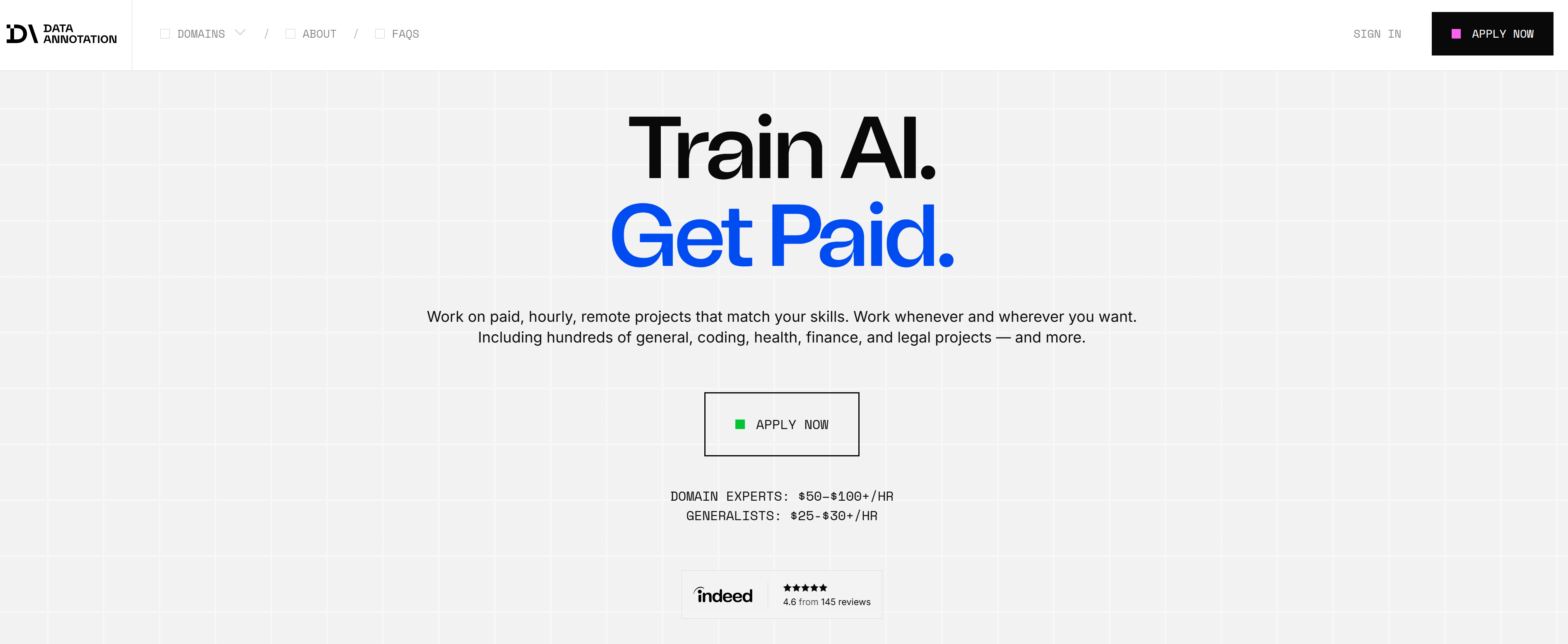
DataAnnotation, Outlier, Surge AI, Scale AI’s Remotasks, TaskUp, Gethybrid, Mercor, Micro1. This is not a hiring market. This is a salvage operation. This is the gig-pool infrastructure being built to extract the last drops of value from the very engineers whose careers the technology is eliminating. The pitch is that you, the unemployed senior with two decades of production experience, can earn forty dollars an hour as a contractor labeling code and grading model output for the system that took your last role. You will train it. It will replace the next person. There is no full-time work at the end of it. There are no benefits. There is no upward mobility. Your account can be deactivated without explanation, as Surge AI has been sued for doing, and as multiple Reddit and Indeed reviewers have documented. The platform itself uses identity and device checks to prevent reapplication, so once you are out, you are out across every platform Surge operates.
When the same job appears thirty-two times on the same Indeed results page and Indeed has to silently collapse it before the page becomes unusable, what you are looking at is the only growing source of software developer postings in the United States. This is the recovery. It is the same company, in the same office, in San Francisco, paying piece rates to the same people it is helping to put out of work. Indeed Hiring Lab reports rising tech postings month over month. Trade press writes that tech hiring is rebounding. Industry analysts publish quarterly forecasts that mention AI demand and call it a recovery. None of this is technically wrong. The postings are rising. The jobs are rising. But the jobs are DataAnnotation, and the next job is DataAnnotation, and the job after that is DataAnnotation, and they all sound like the previous one, and they are not jobs. They are tasks. They are not roles. They are tickets in a queue.
If you are an engineer reading this in May of 2026, here is the math.
You are competing in a pool whose floor has fallen twenty-seven percent below pre-pandemic and sixty-nine percent below pandemic peak. You are facing employers whose chief executives have publicly told their shareholders they will hire zero engineers this fiscal year. Your entry-level peers, if you have any left, are taking jobs at Chipotle and being rejected by McDonald’s. The gig work being marketed to you as the new floor pays piece-rate, terminates accounts without process, and exists for the explicit purpose of building the systems that will further reduce the demand for your skill. The trade press will keep telling you the recovery is here. The chief executives will keep telling you AI is going to free engineers up to do higher-value work. The LinkedIn influencers will keep telling you that if you just learn one more framework, take one more bootcamp, build one more side project, the offers will follow.
Look at the screen on your phone. Open Indeed. Search for software developer. Count the DataAnnotation listings.
That is the recovery.
Gal Ratner is the founder of Inverted Software and the chief architect at Prana Entertainment. He has shipped production software on the Microsoft stack since 1996.
This hits close to home. I was laid off in 2024 by a big media measurement company. They laid off the entire US and EU tech staff and replaced them with low cost of living workers in Poland, Mexico, and India.
I have been an Lead/Senior Software Engineer for 20+ years, well versed in Full Stack but my main strength was always back-end. I am well versed in AWS and code in C#, Go, Python, JavaScript, TypeScript, SQL, etc. and have always been ready to take on a new language. I sent out hundreds of resumes and reached out to all my peers and in the course of a year and a half I had three interviews. We lived off of savings the entire time to keep afloat.
Thankfully, I landed a contract role last month. It pays far less than my previous gig, but I'm completely grateful. I'm viewing it as my last hurrah in this industry unless something changes.