


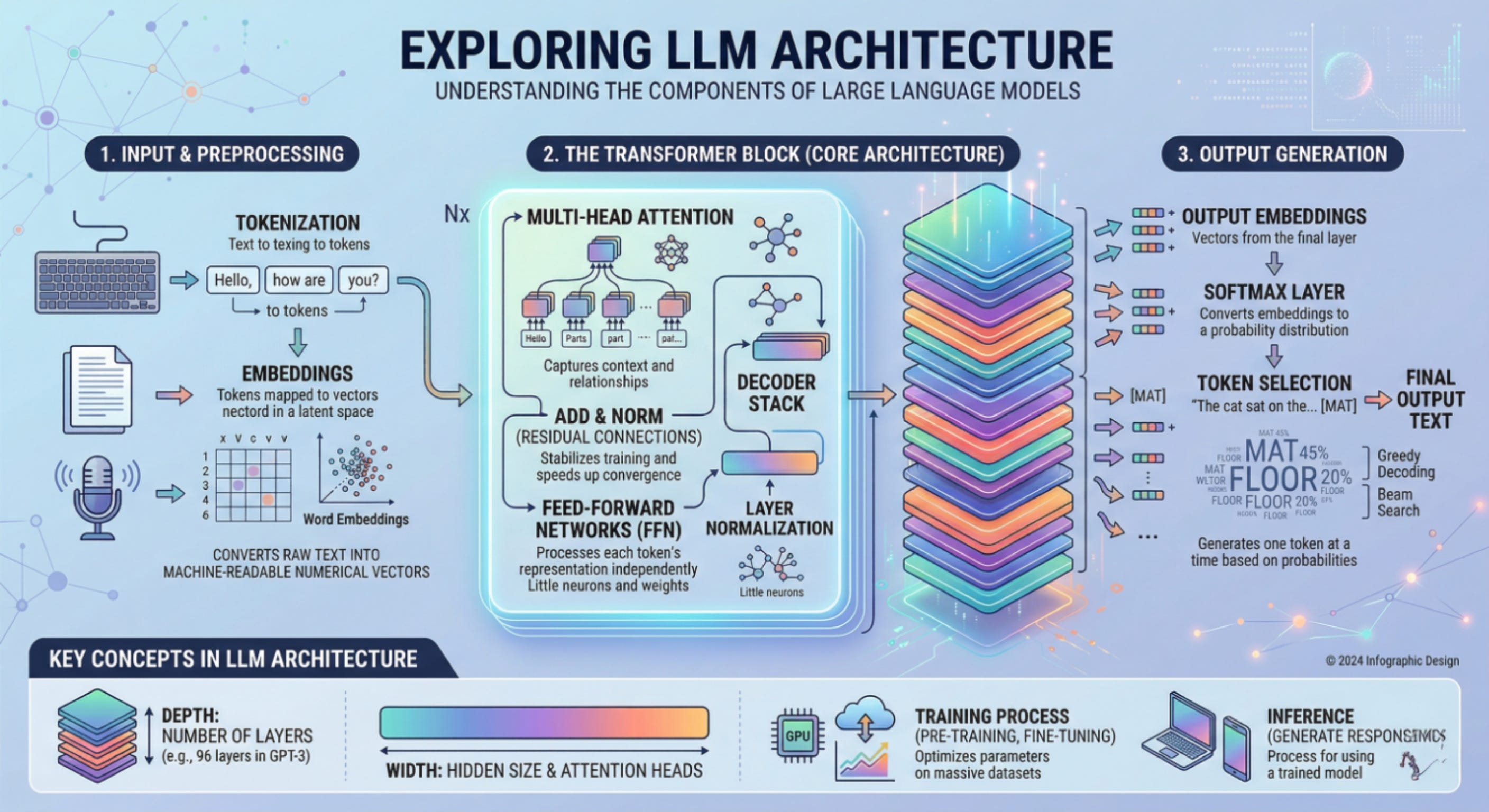
Let me say the quiet part out loud: the Transformer architecture, the engine behind every frontier LLM you’ve ever used, is a computational cul-de-sac. Not because it doesn’t work — it works spectacularly — but because the very mechanism that makes it powerful is the same mechanism that guarantees it cannot scale to what we actually need. We are pouring hundreds of billions of dollars into an architecture whose fundamental math places a hard ceiling on the future of intelligence. And the people building these systems? They know it.
Google’s 2017 paper “Attention Is All You Need” was a genuine breakthrough. It replaced the sequential bottleneck of recurrent networks with a parallelizable attention mechanism that could look at all tokens simultaneously. This unlocked training on massive datasets using GPU clusters in ways RNNs never could. GPT, BERT, PaLM, Claude, Gemini — every model that has defined the AI era traces its lineage to that single architectural choice: self-attention.
But what made the Transformer a training marvel is precisely what makes it an inference nightmare. And as the industry shifts from “can we train it?” to “can we serve it to a billion people?”, the Transformer’s fundamental design flaws are becoming impossible to ignore.
The Quadratic Wall
The core problem is mathematically simple and practically devastating. Self-attention computes a pairwise similarity score between every token in a sequence. For a sequence of length n, this means the attention matrix has n² entries. Double your context window, and you quadruple the compute. This isn’t an implementation detail — it’s baked into the linear algebra.
Attention(Q, K, V) = softmax(QKᵀ / √dₖ) · V
Time complexity: O(n² · d) Memory complexity: O(n²)
That QKᵀ product is the villain. Every token must attend to every other token. At 4K tokens, this is manageable. At 128K tokens, you’re looking at 16 billion attention scores per layer. At the million-token context windows the industry is promising? One trillion scores. Per layer. Per head.
To put it concretely: at 4,096 tokens you’re computing about 16.7 million attention scores per layer with roughly 512 MB of KV cache — totally fine. At 32,768 tokens it’s 1.07 billion scores and ~4 GB of cache — strained but doable. At 128,000 tokens it’s 16.4 billion scores and ~16 GB — expensive and getting absurd. At 1,000,000 tokens? A trillion scores and ~128 GB of cache. Per layer. These numbers are illustrative for a single attention head; real models multiply by heads × layers.
The industry’s response has been to throw hardware at the problem. Longer contexts? More GPUs. Faster inference? Bigger clusters. The KV-cache alone — the stored key and value tensors that grow linearly with sequence length — is eating VRAM alive. We’re not optimizing; we’re brute-forcing our way through a fundamentally flawed algorithm, and NVIDIA is laughing all the way to the bank.
“We don’t have an intelligence scaling problem. We have a quadratic tax on every token that has ever existed in the conversation. That’s not a feature — that’s a design flaw masquerading as thoroughness.”
The Five Fatal Flaws
The quadratic attention cost is the headline, but the Transformer’s problems run deeper. Here are the five structural failures that make it a dead end for the next generation of AI:
1. No Real Memory
Transformers have no persistent state. Every “memory” exists only within the context window. Once the conversation exceeds the context limit, information is simply gone — not forgotten gracefully the way a human mind deprioritizes old information, but hard-deleted. The entire model must re-read everything, every time. There is no mechanism for the architecture to learn at inference time. All knowledge is frozen in the weights at training time, and the context window is a fragile, expensive band-aid over this limitation.
2. Autoregressive Generation Is Inherently Serial
Despite the Transformer’s parallel training advantage, generation is strictly sequential: one token at a time, each conditioned on everything before it. You cannot generate the 100th token until you’ve generated the 99th. This autoregressive bottleneck means that inference latency scales linearly with output length, and no amount of GPU parallelism can fundamentally fix it. Speculative decoding helps at the margins, but it’s duct tape on a structural problem.
3. Energy Consumption Is Unsustainable
A single GPT-4-class query consumes roughly 10× the energy of a Google search. At scale, we’re talking about gigawatt-hours per day. The Transformer’s computational greed isn’t just a cost problem; it’s an environmental and infrastructure problem. Data centers are being built next to nuclear power plants not because AI is that important, but because Transformers are that wasteful. An architecture that requires you to build new power plants is not a viable long-term foundation for ubiquitous AI.
4. The Attention Mechanism Doesn’t Reason
Self-attention computes weighted averages over token representations. It’s a glorified soft lookup table. It excels at pattern matching — finding which tokens in the context are relevant to the current position — but it has no built-in mechanism for logical deduction, causal reasoning, planning, or systematic generalization. Every “reasoning” capability in current LLMs is an emergent property of scale, not a designed feature. We’re discovering what amounts to statistical correlation and calling it intelligence. Chain-of-thought prompting is literally us telling the model to show its work because the architecture itself cannot reason without being walked through it.
5. Theoretical Hardness Is Proven
This isn’t just a practical complaint. An ICLR 2025 paper from a fine-grained complexity perspective proved that any subquadratic replacement for attention cannot perform the same class of tasks the Transformer handles — specifically, tasks involving document similarity. The implication is stark: you cannot make attention faster and keep its full power. The quadratic cost isn’t an implementation accident; it’s the price of the capability. Either you pay it, or you change what capability you’re buying.
Worth noting: the paper assumes standard fine-grained complexity conjectures (specifically SETH). Critics point out these are conjectures, not proofs. But the result aligns with practical experience — every “linear attention” scheme loses something meaningful. The question is whether what it loses matters for your use case.
What’s Already Working: State Space Models
The most credible Transformer alternative isn’t theoretical — it’s shipping. State Space Models (SSMs), particularly the Mamba family, have gone from academic curiosity to production architecture in under three years.
The core idea is elegant: instead of computing pairwise attention between all tokens, an SSM maintains a fixed-size hidden state that gets updated as each new token arrives. Think of it as a compressed, continuous summary of everything the model has seen so far. The mathematical foundation comes from control theory — the same differential equations used to model physical systems:
h[k] = Ā · h[k-1] + B̄ · x[k]     // update state
y[k] = C · h[k]                     // produce output

Time: O(n)   Memory: O(1) per step
vs Transformer: O(n²) time, O(n²) memory
The key innovation in Mamba — what made SSMs finally competitive with Transformers on language tasks — was making the state transition matrices input-dependent. Earlier SSMs like S4 used fixed matrices, treating every token identically. Mamba’s “selective” mechanism lets the model dynamically decide what to remember and what to forget based on the content it’s processing, similar in spirit to how attention selects relevant context, but without the quadratic cost.
And then, just this month, Mamba-3 landed. The results are hard to dismiss: at the 1.5B parameter scale, its MIMO variant hit 57.6% average accuracy across standard benchmarks — a 2.2 percentage point jump over the equivalent Transformer. More importantly, it achieves this while using half the internal state size of Mamba-2, meaning the same intelligence with significantly less memory. The architecture introduces complex-valued states — essentially giving the model an internal “rotary” logic mechanism that lets it solve state-tracking and arithmetic tasks that previous SSMs failed at entirely.
Here’s how the two architectures compare on the properties that matter:
Time Complexity — Transformer: O(n²) vs Mamba-3: O(n) Memory at Inference — Transformer: KV cache grows with n vs Mamba-3: Fixed state size Long Context — Transformer: Degrades, expensive vs Mamba-3: Native, efficient Reasoning Tasks — Transformer: Strong (emergent) vs Mamba-3: Rapidly improving Training Parallelism — Both: Excellent Inference Paradigm — Transformer: Prefill + decode vs Mamba-3: Single-pass recurrence Hardware Efficiency — Transformer: Compute-bound vs Mamba-3: Memory-bandwidth optimal
Mamba-3 represents an “inference-first” design philosophy. Its primary goal is to maximize every second the GPU is active, ensuring the model is thinking as hard as possible without making the user wait.
The Proposal: Convergent Hybrid Architectures
Here’s my actual thesis, and it’s not “SSMs will replace Transformers.” That framing is too simple. The correct answer — the one the best labs are converging on — is a hybrid architecture that uses each mechanism where it’s actually needed. Let me be specific:
The Three-Tier Model
The next generation of foundation models should be built on three distinct computational tiers, each handling a different type of cognitive work:
TIER 1: SSM Backbone — “The Spine.” Handles sequential processing, long-range context, persistent state. Complexity: O(n) time, O(1) memory per step. This should be roughly 80% of all layers.
TIER 2: Sparse Attention — “The Spotlight.” Handles precise retrieval, in-context learning, copy mechanisms. Complexity: O(n·k) where k is much smaller than n (local window + top-k global). About 15% of layers, strategically placed.
TIER 3: Explicit Memory Module — “The Library.” Handles persistent knowledge, test-time learning, long-term context beyond the context window. Complexity: O(log m) retrieval where m = memory bank size. About 5% of layers, at model boundaries.
This isn’t speculative. We’re already seeing early versions of this pattern in production. AI21’s Jamba interleaves Transformer and Mamba layers with Mixture-of-Experts modules. IBM’s Granite V4 runs on a hybrid SSM-Transformer backbone. NVIDIA’s Nemotron integrates Mamba layers into an otherwise Transformer-based architecture. Google’s Griffin alternates gated linear recurrences with windowed local attention. The pattern is clear: the industry is moving away from pure attention, even if marketing departments haven’t caught up yet.
“The Transformer was a brilliant answer to the wrong long-term question. It solved ‘how do we train models in parallel?’ when the real question is ‘how do we serve intelligence efficiently at planetary scale?’”
Why This Specific Architecture
The three-tier design maps directly onto different cognitive demands. The SSM backbone processes the bulk of the sequence, maintaining a compressed, running summary — this is analogous to how you read a novel, holding the gist of the story in mind without re-reading every previous page. The sparse attention layers act as precision tools for tasks that genuinely require pairwise comparison: looking up a specific fact mentioned 10,000 tokens ago, copying a code pattern exactly, matching a name to a description. And the memory module provides what neither SSMs nor attention can: true persistent knowledge that survives beyond the context window and can be updated at inference time.
The cognitive analogy maps cleanly: Tier 1 is your working memory stream of consciousness. Tier 2 is the focused act of scanning back through notes to find a specific detail. Tier 3 is your long-term memory — facts you know without having to re-derive them.
The Tooling Gap: What We Need to Build
The theoretical case is strong. The experimental results are accumulating. But the honest assessment is that the ecosystem isn’t ready. Here’s what’s missing:
Kernel-level optimization. Transformers have years of CUDA kernel engineering behind them — FlashAttention, PagedAttention, vLLM. The SSM stack is comparatively immature. Mamba’s selective scan is fast, but it hasn’t had the same investment in hardware-specific optimization. This is a solvable problem, not a fundamental one, but it matters for production deployment today.
Training infrastructure. Every major training framework is optimized for Transformer-shaped computation: FSDP, Megatron-LM, DeepSpeed. Hybrid architectures need custom parallelism strategies that handle SSM layers, attention layers, and memory modules differently. The team that builds the “Megatron for hybrids” will own the next era.
Evaluation benchmarks. Current LLM benchmarks are designed around Transformer strengths: short-context reasoning, in-context learning, instruction following. We need benchmarks that actually stress long-range dependency, persistent memory, efficiency under load, and real-time streaming scenarios. Without them, SSM-based models will always look “slightly worse” on metrics that were designed for a different architecture.
Inference serving systems. The entire inference stack — from batching strategies to KV-cache management to speculative decoding — assumes Transformer-shaped computation. SSM inference is fundamentally different: there is no KV cache, the state is fixed size, and the computational profile is memory-bandwidth-bound rather than compute-bound. We need new serving frameworks built for this reality.
What Happens Next
If you’re building AI products today, here’s the uncomfortable calculus: every dollar you invest in pure-Transformer infrastructure is a dollar invested in an architecture with a known expiration date. The timeline isn’t tomorrow — Transformers will dominate for at least another 18 to 24 months in production systems — but the writing is on the wall.
The smart money is on building abstraction layers now. Separate your application logic from your model architecture assumptions. Design your systems so that swapping a Transformer backend for a hybrid SSM backend is a configuration change, not a rewrite. The teams that do this will ride the transition. The teams that don’t will scramble.
A note for the .NET crowd: if you’re building on Semantic Kernel, ONNX Runtime, or ML.NET — this matters directly. ONNX Runtime is already adding SSM operator support. Semantic Kernel’s abstraction layer means your plugin and planner logic won’t care what’s underneath. The architecture transition will be invisible to application code if you’ve built the right abstractions. If you’ve hard-coded Transformer-specific assumptions (fixed context windows, KV-cache-aware batching), start decoupling now.
The deeper question is philosophical. The Transformer taught us that parallel training + massive data + scale = remarkable capabilities. But it also taught us to confuse “computationally expensive” with “intelligent.” The next architecture won’t just be more efficient; it will force us to rethink what we mean by machine intelligence. A model that can maintain persistent state, learn at inference time, and reason over arbitrarily long contexts isn’t just a faster Transformer — it’s a different kind of system entirely.
The Transformer was the internal combustion engine of AI: powerful, transformative, and ultimately a transitional technology. We built an entire civilization around it before we understood its limits. Now we do. The question isn’t whether we’ll move beyond it, but whether we’ll do it deliberately or get dragged there by the physics of compute costs and power consumption.
I know which one I’m betting on.