


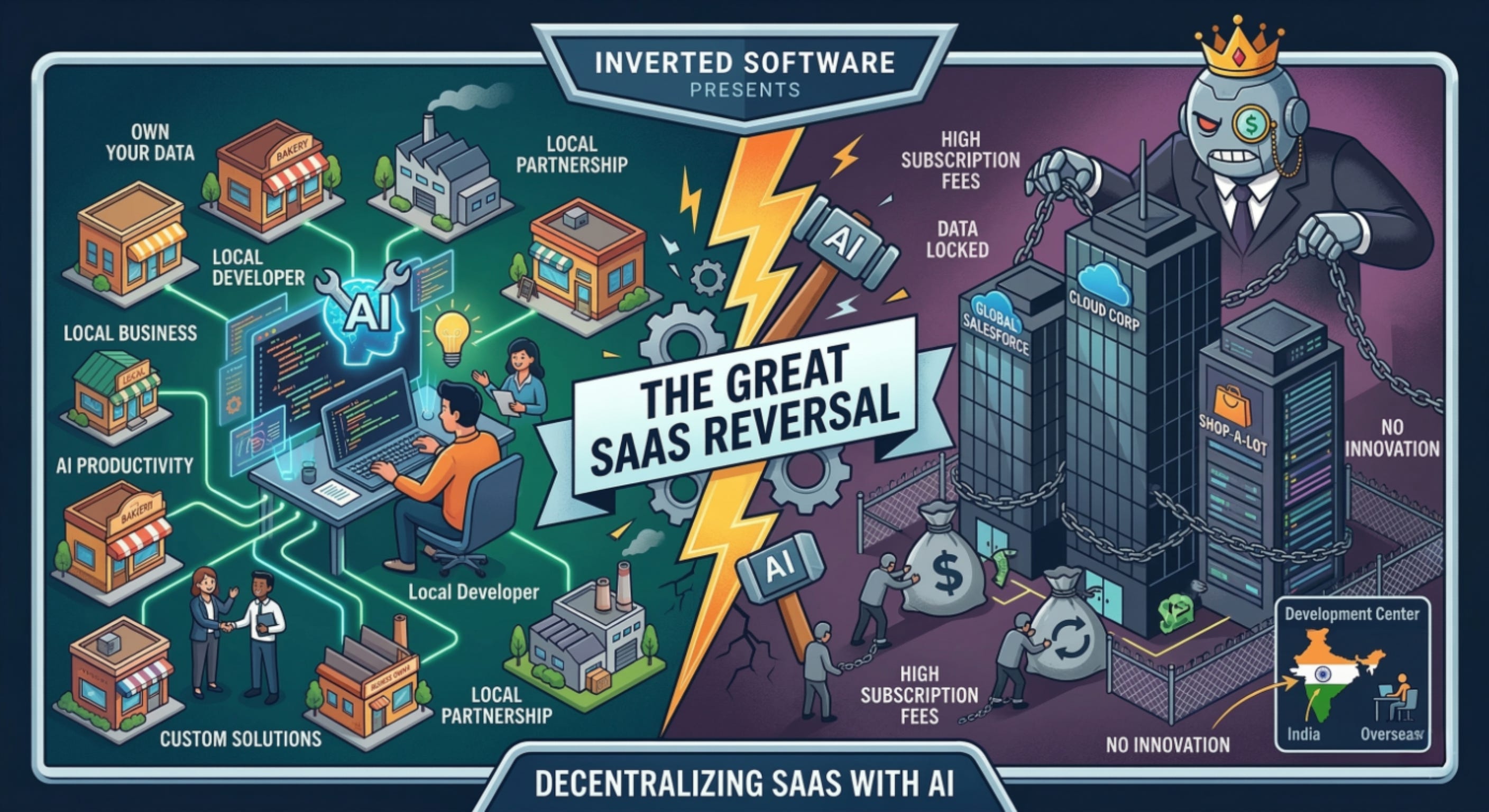
For the last two decades, the narrative of the software industry has been one of relentless consolidation. We were told that “the cloud” was an equalizer, a way for small businesses to access world-class tools without the overhead of an IT department. But as we look at the landscape in 2026, the reality is far grimmer. What began as a promise of efficiency has morphed into a digital feudal system, where small businesses pay ever-increasing “taxes” to a handful of tech giants like Shopify and Salesforce.
However, a revolution is brewing. Powered by Generative AI and tools like Claude Code, the pendulum is swinging back. We are entering the era of the Decentralization of SaaS, and it’s the best thing to happen to the local economy in twenty years.
How We Lost Local Software
In the early 2000s, the relationship between a business and its software was intimate and local. If a manufacturing plant in North Las Vegas needed an inventory system, they didn’t call a 1-800 number or submit a support ticket to a bot. They called a local developer.
Back then, as the owner of Inverted Software, my routine was high-touch and highly personal. I had a handful of local clients that I visited regularly. I sat in their offices, drank their coffee, and watched how their employees actually used the tools I built. Whether it was wringing every last drop of utility out of a custom VBA internal system or enhancing a bespoke online store built in ASP, the software was a living reflection of that specific business’s needs.
Then came the SaaS explosion.
Platforms like Salesforce and Shopify offered a seductive deal: “Stop paying a developer to build it; just pay us a monthly fee to use it.” One by one, local businesses realized they could get a massive feature set for a seemingly low monthly cost. They didn’t need me to visit; they just needed a login. Gradually, I watched my local clients—businesses I had helped grow—migrate their data to the cloud.
They weren’t just buying software; they were surrendering their digital sovereignty.
The Monopoly Brought Cookie Cutter Systems at High Costs
Fast forward to today, and that “low monthly fee” has ballooned into one of the largest line items on a small business’s balance sheet. Subscription fatigue is real, but for years, there was no alternative. How could a single local developer or a small firm possibly compete with the 5,000 engineers Shopify employs? The “feature gap” became a canyon.
But who has actually profited from this monopoly? It isn’t the end user. When a company like Salesforce dominates a market, innovation slows down, and prices go up because they know you have nowhere else to go. The real winners are the CEOs, the board members, and the venture capitalists.
Furthermore, the “5,000 developers” these giants brag about are rarely the high-paid local experts you’d imagine. To maximize margins, these corporations often outsource the bulk of their engineering to massive “coding factories” overseas in places like India. Your subscription dollars aren’t supporting your local economy; they are fueling a global machine that treats software like a commodity and customers like a metric.
The AI Equalizer Now Means Productivity Without the Payroll
The emergence of AI-driven development has shattered the “5,000 developer” advantage.
With systems like Claude Code and advanced LLMs, a single skilled developer today can produce high-quality, secure, and complex code at a rate that was unthinkable five years ago. AI doesn’t just write code; it architects systems, debugs in real-time, and handles the “grunt work” that used to require a massive team.
For the first time in twenty years, a single developer can be as productive as a corporate department.
Small and medium businesses are having an “aha” moment. They are realizing they can ditch the $5,000-a-month subscription for a custom, in-house system that they own. This “New Localism” in software provides:
Zero Subscription Fees: Once the system is built, the “rent” stops.
Data Sovereignty: Your customer data stays on your servers (or your private cloud), not in a third-party database.
Total Customization: No more “working around” the limitations of a generic platform.
Personal Service: You get the developer who actually knows your name and your business workflow.
Conclusion: The Return to Inverted Software
The tide is officially turning. At Inverted Software, the phone has started ringing again—but the conversations are different now.
We are hearing from business owners who are tired of being “just another subscriber.” They want to return to the model that worked: a local partnership fueled by modern, cutting-edge technology. They are looking to ditch the big SaaS monopolies and reclaim their internal systems using AI-augmented local development.
The monopoly is breaking. The era of the local developer is back. And this time, we have the tools to stay.