


The word at the center of everything
On May 11, 2026, GitLab CEO Bill Staples published a nineteen-minute-read open letter on the company blog and titled it “GitLab Act 2.” The first half announces a workforce reduction across nearly sixty countries whose actual scope will not be disclosed for another three weeks. The second half describes the strategic and architectural pivots the company is making. Bolted onto the back is the internal email Staples sent his employees that morning — the one his team actually read with their stomachs in knots.
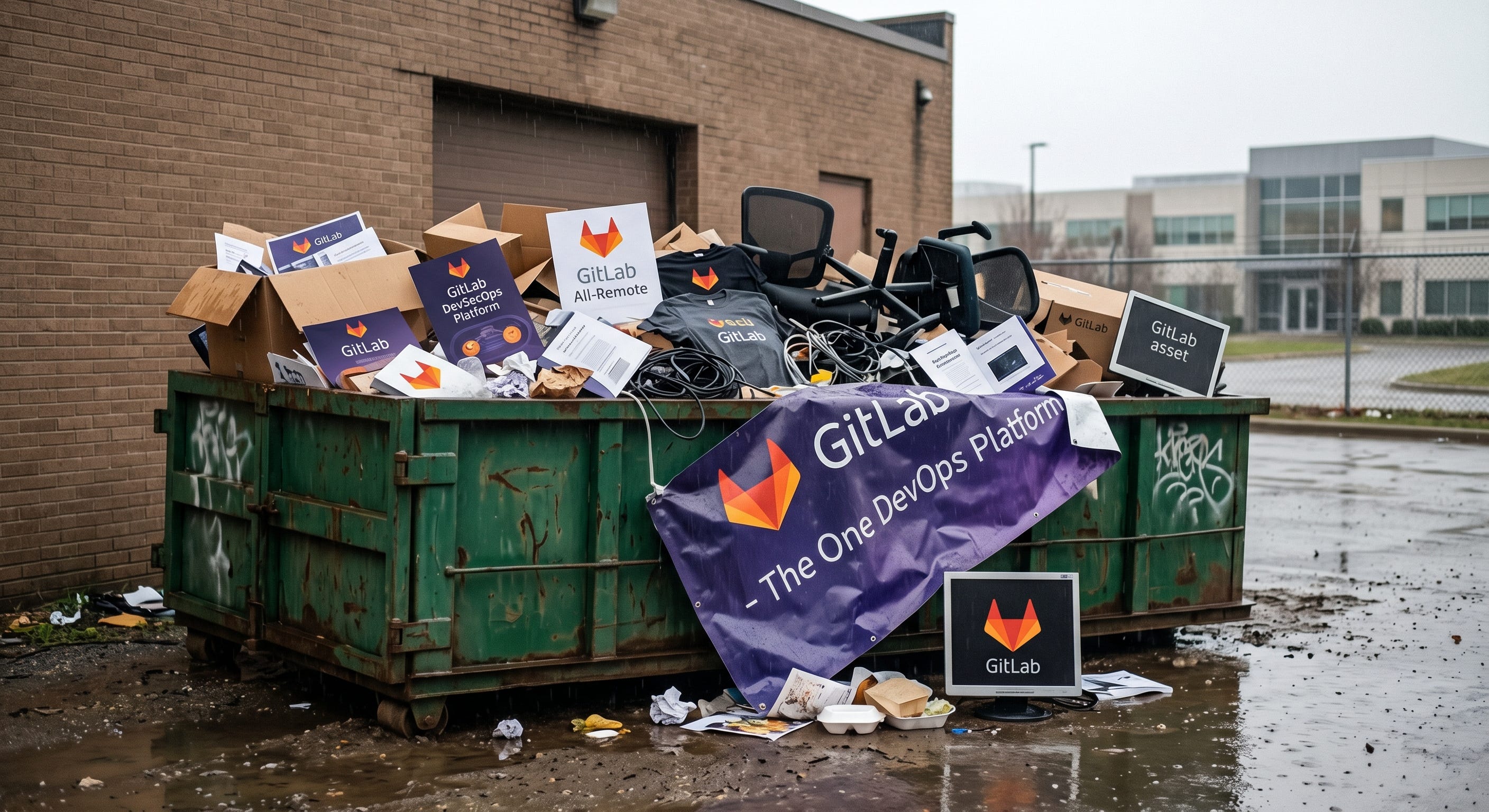
In a section of that internal letter explicitly titled “Why I hope you stay,” addressed to the people who will spend the next three weeks wondering whether their job survives June 1, Staples writes that the company’s overriding objective is to bring a significant improvement to “the joy and impact of each team member” participating in the new era.
Read it again. The CEO of a publicly traded software company, in a memo announcing layoffs, in the section literally pitching survivors on staying, used the word joy to describe the consolation prize.
I have been in this industry for thirty years. I have written my share of severance agreements and signed my share of separation packages. I have never seen the word joy deployed in a workforce reduction announcement. It is a new entry in the corporate dictionary, joining rightsizing, synergy, optimization, and consolidation. But joy is worse than those. Those at least have the decency to sound bureaucratic. Joy is performative. It asks the people whose colleagues just got marched toward the door to feel grateful about it.
The word appears twice. The second time, it surfaces as a behavioral expectation in GitLab’s new operating principles. Employees are now expected to ensure their work generates joy and delight for customers. That bullet point lives three paragraphs after the announcement that AI agents will be automating reviews, approvals, and handoffs across the company, and that the headcount of every role will be reassessed accordingly.
The word joy, in other words, is doing a lot of work in this memo. It is the consolation for the survivors. It is the deliverable for the customers. It is the brand on a layoff. It is also, I will argue, the most honest thing Bill Staples wrote, because it tells you exactly what he thinks his job is.
The denial at the heart of the letter
Two paragraphs before the joy promise, Staples writes a sentence that is becoming the signature move of the 2026 tech CEO. He says the restructure is not an AI optimization or cost cutting exercise. He says this directly, in plain English, in a company blog post that anyone in the world can read.
He then announces, in the same memo: the number of countries where GitLab directly employs people will be reduced by up to thirty percent. Up to three layers of management will be removed from some functions. The R&D organization will be reorganized into roughly sixty smaller teams. Internal processes — reviews, approvals, handoffs — will be rewired with AI agents. Role sizing across the company will be revisited to match. The savings from all of this will be reinvested in agentic AI capabilities.
You do not have to be an industry analyst to notice that “reduce the country footprint, flatten management, automate the work with AI agents, and right-size the roles that did that work” is, in fact, a cost-cutting exercise driven by AI optimization. It is the platonic ideal of a cost-cutting exercise driven by AI optimization. It is what you would draw on a whiteboard if someone asked you to sketch one.
The denial does not negate the policy. It just tells you what the CEO thinks his investors and his press coverage need to hear. It is the linguistic equivalent of stealing a car and then telling the owner you found it that way.
Why the denial? Because the alternative framing — that GitLab is laying off workers to fund AI agents that will replace more of them — is now politically toxic. It is what Tobi Lütke did at Shopify in April 2025, when he ordered managers to justify every new hire against AI augmentation. It is what every other CEO trying to manage the same narrative is now doing. Staples knows this. He is too smart not to. So he says it isn’t that, then proceeds to do exactly that.
On the record for a year
Here is the part of the story Staples seems to be counting on the press not to surface. He has spent the better part of a year on the public-speaking circuit telling the world exactly what the May memo denies.
On June 23, 2025 — nearly a year before the joy memo — Staples sat for a long-form interview on Kleiner Perkins’s “Grit” podcast. The hosts titled the episode “GitLab’s CEO on Why the Next Great Developer Might Not Write Code.” That is not a paraphrase. That is the title of the episode, published on the Kleiner Perkins YouTube channel, with Staples’s photo on the thumbnail.
The episode description, written by the show after recording with him, summarizes the thesis: “AI will 10× software engineers by auto-debugging code and closing security gaps.” The chapter list runs sixteen sections over roughly an hour. The second chapter, beginning at the 02:34 mark, is titled “True joy in life.” So before “Winning teams,” before “Super ambitious,” before “Elevating quality and standard,” the GitLab CEO opens with joy. He has been workshopping that word in public for a year. The May 2026 memo did not invent it. It deployed it.
He has been making this same case in public consistently since. In February 2026, three months before the joy memo, Staples appeared on CXOTalk to discuss what he himself named “the AI paradox.” His own framing on that interview: AI coding agents like Claude Code and Codex are accelerating the coding aspect of the developer’s job, while creating downstream bottlenecks in software review, testing, security checks, and incident response. The solution, he argued, was platform consolidation through what he calls Intelligent Orchestration — the same orchestration layer that anchors the May memo’s second architectural bet.
Read those two appearances together. The Staples on the public-speaking circuit, from mid-2025 through early 2026, was selling a clear and consistent thesis: AI is fundamentally changing what developers do, raw coding output is increasing, the bottleneck is moving downstream, and GitLab’s job is to orchestrate the agents that are doing the work. The next great developer might not write code. AI will 10x what engineers produce. Coding will be accelerated by agents until the bottleneck moves elsewhere.
The Staples on May 11, 2026, in a letter announcing layoffs across nearly sixty countries, says the restructuring is not an AI optimization or cost cutting exercise.
Both of those things cannot be true. Either the public-circuit Staples was overselling — in which case GitLab’s entire agentic-era narrative is overstated, and investors deserve to know — or the memo Staples is gaslighting his own employees about why their jobs are being eliminated. There is no third version. Sam Altman, of all people, coined the term for this practice earlier this year. He called it “AI washing”: the use of AI as cover for cost cuts that were going to happen anyway. By Altman’s own count, fewer than one percent of the job losses in 2025 were directly attributable to artificial intelligence.
I do not know which version of Bill Staples is the real one. I know which version got a year of podcast time and which version got the company press release. I know that one of them is on the record about developers not needing to write code, and the other is on the record claiming that the layoffs of those developers have nothing to do with AI. I know which version GitLab’s employees are entitled to an explanation from.
What the numbers actually say
This is where the press releases stop and the 10-Q’s begin.
GitLab’s fiscal year 2026, which ended in January, was a good year on paper. The company hit $955 million in revenue, up twenty-six percent year over year. Annual recurring revenue crossed a billion dollars for the first time. Free cash flow was $220 million, up more than eighty percent. The board authorized a $400 million share buyback. By any normal measure, this is not a company that needs to lay anyone off.
The story is in the guidance. For fiscal year 2027, GitLab is guiding to revenue between $1.099 and $1.118 billion. That is fifteen to seventeen percent growth, down from twenty-six. The deceleration is sharp, and it is not a surprise to anyone who listened to the Q4 FY26 earnings call in March.
On that call, Staples himself conceded that the company’s fifty percent Premium price increase, executed a few years ago, had coincided with rising AI code experimentation and flat SaaS budgets among customers. Translated from CEO-speak: GitLab raised prices, and SMBs walked. He estimated that roughly twenty percent of the company’s ARR sits in price-sensitive customers, including the SMB weakness leadership had been discussing for several quarters.
In other words, growth is decelerating because of pricing decisions made under prior leadership, in a market where customers have cheap or free alternatives in GitHub Copilot, Cursor, JetBrains’ Junie, Amazon Q Developer, and Gemini Code Assist. The agentic era is the cover story. The actual story is: a maturing developer-tools company facing real competition needs to manufacture a new growth narrative for Wall Street.
The Street is not fully buying it. GitLab shares dropped seven percent in after-hours trading the day the memo was published. Raymond James downgraded the stock from Outperform to Market Perform within twenty-four hours, flagging execution risk on the platform re-architecture and the internal overhaul, plus softer growth trends. The company filed an 8-K with the SEC but did not specify how many employees would be cut, how much the restructuring would cost, or when AI revenue might actually offset the deceleration.
This is the actual letter, the one written between the lines: growth is slowing, the price increase backfired, competitors are commoditizing our core product, and we need a story big enough to justify the multiple. AI agents are that story. The layoffs fund it.
That is a reasonable business decision. It might even be the right one. CEOs do this all the time. What is not reasonable is dressing it up as a transparency-driven joy initiative while ten months of YouTube footage exists arguing the opposite.
Transparency theater
GitLab is, or was, the radically transparent company. The publicly readable handbook, the all-remote model from day one, the open salary bands, the contributor-style decision-making — these were the contributions of founder Sid Sijbrandij to operating culture. They were not gimmicks. They earned GitLab real loyalty from developers and a recruiting moat that competitors envied.
Staples, who became CEO in December 2024 after Sijbrandij stepped down to focus on cancer treatment, has decided to weaponize that brand.
The signature move of this layoff is what he calls a transparent restructure. The company announced on May 11 that it would be restructuring. It told employees that the new shape of the organization will be determined on or before June 1. It opened a voluntary separation window through May 18. It did not say how many people would be affected. It did not say which teams. It did not say which countries. It will not say. Not until the Q1 earnings call on June 2.
The pitch is that this is more humane than a Friday-morning surprise layoff. The pitch is that giving people three weeks to participate in the conversation is more dignified than handing them a calendar invite and a Notion link to their severance package.
The actual experience for the roughly 2,500 GitLab employees scattered across nearly sixty countries is something else. The Register called it layoffs limbo. AOL ran the same frame. Employees are reportedly already organizing in Slack and on forums, trying to read tea leaves about whose team is getting consolidated. Managers, themselves uncertain whether they have jobs, are being asked to lead deeper conversations with their teams about how the principles will land. Everyone is being asked to do their job at one hundred percent intensity while wondering if it will exist on June second.
This is not transparency. This is dread, packaged as transparency.
Real transparency would have been: here is the list, here is the date, here is the severance, here is who got cut and why, here is the org chart on June 2. That is what the Sijbrandij-era handbook would have demanded. What Staples has done is invert the brand — using the language of transparency to extend the discomfort of a layoff over a longer period rather than a shorter one.
The retirement of CREDIT — GitLab’s existing values framework, which Staples himself acknowledges drove the company from zero to a billion dollars in ARR — is the tell. The new operating principles are Speed with Quality, Ownership Mindset, and Customer Outcomes. They are fine. They are also generic to the point of being interchangeable with any McKinsey deck from any year in the last decade. The founder’s framework is out. The professional operator’s framework is in. The brand that earned developer trust is being replaced with the brand that earns analyst trust.
The class of 2026
Staples is not the first CEO to do this. He is the latest in a growing class.
Tobi Lütke at Shopify set the template in April 2025 with his AI-first memo, in which he told managers they could not request more headcount or resources without first demonstrating why the work could not be done using AI. The memo leaked. The leak was the point. Shopify’s reported headcount has declined slightly since.
Andy Jassy at Amazon told employees in a June 2025 memo that the company expects AI to reduce its total corporate workforce in the coming years. Sebastian Siemiatkowski at Klarna spent 2023 and 2024 celebrating the AI assistant Klarna had built with OpenAI to handle the work of seven hundred customer service agents — then reversed course in May 2025, telling Bloomberg the company would resume hiring humans because, in his own words, focusing too much on cost had produced lower quality. Marc Benioff at Salesforce announced in late 2024 that the company would not hire any new software engineers in 2025 because Agentforce had delivered a claimed thirty percent productivity boost — a productivity claim Salesforce has not independently substantiated, and which Benioff himself softened in April 2026, conceding on the Forward Future podcast that AI cannot yet operate autonomously and that engineers are still needed. Even the top AI labs, he acknowledged, are still hiring engineers.
The pattern is now stable enough to name. A CEO of a maturing software company facing real growth deceleration and real competitive pressure announces a workforce reduction. The reduction is framed as a strategic pivot to AI, not as a cost cut. The savings are promised to be reinvested in capabilities the CEO cannot yet demonstrate. The stock takes a short-term hit. The narrative becomes the future-facing story the next earnings call needs. The actual humans on the receiving end of the layoff become collateral for that story, then they disappear from it.
Staples has joined the class. He has done so with more linguistic ambition than most. Joy is, by my count, the first time anyone in this club has tried to wedge a wellness vocabulary into a layoff memo. He gets credit for innovation, if not for taste.
The actual technical bet
I want to spend a moment on the underlying technical claims, because they will matter when the dust settles and we look back at what these decisions actually produced.
Staples announces five architectural bets. Each one is worth taking seriously, though none of them is as inevitable as he wants them to sound.
The first is a rebuild of Git itself for machine-scale workloads — agents opening merge requests in parallel, triggering pipelines around the clock, pushing commits at rates no human team can match. He is correct that Git’s data model was not designed for that load. He is also implicitly betting that GitLab can do this rebuild while continuing to serve existing customers, which is a generationally hard engineering problem on an open protocol. The honest version of this bet would say: we may break things, the rebuild may take years, and our competitors may get there first.
The second is a reimagining of CI/CD as an agent orchestration runtime — the same Intelligent Orchestration concept he was selling on CXOTalk in February. Coordinating multiple agents across the software lifecycle, enforcing policy, managing state, keeping humans in the loop. This is plausible. It is also what every other vendor in the space is trying to build at the same time, and GitHub’s frozen Copilot signups are the canary in the coal mine. On April 20, 2026, GitHub paused new individual Copilot Pro, Pro+, and Student subscriptions because agent-driven usage had broken its unit economics. The VP of product told the world, in a blog post, that it had become common for a handful of requests to incur costs that exceeded the plan’s monthly price. Agent sessions consume tokens at rates traditional autocomplete never did, and the flat-rate pricing model collapsed. GitLab is signing up for the same exposure with a hybrid credit-based model that has yet to be tested at scale.
The third bet is on context as competitive moat — a connected data graph spanning planning, code, review, deployment, and operations, surfacing the right context to agents. This is the most defensible claim in the memo. Context is, in fact, the only thing dev-tool vendors can own once code generation itself commoditizes. Whether GitLab’s data model is actually that graph, or whether it is a marketing reframe of the existing product, will be visible in the next six to twelve months.
The fourth and fifth bets — governance built into the platform core, and one platform serving human-owned, agent-assisted, and agent-autonomous workloads — are sensible and unremarkable. Every enterprise vendor is making them. The differentiation will be in execution.
The point is not that the bets are wrong. The point is that the bets are bets. None of them is yet a product. None of them yet generates revenue at scale. The layoffs are funding speculative platform engineering against the hope that the agentic-era story will be true by FY28. The people whose jobs are being eliminated are paying for a research and development bill the company cannot yet underwrite from growth.
That is what is actually happening. The joy line is the wrapper.
What comes next
I have a hard rule about predicting individual companies, so I will not predict GitLab. I will predict the genre.
The 2026 layoff memo is going to keep getting weirder. The CEOs who get out front of the AI restructuring wave will keep escalating the vocabulary — joy this quarter, purpose and meaning next quarter, flourishing by Q4 if someone hires the right consultant. They will do this because the actual mechanics of the decision — layoffs, headcount funded toward AI, multiple defense — are politically toxic when stated plainly, and CEOs hate stating things plainly.
The reckoning will come from two directions. The first is operational. AI agents will fail at production engineering work, customer support work, and account management work in ways their builders did not anticipate, and the companies that cut their humans deepest will be the slowest to recover. The Klarna walkback was the first example. Benioff’s quieter retreat is the second. There will be many more.
The second is reputational. The class of CEOs who treated the 2025–2026 cycle as an excuse to slash headcount under the cover of an AI narrative will eventually be measured against the AI narrative itself. When the agentic era does not arrive on the schedule the press releases promised — and it will not, because real software is harder than slide decks — those CEOs will own the layoffs without the cover. The story will be: they fired the people, they did not deliver the platform, and the workers were right when they said this was not going to be enough.
Bill Staples will be in that story. He may yet redeem himself with execution. The Duo Agent Platform launched in January and reportedly has decent early adoption. The architectural bets are not crazy. GitLab still has $1B in ARR and a real customer base. If Act 2 delivers, the memo becomes a footnote — the moment of bad taste before the comeback.
But the joy line is going to follow him forever. So is the Kleiner Perkins video. So is the CXOTalk interview. So is every other public statement he made over the past year explaining why developers might not need to write code, archived and timestamped, hyperlinkable forever. The denial in the May memo cannot survive a search engine. It will be quoted at every all-hands the new GitLab holds for the next decade. It will be the slide in every consultant’s deck teaching CEOs what not to say when announcing a workforce reduction. It will be the bar for how cynical a tech executive can be about the people whose lives he is changing.
For my part, I will say what the memo would not. The workforce reduction at GitLab is a cost-cutting exercise driven by AI optimization, executed under cover of an agentic-era story that has not yet generated revenue at the scale promised, funded by the elimination of jobs held by the people who built the company. The transparent restructure is a multi-week extension of layoff dread sold to employees as a process improvement. The retirement of the CREDIT values framework is the replacement of a founder culture with an operator culture. The joy line is the most expensive single word in the entire memo. And the public record of the past twelve months makes the denial of all of it impossible to defend.
The honest version of the letter would have read: we are laying off an undetermined number of you because growth is slowing and we need a story for the next earnings call. We are sorry. We will tell you who you are by June 1. That letter, ironically, would have been a credit to GitLab’s transparency culture.
What we got instead is the joy memo. The layoffs will continue until morale improves.
Gal Ratner is the CTO of WhiteStar Labs and Chief Architect at Prana Entertainment LLC. He has built and shipped enterprise software on the Microsoft stack for over thirty years, and writes on Substack about AI, software engineering, and the tech industry. Connect on LinkedIn.