


On January 6, 2026, Tailwind Labs cut its engineering team from four people to one. Three engineers — by all accounts the people who actually built the framework you are using on your dashboard right now — were laid off in a single morning. Adam Wathan announced it the next day in a GitHub comment that almost immediately went viral, then sat down for a podcast called “We had six months left” and walked through the numbers.
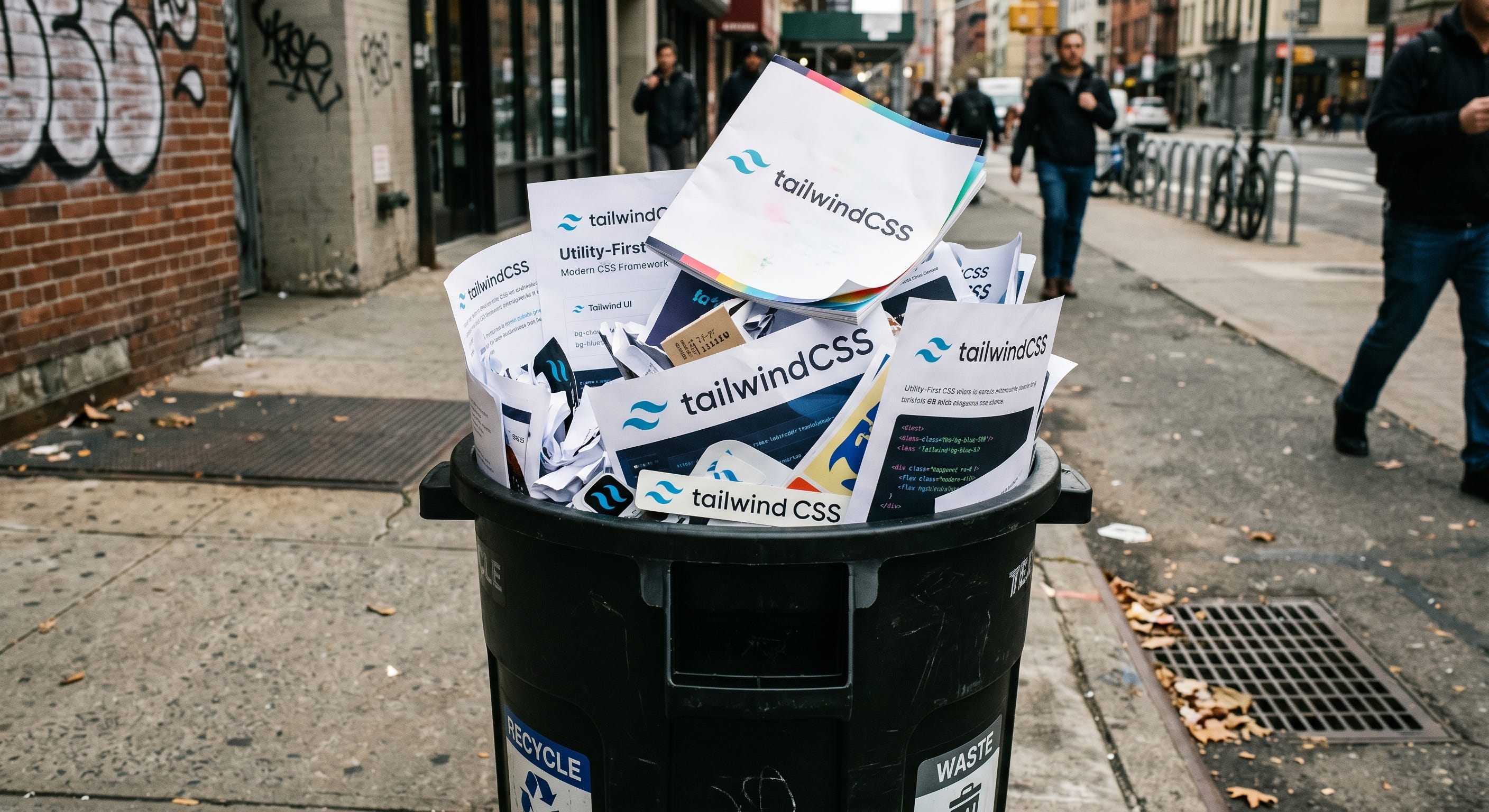
Revenue down roughly 80%. Documentation traffic down about 40% from its 2023 peak. Six months of runway if nothing changed. The framework itself? More popular than ever — 75 million downloads a month, 51% market share in the State of CSS survey, and used by Shopify, GitHub, NASA, Vercel, and most of the AI-coding tools you have ever opened a tab for.
Read that paragraph again. Usage at an all-time high. Revenue at an all-time low. That is not a slow decline. That is the business model breaking in real time.
And it raises a much bigger question for the rest of us — one Tailwind’s own predicament makes hard to dodge: do we actually need this framework anymore?
The numbers, before we go any further
Let me lay this out cleanly so nobody has to chase links.
Headcount: Tailwind Labs had four engineers. It now has one — Robin Malfait, who built Headless UI and shipped most of v3 and v4. The remaining team is Wathan, co-founder Steve Schoger, co-founder Jonathan Reinink, Robin, and Peter Suhm part-time on partnerships. Five people, total, behind the most-installed CSS framework on Earth.
Revenue: Down about 80% from peak, per Wathan’s own podcast. The funnel that worked for years — developer Googles a Tailwind class, lands on the docs, sees Tailwind Plus for $299, eventually buys it — is gone. Cursor, Copilot, Claude, and ChatGPT now answer the class question directly in the editor. The developer never visits the site. The site never sells anything.
Runway: Six months, if nothing changed. Wathan said as much explicitly in the podcast and in his GitHub reply when he closed the LLM-friendly docs PR — the one a contributor opened in November and Wathan refused on the grounds that making the docs easier for AI to scrape would accelerate exactly the problem killing the company.
GitHub activity: Pull up the tailwindcss repo and look at the last six months of commits. The recent v4.2.x releases are bug fixes — Vite alias resolution, Astro v5 import handling, canonicalization tweaks for tracking utilities, character escapes for Biome compatibility. This is the commit log of a project being kept alive, not a project being pushed forward. With one engineer it cannot really be anything else.
Vercel and Google AI Studio have stepped in as sponsors. That is generous, and it might extend the runway. It does not change the underlying problem.
Do we even need a CSS framework anymore?
Here is the part nobody at Tailwind Labs wants to say out loud, but every CTO I talk to has been quietly thinking it for a year: the original problem Tailwind solved is being solved upstream of Tailwind.
Tailwind’s pitch was elegant. CSS is hard. Naming things is hard. BEM is verbose. Switching between HTML and a stylesheet breaks flow. So instead of writing CSS, compose utility classes inline and let a build step purge what you do not use. It was a real productivity win in 2019. It is a less obvious win in 2026.
Why? Because in 2026 I do not write the styles by hand and I do not compose the utility classes by hand. I describe what I want, and the model writes the CSS. Or the Bootstrap markup. Or the Tailwind soup. The friction Tailwind was invented to remove — the friction of typing — is not where my time goes anymore.
And when the model writes raw CSS, it writes pretty good raw CSS. Modern CSS has nesting, custom properties, container queries, layers, scope, color-mix(), light-dark(), and logical properties. A focused stylesheet generated by a competent model is shorter, more readable, and more debuggable than 47 utility classes stacked on a single div like a barcode.
Tailwind solved a problem that was real. AI solved the same problem in a different and arguably better way. That is not a takedown of Tailwind. That is just where we are.
About “HTML6”
Quick honest correction before anyone forwards this to a colleague who actually reads specs: there is no “HTML6” release in the formal sense. WHATWG dropped versioned HTML over a decade ago and has been running the spec as a living standard ever since. There is no version number coming.
But the spirit of the “HTML6” conversation is correct, and it matters here. The platform itself is shipping things that used to be the entire reason you reached for a CSS framework:
Native popover and the popover API. Dropdowns, menus, tooltips. No more wrestling Popper or pulling in three Tailwind plugins.
The dialog element. Modals, accessible by default, with focus trapping built in. Browser-native.
CSS anchor positioning. Pin one element to another without a JavaScript library. This was a Tailwind-plus-Floating-UI problem six months ago.
View transitions. Smooth state changes between routes, again with no framework.
Container queries, @scope, CSS nesting. The component-level reasoning that drove people to utility-class chaos in the first place is now expressible in vanilla CSS.
None of these are Tailwind features. They are browser features. They ship to your users whether you adopt them or not, they have no licensing model that can collapse, and an AI assistant can wire them up for you in seconds. “HTML6,” used loosely, is just shorthand for the platform finally catching up. Which it has.
If you do want a framework, Bootstrap is the better bet
This is the part of the article where I expect the most disagreement, and I am fine with that. If you are standing up a new project in 2026 and you want a CSS framework — meaning a real one, with components, not just a class soup — Bootstrap is a more honest choice than Tailwind right now.
Latest stable is Bootstrap 5.3.8, shipped August 2025. The team behind it is at Twitter’s old scale rather than four-engineers-down-to-one scale. The release cadence is structured around active LTS and maintenance LTS branches, the way grown-up infrastructure tends to be. There is no “docs traffic equals payroll” dependency hanging over the project.
More importantly, Bootstrap actually ships components. A real modal. A real accordion. A real navbar with offcanvas behavior. A real dropdown. Toasts, scrollspy, tooltips, popovers, carousels. Form validation styling. Over 1,800 icons in Bootstrap Icons. Pre-built example layouts — pricing pages, dashboards, sign-ins, magazine layouts — you can drop in and edit. With Tailwind you get atomic utilities and a $299 invitation to buy the components separately. With Bootstrap you get the components.
The other underrated point is teaching surface. If you hand a junior developer a Tailwind codebase, they have to learn the utility vocabulary, the responsive prefixes, the variant prefixes, the JIT mental model, the config file, and somebody’s opinion about what “component classes” should be extracted. If you hand them a Bootstrap codebase, they have to learn class names that read like English: btn-primary, navbar-expand-lg, modal-dialog. The on-ramp is shorter. The Stack Overflow answers go back fifteen years. Every AI assistant on the market has seen orders of magnitude more Bootstrap than any other framework.
And — to the original point of this whole article — Bootstrap’s business model does not collapse if developers stop visiting the documentation. It is sponsored, it is foundation-style, it is just there. Picking infrastructure that depends on docs-page ad-funnel economics in 2026 is picking a project on the wrong side of the AI shift.
What happened to the three engineers
Their names have not all been made public, and out of respect I am not going to guess. What we do know, from Wathan’s podcast directly, is that he spent the closing minutes of the episode personally recommending each of them — describing their specific strengths and offering references to anyone hiring. He called them three of the most talented people he has ever worked with. He said he expected to be jealous of whatever company picked them up.
Given the framework’s reach and the public sympathy that followed the announcement — and the size of the network around Adam, Steve, and Jonathan — it is hard to imagine three engineers with that pedigree sitting on the market for long. “Co-author of Tailwind CSS” is the kind of line on a resume that opens calendars.
I genuinely hope they have landed somewhere they are happier than they were on January 5. Somewhere with a business model that does not depend on developers manually clicking through documentation pages. Somewhere with a longer runway than six months. Somewhere where the work they ship is decoupled from the marketing funnel that pays for it. That is not a knock on Wathan, who handled the disclosure with more honesty than ninety percent of CEOs ever manage. It is just a wish for three people who got caught between the wrong revenue model and the wrong year.
So is this the end?
Probably not the literal end. Tailwind has too many users, too many sponsors lining up, and too much code in production for it to disappear next quarter. v4.2.x will keep shipping. Robin will keep merging fixes. Vercel will keep cutting checks. The framework will be around for a long time the same way jQuery is around for a long time.
But “around” is not the same as “where I would start a new project this year.”
If I were greenfielding a project in May 2026, here is what I would actually do. I would let the AI write the CSS — vanilla, modern, with custom properties for theming. I would lean on the platform for popovers, dialogs, anchor positioning, and view transitions, because those primitives are now native and free. And if I wanted a component library to anchor the design system, I would pull in Bootstrap 5.3, theme it, and move on.
Tailwind solved a real problem in a specific era. That era is over. The framework that fired three quarters of its engineering team because AI ate its funnel is, with respect, not the framework I want sitting underneath my next five years of code.
The question in the title was not rhetorical. My answer is: yes, basically.
— Gal Ratner