



Every few years the technology industry congratulates itself on inventing something that already existed. We did it with video calling. We act as if Zoom willed face-to-face computing into being in 2020, as if Skype invented the consumer video call in 2003, as if the whole category arrived fully formed when the bandwidth finally showed up. It is a comfortable story and it is wrong. The category was working, shipping, and taking real calls in 1999. It just happened in a place nobody was looking: a suite of offices behind a ranch-style house off Ventura Boulevard, built by two people who already knew more about moving images through a computer than almost anyone else alive.
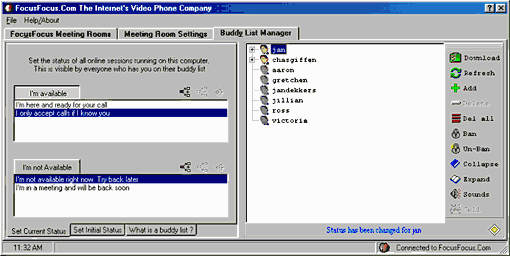
The product was called FocusFocus, and it billed itself, without a trace of irony, as “The Internet’s Video Phone Company.” The Wayback Machine has been quietly holding onto it since November 1999. Open the archive of focusfocus.com from early 2001 and you are looking at something that should not have existed yet: a Windows desktop client that put a live video-conferencing control right on your screen, with a buddy list, presence status, and chat rooms organized by topic. It is Skype and AIM and a little bit of the early social web, fused into one application, years ahead of any of them. And almost no one remembers it.
The people who actually owned the hard part
To understand why FocusFocus could exist in 1999, you have to understand who built it, because they were not a video startup. They were the imaging people. FocusFocus came out of Creative Development Ltd., which traded under the name SkyLine Tools Imaging, run by Jan Dekkers and his wife and business partner Jillian Pinsker out of Woodland Hills. If you wrote Windows software in the late nineties or early two-thousands and you needed to scan, display, manipulate, or store images, there is a real chance you used their code without ever knowing their names.
Their flagship was ImageLib, a royalty-free imaging toolkit that dominated the Delphi and C++Builder component market and reached into Visual Basic and ActiveX as well. It won the Delphi Informant Readers Choice Award for best imaging component, and by 1997 that was already its third award. The licensing model was the part developers loved: you paid once, around six hundred dollars for the Corporate Suite, a thousand if you wanted the source, fifteen hundred for the medical imaging package, and then you shipped as many copies of your application as you could sell without ever owing them a cut. For a small developer that was the difference between using a toolkit and going broke on it.
Dekkers himself was not a typical Valley founder. He was Dutch-born and self-taught, a man who had once run a medical lab in the Netherlands making dental bridges and caps before he came to the United States in 1991 to run a German database company that later failed. He started Creative Development in a North Hollywood apartment in 1995 with two thousand dollars in revenue that first year. By 1998 the company was doing close to a million dollars with seven full-time employees, and Dekkers was still personally writing roughly eighty percent of the code. That detail matters. This was not a company that bought a video stack. This was a company whose founder hand-wrote the imaging primitives that other companies licensed.
And the customers were not toys. Microsoft, AT&T, Lockheed Martin, and Lucent all used SkyLine’s tools. So did government agencies. When Swissair Flight 111 went down off the coast of Nova Scotia in September 1998, killing all 229 people aboard, the Royal Canadian Mounted Police used their software to capture, archive, and manage the tens of thousands of documents, medical records, forms, and photographs involved in identifying the victims and the wreckage. Pinsker noted at the time that it was the first time she had heard of the tools being used for a specific disaster. That is the level of imaging engineering that went into the foundation under FocusFocus. They were not guessing at how to push a video frame across a network. It was the only thing they had ever done.
What FocusFocus actually was
Here is the part that still surprises me when I look at the archived screens. FocusFocus was not just a webcam-on-a-webpage gimmick, which is what most of its contemporaries amounted to. It was a real client with a real presence model, and the design decisions read like they were made by people who had used instant messengers and thought hard about what was missing.

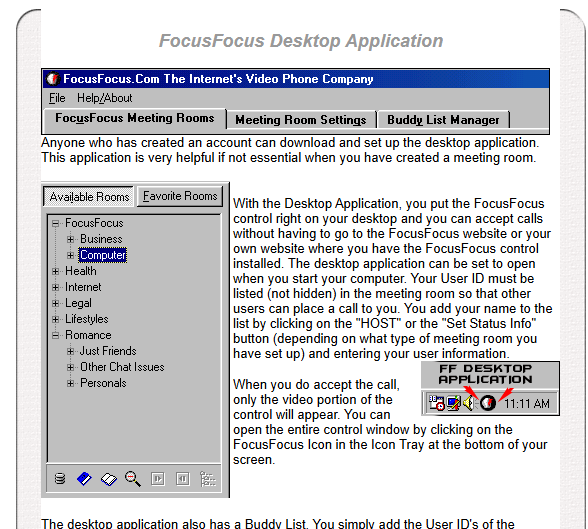
The desktop application installed onto your machine and could be set to launch when Windows started, then sit quietly in the system tray. Open it and you got three tabs: Meeting Rooms, Meeting Room Settings, and a Buddy List Manager. The meeting rooms were organized as a browsable tree by subject, the way you would organize a forum: Business, Computer, Health, Internet, Legal, Lifestyles, and Romance, with Romance further broken out into Just Friends, Other Chat Issues, and Personals. You picked a room, you listed your User ID so other people could see you were there and place a call to you, and you set your status with a button labeled HOST or Set Status Info depending on the room type. That is presence. That is the exact mental model every messenger would standardize on, expressed in a video-first product in 2000.
The buddy list worked the way you would expect a buddy list to work, except this one was attached to video. You added the User IDs of the people you wanted to reach, and you could set an audio cue to notify you when one of them came online and became available. When a call came in and you accepted it, only the video pane appeared on your desktop, and you could expand the full control by clicking the FocusFocus icon down in the tray. The whole thing was designed to feel like a phone that happened to carry your face: lightweight, ambient, always on, ringing only when it needed to.

Then there was the piece that was genuinely ahead of its moment. FocusFocus could be embedded in your own website. The company’s own banner promised “instant, live, web-based video conferencing on your website or PC desktop,” and they meant it literally. You could drop the FocusFocus control onto a page you owned and take calls from your own site, without sending anyone to focusfocus.com first. A consultant, a psychic, a salesperson, a support desk — anyone with a web page and a camera could put a live video call button in front of their visitors. That is the business model half the video-SaaS industry would rediscover and sell as a revolution fifteen years later. These people were doing it on dial-up.
It was probably MFC, and that tells you something

I am fairly sure the client was written in MFC, the Microsoft Foundation Classes, and everything about the archived interface supports that. The tabbed dialog, the tree control listing the rooms, the system-tray integration, the modal call window — that is the visual fingerprint of a native C++ Windows application from that exact period, and MFC was how a small, code-heavy team shipped a serious Windows client in 1999 without a runtime, without a browser dependency, and with direct access to the hardware. It makes complete sense for a shop that lived and breathed native imaging code. You do not write your own scan-and-display primitives and then wrap your flagship consumer product in something interpreted. You build it close to the metal, because the metal is the whole reason your video is smooth and the other guy’s is a slideshow.
That is the thing modern engineers forget about this era. There was no WebRTC. There was no off-the-shelf video pipeline you could npm-install. If you wanted real-time video over a 1999 internet connection, you wrote the capture, the codec handling, the buffering, and the rendering yourself, and you wrote it in C++ because you had no other choice that would keep up. The reason a two-person imaging company could out-engineer the video category was that the video category was, fundamentally, an imaging problem, and they were the imaging people. Everyone else was learning the hard part. They had finished it years earlier and moved on to the application.
So why didn’t you ever hear of it
It is tempting to say FocusFocus failed because it was bad, but it was not bad. It failed for the three reasons good products usually fail, none of which are about the product. The first was bandwidth. In 1999 and 2000 most people reaching focusfocus.com were doing it over a modem or, if they were lucky, the brand-new DSL lines that the site itself was running ads for. Real-time video over those pipes was a heroic engineering act, not a pleasant daily experience. The technology was right and the network underneath it was years from being ready, and you cannot win that fight no matter how good your codec is.
The second was distribution. FocusFocus had no platform, no app store, no pre-installed base, no operating-system vendor bundling it onto every machine. It had a website and word of mouth. As late as September 2001, Jillian Pinsker was still personally inviting people in developer newsgroups to register and try a live video demo with her, promising it would take no more than a minute to get set up. That is a founder doing one-to-one sales for a product that needed one-to-ten-million adoption. AOL had the buddy list because AOL was already on every machine in America. FocusFocus had two people in Woodland Hills and a tree of chat rooms.
The third was timing, which is really just the first two compounding. The category they invented arrived on schedule — just not on theirs. Skype shipped in 2003 on a fatter internet with peer-to-peer plumbing and a free-calling hook. The webcam social wave, the embeddable-video-on-your-site business, the presence-plus-video messenger — all of it became obvious and lucrative once broadband was ambient and the hardware was cheap. FocusFocus was standing in exactly the right spot, holding exactly the right product, about four years too early, with about one ten-thousandth of the distribution. Being early is indistinguishable from being wrong if you run out of runway before the market shows up.
Why this still matters
I did not write this to be nostalgic, although I admit the screenshots got me. I wrote it because the FocusFocus story is the quiet correction to almost every origin myth we tell about communications software, and because the lesson underneath it is the one our current hype cycle keeps refusing to learn. The people who solve the genuinely hard technical problem are very often not the people who get rich from it. Dekkers and Pinsker owned the imaging stack so completely that they could ship a video phone with presence and rooms and embeddable widgets while the eventual winners were still drawing whiteboard diagrams. Mastery of the hard part bought them a head start and almost nothing else, because mastery of the hard part is not what wins markets. Distribution wins markets. Timing wins markets. Being on every machine before anyone asked wins markets.
We are living through a moment that loves to confuse technical capability with inevitable victory. The team with the best model, the cleverest architecture, the deepest command of the actual engineering is treated as the team that will obviously win. FocusFocus is the counterexample sitting in the Internet Archive, waiting for anyone to notice. It was better than it had any right to be, built by people who had earned the right to build it, and it lost anyway, to forces that had nothing to do with whether the code was good. The code was good. The code is still there. It is the network, the distribution, and the calendar that beat it.
So the next time someone tells you that video calling, or presence, or web-embedded real-time communication is a recent invention, send them to the Wayback Machine and the spring of 2001. Tell them the Internet’s Video Phone Company was open for business, that it ran in your system tray and rang when your buddies came online, and that it was built by the people who wrote the imaging code under half the software you used back then. Then tell them it is the best instant messenger they never heard of, and ask them why they think that is.
Gal Ratner is Chief Architect at Prana Entertainment and the founder of Inverted Software and WhiteStar Labs. He writes about AI, software architecture, and the economics of platform decline at galratner.com.