


You’ve been told a story.
It goes like this: artificial intelligence is a triumph of American capitalism. Brilliant founders at Microsoft, Google, Amazon, OpenAI, and Nvidia raised private capital, hired the best engineers in the world, and built world-changing technology. Now they’re going to “transform the workplace.” Innovation. Disruption. Progress. Cue the keynote.
Every word of that story is a lie of omission.

The truth — buried inside CHIPS Act award letters, state tax disclosures, FERC filings, municipal bond prospectuses, DoD procurement records, OMB use-case inventories, and a White House executive order most Americans have never heard of — is that the most expensive technology in human history was built on the backs of American taxpayers. Yours. Mine. The single mom in Loudoun County whose property tax rates are about to climb to plug the data-center revenue hole. The retiree in Phoenix whose electric bill jumped 32% in five years to subsidize Microsoft’s water-cooled GPU farm. The Texas plumber whose state quietly blew $3 billion on a sales-tax exemption originally scored at $14 million.
And here’s the part that should make every American taxpayer set their hair on fire:
The same technology you funded is now being used by every Fortune 500 CEO on Earth to figure out how to fire you.
We didn’t just fund our own replacement. We’re still funding it. Today. This quarter. And both parties — Republicans and Democrats, governors and senators, federal and state — are still signing the checks.
Let me name names.
The Five Pipes
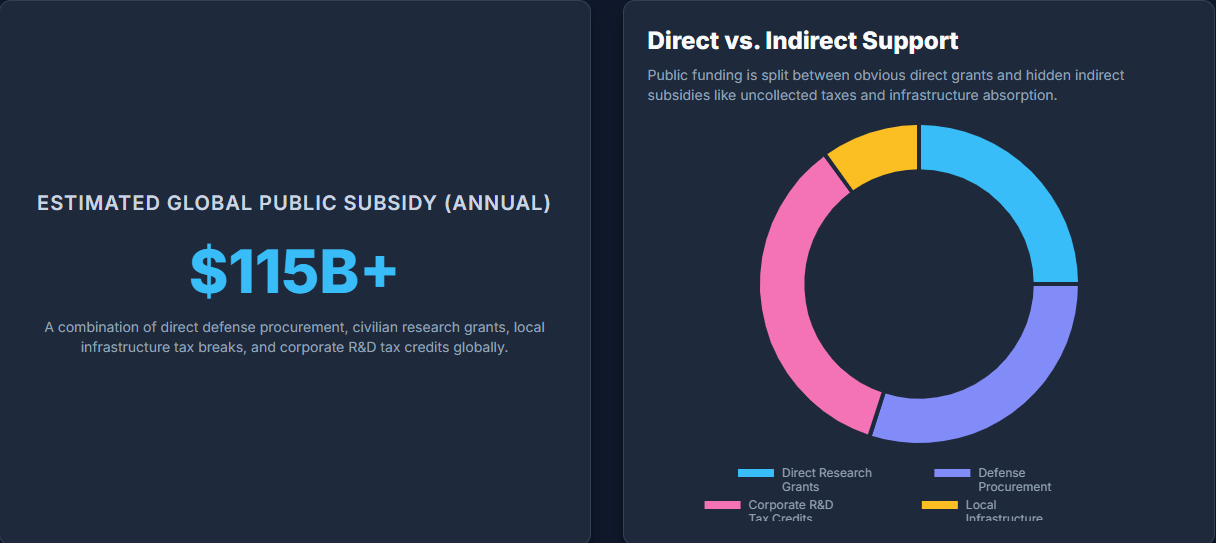
Public money flows into the AI industry through five distinct pipes. Each one is mostly invisible to the people paying for it. Together they constitute the largest, quietest transfer of public wealth in modern American history. Pull the documents and the dollar amounts are not in dispute. Only the consequences are.
Pipe 1: The Federal R&D Faucet — $3.3 billion a year, every year, forever
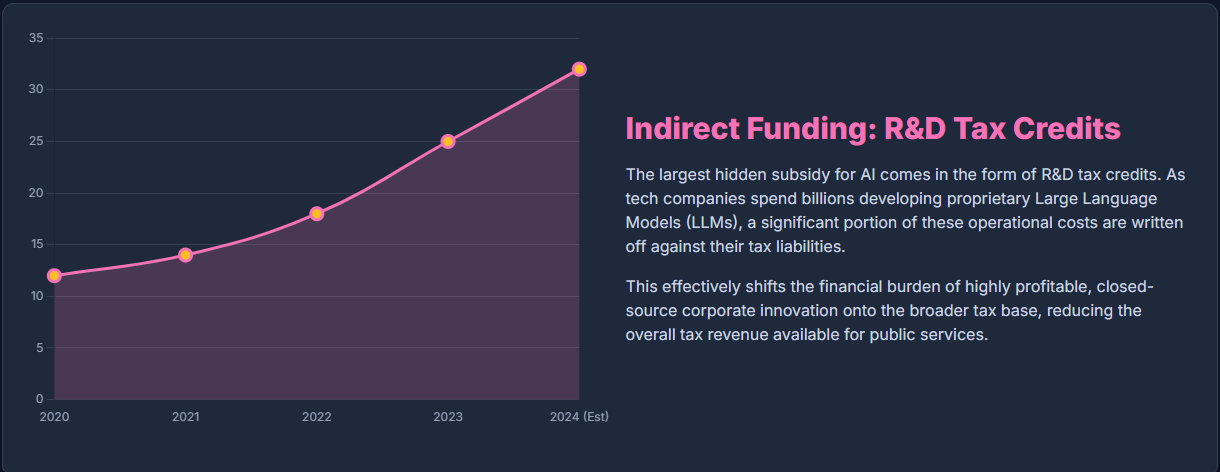
The foundational algorithms behind ChatGPT, Gemini, Claude, and every model OpenAI ships didn’t spring from a Sand Hill Road pitch deck. They were invented across decades by researchers funded by the National Science Foundation (NSF), DARPA, the National Institutes of Health (NIH), and the national labs of the Department of Energy. NITRD — the federal coordinating office for AI and IT research — requested $3.316 billion for AI R&D in FY2025 alone, with $1.95 billion in “Core AI” and another $1.36 billion embedded as “AI Crosscut” inside other agencies. NIH alone planned $1.12 billion in AI investment in FY25.
NSF and the USDA jointly fund 25 National AI Institutes scattered across U.S. universities. The Department of Energy funds open-access HPC time at Lawrence Berkeley, Oak Ridge, Argonne, Savannah River. Every commercial frontier model that today commands a $200 billion private valuation started life on a federal grant ledger.
This is not new spending we can simply vote down. The High Performance Computing Act of 1991 — signed by George H.W. Bush, faithfully reauthorized by Clinton, Bush, Obama, Trump, and Biden — baked it in. The National Security Commission on Artificial Intelligence (chaired by Eric Schmidt, yes, that Eric Schmidt) recommended doubling non-defense AI funding to $32 billion by FY26. Every administration of either party wants the spigot wider.
Pipe 2: The CHIPS Act — $53 billion straight to the silicon
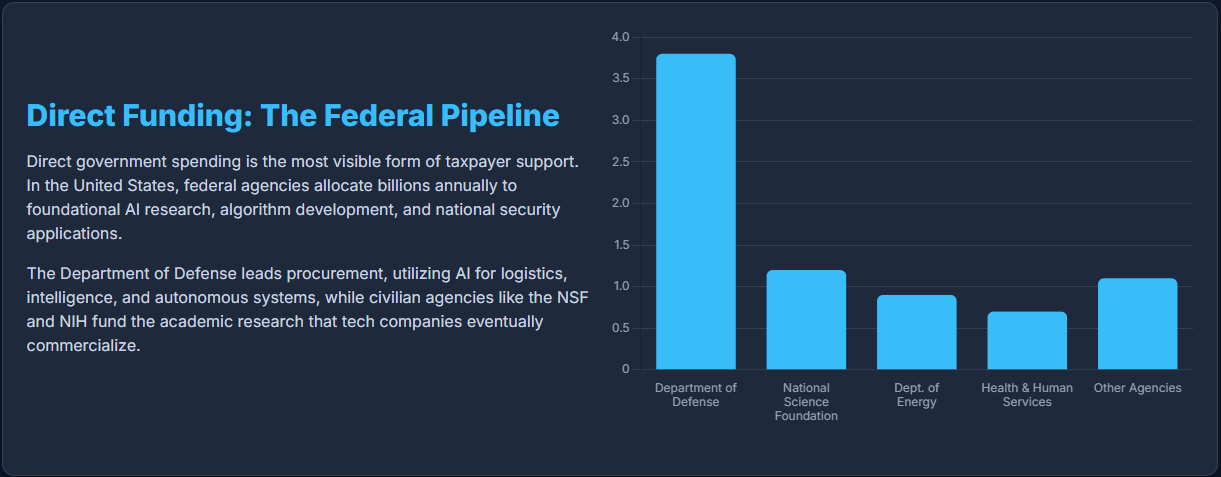
In August 2022, Congress passed the CHIPS and Science Act. It directed roughly $53 billion to domestic semiconductor manufacturing and added a 25% refundable tax credit for “qualified capital expenditures.” Note “refundable.” That isn’t a tax break. That’s a check the IRS cuts to chip companies if their tax bill is smaller than the credit.
This was not a partisan bill. It was a bipartisan bill, in origin and in passage. The CHIPS for America Act was introduced in June 2020 — during the first Trump administration — by Senators John Cornyn (R-TX) and Mark Warner (D-VA). The companion Endless Frontier Act that became the “Science” half was introduced by Senators Todd Young (R-IN) and Chuck Schumer (D-NY) with Representatives Ro Khanna (D-CA) and Mike Gallagher (R-WI). The TSMC Arizona deal that catalyzed the entire effort was brokered by the Trump State Department in May 2020. Two years later, CHIPS passed the Senate 64–33. Seventeen Republicans voted yes. Here are their names, in alphabetical order, for the historical record:
Roy Blunt (R-MO)
Richard Burr (R-NC)
Shelley Moore Capito (R-WV)
Bill Cassidy (R-LA)
Susan Collins (R-ME)
John Cornyn (R-TX) — a co-sponsor with Mark Warner (D-VA)
Steve Daines (R-MT)
Lindsey Graham (R-SC)
Bill Hagerty (R-TN)
Mitch McConnell (R-KY)
Jerry Moran (R-KS)
Rob Portman (R-OH)
Mitt Romney (R-UT)
Ben Sasse (R-NE)
Thom Tillis (R-NC)
Roger Wicker (R-MS)
Todd Young (R-IN) — the lead Republican on the bill
In the House, 24 Republicans joined every Democrat except one (Sara Jacobs, who voted “present”) to pass it 243–187. The only senator caucusing with Democrats who voted no was Bernie Sanders, who called it “massive corporate welfare for the semiconductor industry.” On this one, Bernie was right.
Where did your $53 billion go? In part:
SK hynix: $458M direct + $500M loans for an HBM packaging plant explicitly built for AI chips, in West Lafayette, Indiana
Texas Instruments: up to $1.6B direct + $3B loans for fabs in Sherman, TX and Lehi, UT
GlobalFoundries: $1.45B direct in Malta, NY
Amkor Technology: $407M direct for advanced packaging in Peoria, AZ — the award letter explicitly cites “AI chip demand”
Within eighteen months of enactment, Commerce Secretary Gina Raimondo announced the $39 billion commercial fund was already oversubscribed by $31 billion. The taxpayer ran out of money before the industry ran out of demand. R&D agencies got an $8 billion shortfall as a parting gift, because the chip companies needed it more than American researchers did.
The pipeline did not end with the Biden signature. The second Trump administration expanded it. Executive Order 14179 (January 2025, “Removing Barriers to American Leadership in Artificial Intelligence”) and Executive Order 14318 (July 23, 2025, “Accelerating Federal Permitting of Data Center Infrastructure”) direct the Commerce Department to launch additional financial support — loans, loan guarantees, grants, tax incentives, and offtake agreements — for any “Qualifying Project” with $500M+ in capex or 100+ MW of new AI load. EO 14318 also declares that federal financial assistance representing less than 50% of total project cost is “presumed not to constitute a major Federal action” under NEPA. Translation: Washington can subsidize up to 49 cents on the dollar of a billion-dollar private AI campus and skip environmental review entirely. Different administration, same pipe, wider valve.
Pipe 3: Defense and Civilian Procurement — from $269 million to $13.4 billion in two years
Between 2023 and 2024, Department of Defense AI contract values exploded by 1,500% — from $269 million to $4.32 billion. By FY26 the Pentagon’s projected sustained AI investment is $13.4 billion. The Army handed Palantir a $10 billion commercial software contract. Treasury awarded a $20 billion cybersecurity Blanket Purchase Agreement. The OMB documented 3,611 AI use cases across 56 federal agencies in 2025 — a 105% jump in a single year. HHS leads with 447. NASA: 425. VA: 367. DOE: 340. DOJ: 314. The federal government has become a market-making consumer of commercial AI — with your money.
In early 2025 the Pentagon, under Defense Secretary Pete Hegseth, signed approval pacts with SpaceX, OpenAI, Google, Microsoft, Nvidia, AWS, and Reflection. The DoD then placed a “supply chain risk” designation on Anthropic — a label conventionally reserved for vendors with hostile foreign-state ties — because Anthropic refused to relax its safety guardrails on autonomous weapons and mass surveillance. This is your Pentagon, today, using your tax dollars to actively select for AI vendors willing to build the most aggressive systems and to lock out the ones that won’t.
Both administrations expanded this pipe. Biden’s DoD started the procurement surge. Trump’s DoD industrialized it.
Pipe 4: State Tax Abatements — Billions a Year, Across 38 States, Bipartisan Statehouse Theater
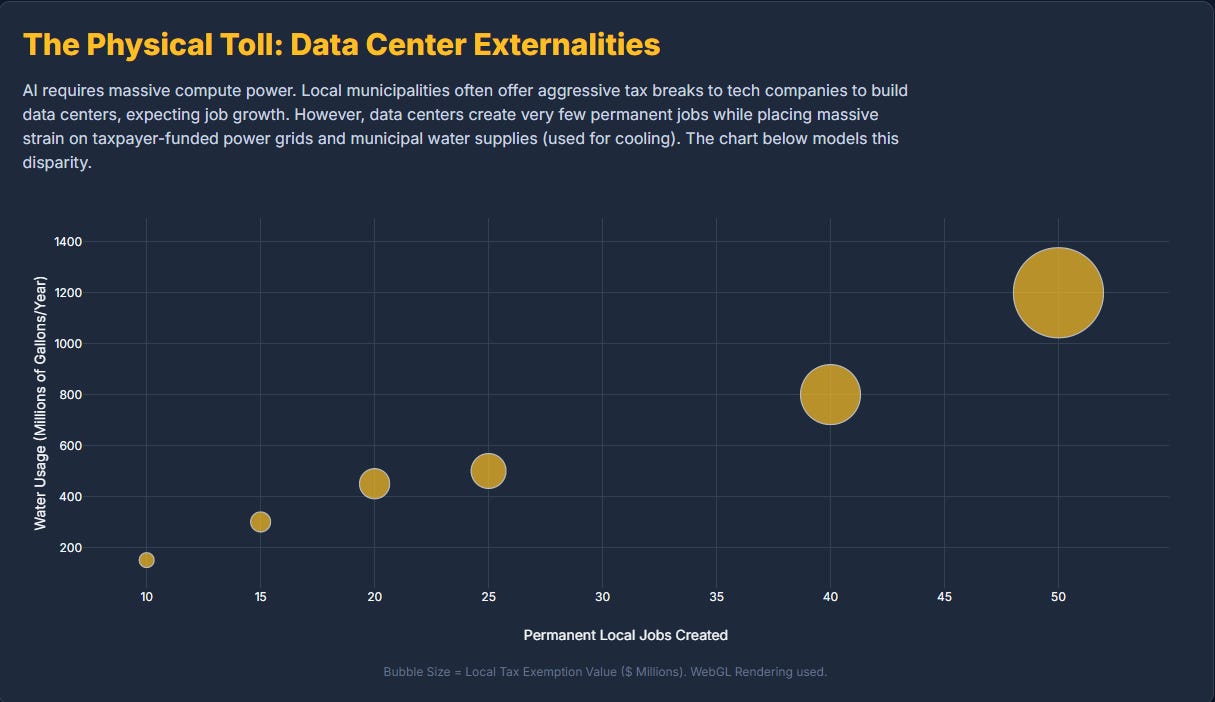
Thirty-eight states offer dedicated tax incentives for data centers. Eleven extend abatements to local property taxes. Fourteen exempt the electricity these facilities consume — the same electricity already being subsidized by residential ratepayers (more on that in Pipe 5). The numbers aren’t theoretical. Pull the audits:
Virginia — the epicenter
Cumulative losses since 2010: roughly $2.7 billion. FY23: $685 million. FY24: $1 billion. FY25: between $1.6 billion and $1.9 billion in a single year. The data center exemption now constitutes nearly 80% of all state economic incentive spending — dwarfing the $750 million Amazon HQ2 grant. This program was built and expanded under Democratic Governors Terry McAuliffe and Ralph Northam. It is currently being expanded under Republican Governor Glenn Youngkin. Loudoun County — where data centers fund nearly half of county tax revenue — projects $1.3 billion in data center tax revenue for 2026, but the county budget office openly warns that any slowdown forces residential property and vehicle tax hikes. They built a fiscal house on a single industry’s boom. When the boom slows, you pay.
Texas — a $14 million giveaway that grew to $3 billion
A 2013 sales tax exemption originally scored at $14 million has grown to a projected $3 billion taxpayer cost. The Texas Senate Finance Committee, controlled by Republicans, is now belatedly trying to figure out what just happened. Governor Greg Abbott has signed every expansion since.
Georgia — a 7.4-to-1 net loss audited by the state itself
A 2025 Georgia state audit found data centers brought in $41 million in tax revenue while pulling $474 million in exemptions — a $433 million net loss in a single fiscal year. The auditors went further: they concluded 70% of these projects would have come to Georgia anyway, with no subsidy required. The forfeited revenue, they calculated, would have funded nearly 8,000 public sector jobs in education, healthcare, and public safety. Republican Governor Brian Kemp has not moved to fix it.
Nevada — $4.5 million per job
Customized “SB1” abatement packages cost the state up to $236 million in school support taxes and over $209 million in consolidated taxes per agreement. The qualifying threshold for a 20-year abatement: invest $100 million and employ 50 full-time Nevada residents. That works out to about $4.45 million in state tax forgiveness per job created. These deals were granted by Republican Governor Brian Sandoval, expanded by Democratic Governor Steve Sisolak, and renewed by Republican Governor Joe Lombardo. Bipartisan in every administration.
North Carolina — the wave is coming
With 6.3 GW of data center pipeline announced, North Carolina is on track for $1.5–$2.3 billion in lost taxes during construction alone, then approximately $450 million per year in operation — a 900% jump over current losses. The qualifying threshold remains a $75 million investment for unlimited abatement. Built under Democratic Governors Roy Cooper and Josh Stein, with no meaningful Republican opposition.
Ohio — even the industry-funded study admitted the game is over
Ohio offers a 100% sales tax exemption on data center equipment. Even the industry-commissioned report claiming a $2.7 billion “net gain” from 2017 to 2024 warned the incentive arms race is effectively over: 37 peer states now offer identical exemptions, so the break has become redundant table stakes. Republican Governor Mike DeWine is keeping the exemption anyway.
Pipe 5: The Stealth Tax on Your Power Bill, Your Water Bill, and Your Municipal Bonds
This is the pipe nobody wants to talk about, because it shows up on receipts you’ve already paid.
Your power bill is subsidizing Microsoft’s margin
State-regulated utility monopolies are negotiating sweetheart “special contracts” with hyperscalers below the cost of service. Internal Duke Energy documents revealed plans to shift a $325 million customer discount onto residential ratepayers. In Maryland, an antiquated FERC cost-allocation formula stuck Maryland residents with the majority of the state’s $500 million share of a $5 billion regional transmission build, most of it driven by data center load. In the PJM grid (65 million people across 13 states), power supply costs jumped from $2.2 billion to $14.7 billion in a single year. Data centers accounted for nearly two-thirds of the increase. Residential electricity rates rose roughly 32% nationally between July 2020 and July 2025. That is not “inflation.” That is a redistribution.
And to make sure the redistribution scales, the Department of Energy’s Grid Resilience and Innovation Partnerships (GRIP) program — funded by the Bipartisan Infrastructure Law — has dished out $4.2 billion in round-two funding “to enable additional grid capacity to meet load growth stemming from data centers.” The DOE’s “Speed to Power” Request for Information is hunting transmission projects that can move 20 GW of incremental load specifically for AI. The Trump White House’s July 2025 EO 14318 then streamlined FAST-41 permitting and identified NEPA categorical exclusions for any qualifying AI infrastructure project. Both parties paved the road.
Your water bill is cooling Sam Altman’s GPUs
A typical hyperscale data center uses up to 5 million gallons of water per day — the daily consumption of a town of 50,000 residents. UC Riverside and Caltech researchers calculated that municipal water systems will need $10–$58 billion in new public infrastructure investments to handle peak data center demand. Within four years, AI cooling alone could require an additional 1.45 billion gallons per day at peak. Tech companies occasionally chip in for token water-reuse projects — a $31 million reuse facility in Quincy, Washington co-funded with Microsoft is the favorite case study. Cities pay for the rest, with bonds.
Your municipal bonds are being weaponized against you
Public power utility bond issuance hit $26.8 billion in 2024 — nearly double the 10-year average of $14 billion. The Large Public Power Council and the American Public Power Association are now actively lobbying Congress and Treasury to loosen IRS “private use” rules so municipalities can issue tax-exempt debt explicitly to build dedicated infrastructure for private AI firms. If they succeed, your local government will borrow on your dime, at a tax-exempt rate that costs the federal Treasury, to construct proprietary infrastructure for trillion-dollar tech companies. Public risk. Private asset. Fee for service: zero.
The Punchline
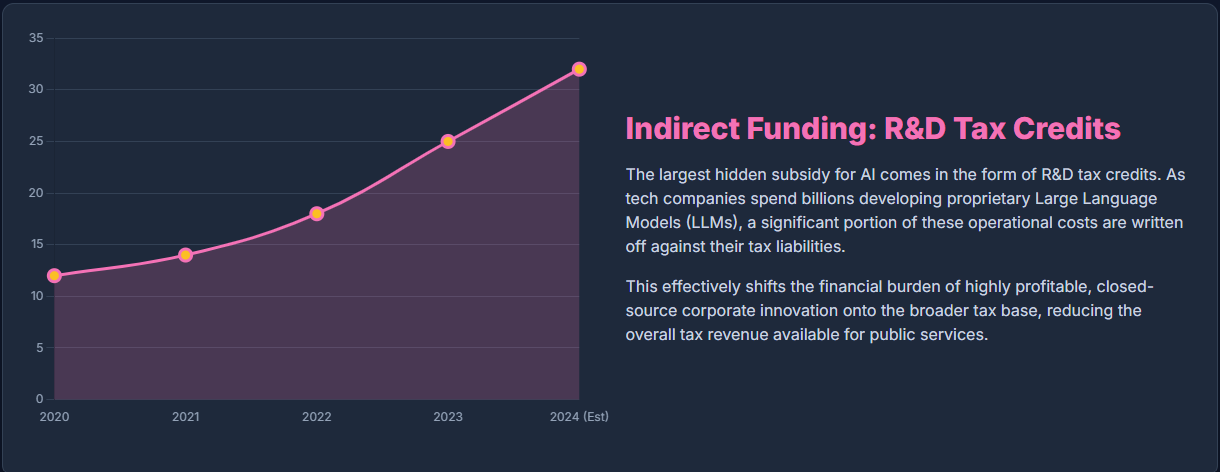
So — the federal government funded the foundational research. The federal government subsidized the chips. The federal government wrote the procurement contracts. The states gave away the property taxes, sales taxes, and electricity taxes. The utilities cross-subsidized the power. The municipalities issued the debt and built the water systems. The taxpayers absorbed the rate hikes.
And now what?
Now Goldman Sachs estimates 300 million jobs globally are exposed to AI automation. CBRE Research reports that AI investment in 2025 was equivalent to roughly half of total U.S. GDP growth — meaning the rest of the economy was essentially flat. Employment among entry-level workers in the most AI-exposed occupations is already 13% lower than for less-exposed roles since 2022. The International Labour Organization adjusted its 2025 outlook downward by 7 million jobs.
You paid for the algorithms. You paid for the chips. You paid for the data centers. You paid for the power grid. You paid for the water mains. You paid for the municipal bonds. And now the same companies that took all that public money are using it to figure out how to remove you from the payroll — and to sell that capability, as a service, to your employer.
When you are laid off and your replacement is a transformer model trained on a federally funded GPU cluster, cooled by city water, powered by ratepayer-subsidized electricity, hosted in a building that paid no property tax, on equipment that paid no sales tax, on land permitted under a NEPA categorical exclusion — that’s not “the free market.” That is a wealth transfer from labor to capital, and you funded it.
And here’s the cherry on top: federal payroll taxes — the dollars that fund Social Security and Medicare — are calculated as a percentage of W-2 wages. Every job replaced by an algorithm is a permanent hole in the payroll-tax base. RAND modeled a scenario in which AI-driven price deflation drops Nominal GDP enough to plunge federal tax revenues by 25%. Once the Social Security trust fund is exhausted, the only options are benefit cuts to retirees or deficit-financed bailouts. Either way, the bill comes back to you.
The Names
I am not going to let any politician hide behind “well, technology is complicated.” Every name below voted for, signed, or actively expanded a specific funding pipe described in this article. Look up your representatives. If they’re on this list, they earned a primary challenge or a general-election loss — regardless of party.
CHIPS Act yes votes that handed $53B to chipmakers
Senate Republicans (17): Blunt (MO), Burr (NC), Capito (WV), Cassidy (LA), Collins (ME), Cornyn (TX), Daines (MT), Graham (SC), Hagerty (TN), McConnell (KY), Moran (KS), Portman (OH), Romney (UT), Sasse (NE), Tillis (NC), Wicker (MS), Young (IN).
Senate Democrats and Independents: every member of the Democratic caucus except Bernie Sanders. That includes Schumer (NY), Warner (VA, co-sponsor), Cantwell (WA), Klobuchar (MN), Wyden (OR), Brown (OH, then), Tester (MT, then), Manchin (WV, then), Sinema (AZ, then) — the entire caucus.
House Republicans (24): Anthony Gonzalez (OH), Brian Fitzpatrick (PA), Chris Jacobs (NY), Fred Upton (MI), John Katko (NY), Kay Granger (TX), Liz Cheney (WY), Michael McCaul (TX), Peter Meijer (MI), Rodney Davis (IL), Steve Chabot (OH), Tom Cole (OK), Troy Balderson (OH), Young Kim (CA), Adam Kinzinger (IL), and others. (Some have since left office; their successors should be asked where they would have voted.)
House Democrats: every member except Sara Jacobs (CA), who voted “present.”
Federal officials who built and ran the AI subsidy pipeline
• Joe Biden — signed CHIPS into law; signed EO 14141 in January 2025 (later revoked) on AI infrastructure on federal lands.
• Donald Trump — signed EO 14179 (January 2025) directing removal of “barriers to AI leadership”; signed EO 14318 and the AI Action Plan (July 23, 2025) directing Commerce to launch financial support for “Qualifying Projects,” declaring federal subsidies under 50% of project cost presumptively non-NEPA, opening federal lands at Idaho National Lab, Oak Ridge, Paducah, and Savannah River for data center development; pushed the One Big Beautiful Bill in mid-2025 that further altered the energy/AI investment landscape.
Gina Raimondo (D) — Commerce Secretary; ran the original CHIPS rollout, lobbied senators with closed-door national security briefings to flip swing votes.
Howard Lutnick (R) — Commerce Secretary, current; tasked with launching the post-EO financial support initiative for data center “Qualifying Projects.”
Pete Hegseth (R) — Secretary of Defense; presided over the 1,500% Pentagon AI contract surge, signed approval pacts with seven major commercial vendors, blacklisted Anthropic over safety guardrails.
Chris Wright (R) — Secretary of Energy; “Speed to Power” RFI for 20 GW of new AI-driven transmission; selected federal lab sites for hosting commercial data centers.
Lee Zeldin (R) — EPA Administrator; tasked with rewriting Clean Air Act, Clean Water Act, CERCLA, and TSCA permitting to expedite “Qualifying Projects.”
Governors actively running data center subsidy programs at a documented net loss
Glenn Youngkin (R-VA) — expanding the largest data center exemption regime in the country during a $1.6–$1.9B annual revenue loss
Ralph Northam and Terry McAuliffe (D-VA, retired) — architects of the Virginia regime
Greg Abbott (R-TX) — every CHIPS-era expansion of the Texas data center exemption
Mike DeWine (R-OH) — 100% sales tax exemption, kept after the industry’s own report admitted it’s redundant
Brian Kemp (R-GA) — the $433M-net-loss program flagged by his own state auditor
Joe Lombardo (R-NV) — renewed SB1-style abatements
Brian Sandoval (R-NV, retired) and Steve Sisolak (D-NV, retired) — built the Nevada regime
Roy Cooper (D-NC, retired) and Josh Stein (D-NC) — built and continue the North Carolina pipeline
One political honorable exception worth noting: Governor Katie Hobbs (D-AZ) proposed in 2025 to roll back data center exemptions and impose a water-volume surcharge to fund a Colorado River Protection Fund. The Republican-controlled Arizona Legislature has resisted. If you live in Arizona, this is the rare cross-aisle fight where the lines are not what you might assume — vote accordingly.
The lobbyists you’ve never heard of who run the racket
Most state-level data center legislation is not drafted by your state legislators. It is drafted, edited, and shopped by the same handful of trade groups in every capitol in America:
The Data Center Coalition
The Information Technology Industry Council (ITI)
The Large Public Power Council
The American Public Power Association
The U.S. Chamber of Commerce
They write the model bills. State legislators paste their names on top. If your state legislator can’t explain the deal in their own words, that’s why.
The corporate beneficiaries who took your money
These are the names on the awards letters, the procurement contracts, and the special-rate filings. Not anonymous. Not unreachable. Their CEOs all have email addresses.
Microsoft — Satya Nadella
Alphabet/Google — Sundar Pichai
Amazon/AWS — Andy Jassy
Meta — Mark Zuckerberg
Nvidia — Jensen Huang
OpenAI — Sam Altman
Palantir — Alex Karp
SpaceX — Elon Musk
Oracle — Safra Catz
SK hynix, Texas Instruments, GlobalFoundries, Amkor Technology — the CHIPS award recipients on the silicon side
What You Can Actually Do
Outrage without action is just entertainment for the powerful. Here’s a practical playbook — ranked roughly from highest leverage to lowest, but every one of them matters.
1. Vote out every incumbent who voted for the CHIPS Act, regardless of party. Look up your senator and your representative’s vote. Senate roll call: senate.gov, vote 117-2-271. House roll call: clerk.house.gov. If they voted yes, vote them out — primary challenger, general-election opponent, doesn’t matter. Pin the vote to their record. Forward the roll call to ten people you know in their district.
2. Vote out any state legislator who voted to create or expand a data center tax abatement. These exemptions, dollar-for-dollar, are the single worst deal in your state tax code right now. State roll calls are public; many state newsrooms now publish searchable databases. Find yours. The single mom in Loudoun and the rancher in West Texas have a common interest in this fight even if they disagree on everything else.
3. Show up at your Public Utility Commission rate hearings. PUCs are where utilities get permission to socialize hyperscaler discounts onto your bill. These hearings are sparsely attended and notice is buried. Sign up for your state PUC’s docket alerts. When a “special contract” or rate-base expansion comes up, file a public comment. Five organized commenters at a PUC hearing have more impact than five thousand angry tweets.
4. Demand transparency on every data center deal in your county. Property tax abatements, special assessment districts, water guarantees, electrical interconnect agreements — all of it. Counties hate publishing these in plain language because the deals are usually indefensible. Force them. FOIA the term sheets. Publish them. Read them at the public-comment portion of board meetings.
5. Oppose the “private use” loosening on tax-exempt municipal bonds. This is the active fight in Washington right now. The Large Public Power Council and APPA are pushing the IRS and Treasury to let municipalities issue tax-exempt debt for dedicated AI infrastructure. Call your senators. Tell them no. Tell them you understand exactly what it does — privatize the asset, socialize the risk, stiff the federal Treasury. They will be shocked you know what private-activity bond rules are. Use it.
6. Support the moratoriums. Over 100 local communities have already passed zoning or permitting moratoriums on new data centers. New York, South Dakota, and Oklahoma have moratorium bills moving at the state level. Indiana’s HB1333 wants data centers to contribute 1% of their exempted taxes back to local government. Arizona’s Hobbs proposed a water surcharge. Maine and Missouri are banning AI therapy chatbots. These bills usually die quietly because nobody shows up. Show up.
7. Demand a “robot tax” or AI excise tax on your state’s revenue agenda. New York’s proposed Robot Tax Act (A3719) would impose a surcharge on corporations using AI to displace human employees. Whether it’s that exact bill or a different framing — a payroll-replacement tax, a token tax on AI-generated outputs, an excise on autonomous transactions — the principle is identical: if a corporation captures the value of automation, it should fund the social costs of automation. Your state representatives need to hear this from you, not from a Brookings paper.
8. Read the public records yourself and quote them. The OMB AI use-case inventory, the CHIPS award letters, the state tax incentive evaluations, the FERC filings, the GRIP awards — every dollar is public, named, and searchable. Most of your fellow citizens don’t know these exist. Forward them. Quote them. Make them inescapable in your local civic conversation. The single most subversive thing an American taxpayer can do right now is read their own government’s budget.
The Bottom Line
This isn’t a Republican scandal. It isn’t a Democratic scandal. It is an American scandal — a bipartisan, federal-state-municipal, executive-legislative, public-private machine for moving wealth out of the working and middle class and into a handful of trillion-dollar tech corporations and their executives, while using public funding to build the very technology that will eventually shrink the labor force funding it.
The good news is that, for once, the machine is easy to see. The dollar amounts are documented. The roll-call votes are public. The award letters are scanned and searchable. The PUC dockets are scheduled. The moratorium bills are filed. The names are knowable.
You weren’t supposed to follow the money. You’re supposed to keep believing the story about the brilliant entrepreneurs and the glorious innovation and the inevitability of it all. The entire AI mythology assumes you will not read the federal budget, the state audits, the FERC filings, and the bond prospectuses.
Read them. Then vote.
Paying for our own demise. It's incredibly infuriating, but thanks for this informative post and for the action steps.