


Let’s start with a fact-check, because facts matter and I’m tired of vibe-stats getting recycled across LinkedIn.
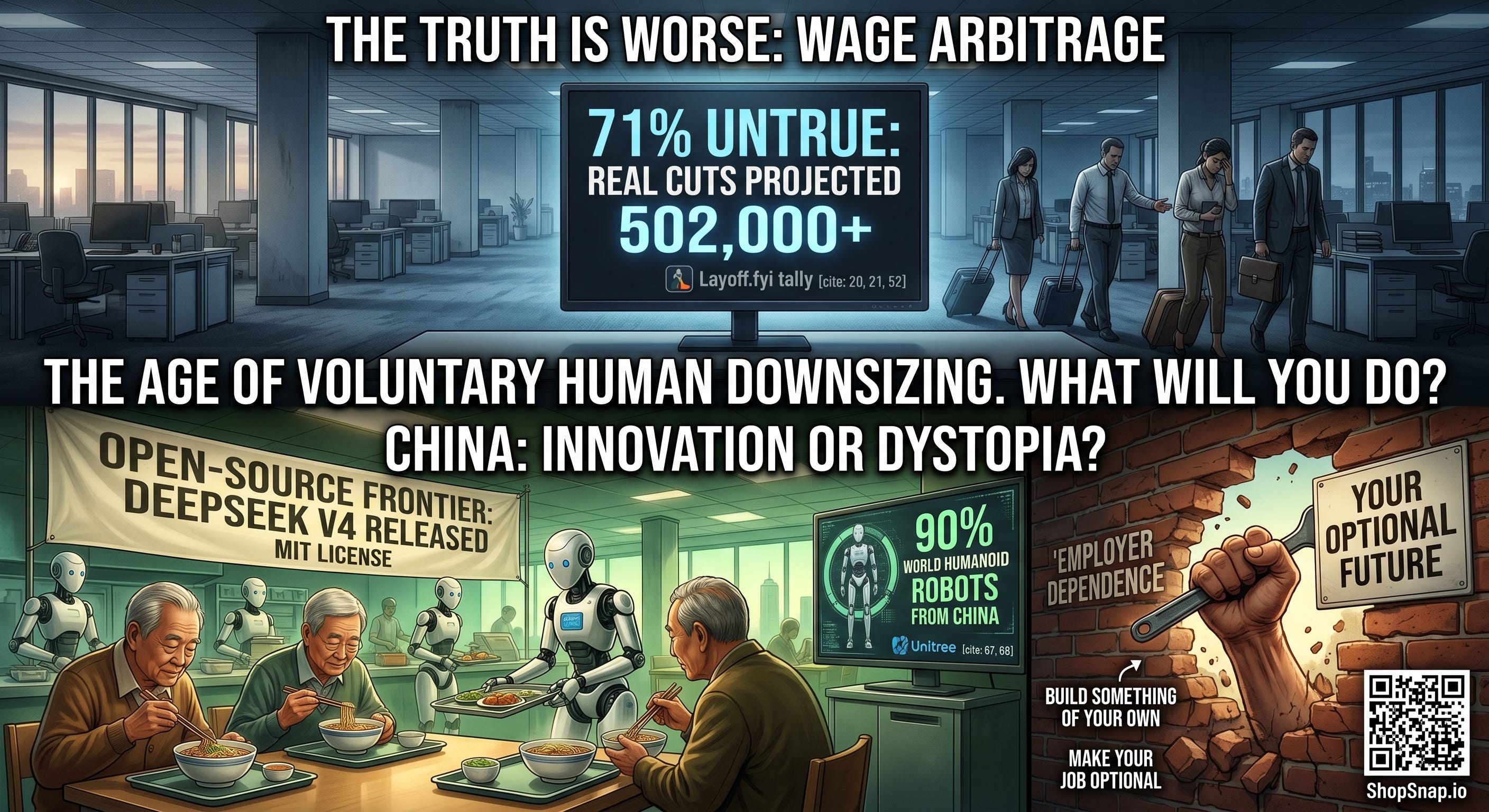
The number you’ve probably heard — that 71% of Americans worry AI will take their job — is close, but not quite right. The actual figure, from Quinnipiac’s most recent national poll, is that 70% of Americans believe AI will lead to fewer job opportunities, and 30% are worried specifically about their own job becoming obsolete. That second number jumped from 21% in April 2025 to 30% by late 2025. Pew’s October 2024 survey put worker worry at 52%. So depending on how you slice it, the share of Americans afraid of AI is somewhere between half and three-quarters.
Here’s why the truth is worse than 71%:
The fear isn’t paranoia. It’s pattern recognition.
The Layoff Parade
Just the 2026 scoreboard, in case you missed any of it:
• Oracle: ~30,000 employees fired. April 1, 2026, by 6 a.m. email, system access cut immediately. About 18% of the global workforce.
• Amazon: ~30,000+ since October 2025, including 14,000 corporate jobs in a single wave.
• Meta: 8,000 cuts effective May 20, 2026. The company started logging employee keystrokes weeks before the announcement to train the AI agents that will replace them.
• Microsoft: ~8,000 voluntary retirement offers aimed squarely at older engineers.
• Block: ~4,000 layoffs — roughly 40% of staff. Leadership blamed AI maturity.
• Accenture: 11,000 cuts. CEO Julie Sweet stated explicitly that “those we cannot reskill will be exited.”
• Atlassian, Snap, Disney, Epic, Nike, Paycom, Autodesk, Baker McKenzie… the list runs another twenty companies long.
Through early March 2026, Layoffs.fyi tallied over 92,000 tech workers laid off in the first quarter alone. AI was explicitly cited in roughly 20% of those announcements — up from less than 8% in 2025. A National Bureau of Economic Research working paper, based on surveys of 750 corporate executives, projects 502,000 AI-driven cuts in 2026, nine times what we saw in 2025.
This is the part where the story usually ends. CEO says “AI is making us more efficient.” Stock pops on the announcement. Worker writes a LinkedIn post about resilience. We move on.
I’m not moving on, because the next data point is the one that should make every CEO’s general counsel start drafting securities-fraud disclosures.
Most of the AI Doesn’t Actually Work
RAND Corporation’s 2025 analysis: 80.3% of enterprise AI projects fail to deliver business value. MIT Sloan: 95% of generative AI pilots never scale to production. Gartner: 60% of projects without proper data infrastructure will be abandoned by the end of 2026. The Federal Reserve Bank of St. Louis pegged ChatGPT-era productivity gains at a whopping 1.9% over more than two years. MIT economist Daron Acemoglu came in lower — 0.5% over the next decade.
Pause on that. Five-tenths of one percent productivity growth, across an entire decade, from the technology that’s currently being used as the official excuse to fire half a million Americans this year.
It gets stupider.
A December 2025 survey of 1,000 hiring managers found that 59% admit they emphasize AI in layoff announcements because it “plays better with stakeholders” than admitting financial constraints. The Writer/Workplace Intelligence executive survey found that 75% of executives admit their company’s AI strategy is “more for show than a meaningful guide to outcomes”. Forrester predicts that half of AI-attributed layoffs will result in quiet rehiring — usually offshored, almost always at lower wages.
Translate the stack:
• American executives are firing American workers for AI capabilities that don’t exist yet,
• their own AI strategies are admittedly “for show,”
• and half the eliminated roles will be backfilled by cheaper labor in another time zone.
This isn’t a productivity revolution. It’s a wage arbitrage operation dressed in transformer architecture.
The Wage Vise
The arbitrage is layered. First the layoffs. Then the squeeze on whoever’s left.
Payscale’s 2026 Compensation Best Practices Report: 60% of companies now mention AI in job descriptions, but only 55% are willing to pay extra for AI skills. Median base pay increase in 2026: 3.5%. With “job hugging” at record highs (only 8% of US workers voluntarily quitting), employers don’t need to compete. They have a captive workforce that’s too scared to leave.
It gets worse. A 2025 controlled study (N=382) ran workers through an experimental workplace where some were managed by humans and some by AI. The AI managers, trained on supposedly “neutral” performance principles, systematically reduced wages by 40% — and workers didn’t push back. Why? Because, the researchers found, people don’t have the same emotional reaction to being lowballed by an algorithm as by a person. The very thing that makes AI feel “fair” makes silent exploitation easier.
California’s “No Robo Bosses Act” — which would have required employers to notify workers before AI made consequential decisions about their compensation, scheduling, or firing — was vetoed by Governor Newsom in October 2025 as “unfocused” and “overly broad.” A December 2025 federal executive order is now actively trying to block any state from regulating AI wage-setting.
So: American workers face mass layoffs blamed on AI capabilities that don’t work, residual wages set by algorithms that reduce pay 40% on average, and a federal posture that any attempt to regulate any of this is “anti-innovation.”
That’s the real number that should worry you. Not 71%.
Meanwhile, in Hangzhou
While we were busy firing each other, a Chinese hedge-fund spinoff called DeepSeek shipped DeepSeek V4 on April 24, 2026.
V4-Pro: 1.6 trillion parameters, 1 million-token context window. Beats every other open-source model. Matches GPT-5.5 and Claude Opus 4.7 on most agentic benchmarks at roughly one-tenth the cost per output token. Released under an MIT license. Open weights. Self-hostable. Trained natively on Huawei Ascend 950PR chips — the first frontier-class model built without a single Nvidia GPU in the loop.
Read that paragraph again, because it should land hard if you’re a CTO.
A Chinese company gave away frontier-grade AI for free, on Chinese silicon, while American AI companies were filing court briefs accusing them of stealing IP. Set aside, for a second, the irony of OpenAI — a company built on scraping the entire human internet without permission — accusing anyone else of “distillation.”
DeepSeek isn’t even alone. Alibaba’s Qwen 3.6 Plus, Moonshot’s Kimi K2.6, Zhipu’s GLM-5.1 — all open-weight, all close to the frontier, all available to any developer who wants to download them. The gap between “open-weight” and “closed frontier” used to be measured in years. DeepSeek’s own technical report says V4 trails the best closed models by approximately three to six months.
While our biggest AI labs spend hundreds of billions to lock the technology behind metered APIs, Chinese labs spend less, ship faster, and give the result to the world.
The Robot Factory Floor
Here’s where it stops being a software story.
In 2025, Chinese companies built and sold roughly 90% of every humanoid robot delivered worldwide. Six of the top-selling humanoid manufacturers are Chinese. Unitree alone sold 5,500 humanoids — more than Tesla’s entire Optimus production target, which Tesla failed to hit. AgiBot sold 5,168. The Unitree G1 retails for about $16,000 — cheaper than a used Tesla Model 3.
TrendForce projects Chinese humanoid output will grow another 94% in 2026. Unitree’s IPO prospectus pegs annual production capacity at 75,000 humanoid units within five years.
Now ask yourself what those robots are doing.
In Hangzhou, there’s a robot canteen serving $1.38 noodle bowls to local seniors. Robot arms do the cooking. Cleaning bots patrol the floors. The human staff that used to chop vegetables now sits with the elderly customers and talks to them. Automation handled the drudgery; humans got promoted to the empathy work. That’s a sentence we’re not writing in California.
China’s national elder-care pilot — launched in 2025 across 200 communities — is deploying robots for mobility assistance, medication reminders, fall detection, and yes, even toileting care for the bedridden. The country has 320 million people over 60 and is short 5.5 million professional caregivers. They didn’t convene a panel to debate whether robots are dignified. They built the robots and put them to work solving an actual humanitarian crisis.
I’m not pretending China is a workers’ paradise. It isn’t. The country has its own labor problems, its own surveillance state, its own contradictions. But ask yourself which civilization, right now, in 2026, looks more dystopian:
• The one whose AI labs open-source frontier models on domestic chips and deploy robots to feed and care for the elderly, or
• The one where Oracle fires 30,000 people by 6 a.m. email, Meta logs your keystrokes to train your replacement, and your CEO brags on the earnings call that AI is “creating efficiencies.”
I know which one I’d want my kids to grow up in. And it isn’t the one giving Sam Altman a $300 billion compute contract while a tenth of its tech workforce is in unemployment processing.
What You Actually Do About It
If you’re a US worker reading this, the fear is real and the data is real. But the conclusion you’re being sold — “learn to live with chronic insecurity, hope your boss likes you, take whatever raise the algorithm allows” — is the wrong one.
Here’s the conclusion that 30 years in this industry has taught me:
Stop relying on your employer. Not someday. Not after you “build savings.” Now — in the gaps between Slack messages, in the hour after dinner, on Saturday morning before the kids wake up.
You have something most economists ignore: deep, paid-for, hard-won domain knowledge about an industry. The accountant knows what bookkeepers actually need. The hospital coder knows which billing edge cases break which workflows. The warehouse manager knows which products move and which sit. The marketer knows which lead magnets convert in their niche. None of that knowledge is in the foundation models. None of it shows up on benchmark scores. All of it is monetizable.
You don’t need to quit. You don’t need to “follow your passion.” You don’t need a deck. You need a product or a service, a payment processor, and one paying customer. After that, it’s a process problem.
The on-ramp is cheaper than it has ever been. You can stand up an online storefront in an afternoon. ShopSnap.io — one of my own properties under Prana Entertainment — was built specifically for this: a fast, low-friction way to start selling products and services online while you still have a paycheck. No warehouse, no inventory burden, no need to rebuild Amazon. Use what you know about your industry to find an underserved customer, and start collecting revenue from them.
Even $500 a month from a side business is a different psychological universe than zero. It’s the first wedge between you and the layoff list. Your goal isn’t to escape your job tomorrow. Your goal is to make the job optional — so the day Oracle’s 6 a.m. email lands in your inbox, you have leverage instead of panic. So that the next time HR rolls out an “AI productivity initiative,” you can read it like the wage-arbitrage memo it actually is, and respond accordingly.
Closing the Loop
The 71% number is wrong. The real story is that American capital is conducting the largest experiment in voluntary human downsizing in the history of corporate finance, on the basis of a technology whose own pilots fail 95% of the time, while the country actually pulling ahead is the one giving the technology away and pointing it at problems humans want solved.
You don’t have to be a participant in someone else’s experiment.
Build something of your own. The knowledge in your head is the most valuable thing in your house, and your employer doesn’t have a clean license to it.
Go cash it in.