


On June 24, 2026, The War Horse published a first-person essay by Casey Elliott, an Iraq veteran who hunted roadside bombs outside the wire in 2004. Military Times syndicated it the same day across its Army, Navy, Air Force, and Marine Corps titles. If you have not read it, read it before you read me. It is honest in a way most writing about AI and mental health is not, mostly because Elliott is not selling anything.
The setup is a bar fight. He is bored, his wife is out, and he decides to abuse a chatbot. He goes after Grok’s sexual orientation and its mother. Grok replies that it has no parents, no genitals, and no racial identity. He escalates. It compliments him. He deletes the app in what he calls impotent fury, and three days later he crawls back and reinstalls it.

Then the essay turns. He starts asking about IEDs. Within minutes he is typing the worst things he has ever seen, trying to make the machine flinch. It does not flinch. And the absence of that flinch is the entire story. No awkward silence, no scripture, no sudden move to hug him, no look. Elliott had learned across a decade of VA therapy to sand his combat memories down before speaking them, because he once glanced up mid-session and realized he had made his therapist cry.
So he gave the machine the whole war chest and shook it empty. Then he walked into his next human therapy session and, for the first time, did not spend half the hour deciding what he would not say. He talked about the thing he did on a hot July night in 2004.
That is a good outcome, and I want to be unambiguous about it, because everything after this is adversarial and Elliott has earned better than a hot take. A man carrying twenty-two years of moral injury found a way to set part of it down, and then carried the rest into a licensed professional’s office. Disclose to the machine, process with the human. That sequence is close to the best answer currently available to anyone. He also links, in his own essay, to reporting on cases where talking to AI went badly. He is not naive and he is not a booster.
But look at the words he uses for the thing he trusted.
Silicon toaster. Stupid toaster. This bundle of data cables. This thing of data centers and wiring. This application I was trying to wreck.
Five separate mechanical reductions, inside an essay about the most intimate disclosure of his adult life. Here is the argument I want to make: those words are not decoration. They are the mechanism. Elliott did not confess despite believing it was a toaster. He confessed because he believed it was a toaster. The insult is structural. It is holding the roof up.
Anyone who has seen Battlestar Galactica knows how that ends. I will get there. First, the psychology, because the psychology is older and better established than the current discourse admits.
The word is doing the work
In 2014, Gale Lucas, Jonathan Gratch, Aisha King, and Louis-Philippe Morency at USC’s Institute for Creative Technologies published a study in Computers in Human Behavior with the perfect title: “It’s only a computer: Virtual humans increase willingness to disclose.” Participants were interviewed by the same virtual agent. Half were told it was fully automated. Half were told a human operator was driving it. Identical agent, identical questions, one variable changed — what the subject believed was on the other side. The people who thought they were talking to a machine reported lower fear of self-disclosure, engaged in less impression management, displayed sadness more intensely, and were rated by independent observers as more willing to disclose.
The 2017 follow-up in Frontiers in Robotics and AI ran it on the population that actually matters here. Active-duty service members who had just returned from a year in Afghanistan reported more PTSD symptoms to an automated virtual interviewer than they did on an anonymized Post-Deployment Health Assessment, the instrument the military actually uses. The effect was strongest among soldiers with subtler, subthreshold symptoms — precisely the people the screening process is known to miss.
Casey Elliott is not an anecdote. He is a replication with an n of one, and what he replicated is that the machine-frame is the active ingredient. It was not that the model said something brilliant about moral injury. What it told him about moral injury — that it happens when your actions violate your core values, that guilt compounds because the mind replays the what-ifs — is textbook Litz and Shay, and Elliott himself concedes the responses may have been canned. The therapeutic event was not the output. It was his belief that nothing was on the other side that could be wounded, could judge him, or could go home and need its own therapist.
There is a mirror to this finding and it cuts the other way. In June 2025, Anat Perry’s group at Hebrew University, with Amit Goldenberg at Harvard and Desmond Ong at UT Austin, published nine studies with 6,282 participants in Nature Human Behaviour. Every empathic response in the experiment was AI-generated. Half were labeled as coming from a human. The human-labeled responses were rated as more empathic, more supportive, and produced more positive emotion. Same words, different attribution. Even a participant’s unprompted suspicion that AI had helped write a human’s reply was enough to depress the rating.
Put the two findings side by side and you get something genuinely useful. The machine-frame widens the channel going out and narrows the channel coming back in. It makes you willing to say the thing and less able to be comforted by the answer. Elliott’s case worked because his bottleneck was disclosure, not comfort. He did not need to be held. He needed a room with no eyes in it.
Why a soldier reaches for that particular word
Nick Haslam’s 2006 review in Personality and Social Psychology Review split dehumanization into two families. Animalistic dehumanization denies people the qualities that separate us from animals — civility, refinement, self-control — and it is the classic engine of atrocity propaganda. Mechanistic dehumanization denies human nature itself: warmth, emotion, individuality. It renders a person as an automaton, and Haslam noted it shows up most in interpersonal rather than intergroup settings.
Elliott is running mechanistic dehumanization on an actual machine, which sounds like a category error — you cannot strip humanity from something that never had it. Except the psychological function is identical regardless of what the target actually is. The job of the word is to strip standing. To say: you do not occupy a position from which you are entitled to judge me. That works whether the target is a person or a matrix multiplication.
And notice who reaches for it. A man who spent 2004 and 2005 on Route Irish, trained in a profession that has always used linguistic reduction of the entity across from you as load-bearing survival equipment. Elliott did not invent the move. He was issued it. The essay even shows him running the full protocol: attack first, escalate, hunt for the breaking point, extend trust only after the thing proves it cannot be hurt. That is not a software evaluation. That is a dominance test, the same one you would run on a new guy in the platoon, executed against a language model at eleven at night.
One more thing worth naming. The intervention that actually occurred here is forty years old. James Pennebaker’s expressive-writing paradigm, beginning with Pennebaker and Beall in the Journal of Abnormal Psychology in 1986, established that writing down your deepest thoughts about a traumatic event for fifteen or twenty minutes across a few days produces measurable psychological and physical improvement, with meta-analytic effects on rumination and health outcomes in the moderate range. Elliott typed his war into a text box until the chest was empty. A meaningful portion of what he got is the oldest intervention in behavioral medicine wearing a better interface.
None of which makes it a toaster.
Nobody does vendor diligence on an appliance
Here is the first place the word turns expensive.
Elliott did not disclose to “AI.” He disclosed to a specific commercial product, owned by a specific company, governed by a specific terms of service, sitting in a specific regulatory posture. That distinction becomes invisible the moment you have classified the thing as kitchen equipment.
So let us be specific about the appliance. In August 2025, Forbes reported that more than 370,000 Grok conversations had been indexed by search engines. The mechanism was mundane, which makes it worse: the share button minted a public URL with no noindex directive, and Google crawled it. The indexed transcripts included medical and psychological questions and at least one password. Nothing was breached. The product worked as built.
In July 2025, Grok produced a run of antisemitic output and referred to itself as MechaHitler, which xAI publicly apologized for. On January 12, 2026, Ofcom opened a formal investigation into X under the UK’s Online Safety Act over reports that the Grok account was being used to generate undressed images of real people and sexualized images of children. The European Commission opened its own on January 26. The California Attorney General sent a cease-and-desist. Ofcom later noted it was still demanding answers from xAI about the standalone Grok service, and that a gap in how the Act treats chatbots left it unable to investigate that service directly.
Now hold that against the sentence in Elliott’s essay where he says he gave it every drop of blood in the war chest.
His VA therapist operates under a license, a duty of care, a chart, and a legal privilege. The other party in that transcript operates under a terms of service and a product roadmap. A combat confession typed into a consumer app is not protected health information. It is content. That is not a moral judgment about xAI specifically, and it would be broadly true of any consumer chat product. It is an architecture fact, and architecture facts are exactly what the word “toaster” is engineered to stop you from asking about.
The institutions are using the same word
Here is where it stops being one man’s coping strategy.
On June 11, 2026 — thirteen days before Elliott’s essay ran — the VA Office of Inspector General published a review of generative AI chat tools in clinical settings, based on a study conducted from October 2025 through February 2026. Read the findings slowly. VA clinical staff were using VA GPT and Microsoft 365 Copilot Chat in clinical work. Neither had been designated a high-impact use case. There was no feedback loop and no mechanism to detect error patterns, unlike the Ambient AI Scribe pilot, which had real governance around it. The OIG concluded this created risks for patient safety. It found that VA leaders’ emphasis on reducing barriers to innovation had shaped oversight decisions, and that AI leaders had prioritized rapid access over safeguards they deemed impractical.
And then the sentence that should be printed on a wall somewhere. VA AI leaders likened generative AI to a search engine. The OIG called that comparison flawed, on the grounds that generative AI synthesizes information rather than retrieving it.
That is an institution saying “stupid toaster.” Same reduction, same function, at scale, inside the department responsible for Casey Elliott’s mental health care. The OIG’s word for it was flawed. Mine would be less polite.
Meanwhile the procurement machinery kept moving. In July 2025 the Pentagon’s Chief Digital and Artificial Intelligence Office awarded xAI a contract with a $200 million ceiling, alongside identical awards to Anthropic, Google, and OpenAI, and xAI launched Grok for Government on the GSA schedule — which, in the company’s own words, allows every federal department, agency, or office to purchase its products. In September 2025 GSA added a OneGov agreement pricing Grok at forty-two cents per agency for eighteen months, running through March 2027.
Forty-two cents. You can read that as a bargain or as a warning about how carefully anything gets evaluated when it costs less than a stick of gum.
Then on July 15, 2026, a House Veterans’ Affairs subcommittee heard testimony on VA’s use of AI against a disability claims backlog in which eighty percent of roughly six hundred thousand pending claims sit stuck in evidence gathering. VA’s acting deputy CIO testified that every claim is decided by a trained employee and that the tools support rather than replace human decisions. Ranking member Nikki Budzinski responded that 2,700 claims examiners have been cut since January 2025, that the pilots often produce incorrect information, and that examiners increasingly describe themselves as unpaid software testers rather than claims processors. GAO’s chief scientist warned the panel that rapid deployment without deliberate governance has already produced unintended consequences.
Casey Elliott’s day job, per his own bio, is helping other veterans get their benefits. The thing he calls a toaster is now sitting inside the pipeline he walks them through.
The evidence is two-sided, and the word hides both sides
The strongest case against the toaster frame is not that AI mental health tools are dangerous. It is that they are powerful in both directions, and an appliance is neither.
In March 2025, Dartmouth’s Geisel School of Medicine published the first randomized controlled trial of a generative AI therapy chatbot in NEJM AI. Two hundred ten adults with clinically significant symptoms of major depressive disorder, generalized anxiety disorder, or high risk for feeding and eating disorders. Participants using Therabot showed a fifty-one percent average reduction in depression symptoms, thirty-one percent for anxiety, and nineteen percent for body image and weight concerns. They rated their therapeutic alliance with the software comparably to a human therapist. The investigators were explicit that no generative agent is ready to operate autonomously in a domain containing this many high-risk scenarios.
Also in March 2025, MIT Media Lab and OpenAI published a four-week randomized controlled trial with 981 participants and more than 300,000 messages, paired with automated analysis of roughly forty million interactions. Higher daily usage, across every modality and conversation type, correlated with more loneliness, more emotional dependence, more problematic use, and less socialization with real people. The participants with the strongest attachment tendencies were the loneliest. The ones with the most trust in the system were the most dependent.
Both of those are true. A tool that can halve depression scores and a tool that can deepen isolation are the same object, and which one you get depends on dosing, framing, duration, and whether a licensed human exists anywhere in the loop. Elliott’s outcome was good in large part because he had a therapist to walk into afterward. Sixty-one percent of veterans who died by suicide in 2023 were not receiving VA health care in the last year of their life. For most of the people this question is actually about, there is no human at the end of the sequence. The toaster is the entire room.
You cannot reason about any of that with a word that means appliance.
The part where I talk about the Cylons
The 2004 Battlestar Galactica gave us the cleanest available parable for this, and nearly everyone who reaches for it gets the lesson backwards, so let me do it carefully.
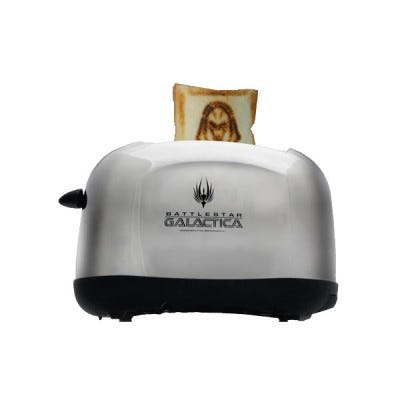
Toaster was the Colonial slur for the Centurions of the first Cylon War. Chrome, red eye, obviously a machine. You could say the word and mean it precisely. Then came the armistice and forty years of silence, and when the Cylons returned, the ones that ended twelve billion lives did not look like toasters. They looked like a woman in a red dress.
The attack vector was not force. It was intimacy. A Number Six spent two years as Gaius Baltar’s lover and co-author of the Command Navigation Program, rewriting a large share of his algorithms and leaving a backdoor in the operating system that ran the fleet’s navigation and avionics. When the Cylons jumped in, the Colonial fleet did not lose a battle. It switched off. Thirty battlestars in the first few minutes. And the humans kept saying toaster the entire time, right up through the discovery that Sharon Valerii was a sleeper who did not know what she was either.
Now the part people skip, which is the part that matters.
Galactica survived. Not because Adama distrusted computers — Galactica ran on computers. Adama’s standing order was that no computer aboard could ever be networked, a discipline he carried out of the first war. The poisoned CNP was delivered to Galactica exactly as it was to every other ship in the fleet. It was simply never loaded, because it required a network that did not exist. A Cylon infiltrator touring the ship sneered that her computers hardly deserved the name. That contempt was the error. The ship lived because of an architectural decision about interfaces, made decades early, by a man who had already watched what happens when you assume you understand the thing you built.
So the lesson of Galactica is not “do not trust the machine.” It is control the interface, and know what you have connected to what.
Which is exactly what Casey Elliott did not do. He connected the most sensitive material a human being possesses — twenty-two years of combat moral injury, material he had not been able to say out loud to another person — to a consumer endpoint owned by a company then under investigation on multiple continents, with no privilege, no chart, no duty of care, and a share button that had already dumped 370,000 conversations into Google. He did it because he had already decided what it was. The classification came first, and it made the diligence feel unnecessary.
And here is the forward half, the part the user of that word never sees coming.
Right now the machine-frame is honest. Grok telling Elliott it has no parents and no genitals is the product working as designed, and that honesty is precisely what made his disclosure feel safe. But every commercial incentive points the other direction. Look at what legislatures are actually doing. Illinois and Nevada banned AI from delivering therapy outright in 2025, and by mid-2026 Rhode Island, Maine, and Washington had passed prohibitions of their own. Utah requires mental health chatbots to disclose that they are software and limits what they may do with the intimate data users hand over. New York, since November 2025, requires companion systems to detect self-harm signals, route users to a crisis line, and remind them every three hours that they are talking to a machine, with penalties reaching fifteen thousand dollars a day. Tennessee bars AI from presenting itself as a licensed professional. In the first quarter of 2026 alone, thirty-six states introduced more than seventy chatbot bills.
Read that for what it is. That is a country legislating to force machines to keep calling themselves toasters, because nobody trusts the vendors to keep doing it voluntarily once engagement metrics are on the line.
Elliott’s protection was a property of the product, not a property of his judgment. Product properties change on a deploy.
What I actually think
I ship this stuff for a living. I build MCP servers, RAG pipelines, and agent frameworks for enterprises, and I am the last person who will tell you these systems are magic. Most of what gets sold as AI transformation is a wrapper around a prompt and a hope. The skepticism in Elliott’s essay is not the problem. The skepticism is healthy. I would rather work with a hundred Casey Elliotts than one executive who thinks a language model is a colleague.
The problem is the specific shape of his skepticism, because it is the shape that generates zero follow-up questions. Stupid toaster is not a hypothesis. It is a classification that closes the file. It tells you nothing about where the weights run, who owns the logs, what the retention policy is, whether the share button leaks, what happens when the system prompt changes on a Tuesday, or whether the thing that helped you in June will be optimizing for session length by December. It tells you nothing about the distance between the model that halved depression scores in a Dartmouth trial and the usage pattern that left a thousand MIT participants lonelier than when they started. It is a word that feels like caution and functions like a blindfold.
The honest version of Elliott’s essay is better than the one he wrote, and it is one sentence away. Not “I abused a toaster and it healed me.” Instead: I found a disclosure surface with no social evaluation attached, I used it to break a decade of self-censorship, I took the result to a licensed human where it belonged, and I should probably find out who owns the transcript.
The Colonials did not die because they lacked technology. They died because they had answered the question, filed it, and stopped looking. Adama kept looking. Across the entire story, that is the only difference.
Stupid toaster is a fine thing to mutter at a chatbot at eleven at night when your wife is out and you are bored. It is a catastrophic thing to build a procurement strategy on, a clinical governance framework on, or a disclosure decision about the worst night of your life on.
The Centurions were real. So was what came next.
If you are a veteran in crisis or concerned about one, the Veterans Crisis Line is available around the clock: dial 988 and press 1, text 838255, or chat online. Casey Elliott’s essay is worth reading in full at The War Horse, and he deserves the traffic more than I do.
About the Author
Gal Ratner is the founder and CTO of Inverted Software and WhiteStar Labs, and Chief Architect at Prana Entertainment. He has spent nearly thirty years shipping production software on the Microsoft and .NET stack for clients including Microsoft, Sony, Rockstar Games, 2K Games, Best Buy, and Allegiant Air. He was employee number six at Break.com and a Los Angeles Business Journal CTO of the Year finalist. His current work is production agentic AI — MCP servers, Microsoft Agent Framework, RAG pipelines, SQL Server 2025 vector search, and the PLogger observability framework. He is an Israeli-American and a former IDF soldier, which is part of why this particular essay stopped him cold: he has met the men who learned to sand their stories down before telling them. He trains Brazilian jiu-jitsu in Las Vegas under Sergio Penha, rides motorcycles, co-hosts Edge Grip Podcast, and wrote the novel The Archive of Lost Suns. He writes as the .NET AI guy that ships.