


There is a specific sound a Fortune 500 executive makes when the invoice arrives. It is somewhere between a gasp and a deposition. For two solid years these people stood on stages with the confidence of men who had never read their own AWS bill and told us that the human being—the one with the dental plan and the opinions—was a line item they could not wait to delete. Headcount was friction. Salaries were legacy infrastructure. The future, they explained slowly, as if to a child, did not require people. The future required a subscription.
And then the future sent them a subscription. And now they are crying.
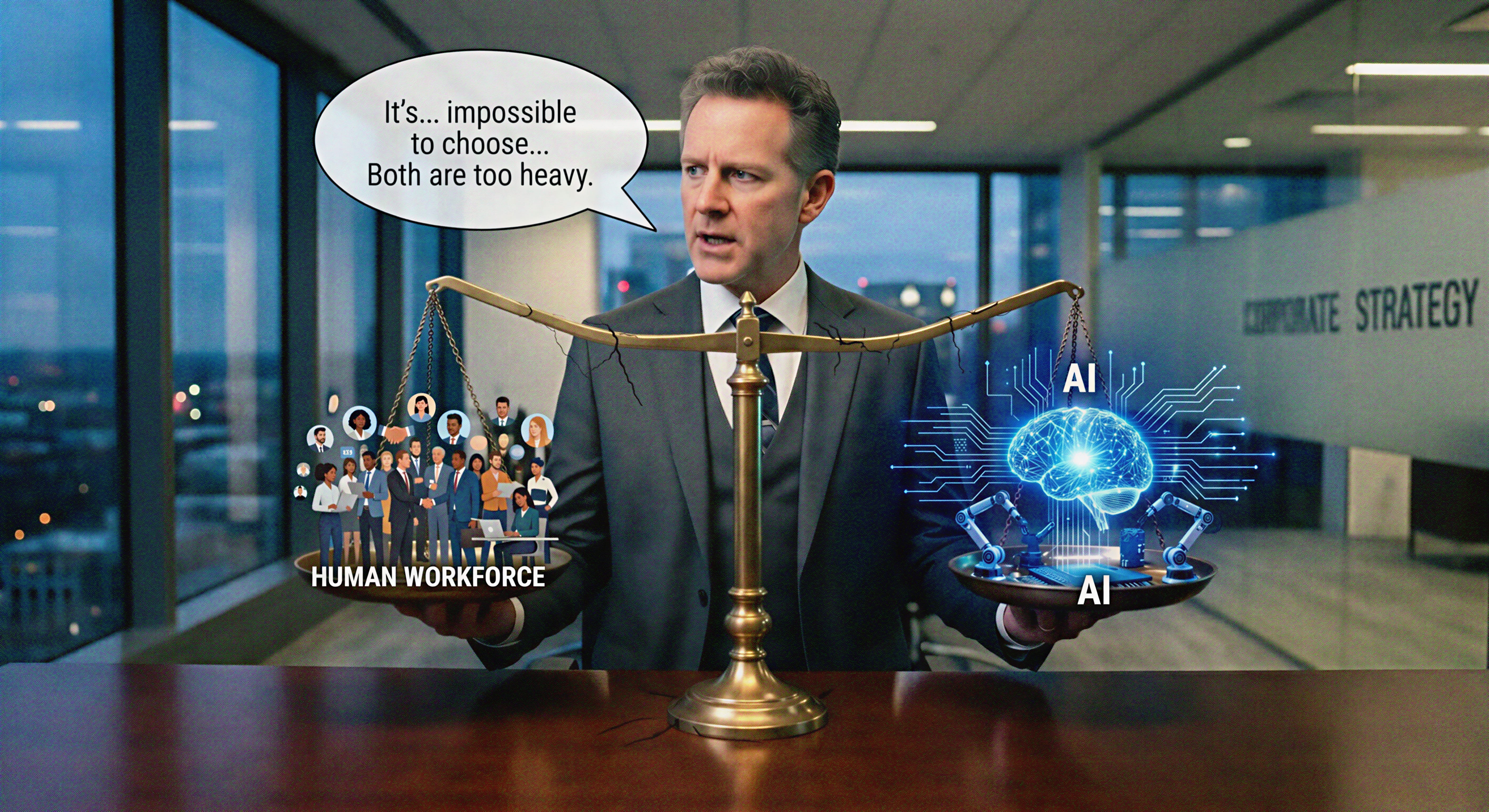
I want to be precise about the comedy here, because it is a very particular and very stupid kind of comedy. These are not people who tried artificial intelligence, found it lacking, and made a sober engineering decision to walk it back. These are people who fired their employees for being expensive, bought a machine to replace those employees specifically because they were told it would be cheaper, discovered that the machine is in fact wildly expensive, and are now standing in the wreckage of their own org chart complaining that the thing they chose over human beings costs money. The call is coming from inside the spreadsheet.
Act One: People Are Too Expensive, So Fire Them
Let us establish the baseline, because you will want it in your pocket when these same executives pivot to wounded innocence later in the article.
When the AI story was about cutting payroll, nobody could shut up about it. Marc Benioff went on a podcast and announced that Salesforce had taken its customer support organization from roughly nine thousand people down to about five thousand, cheerfully explaining that he simply needs fewer heads now that the agents can talk to customers. Fewer heads. He said it the way you would describe trimming a hedge. This was the same Benioff who, a couple of months earlier, had assured everyone that AI would not produce a white-collar massacre. The massacre arrived ahead of schedule, roughly four thousand jobs deep, and he narrated it like a quarterly win, because at the time it was one.
He had company. Snap told its staff it was cutting around sixteen percent of the workforce, and the CEO cited AI-driven efficiency in the letter, because nothing softens a layoff like informing people that a model made them redundant. Oracle moved to shed thousands as it cranked up AI spending, with analysts openly modeling how many billions in free cash flow the company could squeeze out by removing twenty to thirty thousand humans. Meta and Microsoft between them queued up tens of thousands of cuts. The throughline was always the same triumphant little sentence: the machines are here, the people are optional, look how lean we are.
I want you to hold that energy in your mind—the swagger, the “less heads,” the slide deck with the downward-sloping headcount curve rendered in a soothing corporate teal—because we are about to watch the exact same men discover, with the trembling outrage of someone who has never once been told no, that the replacement they chose is not free either.
Act Two: The Robots Are Too Expensive, So Cancel Them
Enter Uber, which deserves a small monument for the purity of its faceplant. Uber handed its engineers a 2026 budget for Claude Code worth in the neighborhood of three and a half billion dollars and then watched its engineers blow through the entire annual allocation in roughly four months. Four. The whole year, spent by April, like a teenager with a credit card and no concept of February.
Uber’s president and chief operating officer, Andrew Macdonald, then went on a podcast and, in front of God and the internet, admitted he cannot find the productivity. He talked to his senior engineering leaders. He asked them the only question that matters: how many features that were dead on the cutting-room floor got resurrected because a quarter of our code now comes out of a model? And the answer, as he put it, is that the link is not there yet. The spend is astronomical. The output is… vibes. He described the moment the company realized it had torched its annual AI budget by spring as essentially head-exploding, which is the most honest thing any executive has said about this technology in two years.
Sit with the structure of his complaint, because it is the whole joke in miniature. Macdonald is upset that the AI spending makes it harder to justify the staffing trade-offs. Translation: we cut, or planned to cut, human beings on the theory that the robot was the cheaper option, and now the robot is somehow the expensive option, and we are confused. Welcome to arithmetic, gentlemen. It has been waiting for you in the lobby this whole time.
Then there is Microsoft, which managed to fail in the most Microsoft way imaginable. In December it opened Claude Code to its workforce—engineers, designers, project managers—and told them to go forth and vibe-code. They did. They loved it. Adoption was immediate and aggressive, the tool was genuinely good, and people built it into their daily workflow. So, naturally, six months later, Microsoft began canceling the licenses and shoving everyone back toward its own GitHub Copilot CLI. Not because Claude Code was bad. Because it was popular, and popular means used, and used means metered, and metered means a bill that made some vice president’s monocle pop clean out of his eye socket. The official reason given was “toolchain unification.” The actual reason was the calendar: the deadline to stop landed conveniently on the last day of the fiscal year. A company that has shoveled tens of billions into this technology looked at its own engineers happily using the best tool available and decided the correct move was to take the good tool away because the good tool works and working costs money.
And if you think that is the floor, it is not the floor. There is a company—mercifully unnamed in the reporting—that burned through roughly five hundred million dollars in Claude credits in a single month because nobody bothered to set a usage limit. Half a billion dollars. In one month. Because they forgot to turn on the equivalent of a parental control. These are the people who spent two years lecturing the rest of us about operational discipline and the bloat of the human workforce.
Even the one company actually getting rich off all this knows the math is upside down. An Nvidia research VP—Nvidia, the company selling the shovels in the gold rush—flatly conceded that for his team the cost of compute is far beyond the costs of the employees. Read that again. The shovel salesman is telling you the shovels cost more than the diggers. And the diggers are the ones who got fired.
The Receipts: It Was Never Actually Working
Here is the part the swaggering deck-builders skipped. The savings were a press release, not a result.
MIT’s NANDA initiative went and looked at the actual record—interviews, surveys, three hundred public deployments—and found that despite something like thirty to forty billion dollars poured into enterprise generative AI, ninety-five percent of organizations had seen no measurable return on their profit and loss statement. Ninety-five percent. Eighty percent of companies explored the tools, sixty percent evaluated them, twenty percent piloted them, and a whole five percent reached production with anything you could point to as a real business outcome. That is not a transformation. That is a very expensive group hobby.
Gartner, not exactly a den of anti-AI radicals, expects more than forty percent of agentic AI projects to be canceled by the end of 2027 on cost, fuzzy value, and missing guardrails. Gartner also predicts that half of the companies that cut jobs and blamed AI will turn around and rehire for the same functions by 2027, often dressed up under new job titles so nobody has to admit anything out loud. Separate research found that fifty-five percent of organizations that rushed to swap humans for AI already regret it. The regret is not a forecast. It has a receipt and a date.
We have watched this reversal happen in real time. Klarna built the entire mythology of the AI-first company—froze hiring, bragged that a chatbot was doing the work of seven hundred customer service agents, made the chatbot the centerpiece of its IPO story—and then quietly began rehiring humans once customer satisfaction fell off a cliff. The CEO’s confession was almost touching in its banality: they focused too much on efficiency and cost, and the result was lower quality. You do not say. IBM aggressively replaced chunks of its HR operation with an automated system, watched resolution times rot and morale curdle, and then went back to hiring humans for engineering, strategy, and client work. Duolingo, after pushing employees to use AI, reversed its plan to bake AI usage into performance reviews once staff started asking the obvious question of whether they were being told to use the tool for the tool’s sake. Every one of these is a company that ran the experiment, got the bill and the complaints, and crawled back to the species it had publicly written off.
Suddenly Everyone Loves Humans Again
And now—oh, this is my favorite part—the rehabilitation tour. The exact same C-suite that spent two years describing employees as a cost center to be optimized into oblivion has discovered, at the precise moment the AI invoices got scary, a deep and abiding love for the human being.
Costco’s CEO, Ron Vachris, stood up at the Economic Club of Chicago and explained that AI is there to elevate his workers, not eliminate them, that the company has not displaced people because the business is growing faster than the tasks the machines absorb. He says he does not see AI making the choices that a skilled buyer makes, and he does not expect it to. The bosses of Delta and IBM have been singing from a similar hymnal—AI to enhance the humans, not erase them. It is a lovely sentiment. It is also a sentiment that arrived with suspicious convenience right as the token meters started spinning like a Vegas slot machine on a busted payout, which, being a Vegas resident, I can tell you is a sound that empties wallets and souls in roughly equal measure.
I am not knocking Vachris, for the record. “Use the tool to make your people better” is the correct answer and always was. What I am knocking is the speed of the conversion. These men did not arrive at humility through reflection. They arrived at it through a credit card statement. The empathy is real the way a New Year’s resolution is real: load-bearing for about as long as the consequence is fresh.
The Funniest Part: The Future Itself Loses Money
Now for the punchline these geniuses have not even noticed they are standing inside of. The “expensive” future they keep flinching away from? It is being sold to them at a catastrophic loss. They are not even paying full price. They are getting the everything-must-go, venture-subsidized, below-cost clearance rate—and they are still showing up at the customer service desk to complain about it.
OpenAI, by its own founder’s admission, loses money on the two-hundred-dollar-a-month Pro plan because heavy users consume more compute than the price covers. Reporting has it spending around a dollar sixty-nine for every single dollar of revenue, with cash burn projected in the tens of billions for the year. Anthropic—the maker of the very Claude that Uber and Microsoft just choked on—ran deeply negative gross margins, and Dario Amodei has said out loud that if the company’s growth slows from tenfold to merely fivefold a year, it goes bankrupt. The labs are torching investor money to hand these enterprises a discount so steep it would be illegal in a normal market, and the response from the enterprise is to weep about the bill.
Think about what that means. The price is already artificially low. The real cost—the unsubsidized, someone-eventually-has-to-pay-for-the-data-center cost—is higher than what these companies are crying about today. The bill they find unbearable is the friends-and-family rate. When the subsidy ends, and it will end, either the price goes up or the limits come down, and every one of these executives is going to learn what the future actually costs without a billionaire eating the difference. They are pre-grieving the discount.
Just Go Work For Dario And Sam Already
So here is my modest proposal for the wounded titans of industry, the men who cannot decide whether the problem is that people are too expensive or that the thing they bought to replace people is too expensive, and who have settled on the only intellectually consistent position available to them, which is that everything is too expensive and they would like to keep all the money and produce all the output and pay for none of it.
Stop fighting it. You clearly cannot run the numbers, you clearly cannot resist the demos, and you clearly cannot tell the difference between a productivity gain and a line item trending in an astronomical direction. The future does not want your strategic input. It wants your purchase order. So accept the obvious endgame: dissolve your little companies, hand the keys to the labs, and go work for Dario and Sam directly. Let them set the price. Let them meter the tokens. Let them decide how many heads you need, which—given how this is going—will be exactly as many as it takes to keep paying the invoice.
You fired the humans because they were expensive. You’re canceling the robots because they’re expensive. The only thing left in the building that still costs more than it returns is the guy in the corner office crying about both. The future isn’t too expensive. You just finally found a vendor who doesn’t care that you’re important. Welcome to the other side of the table. It’s where the rest of us have been sitting the whole time.
Ironic, isn’t it.