


A recruiter slides into your inbox. The role is great, the company is “hot,” the founders are “incredible,” and the comp is… well, it’s about 30% under market. But don’t worry. They’re going to make it up to you in equity. “You’ll thank us when we IPO.”
Walk away.
I’m not a financial advisor. I’m a CTO who has been in the technology business for thirty years, who has lived through three boom-and-bust cycles, who has hired engineers, been hired as one, and watched too many smart people sign away their leverage for a piece of paper that turned out to be exactly that — a piece of paper. So take this as one practitioner’s opinion, not investment advice. But the opinion is informed by a stack of receipts that should make every working engineer angry.
If a company tells you the equity is worth a lot, then the company can afford to pay you a lot. Insisting you take less cash because the equity is so valuable is, by definition, an admission that the equity is not worth what they say.
First, a sober definition
A stock option is a right, not a thing. It is the right to buy a share of company stock at a fixed price (the “strike”) at some future date, assuming a long list of conditions are met. Those conditions usually include: you stay employed, you make it past the cliff, the options actually vest on schedule, the company is still solvent, the company eventually has a liquidity event, the strike is below the eventual sale price, the post-termination exercise window doesn’t expire on you, and you have the cash to actually exercise when the moment comes.
Each one of those is a coin flip. Stack them, and the joint probability of “options become real money” is brutally low. Yet recruiters and founders quote the headline number — “$300K of equity!” — as if it were $300K in your bank account. It isn’t. It is a lottery ticket, and the lottery operator is also your employer, also the rule-maker, and also the person who can fire you the day before you collect.
The Skype playbook everyone forgot
In 2011, Microsoft agreed to buy Skype for $8.5 billion. Skype was at that time controlled by Silver Lake Partners, a private equity firm that had bought a 70% stake from eBay two years earlier. In the weeks before the acquisition closed, something interesting happened: Skype fired a list of senior executives. Multiple Vice Presidents. The CMO. The head of HR. Executives from a recently-acquired subsidiary. Out, out, out — right before the deal that would have triggered their change-of-control payouts.
Bloomberg reported it plainly: the timing of the dismissals meant the executives’ stock options would be worth dramatically less than if they had been allowed to ride out the deal a few more weeks. Those millions of dollars didn’t evaporate. They went somewhere. They went to Silver Lake.
Then a former Skype engineer named Yee Lee published a blog post that should be required reading for anyone signing an offer letter in 2026. Lee had joined Skype, vested a portion of his options on the standard schedule, then quit a year later to join a startup. He assumed his vested portion was his. That’s what “vested” means in Silicon Valley. That is the whole point of the word.
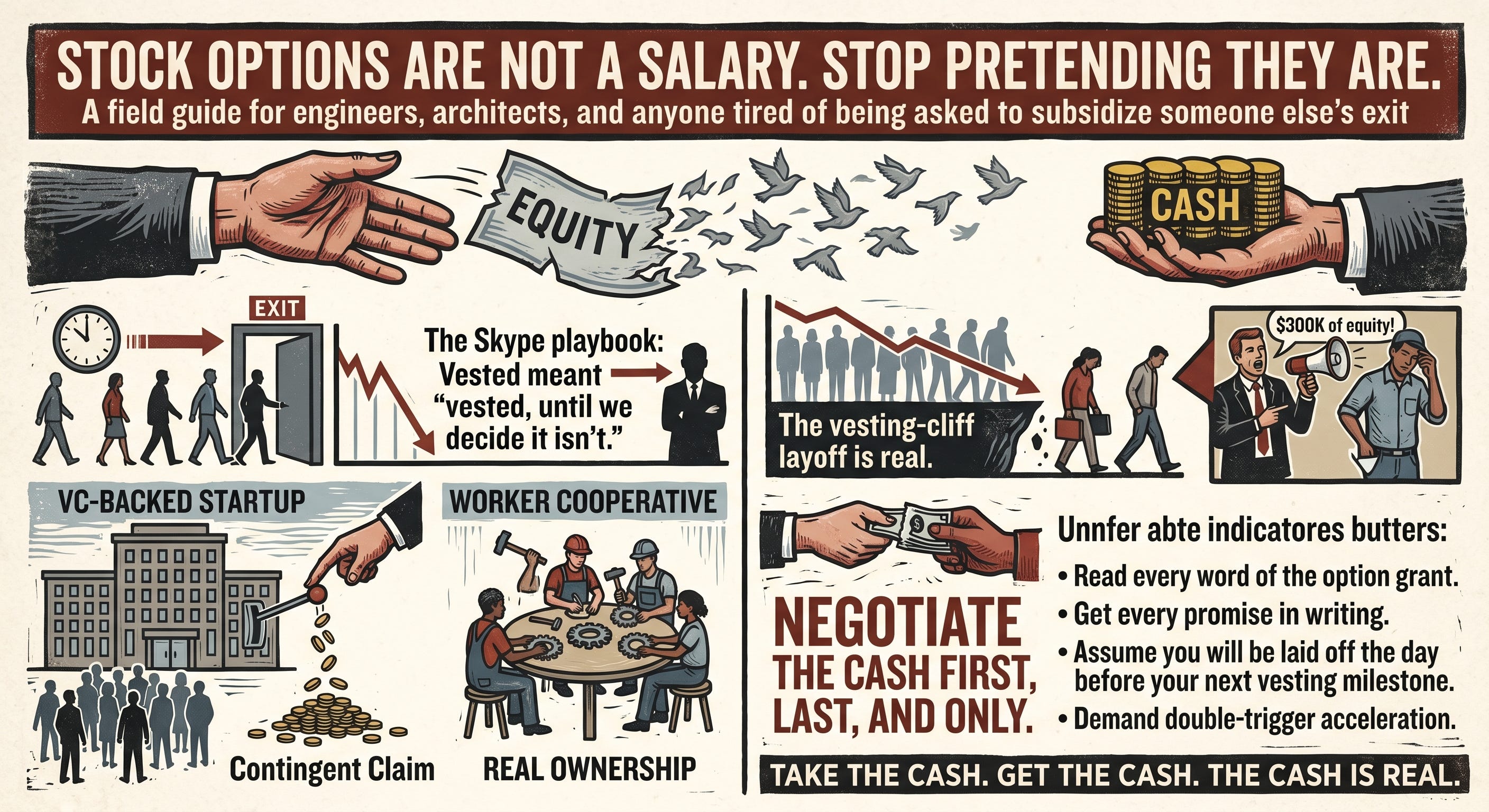
Skype told him no. Buried in his stock option grant — and cross-referenced to a separate “Management Partnership” document Lee had never seen — was a clause stating that if you left before the company went liquid, the company could buy back your vested shares at a price they chose. Often that price was zero. As TechCrunch wrote at the time, the company had the right to terminate not only your unvested options, but also your vested ones, and even shares you had already paid cash to exercise. Vested didn’t mean vested. Vested meant “vested, until we decide it isn’t.”
Two corporate lawyers who looked at the contract said this kind of structure was “not uncommon” in PE-backed deals. Read that sentence again. The trick wasn’t a one-off. It was a template.
Vested didn’t mean vested. Vested meant “vested, until we decide it isn’t.”
It’s not just private equity. It’s everyone with leverage.
If you think this is a relic of 2011, look at what happened the night Elon Musk closed the Twitter deal in October 2022. According to Walter Isaacson’s Musk biography, Musk “meticulously” planned to terminate CEO Parag Agrawal, CFO Ned Segal, and Chief Legal Officer Vijaya Gadde before their stock options vested in the closing. The three were owed change-of-control packages totaling around $76 million combined. Instead they were walked out of the building by security, fired “for cause,” and Musk’s lawyers proceeded to argue they were owed nothing. The executives sued for $128 million in unpaid severance. The rank-and-file fared no better — a separate $500 million severance lawsuit on behalf of laid-off employees was dismissed on technical ERISA grounds in 2024.
These are not small companies run by amateurs. These are the largest tech transactions of the decade. And the consistent pattern at the top of the deal stack is: figure out how to pay employees less than the contract appeared to promise.
The vesting-cliff layoff is real, and it has a season
Down at the line-engineer level, the equivalent move is the cliff layoff. Standard tech equity vests over four years with a one-year cliff: you earn nothing in year one, then 25% snaps into vesting on your first anniversary, then the rest drips out monthly. If your employer terminates you before that one-year mark — even one day before — you walk away with zero equity. Not 11/12ths. Zero.
Look at the public layoff data: in 2025, more than 245,000 tech employees were laid off across roughly 783 companies, per the Layoffs.fyi tracker. We’re already 95,000-plus deep in 2026. Some of those are people who had been there four years. Plenty are people who had been there ten or eleven months. The companies will tell you the timing was about “performance” or “restructuring” or “market conditions.” Sometimes that’s even true. But the financial outcome — for the company — is identical regardless of the reason: the company recaptures the unvested options, returns them to the pool, and re-grants them to the next round of hires at a lower strike price. The CFO smiles.
There are honorable exceptions. Stripe famously waived the cliff during its 2022 layoffs so departing employees got their first 25%. Some companies extend the post-termination exercise window from the standard 90 days out to several years. Those companies should be celebrated and copied. They are also, by their own admission, the exception. The norm is the 90-day window, and the norm is the cliff, and the norm is that the company gets to use both as cudgels.
The math no one in the recruiter chain wants you to do
Engineer Dan Luu wrote one of the sharpest pieces I’ve read on this. His argument, paraphrased: if startup options were really worth what companies claim they’re worth, the companies could simply raise more money and pay competitive cash. The fact that they refuse to is not a clever financial structure. It’s a tell. It is, in his words, an admission that the options aren’t worth as much as the headline number suggests, dressed up in language that obscures the fact.
Steve Blank, who has watched Silicon Valley compensation since the 1980s, has made a related observation: the bargain has gotten worse. In the 20th century, founders genuinely bet their mortgage on the company. Today, founders cash out at Series B, take liquidity in secondaries, and get cushioned by multimillion-dollar seed rounds. The early employees still take all the original risk, work the same eighty-hour weeks, and now find that their stock has been diluted, repriced, or made subject to clauses they never read.
Run the numbers yourself. If you take $40,000 less in cash compensation per year for four years in exchange for $300,000 of “equity,” you have just lent the company $160,000 of your own money — interest-free, with no collateral, with the lender (you) bearing 100% of the downside, and with the borrower (the company) holding all the cards on whether you ever see a return. No one in any other context would call that a good deal. We only call it a good deal when the asset class is called “startup equity” because the industry has spent thirty years training people to call it that.
Equity is a tip. A salary is the meal. You don’t go to a restaurant, eat a smaller meal, and feel good because the waiter promised you a great tip later if business picks up.
The contrast: a worker cooperative actually means what it says
There is a model where “employee ownership” is not a marketing phrase. It’s called a worker cooperative. In a worker co-op, the workers themselves own the business outright. There is no founder holding super-voting shares. There is no PE firm with a clawback clause buried in a Management Partnership document. Each worker-member typically holds one share, gets one vote, and shares in profits through patronage dividends — distributions based on hours worked or wages earned, paid annually.
The structural difference is enormous. In a co-op, governance is democratic and one-member-one-vote, by design. There is no class of preferred shareholders ahead of you in the liquidation stack. There is no board appointed by Silver Lake. The Spanish Mondragon Corporation, the canonical example, has run this model for sixty years across more than a hundred businesses. In the U.S., co-ops are smaller and rarer, but they exist, and the principle is what matters.
Now, I am not arguing that everyone should go work at a worker cooperative tomorrow. Most of us — me included — work at conventional capital-stack companies, and that’s fine. The point of the comparison is to clarify what “ownership” actually looks like when the structure is designed for the worker rather than around the worker. Stock options at a VC-backed startup are not ownership. They are a contingent claim, structured by the company’s lawyers, exercisable only on terms the company controls, and revocable in dozens of subtle ways.
If you want real ownership, work at a co-op or start your own business. If you take a job at a normal company, take it for the cash. Anything beyond cash is a tip.
Your only fiduciary duty is to your family
Here is the part of this essay where some readers will get uncomfortable. The employer-employee relationship is not a friendship. It is not a partnership. It is not a family. It is a transaction governed by an at-will employment agreement that, in most U.S. states, the company can end on any day, for almost any reason, with no notice and no obligation beyond what’s been promised in writing. That is the deal. The company has accepted those terms because they are good for the company.
You should accept those terms too — and act accordingly. In an employer-employee relationship, your first and only fiduciary duty is to yourself and the people who depend on you. Not to the founder’s vision. Not to the mission statement. Not to the kombucha tap. Your job is to take care of your spouse, your kids, your aging parents, your mortgage, and your future self. Loyalty to a corporation is, almost without exception, loyalty that is not reciprocated. Ask the Skype engineers. Ask the Twitter executives. Ask the people whose layoff date landed two weeks before their cliff.
This isn’t cynicism. It’s symmetry. The company optimizes for the company. You optimize for you. When both sides do that openly, the negotiation is honest.
Rules I would tell my own kid
• Negotiate the cash first, last, and only. Treat equity as a bonus, never as a salary substitute. If the cash number doesn’t work, the offer doesn’t work, full stop.
• If you do take equity, read every word of the option grant — and ask for the documents it cross-references. If they refuse to show you the Management Partnership agreement (or whatever they call it this decade), refuse the offer.
• Demand double-trigger acceleration on change of control. That means your unvested equity vests if (a) the company is acquired AND (b) you are terminated without cause within some window. This is the single most important clause for protecting yourself against the Skype scenario.
• Negotiate an extended post-termination exercise window. The standard 90 days is a trap — most people don’t have the cash to exercise on short notice, especially after a layoff. Push for 5 to 10 years.
• Get every promise in writing. Verbal commitments from the founder over coffee are worth what’s printed on them: nothing.
• If the company is private, ask the strike price, the 409A valuation, the total share count, and your percentage. If they won’t tell you the denominator, your “10,000 shares” might be 10,000 out of 10 billion.
• Assume you will be laid off the day before your next vesting milestone. Plan accordingly. If that assumption ruins the offer, the offer wasn’t actually that good.
The bottom line
Stock options are not bad. I have them. I’ve granted them. They are a legitimate tool for aligning long-term incentives between a company and its earliest, most committed builders — the people who would have signed up anyway, who genuinely want the upside, who can afford to bet a slice of their compensation on a moonshot. That is fine.
What is not fine is the practice of using stock options to depress cash compensation across the industry, while simultaneously building legal mechanisms — the cliff, the 90-day window, the change-of-control workaround, the buried clawback clause, the for-cause termination — that ensure the company gets to keep most of the upside no matter what happens to you. That is not a compensation strategy. That is a transfer of wealth from the people doing the work to the people structuring the deal.
So when the recruiter calls and the salary is light and the equity is heavy and the founder talks about the mission, just remember: in 2011, Skype’s lawyers had already written the document that made vested mean unvested. In 2022, the new owner of Twitter had already mapped out which executives to walk out the door minutes before they got paid. In 2025 and 2026, hundreds of thousands of tech workers learned that “part of the family” lasted exactly until the next earnings call.
Take the cash. Get the cash. The cash is real. Everything else is a story someone else is telling about your future.
— Gal
Disclaimer: I am not a financial advisor, a lawyer, or a tax professional. This essay is opinion and analysis, drawn from public reporting and three decades in the industry. Before signing or rejecting any compensation package, talk to an actual employment attorney who has read your specific contract.