


If your company has more than 150 humans on Claude Team, ChatGPT Enterprise, or any seat-licensed flavor of frontier AI, your CFO is currently signing a recurring expense that compounds against you every month. The vendor’s job is to make sure that number only goes up. Mine, today, is to convince you it shouldn’t.
DeepSeek V4 Pro shipped on April 24th. Open weights. MIT license. 1.6 trillion total parameters with 49 billion active per token. A million-token context window that actually works at depth — 83.5% on the 1M MRCR comprehension test, which is roughly two-and-a-half times what Claude Opus 4.7 manages at the same depths. By every meaningful technical measure, it is frontier. And it is the first frontier model in history that you can put on your own racks and forget the API ever existed.
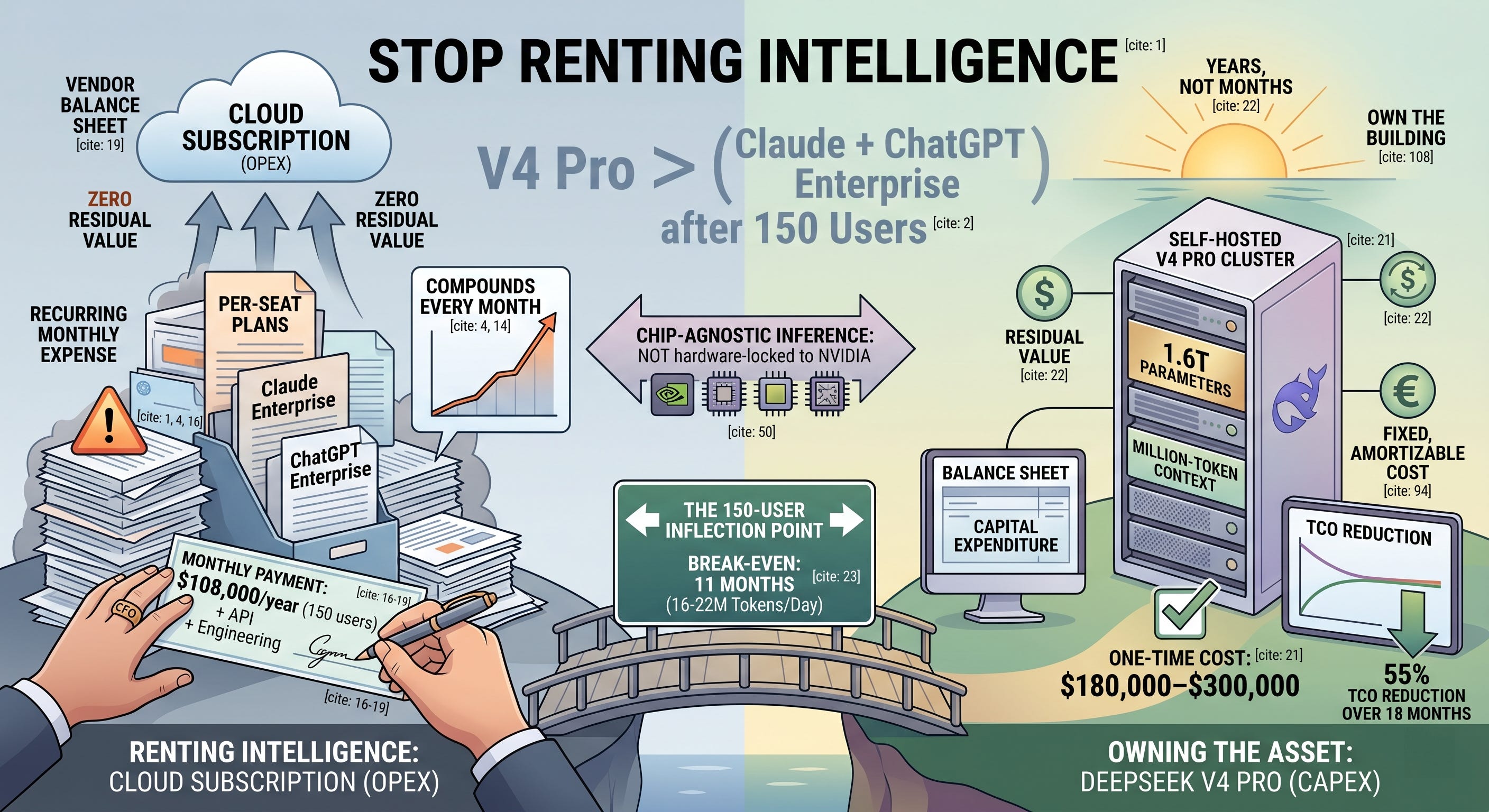
That changes the arithmetic. Let me show you how.
The 150-Seat Inflection Point
The dirty secret of enterprise AI billing in 2026 is that it scales the wrong direction. Per-seat plans look reasonable at 30 users. Survivable at 80. At 150 they start eating budget that used to belong to actual headcount. And they never. stop. growing.
Here is a representative 150-user enterprise running a modern AI stack:
150 seats on Claude Enterprise or ChatGPT Enterprise at roughly $60 per user per month: $108,000 a year.
A handful of power users blowing past their quotas onto API: another $40,000 to $80,000 a year, conservatively.
Engineering team running agentic workflows in Claude Code or Codex: another $50,000 to $150,000, depending on how aggressive they are.
You are now staring at a $200,000 to $300,000 annual line item that exists entirely on someone else’s balance sheet. Over an 18-month planning horizon, that’s between $300,000 and $450,000 leaving the building, recurring, with zero residual value.
A self-hosted DeepSeek V4 Pro cluster — the real one, not a toy — costs $180,000 to $300,000. One time. With residual value. With a hardware refresh cycle measured in years, not months. Break-even, once you cross 16 to 22 million tokens of inference per day, sits at around the eleven-month mark and gets steeper in your favor every month after. The whole second year is gravy.
This is not a marginal optimization. This is a structural shift in how AI shows up on your books.
What You Actually Need on the Floor
Let me kill a myth. Running V4 Pro is not “hard.” It is expensive at the front and boring after that. The hard work is architectural — DeepSeek already did it for you.
The native footprint is roughly 1.34 TB of VRAM at FP8, climbing past 2.4 TB once you account for KV cache and a million-token context. Your three realistic deployment tiers:
Tier 1 — Full precision, full throughput. Two to three 8-GPU H100 nodes wired with NVLink. 16x H100 (80GB) total. Tensor parallel size 8, pipeline parallel 2. Capex: $250K–$300K with networking, racks, and power. This is the configuration for a company actually replacing a six-figure API bill.
Tier 2 — INT4 quantization, single 8-GPU node. AWQ or GPTQ INT4 shrinks the weights to about 700 GB. Now it fits on one 8x H100 box. Capex: $120K–$160K. Quality cost: between 1.5% and 4.2% degradation depending on workload — survivable for 90% of enterprise use, painful for the niches where it isn’t.
Tier 3 — V4 Flash on commodity hardware. 284B parameters, 13B active. Fits on 2x H100 in FP8 or 2x A100 in INT4. Capex: $60K–$90K. This is the dev-team-of-30 configuration, not the 150-user company configuration. But for stand-up, prototyping, and edge cases, you’ll want a Flash node anyway.
For the serving layer, you want vLLM 0.9+ for the production endpoint — its PagedAttention is what makes the million-token context tractable at concurrency above 20 requests, and it scales 11–20% better than alternatives at enterprise load. Stand up SGLang 0.4+ on the side for single-user, low-latency, reasoning-heavy paths — it returns 583ms time-to-first-token where vLLM sits at 2,141ms in the same conditions, and uses about 47% less GPU memory per request. Use vLLM for the floor. Use SGLang for the lab.
The Architecture That Lets You Skip NVIDIA
Here is the part that should make your CTO sit up.
DeepSeek V4 was trained, optimized, and inference-tuned end-to-end on Huawei Ascend 950 PR and 910C silicon, fabbed at SMIC on a 7nm process. The team rebuilt the kernels from scratch to run without CUDA. Not “ported.” Rebuilt. They did it because export controls forced their hand, and they did it well enough that the model is now objectively competitive with everything OpenAI and Anthropic shipped this April.
The implication for your infrastructure decision is enormous and being ignored by 90% of buyers: the inference layer is no longer hardware-locked to NVIDIA. You can deploy V4 Pro on Ascend hardware. You can deploy it on AMD MI300X, where 192GB per card means you fit 2.4TB in 13 cards instead of 30. You can mix tiers. The software stack supports it. The model architecture is fundamentally chip-agnostic in a way the GPT-5.5 generation, which was co-designed with NVIDIA on GB200 NVL72 clusters, structurally is not.
This matters for two reasons. First, the $30,000-per-card NVIDIA premium is no longer load-bearing — you have a real second source. Second, when the next hardware cycle hits, you are not locked to a single vendor’s roadmap.
Three architectural choices made this possible.
The Hybrid Attention Architecture — Compressed Sparse Attention plus Heavily Compressed Attention, interleaved across 61 layers — means a million-token context costs you about 27% of the FLOPs and 10% of the KV cache that a traditional transformer would burn through. Against GQA-bfloat16 baselines, V4’s KV cache footprint is roughly 2% of what you’d otherwise need. Quadratic attention complexity is the reason every vendor before this generation gave up on real long-context performance. DeepSeek didn’t give up. They engineered around it.
Engram Conditional Memory decouples static factual recall from active computation. The model offloads up to 100 billion parameters of embedding tables to host DRAM and pulls them in O(1) — constant time, not “fast for an LLM” time — with under 3% inference overhead. Your CPU RAM is now part of the model. That’s a category-shift in how memory hierarchy works for inference, and it’s why V4 Pro hits 97% on Needle-in-a-Haystack across the full million-token span.
Manifold-Constrained Hyper-Connections (mHC) solve the training instability that has been quietly limiting how deep these models can go. Signal amplification across deep residual paths used to spiral to 3,000x in pathological cases — the loss spikes that derail multi-million-dollar training runs. mHC pins the amplification under 2x by mathematically constraining the relevant matrices to be doubly stochastic. Sounds like a math curiosity. It is the difference between a model that trains and a model that doesn’t.
These are not marketing bullets. These are why a 1.6T-parameter model fits and serves on hardware your competitors thought required a CUDA monopoly to operate.
Plugging It Into the Stack You Already Have
If your team currently uses Claude Code, Cursor, Continue.dev, or any IDE-bound assistant, the migration cost is approximately one config change. V4 Pro exposes an OpenAI-compatible API surface out of vLLM. Point your tools at https://your-internal-endpoint/v1 instead of api.anthropic.com, swap the API key, done. Function-calling and tool-use schemas match the format your stack already expects.
For the agentic tier, V4 Pro ships with native MCP server compatibility — every internal tool you’ve already wired up via Model Context Protocol works without modification. Your Slack bot, your Jira integration, your internal documentation RAG, your SQL agent: all of it talks to the local model the same way it talked to Claude.
Then you do the thing the SaaS vendors absolutely do not want you to do. You point V4 Pro at your private knowledge base. Every Confluence page. Every SharePoint document. Every internal codebase. Every meeting transcript. Every customer support ticket. A million-token context window means your retrieval pipeline doesn’t have to be clever — you can stuff entire repositories into the prompt and let Engram do the work. Now your AI doesn’t just understand “general software engineering.” It understands your codebase. Your deal terms. Your operational runbooks. None of that ever leaves your network. None of it trains a public model. None of it shows up in someone else’s training data after a vendor “policy update.”
That’s the differentiator. The hosted vendors will eventually offer this — they’ve been promising it for two years — but they will charge you for it, throttle it, and reserve the right to change the terms. You can have it now, in your basement, for a fixed cost.
The Math, Honestly
Here’s what 18 months looks like in dollars.
Scenario
18-Month Cost
150 seats on Claude Enterprise + power-user API + agentic workflows
$300K – $450K
8-GPU H100 cluster (INT4 V4 Pro) — capex + power + ops engineer
$200K – $260K
16-GPU H100 cluster (FP8 V4 Pro) — capex + power + ops engineer
$290K – $370K
Industry analysis pegs break-even at 16–22 million tokens of inference per day, or about 500–650 million per month. A 150-person knowledge-work company running modern AI tooling routinely burns through that range — a single team of 20 engineers using AI-assisted coding eight hours a day will get you most of the way there by themselves. Cross the line and you’re realizing roughly a 55% TCO reduction over 18 months relative to the proprietary API path. Stay below it and the cloud APIs are still cheaper. Honest answer: count your tokens before you sign the PO.
What This Does to Your Balance Sheet
This is the part the technical leadership tends to undersell when they bring it to the CFO.
Right now, your AI spend is an operating expense. Recurring. Grows linearly with usage. Leaves the building monthly. Generates zero residual value. It looks like rent.
A self-hosted V4 Pro cluster is a capital expenditure. It depreciates on a schedule (typically three to five years), it sits on the balance sheet as an asset, and it converts your AI spend from an unbounded operating drain into a fixed, amortizable cost. Every additional token your users generate after capex is recovered is essentially free intelligence.
The second-order effects are larger. Usage isn’t capped by per-seat quotas anymore — power users can hammer the model 24/7 without escalating bills, which means workflows that were too expensive to automate at API rates suddenly become viable. Your data stays inside your perimeter, which simplifies SOC 2 and HIPAA conversations and removes a recurring vendor risk-review line item from your security team’s calendar. Your uptime decouples from someone else’s status page — if you’ve watched Anthropic or OpenAI go dark on a Tuesday morning lately, you know what that’s worth. Your model doesn’t change underneath you on a vendor’s release schedule, breaking three internal prompts every time they “improve” something.
Capex over opex. Asset over expense. Fixed cost over compounding cost. Sovereign over rented.
If your finance team understands the difference between owning a building and leasing it, they understand this trade. They just haven’t been asked to think about AI in those terms yet, because the vendors have spent two years training the market to treat intelligence as a subscription.
It isn’t. Not anymore. Not since April 24th.
The companies that move on this in the next twelve months will lock in a structural cost advantage their competitors are paying a premium to avoid. The ones that don’t will spend the next five years explaining to their boards why a fixed-cost asset their peers are running for $5,000 a month is showing up on their P&L for $250,000 a year.
Run the math once. Then run it again with your actual token volume. The conclusion is the same conclusion every CFO eventually reaches when an asset is cheaper than the rent on the equivalent service.
You buy the building.
If you've read this far and your CFO is already running the numbers, the practical question is who racks the hardware. Inverted Software builds these deployments end to end — procurement, the vLLM/SGLang serving layer, MCP wiring into your existing stack, RAG against your private knowledge base, and a clean ops handoff your team can actually maintain after they leave. Tell them I sent you.
-Gal