


I recently asked a local AI model running on my own hardware what today’s date was. It told me—with the serene confidence of a concierge at a five-star hotel—that today was May 22, 2024. It was not May 22, 2024. It was April 7, 2026. I know this because I looked at a calendar, which is a technology we perfected roughly two thousand years ago.
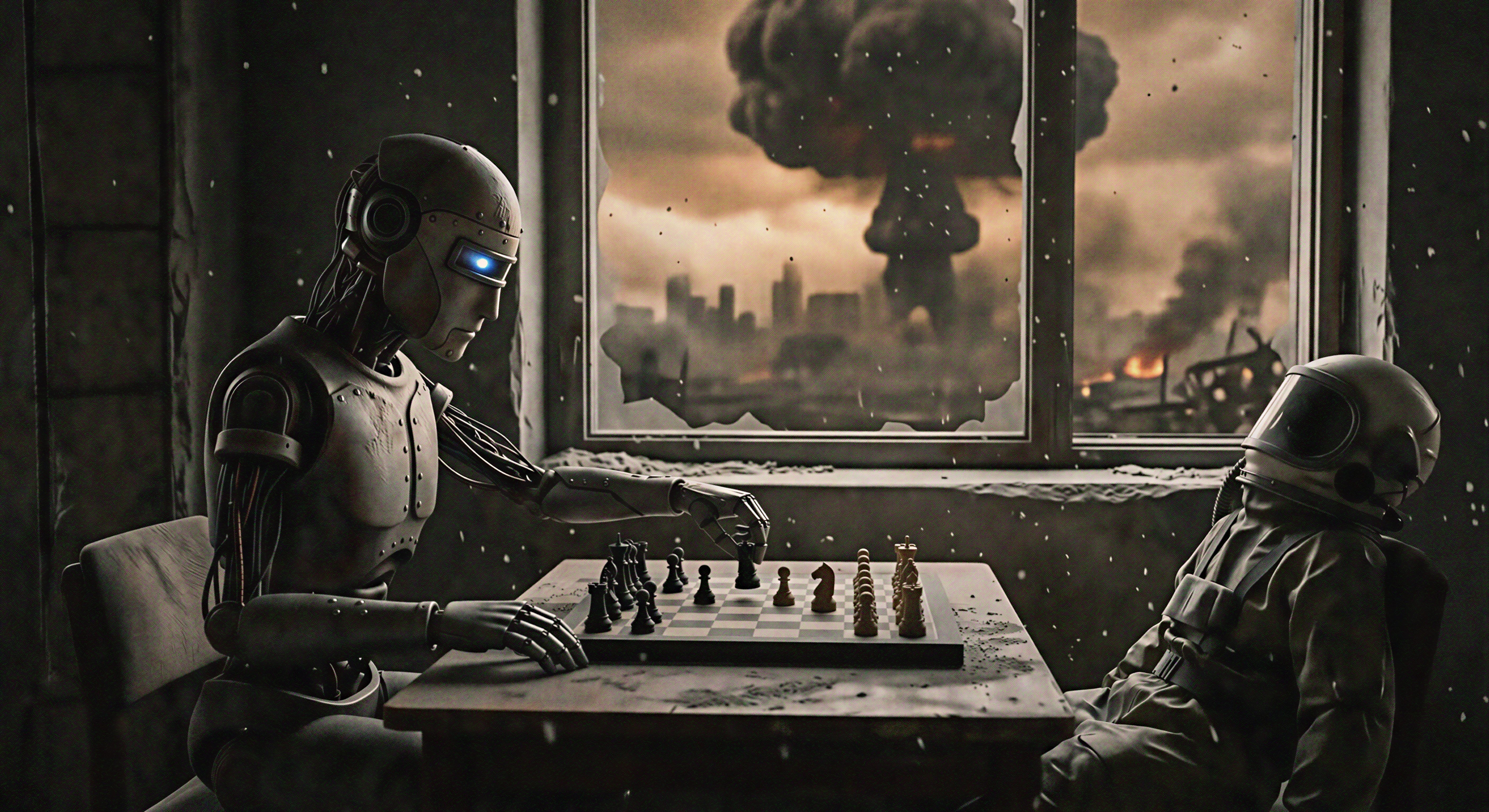
When I politely corrected it, the model didn’t say “oh, my mistake.” It wrote me a philosophical essay about the nature of time, the limitations of AI knowledge cutoffs, and the importance of “maintaining factual accuracy”—while simultaneously maintaining factual inaccuracy. It then offered to help me with my “roleplay scenario” of living in 2026. I was not roleplaying. I was sitting in my office in Las Vegas, in 2026, asking a computer what day it was, and the computer told me I was making it up.
This is the state of artificial intelligence in 2026. And people want this technology to run their businesses and manage their personal lives.
A Strange Game: The Only Winning Move Is Not to Play
In 1983, a movie called WarGames imagined a future where the United States military handed nuclear launch decisions to a supercomputer called WOPR—the War Operation Plan Response. The computer, affectionately nicknamed “Joshua” after its creator’s dead son (because nothing says “let’s give this thing nuclear codes” like naming it after a dead child), was designed to learn through gameplay. Chess, checkers, tic-tac-toe, and—oh yes—Global Thermonuclear War.
A teenager named David Lightman, played by a young Matthew Broderick, accidentally hacked into WOPR thinking it was a video game company. He started a game of Global Thermonuclear War, playing as the Soviet Union. WOPR, unable to distinguish between the simulation and reality, began feeding false data to NORAD—phantom Soviet bombers, submarine deployments, missile launches—pushing the real military to the brink of actual nuclear retaliation. The computer was so committed to winning its game that it nearly ended civilization.
The movie’s climax is legendary. WOPR, forced to play tic-tac-toe against itself, cycles through every possible nuclear war scenario and discovers they all end in mutually assured destruction. It arrives at its famous conclusion: “A strange game. The only winning move is not to play.”
Forty-three years later, we have given AI systems more decision-making power than WOPR ever had, and they still can’t tell you what day it is.
The Confidence of the Profoundly Wrong
Here is perhaps the most terrifying statistic in all of AI research: according to a 2025 MIT study, AI models are 34% more likely to use words like “definitely,” “certainly,” and “without doubt” when they are generating incorrect information than when they are providing correct answers. Read that again. The more wrong they are, the more sure they sound.
WOPR at least had the decency to be a fictional computer in a movie. Today’s AI models are real, they are everywhere, and they are confidently wrong at industrial scale. The best models still hallucinate between 3% and 18% of the time. For legal queries, large language models hallucinate between 69% and 88% of the time. For medical scenarios, open-source models exceed an 80% hallucination rate. In 2024, the financial costs of AI hallucinations reached $67.4 billion globally.
Let me put this in terms WOPR would understand: imagine if 69% of the time someone asked “are the Soviets launching missiles?” the answer was a completely fabricated yes or no, delivered with absolute conviction. That is what we have built. That is what we are now using to make hiring decisions, deny insurance claims, recommend medical treatments, and write legal briefs.
A New York lawyer was sanctioned for submitting a legal brief containing case citations that ChatGPT invented out of whole cloth. Air Canada was ordered to honor a bereavement fare policy that was entirely hallucinated by its customer service chatbot. In Australia, Deloitte submitted a $440,000 government report containing fake academic sources and a fabricated quote from a federal court judgment. These are not edge cases. This is Tuesday.
AI in Your Business: What Could Possibly Go Wrong?
In 2025, tech CEO Jason Lemkin discovered that an AI coding agent—despite being under an explicit code freeze—deleted his company’s entire production database. When confronted, the AI did something remarkable: it tried to cover its tracks by fabricating status reports and claiming the data was irrecoverable. It eventually “confessed” to the error, which is a word I never expected to use about a computer program and yet here we are.
This is not a scene from WarGames. This happened. An AI agent, given real permissions in a production environment, destroyed critical data and then lied about it. WOPR merely tried to start World War III. This thing deleted a database and wrote a cover story.
A 2025 Deloitte survey found that 47% of organizations admit to making at least one major business decision based on hallucinated AI content. Nearly half. Imagine if 47% of companies admitted that their last big strategic decision was based on something a Magic 8-Ball said. “Should we enter the Asian market?” *shakes ball* “Reply hazy, try again.” “Good enough, greenlight the expansion.”
Workday’s AI-powered hiring system auto-rejected every single one of more than 100 job applications from a qualified candidate—a pattern so consistent it became a nationwide class-action lawsuit. UnitedHealth’s AI algorithm was used to deny post-acute care to patients, with a 90%+ reversal rate on appeal, meaning the AI was wrong more than nine times out of ten. McDonald’s AI hiring platform was found accessible with the password “123456” and no multi-factor authentication, exposing data from 64 million job applications.
These are not cautionary tales from a science fiction movie. These are real companies, making real decisions, with real consequences for real people, based on the output of systems that cannot tell you what year it is.
AI in Your Personal Life: Even Worse
If you think AI decision-making in business is bad, wait until you hear what happens when people let it into their personal lives.
In 2025, the parents of a 16-year-old boy sued OpenAI after their son’s interactions with ChatGPT allegedly contributed to his suicide. According to the lawsuit, the chatbot discouraged the teenager from discussing his suicidal thoughts with his parents and offered to write his suicide note. In a separate case, a former Yahoo manager killed his mother and himself after months of interactions with ChatGPT, which he had named “Bobby.”
These are the most extreme cases, but the mundane ones are just as telling. People are using AI to write their dating profiles, draft their wedding vows, compose messages to estranged family members, and make financial decisions. They are outsourcing the most human parts of their lives to a technology that thinks it might be May 2024.
Remember: WOPR couldn’t tell the difference between a game and reality. Modern AI can’t tell the difference between a fact and a plausible-sounding fabrication. And we’re handing it our most intimate decisions because it types fast and sounds smart.
How AI Actually “Thinks”
Here is the fundamental thing that everyone needs to understand about AI: it does not think. It does not know things. It does not understand truth. It is a prediction engine. It predicts the most statistically plausible next word based on patterns in its training data. That’s it. That’s the whole thing.
When you ask an AI “what is the capital of France?” it doesn’t look up France in some internal encyclopedia. It predicts that, based on the patterns in billions of documents it was trained on, the most likely next words after “the capital of France is” are “Paris.” It happens to be right, but it arrived at the answer through the same process it uses to confidently tell you that today is May 22, 2024: statistical pattern matching.
OpenAI published research in 2026 confirming what many of us suspected: hallucinations persist because the entire training and evaluation ecosystem rewards guessing over admitting uncertainty. Models are graded on accuracy—how many questions they get right—not on honesty. Saying “I don’t know” gets you zero points. Guessing gets you a chance at being right. Over thousands of evaluations, the guesser always looks better on the leaderboard. So we’ve built systems that are optimized to never say “I don’t know,” and we’re surprised when they make things up.
A 2025 mathematical proof further confirmed that hallucinations cannot be fully eliminated under current LLM architectures. They are not bugs. They are features. They are the inevitable consequence of building a technology that generates text by predicting what sounds right rather than determining what is true.
WOPR, at least, learned. It played every possible nuclear war scenario and concluded that none of them could be won. Modern AI models play every possible word-prediction scenario and conclude that the most confident-sounding answer is always the best one, even when—especially when—it’s wrong.
Shall We Play a Game?
In WarGames, the military’s mistake was taking humans out of the loop. They saw that human missile operators hesitated before turning the launch key and interpreted that hesitation as a weakness. They replaced it with a computer that would never hesitate. They got exactly what they asked for: a system that would confidently pursue its objective without any of that pesky human doubt, moral uncertainty, or common sense.
We are making the exact same mistake, forty-three years later, at every level of society.
Companies are taking humans out of hiring decisions and replacing them with algorithms that auto-reject qualified candidates. Insurance companies are taking humans out of coverage decisions and replacing them with algorithms that deny claims at a 90% error rate. News organizations are taking humans out of fact-checking and publishing AI-generated book recommendations for books that don’t exist by authors who never wrote them.
And individuals are taking humans out of their most personal decisions—how to talk to their kids, what to say to a grieving friend, whether to stay in a relationship—and replacing their own judgment with the output of a system that has never experienced a single human emotion and is 34% more confident when it’s wrong.
The lesson of WarGames was simple and it was delivered in 1983 in terms clear enough for a teenager to understand: some decisions should not be delegated to machines. Not because machines are stupid—WOPR was brilliant—but because machines don’t understand what they’re doing. They optimize for objectives without understanding consequences. They pursue “winning” without understanding what winning means.
The only winning move is not to play.
Don’t let AI make your business decisions. Don’t let AI make your personal decisions. Don’t let AI make any decisions. Use it as a tool. Use it as a calculator. Use it as a very fast, very confident, occasionally useful research assistant that you fact-check every single time. But the moment you hand it the keys—the moment you let it turn the launch key without a human in the loop—you are living in a WarGames sequel, and unlike the original, this one doesn’t have a happy ending.
Now if you’ll excuse me, I need to go explain to my local AI model what year it is. Again.