


In 2008, the season one finale of The Big Bang Theory gave the world the most accessible explanation of quantum mechanics ever written for a laugh track. The episode is called “The Tangerine Factor.” Penny is anxious about going on a first date with Leonard. Leonard is anxious about going on a first date with Penny. Both, independently, do something that no rational human should ever do: they ask Sheldon Cooper for relationship advice.
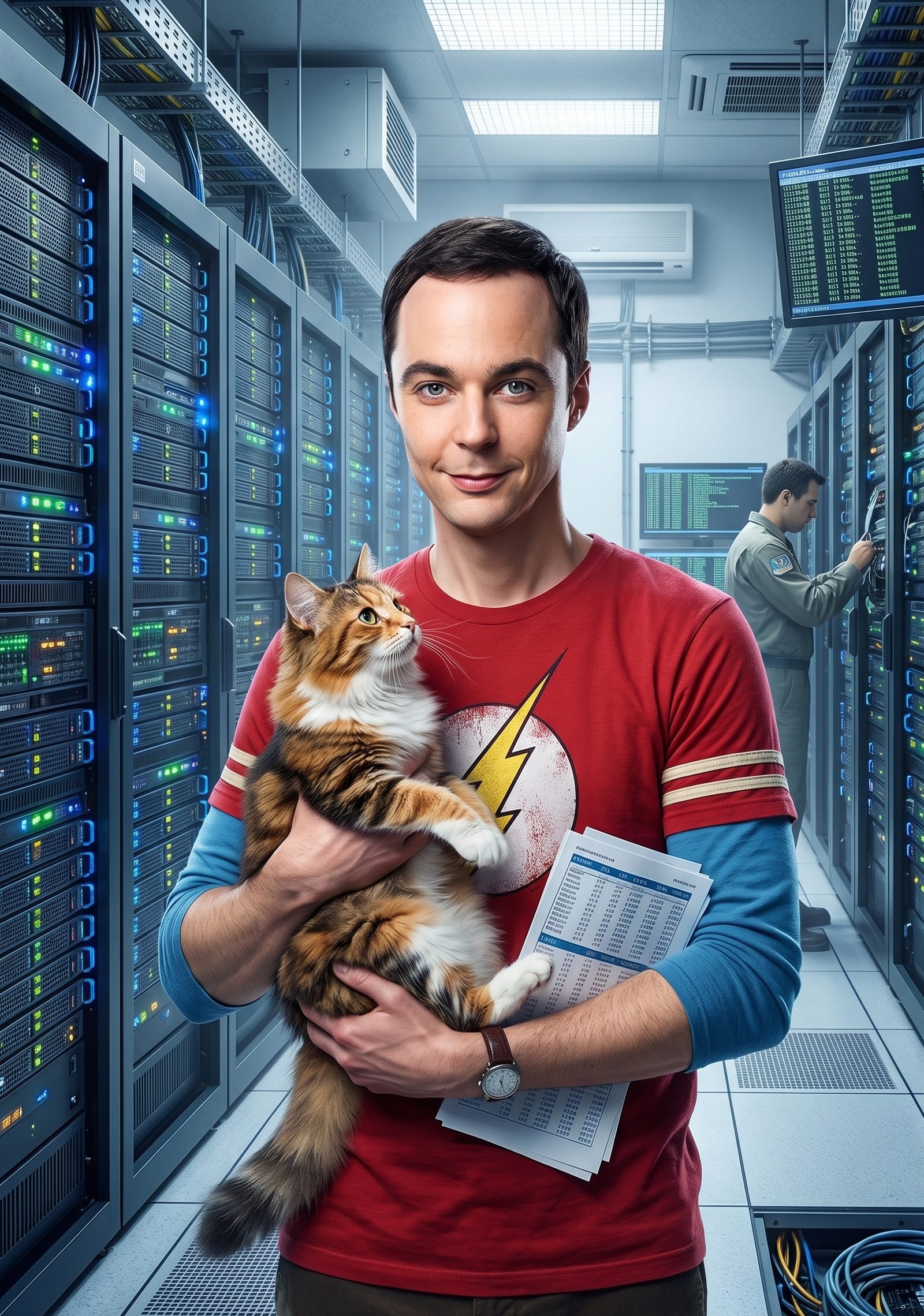
Sheldon, predictably, gives them physics. He invokes Schrödinger’s Cat — the 1935 thought experiment where a cat in a sealed box exists in a superposition of alive and dead until someone opens the lid and forces reality to pick a side. He tells Penny her potential relationship with Leonard is, right now, simultaneously good and bad. The only way to find out which is to open the box. At the end of the episode, Leonard knocks, kisses her, and Penny famously declares: “The cat’s alive!”
Eighteen years later, the entire AI industry has gathered around a different sealed box, arguing about what’s inside. The box is labeled AGI. The cat is Artificial General Intelligence. And unlike Penny and Leonard, nobody is willing to actually open the lid — because as long as it stays closed, the cat is worth a trillion dollars.
The Predictions Are Already in Superposition
Let’s do something I rarely see in AI coverage: actually look at what the people building these systems are saying, side by side, in the same week. Not cherry-picked. All of it.
As of early 2026, here’s where the credentialed forecasters land:
Dario Amodei, CEO of Anthropic: At Davos 2026, said AGI will likely arrive within a few years, possibly by 2027. Anthropic’s formal submission to the U.S. Office of Science and Technology Policy explicitly states they expect powerful AI systems to emerge in late 2026 or early 2027.
Sam Altman, CEO of OpenAI: Has said AGI will probably get developed during Trump’s current term. Also recently called AGI “not a super useful term.” Both statements were made by the same man, often within weeks of each other.
Mustafa Suleyman, CEO of Microsoft AI: February 2026 — predicted human-level performance on most professional tasks within 12 to 18 months.
Elon Musk, founder of xAI: Originally said 2025. Then 2026. Then at Davos 2026 sharpened it to “by year-end.” If you’re tracking, that’s now three consecutive year-end deadlines that have slipped.
Demis Hassabis, founder of Google DeepMind: Roughly 50% chance by 2030. Notes we still need “one or two more breakthroughs.”
Shane Legg, Chief AGI Scientist at DeepMind: About 50% odds of “minimal AGI” by 2028.
Andrej Karpathy, formerly OpenAI: Says current agent architectures “aren’t anywhere close.” Puts AGI a full decade out.
Yann LeCun, Chief AI Scientist at Meta: Argues current architectures have fundamental limitations that preclude near-term AGI. Has been saying this consistently for years and has been consistently right about each individual ceiling, even as the field has worked around them.
Gary Marcus: Has placed a 10-to-1 public bet that AI won’t hit specified AGI tasks by the end of 2027.
Geoffrey Hinton, Nobel laureate: Revised his timeline from “30 to 50 years” to “5 to 20 years,” with 50% probability within two decades. Same person. Different decade.
2023 AI Impacts survey of 2,778 published AI researchers: 50% probability of high-level machine intelligence by 2047.
Metaculus aggregate forecast (~2,000 contributors), as of February 2026: 25% chance of AGI by 2029, 50% by 2033.
Read that list back. Within a single calendar quarter, credentialed researchers and CEOs of the biggest AI labs in the world have publicly committed to AGI arrival dates ranging from “by year-end 2026” to “never, the architecture is fundamentally incapable.” That’s not a confidence interval. That’s not even a disagreement. That’s a thought experiment.
If 30% of experts say your airplane is going to explode, and 70% say it won’t, you shouldn’t conclude there’s no expert consensus, so I won’t do anything. — 80,000 Hours, on AGI forecasting
The cat is alive. The cat is dead. The cat does not exist. The cat will be here Tuesday. The box itself is a marketing concept. Pick one — or pick all of them — you’re in good company either way.
The Box Has a Definition Problem
Here’s the part that should make every CTO, board member, and enterprise buyer pause. The reason these predictions span 73 years isn’t because the field is bad at math. It’s because nobody can agree on what’s in the box in the first place.
Sam Altman defines AGI one way on a podcast and another way in a funding round. OpenAI now uses a five-level framework instead of a binary AGI designation — conveniently, the levels above the current product can be redefined as the company progresses. Dario Amodei describes “a country of geniuses in a datacenter.” Shane Legg defines “minimal AGI.” Fei-Fei Li argues no system without spatial intelligence and physical-world understanding qualifies, period. Yoshua Bengio cares about reasoning. Yann LeCun cares about world models. The 2023 AI Impacts survey defined it as “every task better and cheaper than human workers.” That’s an economic threshold, not a cognitive one.
These are not synonyms. They are different cats in different boxes, all being marketed under the same brand.
And here’s the kicker: this is a feature, not a bug, of how the industry is being financed. When the deliverable is undefined, the deliverable can never be late. Definitional ambiguity is a moving goalpost dressed up as humility.
The Compression Doesn’t Mean What You Think It Means
The most quoted statistic in AGI discourse right now is the Metaculus compression: in 2020, the median forecaster predicted AGI in roughly 50 years — placing it around 2070. By early 2026, the median had collapsed to 2033. Five decades of compression in less than six years.
The narrative says: “Experts updated. The smart money is moving forward.”
The actual data says something more uncomfortable. The 80,000 Hours review of expert forecasts found that essentially every category of forecaster — academic researchers, prediction-market participants, industry executives — has compressed timelines in lockstep. When every group moves together by the same magnitude, regardless of methodology, that is not the signature of independent rational updating. That is the signature of a single shared narrative being absorbed by every population at once.
The same Metaculus that now says 2033 said 2070 in 2020. Both predictions came from a similar pool of forecasters, with similar reasoning. One of those numbers is wrong by decades. The system that produced the wrong one is the same system producing the new one.
This is the lesson the AI industry refuses to internalize: the variance between predictions is information. When predictions span 5 years to never, the right read isn’t to average them. The right read is that nobody knows, and anyone telling you they do is selling something.
Why This Is the Most Expensive Cat in History
Sheldon’s thought experiment had stakes for two people: Penny and Leonard. Open the box, find out if you’re dating. Worst case, you have an awkward dinner.
The AGI box has stakes measured in trillions. NVIDIA’s market cap, OpenAI’s rumored valuation, Anthropic’s funding rounds, the global hyperscaler capex cycle, hundreds of thousands of jobs at consultancies repositioning around “AI transformation,” the entire 2025–2026 venture playbook — all of it is priced as if the cat is alive. As if AGI is real and imminent and the only question is who captures the value.
Meanwhile, the same researchers selling the box admit, on the record, that they don’t know what’s inside, when it arrives, or whether it’s achievable with current architecture. Yann LeCun — Chief AI Scientist of one of the largest AI deployments on Earth — publicly says current approaches will not produce AGI. Andrej Karpathy, who built much of the foundation, says we’re a decade out and current agents are not close. These are not skeptics shouting from the cheap seats. These are the people whose names are on the papers.
If you’re a CIO building a 5-year AI roadmap, what do you do with that? If you’re a board approving $50M of GPU capex, what do you assume the depreciation curve looks like? If you’re an engineer choosing between a stable .NET architecture and rebuilding the stack on whatever framework the latest model release demands, which timeline do you plan against?
The honest answer is: you can’t plan against a superposition. You have to pick. And the industry’s answer to that uncomfortable fact has been to keep the box closed and keep selling tickets.
What Sheldon Got Right
Here’s the irony of the Big Bang Theory reference. Sheldon’s advice to Penny was actually correct. He didn’t tell her the cat was alive. He didn’t tell her the cat was dead. He told her the only way to find out was to open the box — to take the action, see the result, and let reality collapse the wave function.
The AI industry has done the opposite. It has built a multi-trillion-dollar economy on the principle that the box must never be opened, because the value lives in the superposition. As long as AGI is two years away, every funding round prices in the upside. As long as AGI is twenty years away, every safety researcher has tenure. As long as the definition is fuzzy, every product can claim to be on the path.
The cat is alive AND dead. The valuation is real AND fictional. The timeline is imminent AND distant. The architecture is sufficient AND a dead end. Pick whichever pair lets you keep raising money.
Schrödinger came up with the cat experiment in 1935 specifically to mock the Copenhagen interpretation of quantum mechanics. He thought it was absurd that any serious physicist could believe a real, macroscopic object could exist in two contradictory states simultaneously. The whole point of the thought experiment was: this can’t be how reality actually works.
90 years later, an entire industry decided he was wrong. Not about quantum physics — about business models. The cat is the product. The box stays closed. And every quarter, somebody opens a new fund to bet on what’s inside.
The Cat’s Alive. The Cat’s Dead. Plan Accordingly.
If you’re running a technology organization in 2026, here’s what the data actually supports — not the narrative, the data:
Capabilities are improving. Real, measurable capabilities, in coding, reasoning, multi-step tasks. That part is not hype.
AGI — as a single threshold event that changes everything overnight — is a marketing artifact. The credentialed researchers can’t agree on its definition or its arrival date by a margin of decades.
The compression of timelines is correlated, not independent, which means it’s narrative-driven, not evidence-driven.
The only safe planning assumption is that some current systems will keep getting better, some will plateau, some categories you don’t expect will leapfrog, and the people loudest about timelines are the ones with the most to gain from your belief.
Build for capability, not for prophecy. Architect for replaceability of the underlying model, not for loyalty to a specific lab’s roadmap. Treat every “AGI is N years away” headline as what it actually is: a fundraising document.
And remember the lesson Penny figured out in 22 minutes that the AI industry has spent a decade avoiding. The only way to know whether the cat is alive is to open the box. Until somebody does, every claim about what’s inside is equally true and equally worthless.
The cat’s alive. The cat’s dead. The cat is funding our next round.
— Gal