


Let me be precise about the claim in that headline, because somewhere a professor is already drafting the angry reply. Papers still get published. Labs still run. The machine still turns. What died is not the output — it is the idea that the output requires the institution, and that you, the person who actually wants to learn something, need to buy a seat inside the building to do it.
For eighty years the American university sold two products bundled so tightly that most people never noticed they were separate. One was research: the real work of discovery. The other was the credential: the laminated permission slip certifying that you were allowed to know things. This week the federal government started prying the first one loose from the institution. The market has been prying the second one loose for a decade. And a physics lab at Harvard just published the number that tells you the whole arrangement is over.
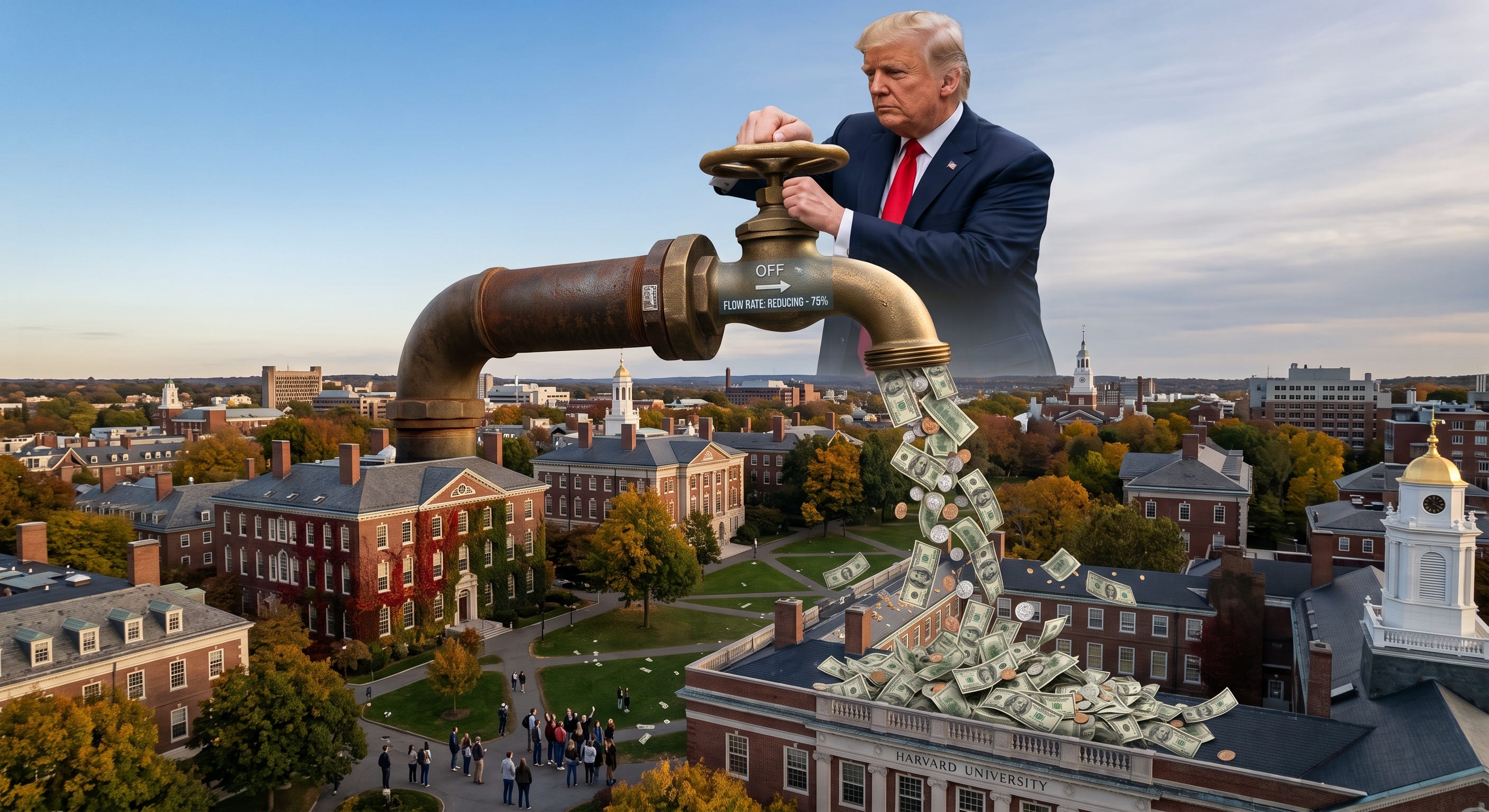
The government just noticed the middleman
On Monday the White House Office of Science and Technology Policy released a report with the immodest title “Science: A New Golden Age.” Michael Kratsios, the OSTP director, framed it as the first ground-up rethink of the American research enterprise since Vannevar Bush’s 1945 report — the document that built the university-centric funding system we have lived under ever since. Bolted to it was a memo from the Office of Management and Budget ordering every federal science agency to rewrite its 2028 budget priorities around the new doctrine.
The load-bearing sentence is this: federal research money — roughly two hundred billion dollars a year spread across the NIH, the NSF, the Energy Department, DARPA, NASA and the rest — should flow to individual scientists rather than to legacy institutions. Portable fellowships a researcher can carry between employers. Rapid grants. Prizes. ARPA-style bets. Money that follows the person doing the work instead of the letterhead they happen to be standing under that year.
And here is the part the “war on universities” framing buries: the report does not merely move money away from the institution, it names what it wants the money moving toward, and the answer is artificial intelligence. The centerpiece is a directive to fully fund and scale the Genesis Mission — launched last November as the flagship national AI-for-science initiative, with the declared goal of doubling the productivity of American research within a decade by wiring the national laboratories’ supercomputers, datasets and AI models into a single discovery engine. Autonomous laboratories. Domain-specific scientific foundation models. A transition, in the government’s own language, toward AI-native scientific institutions. Read that back slowly. The federal science apparatus just published a blueprint declaring that the future of producing knowledge is AI-augmented, not lecture-hall-bound. The thing I am about to argue is no longer a fringe opinion held by a guy who ships software. It is now the official science policy of the United States.
The press covered this as a war on universities, which it partly is. But the practitioner reading is simpler and less dramatic. The government looked hard at where its research dollar actually goes and noticed that a large slice of it never touches research at all. It goes to the middleman. And once you see the mechanic, you cannot unsee it.
The overhead racket, in one number
Here is the part nobody outside a grants office ever explains. When a scientist wins a federal grant, the university clamps a surcharge on top of it called the indirect cost rate — “facilities and administrative” costs, in the paperwork. The national average runs about fifty-three percent of direct costs, and at some institutions it climbs past seventy. Fifty-three cents of overhead skimmed for every dollar that reaches the actual science.
Put real figures on it. Out of the thirty-four billion dollars the NIH awarded in fiscal 2025, about nine and a half billion — twenty-eight percent — went to indirect costs rather than to research. Across the whole university system the overhead take runs into the tens of billions every year. That is the “expensive middleman with its own agenda” in a single sentence, and you do not have to guess at the agenda, because it is written in the rate. When the administration floated capping indirect costs at fifteen percent, the universities did not respond by itemizing what the missing thirty-eight points actually buy. They sued. Repeatedly. They are still suing. When an organization fights that hard to protect a surcharge, the surcharge is the business.
I have spent thirty years shipping software for companies that have to defend every line item to somebody who signs the checks. I know exactly what fifty-three percent overhead looks like from the inside. It looks like a layer that has learned to make itself load-bearing precisely so that it cannot be removed.
You already paid at the retail counter
The same racket runs a retail window, and you have already stood in line at it. Adjusted for inflation, tuition at four-year colleges has roughly quintupled since 1970. Americans now carry about one point eight seven trillion dollars in student debt — close to four times what they owed in 2006. And the mechanism wiring those two facts together has a name: the Bennett Hypothesis, after the education secretary who proposed it, later given a hard number by a Federal Reserve Bank of New York study finding that every additional dollar of subsidized federal loans translates into roughly sixty cents of tuition increase.
Cheap government money did not make college affordable. It handed colleges permission to raise the price, because the buyer was never spending his own cash. That is the identical overhead logic as the research grant, only aimed at an eighteen-year-old instead of a principal investigator. So the two products are decoupling from opposite ends at once: the government is pulling the research money out of the institution, and students are drowning in the cost of the credential. And in the widening gap between them, a question that used to be unthinkable has turned obvious. If I only want to learn the material, why am I paying for either one?
CEO paychecks, no CEO results
Follow that money up the org chart and it gets harder to stomach. The President of the United States runs the entire country — the military, the economy, the nuclear codes — for a salary of four hundred thousand dollars, a number that has not moved since 2001. Now look at the people running the institutions we are debating whether to keep funding. At least fifty public-university presidents out-earn the President of the United States, several of them by four or five times, and in the Chronicle of Higher Education’s tally more than twenty public-university chief executives cleared a million dollars a year. On the private side it is worse, because private universities can pay whatever their boards please, and those boards are stacked with the same corporate titans who set runaway CEO pay everywhere else. Dozens of private-college presidents pull seven figures. Penn’s Amy Gutmann was compensated north of three and a half million dollars in a single year. Deferred-compensation packages routinely detonate into single-year payouts in the millions — the president of the Savannah College of Art and Design saw more than seven million dollars vest in one year, and the president of Rensselaer collected nearly six.
Fine, pay for performance — except what, exactly, is the performance? These are Fortune 500 paychecks for running organizations whose federal research funding is now being pried loose precisely because too little of it ever reached research; whose tuition is a documented racket the Federal Reserve traced dollar-for-dollar to subsidized loans; and whose own most celebrated leaders, as we just saw, could not clear the plagiarism bar they hold a first-year student to. A corporate CEO who lost the core product, gouged the customers, and got caught cheating would be gone by lunch, with the board clawing back the bonus on the way out. In higher education he gets a deferred-compensation package and a building with his name on it. The pay does not track learning outcomes, or research output, or graduate earnings, or affordability. It tracks fundraising and prestige — the only two metrics that keep the machine fed. You are not being asked to fund scholars. You are being asked to fund executives, at executive rates, to preside over a product that stopped working.
The material was never the moat
Because the material — the thing you were told was locked inside the building — has been sitting in the open for twenty-five years. MIT published its entire curriculum online starting in 2001. OpenCourseWare now offers free, no-signup, Creative-Commons materials from more than twenty-five hundred MIT courses, and aggregators catalog north of eight thousand full courseware sets from MIT, Stanford, Yale and the rest. People have earned doctorates off of it. There are working quantum physicists in the world today whose entire foundation was MIT lecture notes they downloaded for nothing.
The knowledge was never the moat. The syllabus, the reading list, the problem sets, the lectures — all free, all indexed, and frequently better organized than whatever gets delivered from an actual podium. What the university sold you was never access to the knowledge. It was the credential stapled to the far end of it, plus one unspoken assumption doing all the quiet work: that you could not assemble the knowledge yourself without a professional walking you through it. That assumption was the last thing holding the price up. And it just fell.
The institution couldn’t meet its own standard
And while we are on the subject of the institution’s authority to certify knowledge, consider who was recently running the most prestigious one of them all. In January 2024, Claudine Gay resigned as president of Harvard after barely six months in the chair — the shortest tenure in the university’s nearly four-hundred-year history — amid allegations of plagiarism threaded through her scholarship, from her dissertation to peer-reviewed papers, some of the disputed passages dating back three decades. Harvard’s governing board, in the finest traditions of the house, declined to use the word “plagiarism” at all. It allowed that there had been “inadequate citations” and quietly issued corrections. The resignation landed in the same storm as her calamitous congressional testimony on campus antisemitism, but it was the integrity findings that drove the final nail.
Sit with the irony, because it is the entire point. The institution that runs every undergraduate’s term paper through plagiarism-detection software — that will haul a nineteen-year-old before a disciplinary board for precisely the conduct in question — could not hold its own president to the standard it enforces on teenagers. And Gay was not an isolated case. Months earlier, Stanford’s president, Marc Tessier-Lavigne, had stepped down after a review found manipulated data in papers out of his lab. Two of the most prestigious universities on Earth, two leaders unseated by the collapse of the very rigor they exist to embody. This is the authority you are being asked to go six figures into debt to sit beneath. When the referee cannot follow the rulebook, you are allowed to ask why you are still buying a ticket to the game.
The Harvard result that ends the argument
So set the integrity problem aside entirely, and grant the institution every possible benefit of the doubt. Even then, its one genuinely irreplaceable function — teaching a human being something — no longer favors it, and we finally have the hard number to prove it. It is almost too perfect that the number came out of Harvard’s own faculty.
In June, a team led by Gregory Kestin in Harvard’s physics department published a randomized controlled trial in the journal Scientific Reports. They took a real introductory physics course and split the students between two conditions. One group got an in-class active-learning session — not a droning lecture, but the peer-instruction, small-group, real-time-feedback pedagogy that decades of education research have crowned as the gold standard of human teaching. The other group learned the same material at home from a purpose-built AI tutor.
The AI group learned more than twice as much, measured on the same test, in less time — a median of forty-nine minutes against sixty. Effect sizes landed between roughly seven-tenths and one-and-three-tenths of a standard deviation, with a statistical significance below ten to the negative eighth. And the students reported being more engaged and more motivated while doing it. Read that carefully: this was not an AI beating a bad teacher. It was a well-designed AI beating what the field itself considers excellent teaching.
I will give you the honest caveat, because I do not deal in hype. The tutor had to be engineered with real pedagogical scaffolding — this was not “paste your homework into a chatbot” — and the study measured foundational learning over two weeks rather than a full semester of higher-order synthesis. The researchers say as much themselves. But look at the direction, and look at the date. That result came out of GPT-4, a model that is already old news. A broader meta-analysis spanning twenty-eight studies and some forty-six hundred learners found the same pattern everywhere the system combined personalized pacing, instant feedback and step-by-step guidance. The advantage is structural, and it is the exact advantage a human professor facing a hundred and twenty students in a lecture hall can never provide: it teaches one person at a time, at that person’s pace, with infinite patience and zero ego.
You hold the syllabus now
There is a second advantage, and it is the one that makes people flinch, so I am going to put data under it instead of adjectives. The professoriate is not politically representative of the country it teaches, and that is not a talking point, it is a measurement. A 2022 study of more than twelve thousand professors at flagship universities found registered Democrats outnumbering Republicans by about eight and a half to one. Harvard’s own faculty survey runs around sixty-three percent liberal against nine percent conservative. Yale came in at eighty-three percent Democrat and under three percent Republican. The imbalance is heaviest in the humanities and the softer social sciences, and lightest in engineering and the hard sciences — which, not by coincidence, are the fields that actually ship things.
Now, I am not going to insult your intelligence and claim an AI is some politically neutral oracle; every model carries the fingerprints of the data it was trained on. But that framing misses the real mechanism. When you sit in a lecture hall you are a captive audience: you get the material and whatever worldview the person holding the microphone decides to fold into it, on their schedule, with your grade in their hand. When you ask an AI to teach you thermodynamics, or contract law, or the C# type system, you hold the syllabus. You set the scope. You get thermodynamics — not a detour into the instructor’s politics — because you are the one steering, and there is no grade being held hostage to your agreement. The material without the sermon. That is not the AI being neutral. That is you being in charge for the first time.
The credential is cracking too
The final thread holding the old bundle together is the belief that the paper at the end still functions as a gate — that employers require it. Increasingly, they do not. By late 2025 only about nineteen percent of job postings on Indeed required a bachelor’s degree, and a slight majority listed no formal education requirement at all. Google dropped degree requirements for many roles back in 2018 and built its own certificate program to replace them. In tech specifically — my world — the migration from credential to demonstrated skill is the realest it is anywhere in the economy.
And I will be straight about the limit, because the data cuts both ways and I would rather you hear it from me than from a critic looking to score. Harvard and the Burning Glass Institute found that companies announce skills-based hiring far more than they practice it — after the job-posting language changed, fewer than one in seven hundred hires in some samples were actually non-degree candidates. The press release outran the behavior. Fine. But two things stay true underneath that gap. In technical fields the erosion is genuine and accelerating, and in every field the candidate who can actually do the thing — who can show the repository, the model, the shipped product — beats the candidate holding only a diploma. The degree was always a proxy for competence. Once you can demonstrate the competence directly, you no longer need the proxy.
Permission just went to zero
So add it up honestly. The research funding is being pulled out of the institution by the government itself. The knowledge has been free and open for a quarter century. A well-built AI tutor now out-teaches an excellent human classroom — on the record, in a peer-reviewed journal, more than two to one. The credential is losing its grip on hiring, fastest in exactly the fields that build the future. Every pillar the tuition bill rested on has been kicked out from under it except one, and that one is inertia.
You do not need to go into debt to learn something. Not anymore. That sentence would have been naive optimism ten years ago, and today it is a flat description of the toolset sitting in your pocket. You want to learn machine learning, or Roman history, or organic chemistry, or how to build a production agentic system in .NET — you do not apply, you do not enroll, you do not sign a promissory note that shadows you for twenty years. You open an AI and you tell it to design you a course. Syllabus, sequence, a reading list pointed straight at the free MIT and Stanford materials, problem sets, and a tutor that never tires of your questions and never once tells you what to think about anything other than the subject in front of you.
You can start this afternoon. For free. And you will learn more, and learn it faster, than the version of you who would have spent four years and six figures to be handed the same information with a worse teacher-to-student ratio and a mandatory worldview thrown in at no extra charge. The building was never selling knowledge. It was selling permission. And permission just went to zero.
About the Author
Gal Ratner is the founder and CTO of Inverted Software and WhiteStar Labs and Chief Architect at Prana Entertainment, with nearly thirty years of production software experience on the Microsoft and .NET stack for clients including Microsoft, Sony, Rockstar Games, 2K Games, Best Buy and Allegiant Air. He builds production agentic AI systems — MCP servers, the Microsoft Agent Framework, RAG pipelines and SQL Server vector search — and writes about the line where the AI industry’s marketing stops and its real utility begins. He was employee number six at Break.com and a Los Angeles Business Journal CTO of the Year finalist. He trains Brazilian jiu-jitsu in Las Vegas, rides motorcycles, and co-hosts Edge Grip Podcast. He is the .NET AI guy that ships — the one who reads the study before he writes the headline.