


The State of the Cloud — A Four-Provider Comparison
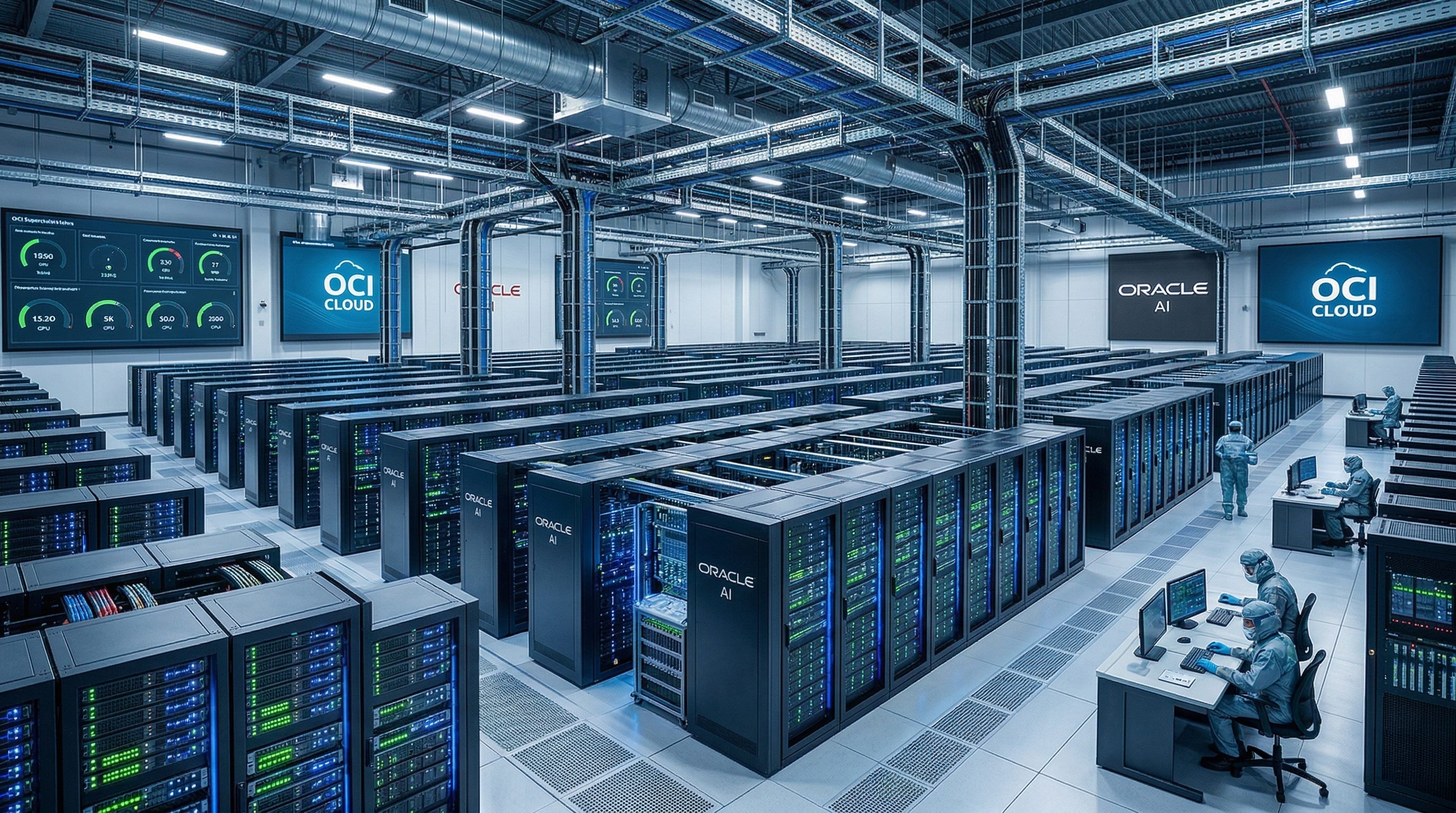
The cloud computing market in 2026 is an $800+ billion industry dominated by three hyperscalers and one perennial also-ran desperate to buy its way to relevance. Amazon Web Services, Microsoft Azure, and Google Cloud Platform together control roughly 65% of global cloud infrastructure spending. Oracle Cloud Infrastructure, despite years of aggressive spending and marketing, holds approximately 2–4% of the market. Understanding the gulf between these providers is essential context for what follows: Oracle’s decision to sacrifice 30,000 human beings on the altar of a strategy that the numbers say cannot work.
Amazon Web Services (AWS): The Incumbent Titan
AWS pioneered the cloud infrastructure market when it launched in 2006, and two decades later it remains the undisputed leader with approximately 30–32% global market share and more than 200 fully featured services spanning compute, storage, databases, machine learning, IoT, and analytics. AWS generated over $100 billion in annual revenue in 2025 and continues to grow at 19–21% year-over-year. Its competitive moat is staggering: the deepest service catalog in the industry, the largest global data center footprint, the most mature partner ecosystem, and the highest institutional familiarity among developers and architects worldwide. When enterprises say “cloud,” most still think AWS first.
AWS’s AI strategy is multi-pronged: its Bedrock platform offers access to foundation models from Anthropic, Meta, Mistral, and others. Custom Trainium and Inferentia chips provide cost-competitive alternatives to Nvidia GPUs. SageMaker remains the most widely adopted ML platform in production environments. AWS’s approach to AI is characteristically pragmatic: offer every tool, let the customer choose, and profit from the compute regardless of which model wins.
Microsoft Azure: The Enterprise Integrator
Azure holds approximately 20–23% of the cloud market and has been the fastest-growing major provider, driven almost entirely by the most important strategic partnership in AI: its exclusive relationship with OpenAI. Microsoft’s $13+ billion investment in OpenAI gave it the right to integrate GPT-4 and subsequent models across its entire product surface — from Azure OpenAI Service for developers to Copilot embedded in Office 365, GitHub, Dynamics 365, and Windows itself. This is what an actual AI integration strategy looks like: you build the models (or pay someone else to), then you embed them into products that a billion people already use daily.
Azure’s hybrid cloud capabilities via Azure Arc and Azure Stack give it an unmatched advantage in regulated industries like healthcare, finance, and government. Its tight integration with Active Directory, Windows Server, and the Microsoft 365 ecosystem makes it the default choice for enterprises already in the Microsoft orbit. Azure’s AI strategy isn’t about selling data center space — it’s about making every Microsoft product smarter, stickier, and more valuable.
Google Cloud Platform (GCP): The AI Native
Google Cloud holds roughly 11–13% market share and has found its niche as the AI-native cloud. Google invented the Transformer architecture that underpins every modern LLM — including the ones Oracle is desperately trying to host. Its Tensor Processing Units (TPUs) are the only commercially available custom AI accelerators that rival Nvidia’s GPUs at scale. Vertex AI, BigQuery, and the Gemini model family give Google a vertically integrated AI stack that no competitor can replicate.
Google Cloud achieved profitability for the first time in 2025 and has maintained positive operating margins since. Its strengths in data analytics, Kubernetes (which Google also invented), and open-source technologies make it the preferred platform for data-intensive and AI-native workloads. Google doesn’t need to buy an AI model — it builds the best ones in-house.
Oracle Cloud Infrastructure (OCI): The Distant Fourth
And then there’s Oracle. With roughly 2–4% of the global cloud market, OCI is not in the same conversation as the Big Three. According to the Flexera 2026 State of the Cloud report, Oracle represents just 5% of primary cloud spending among enterprises, compared to 47% for AWS, 32% for Azure, and 12% for Google Cloud. Oracle’s cloud business was a late-mover afterthought, born from a company that spent the 2010s in denial about the cloud revolution while AWS and Azure ate its lunch.
OCI’s only competitive differentiator is its RDMA-based networking architecture, which offers strong price-to-performance for AI training workloads. This is real, and it’s the reason OpenAI chose Oracle for some Stargate capacity. But hosting someone else’s AI workload as a landlord is fundamentally different from owning the AI value chain. Oracle is building data centers. Microsoft, Google, and Amazon are building intelligence.
March 31, 2026 — The Morning 30,000 People Lost Everything
At approximately 6:00 a.m. local time on Tuesday, March 31, 2026, employees of Oracle Corporation across the United States, India, Canada, Mexico, and Uruguay opened their email to find a message from “Oracle Leadership.” The message was brief and formulaic. It informed them that their roles had been eliminated as part of a broader organizational change. That the day of the email was their final working day. That access to company systems would be cut immediately. There was no prior warning from HR. No conversation with a direct manager. No meeting. Just an email sent at dawn, and then silence.
Investment bank TD Cowen estimates the layoffs affect between 20,000 and 30,000 employees — roughly 18% of Oracle’s 162,000-person global workforce. Employee posts on Reddit’s r/employeesOfOracle and the professional forum Blind confirmed cuts in real time, with entire teams in the Revenue and Health Sciences division and SaaS and Virtual Operations Services seeing reductions of at least 30%. NetSuite’s India Development Centre was gutted across project management and engineering. Some employees reported being invited to a “Project Update” meeting, only to have HR appear and terminate them on camera with five minutes’ notice. Reports surfaced that Oracle had recently installed monitoring software on company-issued Mac laptops capable of logging all device activity, with warnings circulating not to copy any files before returning machines.
Oracle disclosed a $2.1 billion restructuring plan in its March 2026 10-Q SEC filing, with $982 million already recorded. The company said most of the costs stem from employee severance payments. TD Cowen estimates the cuts will free up $8 to $10 billion in annual cash flow.
This is not a company in financial distress. Oracle posted a 95% jump in net income last quarter, reaching $6.13 billion. Its remaining performance obligations stood at $523 billion, up 433% year over year. Revenue was at record levels. Yet 30,000 people received a cold email at 6:00 a.m. because a billionaire decided their lives were worth less than a data center in Abilene, Texas.
Why Freeing Capital for AI Data Centers Will Not Save Oracle
Oracle’s thesis is simple: fire people, save money, build data centers, host AI workloads, gain market share. Every step of this logic is flawed.
You Cannot Buy Market Share in Cloud. You Earn It.
AWS has a 20-year head start. Azure has a billion-user Microsoft ecosystem. Google invented the fundamental architecture behind every modern AI model. Oracle has… a database. A very good database, yes, but a database is not a cloud platform, and a cloud platform is not an AI company. Oracle’s 2–4% cloud market share has barely moved in years despite billions in spending. Adding data centers does not solve the fundamental problem: enterprises do not trust Oracle, do not like Oracle, and do not want to be locked into Oracle’s ecosystem.
Oracle Is a Landlord, Not an AI Company
Here is the critical distinction that Oracle bulls refuse to acknowledge: Oracle does not have a competitive AI model. Not one. After decades of acquisitions — PeopleSoft for $10.3 billion, Siebel for $5.8 billion, Sun Microsystems for $7.4 billion, Cerner for $28.3 billion, and over 100 other companies — Oracle still cannot produce an AI model that competes with GPT-4, Gemini, Claude, Llama, or even Mistral. Oracle spent more than $60 billion on acquisitions in the last twenty years and has nothing to show for it in AI.
Instead, Oracle is positioning itself as a landlord for OpenAI’s Stargate project: building the data centers, racking the Nvidia GPUs, and charging rent. This is the cloud equivalent of being the contractor who builds the factory while someone else owns the product. When the product owner decides to use a different contractor — or build their own factory — the landlord is left with empty buildings and $58 billion in new debt.
The Circular Investment Shell Game
The financial architecture of the Stargate project should alarm anyone paying attention. Oracle is an equity funder of Stargate, contributing roughly $7 billion. OpenAI is the operational partner. SoftBank provides the financial muscle. But here’s the circularity: Oracle builds data centers for OpenAI. OpenAI pays Oracle for cloud capacity. Oracle’s revenue from that capacity inflates its remaining performance obligations, which inflates its stock price, which increases Larry Ellison’s net worth. The entire cycle depends on OpenAI continuing to need Oracle’s capacity at premium rates.
But OpenAI has also expanded relationships with Microsoft (which still provides core Azure cloud services to OpenAI), CoreWeave, and SoftBank directly. Nvidia recently invested $100 billion in OpenAI’s infrastructure. When OpenAI’s compute needs are so massive that it needs every available provider, Oracle benefits. When those needs consolidate — or when OpenAI builds its own capacity, as every maturing tech company eventually does — Oracle will be the first partner shown the door. You don’t get loyalty when your primary business model is suing your own customers.
Nobody Trusts Oracle — And With Good Reason
The Audit-Bargain-Close Playbook
Oracle’s relationship with its own customers is uniquely adversarial in the technology industry. The company’s licensing enforcement division — known internally as LMS (License Management Services) — conducts aggressive audits of Oracle customers, deploys scripts to scan customer environments for compliance gaps, then presents inflated licensing shortfall findings designed to pressure customers into purchasing additional Oracle products or migrating to Oracle Cloud to “resolve” the audit. Industry attorneys have labeled this the “Audit, Bargain, Close” (“ABC”) playbook, and an entire cottage industry of law firms now specializes in defending companies against Oracle’s audit practices.
Tactical Law Group’s court filings have described Oracle and its subsidiaries as “notorious around the globe for their predatory audit practices,” stating that Oracle uses “limited audit rights granted under software license agreements as a tool to improperly drive further sales.” The firm has defended companies including Cogent Communications against Oracle lawsuits for copyright infringement arising from audits.
In 2021, Oracle escalated dramatically by filing its first-ever copyright infringement lawsuit against a database customer — Envisage Technologies — in the Northern District of California. This was followed by a suit against NEC Corporation of America seeking at least $7 million in damages plus treble damages for alleged willful copyright infringement, all stemming from an audit. Oracle has also been accused in multiple lawsuits of running a scheme through Oracle Credit Corporation where it misrepresented software capabilities, assigned financing agreements to third-party banks before breaches became apparent, and then allowed those banks to enforce payment on customers whose software never worked.
Counter-Suits and Customer Revolt
Customers have fought back. Mars Inc. filed a landmark lawsuit against Oracle challenging the company’s licensing tactics — one of the few times a major licensee publicly confronted Oracle’s audit script. The state of Oregon fought six simultaneous lawsuits against Oracle over a failed ERP installation that was variously described as “bitter” and “nasty,” eventually settling for $100 million. Trinity Health in North Dakota sued Cerner (now Oracle Health) over patient accounting software that didn’t work correctly, settling for $106 million. A California grand jury found that Cerner knew a county healthcare agency was unprepared to complete a $32 million installation.
A former Oracle employee even filed a lawsuit alleging that Oracle’s subsidiary NetSuite had concocted a “fraudulent scheme to sell SaaS software that didn’t actually exist,” then blamed customers for problems with the non-existent product to justify extracting additional licensing fees.
Why No Enterprise Will Trust Oracle with AI Model Memory
This is the crux of Oracle’s AI problem, and it’s one that no amount of data center construction can solve. AI workloads are fundamentally different from traditional database licensing. When you run an AI model on Oracle Cloud Infrastructure, Oracle has potential visibility into the data flowing through its systems: the training data, the model weights, the inference queries, and the outputs. For any company running proprietary AI models, this data represents the crown jewels of competitive advantage.
Now ask yourself: would you trust the company known globally for predatory software audits — the company that deploys scanning scripts to find compliance gaps in customer environments, the company that sues customers for copyright infringement when audits reveal discrepancies, the company whose own employees have testified about fraudulent sales practices — would you trust that company with access to your AI model’s training data and inference patterns?
The answer, for any competent CTO, is an unequivocal no. Oracle’s decades of audit-driven antagonism have created a trust deficit that makes it fundamentally unsuited to the AI era, where customers must share their most sensitive intellectual property with their infrastructure provider. AWS, Azure, and Google all have their own privacy and trust challenges, but none of them have built a business model around systematically suing their own customers.
The Obscene Wealth of Larry Ellison

While 30,000 Oracle employees opened termination emails at 6:00 a.m. on March 31, 2026, Larry Ellison’s personal fortune stood at approximately $201 billion, according to Bloomberg. Even after losing $46.7 billion in paper wealth in the first three months of 2026 — a 19% decline driven by Oracle’s stock dropping 22% year-to-date — Ellison remains the sixth-richest person on Earth.
Let that sink in. The man who just fired 30,000 people via a dawn email is worth two hundred and one billion dollars. His personal losses in 2026 alone — $46.7 billion — are more than the GDP of most nations. He still has $201 billion left.
How Larry Ellison Spends His Money
Ellison’s lifestyle is a monument to concentrated wealth. He owns approximately 98% of the Hawaiian island of Lanai, purchased in 2012 for $300 million. He bought a $173 million oceanfront mansion in Manalapan, Florida, and the $277 million Eau Palm Beach Resort and Spa. His real estate portfolio includes estates in Malibu, Lake Tahoe, San Francisco, Rhode Island, and a property in Woodside, California modeled on 16th-century Japanese feudal architecture.
He sails a 288-foot mega-yacht called Musashi, named after the Japanese samurai, built by Feadship and featuring a swimming pool, basketball court, movie theater, gym, spa, elevator, and a crane to launch racing boats. He previously owned the 453-foot Rising Sun, which cost over $200 million to build and was the 12th largest yacht in the world before he sold it to David Geffen. He flies a $75 million Gulfstream G650 and owns two military fighter jets, including a decommissioned Soviet MiG-29 that the U.S. government considers a weapon of war and will not allow him to fly domestically. He owns the Indian Wells Tennis Garden and tournament, purchased for $100 million with another $100 million invested since.
Larry Ellison’s Assets vs. His Laid-Off Employees
The math is simple and devastating. Oracle’s entire restructuring budget — the $2.1 billion earmarked to cover severance for up to 30,000 terminated employees — represents roughly 1% of Larry Ellison’s personal net worth. He could fund the entire severance package from his personal fortune and still be worth $199 billion. He would still own Lanai. He would still have the yacht. He would still have the fighter jets. He would still be one of the ten richest humans who have ever lived.
Instead, Oracle took on $58 billion in new debt in just two months — including $50 billion through a single bond offering in February 2026 — to fund data centers. The debt burden, combined with a stock price that has fallen 30% in 2026, means that Oracle’s financial flexibility is more constrained than at any point in its modern history. The people being fired are paying for a gamble that overwhelmingly benefits one man and his shareholders.
The Cancer Cure That Required 30,000 Casualties
On January 21, 2025, Larry Ellison stood in the Roosevelt Room of the White House alongside President Trump, OpenAI CEO Sam Altman, and SoftBank CEO Masayoshi Son to announce the Stargate project. With visible excitement, Ellison described a future where AI would enable early cancer detection through a simple blood test, design personalized mRNA vaccines tailored to each patient’s unique tumor signature, and produce those vaccines robotically within 48 hours.
“Imagine early cancer detection, the development of a cancer vaccine for your particular cancer aimed at you, and having that vaccine available in 48 hours. This is the promise of AI and the promise of the future.” — Larry Ellison, White House, January 2025
Fourteen months later, the “promise of the future” arrived in the form of 30,000 termination emails. The man who told the world that AI would cure cancer just fired 18% of his workforce — including employees in Oracle’s own Health Sciences division — to free up cash for the data centers he claimed would power that cure.
The contradiction is nauseating. Ellison’s cancer vaccine rhetoric was deployed at a White House press conference to generate excitement for Stargate — and to boost Oracle’s stock price, which directly increases his personal wealth. When the time came to actually fund the project, the cost was borne not by the billionaire, not by the shareholders, and not by the executives, but by tens of thousands of middle-class employees who were discarded via an automated email before dawn.
This is the pattern of Oracle under Larry Ellison: grand visions announced from podiums of power, funded by the destruction of ordinary lives. The promise is AI-powered cancer vaccines in 48 hours. The reality is a 6:00 a.m. termination email and a few months’ severance.
The Apple Alternative — A Path Oracle Refuses to See
There is a company that has managed to integrate AI deeply into its business without laying off 30,000 people, without taking on $58 billion in debt, and without building a single massive AI data center. That company is Apple.
Apple’s 2026 AI strategy is the exact opposite of Oracle’s, and it’s working. While Oracle plans to spend approximately $50 billion on AI infrastructure CapEx in fiscal 2026 — funded by debt and human sacrifice — Apple plans just $14 billion in total capital expenditure. That’s not a typo. Apple is spending 72% less than Oracle on CapEx while sitting on $130 billion in cash reserves.
Apple’s Platform Strategy: The AI App Store
Rather than trying to build the best AI model — a race Apple correctly identified it would lose against OpenAI, Google, and Anthropic — Apple is turning its hardware ecosystem into an AI platform. Apple Intelligence runs on-device using efficient models optimized for Apple’s M-series and A-series chips, with Private Cloud Compute handling heavier workloads through privacy-preserving cloud infrastructure. Third-party AI models like Google’s Gemini and potentially others are being integrated into iOS through a Siri Extensions program that mirrors the App Store’s original model: Apple provides the platform, developers provide the apps, everyone profits.
This is strategic brilliance. Apple doesn’t need to win the AI model race. It needs to be the best place to use AI models. With over 2 billion active devices worldwide, Apple controls the hardware, the operating system, and the distribution channel. Every AI company in the world wants access to Apple’s user base. Apple takes a percentage of the revenue and maintains control of the customer relationship. No debt required. No layoffs required. No trust violations required.
What Oracle Could Learn from Apple
Oracle actually has real strengths that a competent strategy could leverage for AI without mass layoffs. Oracle Database remains the gold standard for enterprise transactional workloads. Oracle’s installed base of enterprise customers — 97% of Fortune 500 companies license Oracle software — is an asset that could be transformed into an AI advantage if Oracle stopped treating those customers as adversaries to be audited and started treating them as partners to be served.
Here is a strategy Oracle won’t consider because it would require Larry Ellison to think about someone other than himself:
1. Embed AI into Oracle Database natively. Stop building data centers and start building intelligence into the product that customers already use. SQL Server 2025 already has vector search and AI integration. Oracle should be ahead of this curve, not behind it.
2. Open the platform. Follow Apple’s model: let customers run any AI model they want on Oracle’s infrastructure with zero audit risk. Provide guarantees that AI workload data will never be used for licensing compliance. Build trust instead of destroying it.
3. Retrain instead of terminate. Oracle has 162,000 employees with deep enterprise knowledge. Retrain them for AI-adjacent roles — AI implementation consulting, model fine-tuning for enterprise use cases, data pipeline engineering. These people understand Oracle’s customers better than any AI model will for years.
4. Stop the audits. Permanently. The revenue Oracle gains from predatory licensing enforcement is dwarfed by the market share it loses from the resulting trust deficit. Every dollar extracted through an audit costs Oracle ten dollars in cloud revenue that went to AWS or Azure instead.
Apple proved that you can be the most valuable company in the world without building your own AI model and without firing your workforce. You do it by leveraging your strengths — hardware, ecosystem, distribution, trust — and letting others carry the weight of AI model development while you capture the value at the platform layer. Oracle has ecosystem strengths. It simply refuses to use them because its culture, from the very top, is built on extraction rather than creation.
Conclusion: The Human Cost of a Billionaire’s Vanity
On the morning of March 31, 2026, approximately 30,000 human beings — software engineers in Bangalore, project managers in Austin, operations specialists in Toronto, developers in Mexico City — discovered they were unemployed through an email sent before most of them had finished their first cup of coffee. Their access was cut immediately. Their work, their relationships, their daily routines — erased by a script running on the same Oracle systems they had spent years maintaining.
They were sacrificed so that Oracle could free up $8 to $10 billion in cash flow to build data centers for a company — OpenAI — that may not need Oracle in five years. They were fired by a company that posted record profits and a 95% jump in net income. They were discarded by an organization controlled by a man worth $201 billion who owns an island, a mega-yacht, military fighter jets, and a $277 million resort hotel.
Larry Ellison told the world that AI would cure cancer. Instead, it cured him of 30,000 employees.
Oracle’s AI strategy will fail. Not because the technology is wrong — OCI’s RDMA networking is genuinely good — but because the company is incapable of the one thing AI demands above all else: trust. You cannot be the company that audits, sues, and threatens its customers for decades and then ask those same customers to hand over their most sensitive AI workloads. You cannot be the company with no AI model of its own and expect to compete against companies that build the best models in the world. You cannot fund your AI ambitions by destroying the lives of 30,000 people and expect the market to reward you for it.
The cloud wars have a winner, and it isn’t Oracle. The AI race has leaders, and Oracle isn’t among them. What Oracle does have is a billionaire’s vanity project, $58 billion in new debt, and 30,000 people who woke up today to find that their livelihoods were worth less than a server rack in Abilene, Texas.
The promise of AI is extraordinary. The promise of Oracle is broken.