


On March 24, 2026, OpenAI killed Sora.
Not sunset. Not transitioned. Not donated to the research community. Killed. The app goes dark April 26. The API follows in September. After that, every video, every creation, every piece of work users built on the platform gets permanently deleted. Gone. As if it never existed.
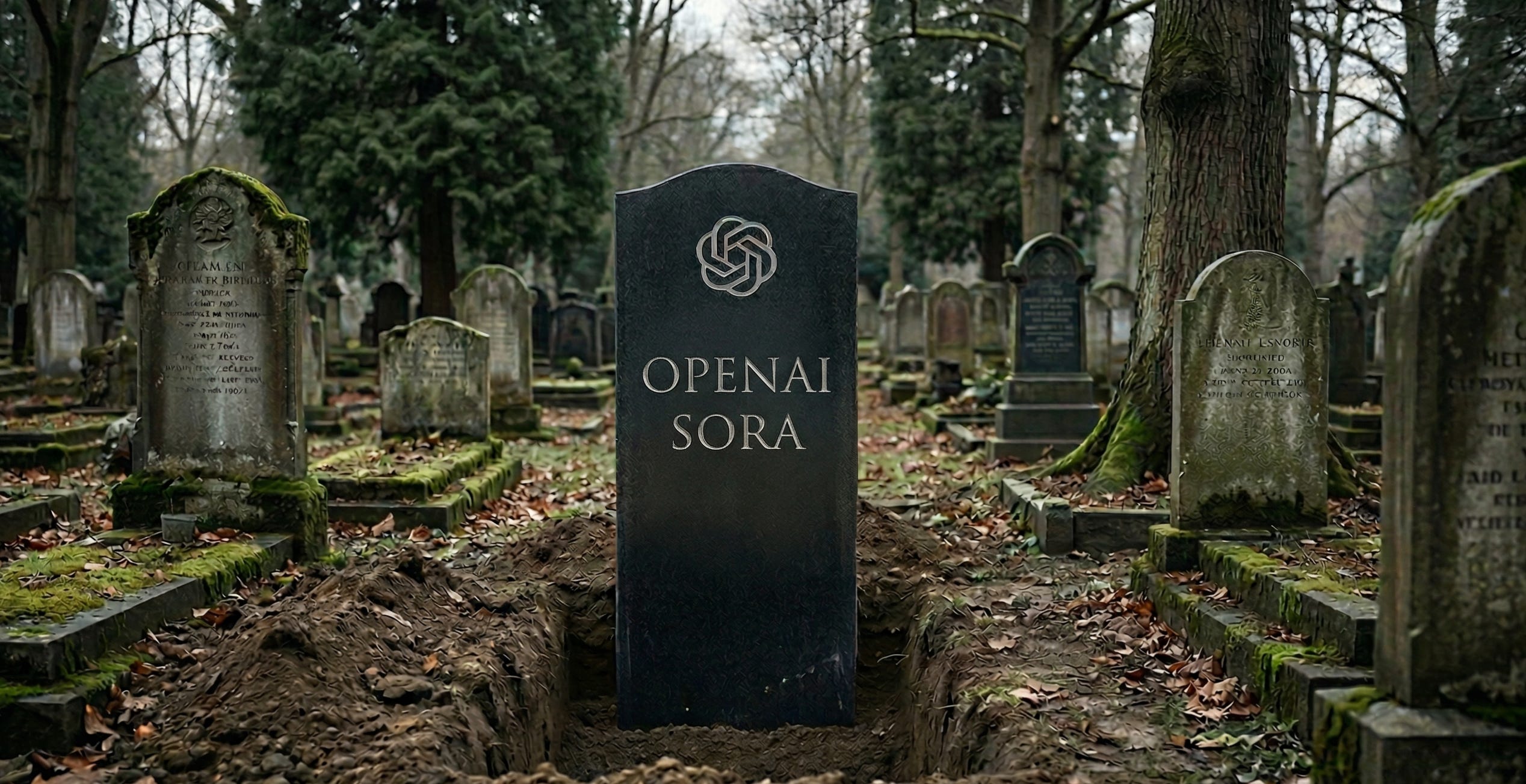
This is a company that was founded as an open-source nonprofit with the explicit mission of ensuring artificial intelligence benefits “humanity as a whole.” A company that Elon Musk co-founded specifically because he wanted it to be an open counterweight to Google’s proprietary AI ambitions. A company with “Open” in its name.
They would rather destroy the technology than share it.
Let that sink in.
The Numbers Tell a Damning Story
According to a Wall Street Journal investigation published March 29, Sora was burning through approximately one million dollars per day in compute costs. User counts peaked at around a million, then collapsed to fewer than 500,000. Downloads plunged 75 percent from their November 2025 peak. The Sora team’s own head, Bill Peebles, publicly admitted the economics were “completely unsustainable.”
So what did Sam Altman do? He killed the product entirely, freed up the GPU resources, and redirected everything toward competing with Anthropic’s Claude Code, which was — in TechCrunch’s words — “eating OpenAI’s lunch” among the software engineers and enterprise clients that actually generate revenue.
This is business logic, and it’s the kind of cold calculation you expect from any corporation optimizing for an IPO. Fine. But here’s where the story gets unconscionable: OpenAI didn’t just shut down the service. They chose to take the model, the weights, the architecture, and all the research that made Sora possible — and lock it all in a vault. No open-source release. No weights on Hugging Face. No community handoff. Nothing.
They built it. It didn’t print money fast enough. So they’re burying it in the backyard where nobody can touch it.
The Disney Fiasco Tells You Everything
In December 2025, Disney committed to a billion-dollar investment in OpenAI. The deal included a three-year licensing agreement giving Sora users access to more than 200 Disney, Marvel, Pixar, and Star Wars characters. An OpenAI executive reportedly described it as a “cinematic sea change on par with the end of the silent-film era.”
Three months later, Disney found out Sora was being killed less than an hour before the public announcement. A billion-dollar partnership, dissolved via what amounts to a text message. Disney’s public response was the diplomatic equivalent of a door slammed in someone’s face: they “respect OpenAI’s decision to exit the video generation business.”
If OpenAI treats a partner worth a billion dollars like this — blindsiding them with less than sixty minutes’ notice — what do you think they think of you? Of the independent creators who built workflows around Sora? Of the developers who integrated the API into production systems? Of the users who uploaded their faces to the platform trusting it would be there next month?
You are nothing to them. You are a line item that got crossed out on a spreadsheet in a pre-IPO strategy meeting.
Meanwhile, In the Real Open-Source World
While OpenAI chooses to destroy what it can no longer monetize, the actual open-source AI community is thriving — and it’s building video generation that anyone can run, modify, and own.
Alibaba’s Qwen team has become the most downloaded open-source model family on Hugging Face, surpassing all competitors combined. Their models ship under Apache 2.0 licenses. You can download them. You can run them locally. You can fine-tune them. You can build businesses on top of them. Nobody is going to yank them away from you with sixty minutes’ notice because some VP decided the unit economics didn’t work for the IPO roadshow.
Tencent released HunyuanVideo, a 13-billion parameter open-source video foundation model that, according to professional evaluations, outperforms Runway Gen-3 and Luma 1.6. You can download it right now from Hugging Face. It runs on a single RTX 4090 for the distilled variants. Wan 2.2, from Alibaba’s Tongyi Lab, uses a Mixture-of-Experts architecture that delivers cinematic-quality video generation, also under Apache 2.0, also available for anyone to download and run locally. CogVideoX, Open-Sora, SkyReels, AnimateDiff — the list goes on. There are over thirty open-source video generation models available right now that you can run on your own hardware.
These aren’t toy projects. These are production-ready systems that match or exceed what Sora could do. And critically, they can’t be taken away from you. Because the weights are on your hard drive. Because the code is on GitHub. Because that’s what “open” actually means.
“Open” AI Is the Biggest Lie in Tech
Let’s talk about the name. OpenAI was founded in 2015 with a stated mission to advance AI “unconstrained by a need to generate financial return.” Their founding charter explicitly said their research would be free from financial obligations so they could “better focus on a positive human impact.”
Since then, they’ve converted to a capped-profit corporation controlled by Microsoft. They’ve raised $120 billion at a $730 billion valuation. They project $200 billion in revenue by 2030. They introduced ads in ChatGPT. Sam Altman once called ads a “last resort” — that lasted about as long as Sora did.
Elon Musk, who co-founded the organization and named it “Open” AI specifically because it was supposed to be open-source, called it out directly: “OpenAI was created as an open source, non-profit company to serve as a counterweight to Google, but now it has become a closed source, maximum-profit company effectively controlled by Microsoft.”
When OpenAI accused DeepSeek of training on ChatGPT outputs, the internet’s response was immediate and merciless. One commenter captured it perfectly: OpenAI, “the company built on stealing literally the entire internet, is crying because DeepSeek may have trained on the outputs from ChatGPT.” Another put it more bluntly: “OpenAI has zero moral authority to claim copyright.”
This is a company that scraped the entire internet — copyrighted books, articles, creative works — to build its models. And when someone else does the same thing to them? Lawyers. When their own model stops being profitable? Destroy it. Under no circumstances let the public benefit from the billions of dollars of research and compute that went into building it.
What Open-Sourcing Sora Would Have Looked Like
Let me paint you a picture of the road not taken.
OpenAI could have released the Sora model weights on Hugging Face under an Apache 2.0 license, just like Qwen, HunyuanVideo, Wan, and dozens of other models. The community would have quantized it for consumer hardware within days. GGUF quantization now allows 14-billion parameter video models to run on GPUs with just 8 to 10 gigabytes of VRAM. Within a week, you’d have had Sora running in ComfyUI on a gaming PC.
Researchers would have fine-tuned it. Startups would have built products on it. Film students would have made short films with it. Independent creators — the ones Disney and OpenAI were supposedly trying to empower — would have actually been empowered.
The cost to OpenAI? Zero ongoing compute expense. Massive goodwill. A legacy as the company that democratized video generation. A credible claim to the “Open” in their name for the first time in years.
Instead, they chose to light it all on fire. Because the only thing worse than not making money on a technology, apparently, is letting someone else benefit from it for free.
Sam Altman’s Priorities Are Crystal Clear
In the same week he killed Sora, Sam Altman handed off safety and security oversight to focus on what he called “raising capital, supply chains, and building data centers at unprecedented scale.” He teased a new model codenamed “Spud” that he promised would “really accelerate the economy” while offering zero details about what it actually does.
Meanwhile, the company had already been running in what employees called “code red” mode since December. Fidji Simo, OpenAI’s “CEO of applications,” told staff in an all-hands meeting that they would be eliminating “side quests” to optimize for “productivity on the business front.”
Sora was a “side quest.” The billion-dollar Disney deal was a “side quest.” Video generation — the technology that rattled Hollywood, that prompted a genuine debate about the future of creative work — was a “side quest.” But data centers? Fundraising? IPO preparation? Those are the main quest.
This is not a technology company. It is a financial instrument with a chat interface.
The Pattern You Should Be Furious About
The Sora shutdown isn’t an isolated incident. It’s a pattern. OpenAI launches products with enormous fanfare. They collect your data, your content, your biometric information (Sora specifically encouraged users to upload photos of their faces). They use the buzz to pump their valuation. Then when the product doesn’t deliver returns fast enough, they kill it — but they keep your data.
OpenAI hasn’t clarified what happens to the facial biometric data that thousands of users uploaded to Sora. Privacy advocates are already raising alarms. The pattern is familiar: launch a consumer product, collect training data, shutter the public tool, retain the data for internal use. It’s a playbook the industry has seen before, but rarely with biometric information at this scale.
And it’s not just Sora. In the same month, OpenAI also quietly pulled back its “erotic chatbot” feature and scaled down ChatGPT’s shopping integration. Products launch, data is harvested, products die. The data remains.
The Choice Was Always There
Every piece of technology that OpenAI has killed could have been released to the public. Every model that wasn’t profitable enough for the IPO timeline could have been put on Hugging Face. The marginal cost of uploading model weights to a public repository is effectively zero. The benefit to humanity — the thing OpenAI was literally founded to serve — would be enormous.
Alibaba does it. Tencent does it. Meta does it with Llama. Mistral does it. DeepSeek does it. Chinese and European companies, some operating under far more restrictive regulatory environments, manage to release powerful AI models to the public. But OpenAI — the company with “Open” in its name, the company founded on the principle of benefiting humanity — can’t bring itself to share anything it can’t charge for.
The next time Sam Altman gets on stage and talks about AI benefiting humanity, about democratizing access to intelligence, about building a future that works for everyone — remember Sora. Remember that when it came time to choose between giving the technology to the world or destroying it entirely, he chose destruction. Every single time.
The “Open” in OpenAI isn’t ironic anymore. It’s an insult.