


Mike Cannon-Brookes is a billionaire. He laid off 1,600 people on March 11. Atlassian’s last quarter was profitable. The company is still profitable. The 8-K he filed the same week pegged the restructuring charge at $225 million to $236 million — with $169 million of that going to severance, which is corporate accounting for “we are paying people to leave so we can stop paying them to work.”
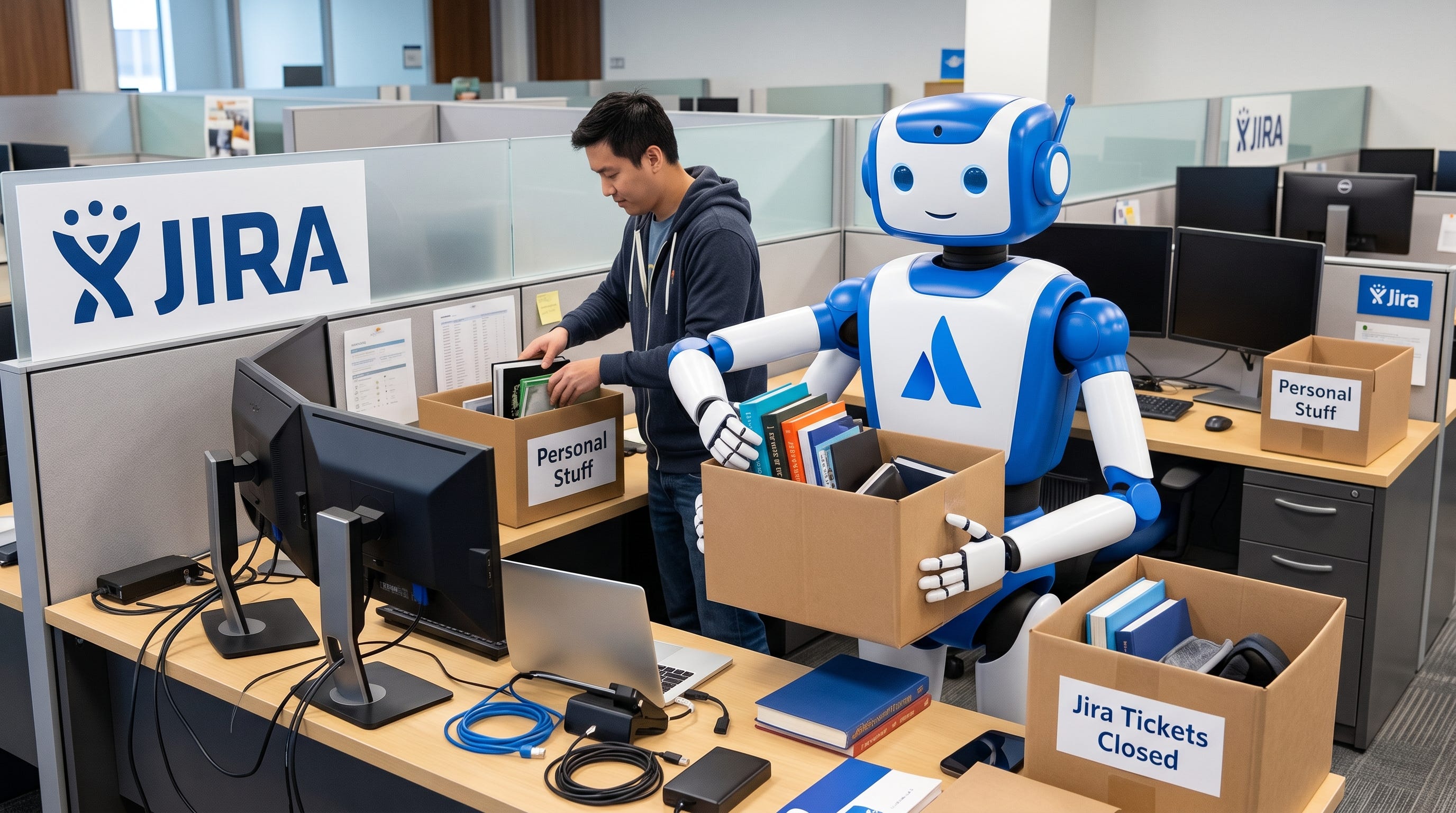
I have been building software for thirty years. I was employee number six at a company called Break.com that pushed over a hundred million pageviews a day in 2006 with six engineers and a server room held together by zip ties and prayer. I have watched companies grow, plateau, get sold, get gutted, and disappear. I have been on the wrong side of more than one layoff. So I want to say this with the appropriate amount of restraint, which is none:
Profitable companies do not get to fire the people who made them profitable.
That is not a financial argument. The financial argument is for the bankers, and the bankers will write you a different op-ed. That is a moral argument, and most of corporate America stopped being able to hear moral arguments around 2008. I am going to make it anyway, because we are in a moment where the people running technology companies need to be reminded that the engineers who built the product they are selling are not a line item to be optimized down to zero.
The Psychological Contract Got Torn Up
Atlassian was founded in 2002 by Cannon-Brookes and Scott Farquhar with a loan they reportedly put on a credit card. It is a nice founder story. It is the story they tell at the IPO roadshow and the Aspen panel and the Bloomberg profile. The story they do not tell is that for the next twenty-three years, several thousand engineers — many of whom never appeared in a single magazine profile and never owned more than a rounding error of the company — built the actual products. They scaled Jira from a bug tracker into the system of record for half the world’s software teams. They built Confluence into the wiki that runs every enterprise. They acquired Trello, Loom, Statuspage, Opsgenie, and turned them into a platform. They were on call at three in the morning when the production database lost its mind. They onboarded the next hire. They wrote the runbooks. They drank the Kool-Aid.
Cannon-Brookes paid them in salary and stock, and the deal was fair as far as it went. I am not saying he stole anything. I am saying that there is something called a psychological contract — a phrase from organizational behavior that names the implicit understanding sitting underneath the explicit one. The explicit contract said: do your job, get paid. The implicit contract said: build this company with us, and we will not throw you overboard the first time the stock price gets choppy and the analysts get loud about margins.
The stock price has been choppy. Atlassian is down 84% from its 2021 peak, more than half of that drop happening in 2026. The analysts have been loud. So Cannon-Brookes broke the implicit contract.
He broke it badly. The notice was a pre-recorded video. The affected employees got six to twelve hours of Slack access before being locked out. Six hours. Six hours to say goodbye to colleagues they had built four years of professional relationships with. Six hours to copy the half-finished design doc out of Confluence — the one you cared about more than your manager did. Six hours, then dark.
You can tell yourself a lot of stories about why this was necessary. Cannon-Brookes told the most popular one: this is to “self-fund” AI investment. The mix of skills the company needs is changing. He even conceded, in the same memo, that it would be “disingenuous to pretend AI doesn’t change the mix of skills we need or the number of roles required in certain areas.” That is the 2026 CEO version of “it’s not me, it’s the economy.” Except the economy is doing fine. And Atlassian is doing fine. The story isn’t that the company cannot afford these people. The story is that the company has decided it does not have to keep them.
The Part Nobody at Atlassian Wants to Say Out Loud
Here is the part that should make Cannon-Brookes and the board nervous, and the part I do not see in any of the layoff coverage:
Atlassian’s product portfolio is the most AI-exposed enterprise software stack in the world.
Think about what Jira actually is. It is a database with forms attached, a workflow state machine, a permissions model, and a query language. That is it. Anyone with a weekend, a copy of Claude or GPT, and a working knowledge of Postgres can vibe-code a credible Jira clone. People are doing it right now. Linear ate Atlassian’s lunch on design and speed before AI was a factor in the conversation. The AI-native generation of project trackers will eat what is left.
Confluence is a wiki with a WYSIWYG editor and a permissions model. That is a one-weekend build for any halfway competent engineer with a model in the loop. The hard part of Confluence was never the technology. It was the network effect of every enterprise already having one — and network effects do not survive a generational shift in how teams want to coordinate.
Bitbucket is a Git host with a pull request flow. GitHub won that war a decade ago. The only reason Bitbucket still has a customer base is the bundle deal with Jira.
Trello is a Kanban board. Statuspage is a static site generator with a CRUD app stapled to it. Jira Service Management is Jira with a different paint job.
I am not saying these products are bad. I am saying they are structurally simple in the AI era. They are exactly the category of tool where a vertical-AI competitor with five engineers can ship a credible alternative in six months — work that, two years ago, would have taken a forty-person team three years and an acquisition.
Cutting nine hundred engineers from R&D to “self-fund AI” while your entire product portfolio is the most replicable software in the enterprise stack is not a strategy. It is seed corn going into the pot. The contraction will accelerate. The 84% stock drop is the market telling you it has already noticed.
The people Cannon-Brookes laid off are exactly the people who, given the right brief, could have built the AI-native next generation of Atlassian. They have the domain knowledge. They have the customer relationships. They have the codebase context that no LLM has. They are now going to do that work at HubSpot, Linear, Notion, Cursor, or their own seed-stage startups. Atlassian just paid $169 million in severance to fund its own competition.
That is not “self-funding AI.” That is self-funding obsolescence.
So I Asked Claude
Look, I know I am hot about this. I am an immigrant kid who grew up in a country where loyalty to the people who stood next to you was not a metaphor. I take the disloyalty thing personally. I have my biases, and I am not going to pretend I do not.
So I did what any reasonable opinion writer does when he is worried his emotions are outrunning his analysis. I went to Claude. I asked it to look at the same facts I was looking at. I asked it to evaluate the actual architecture work the laid-off engineers had been doing, using a long retrospective video one of them posted. I asked it to tell me, with the cold structural math that language models are supposed to be good at, whether Cannon-Brookes’ decision made sense.
I expected something diplomatic. I got something sharper than I bargained for.
What follows is Claude’s reply to me, unedited. Read it and decide whose framing you find more honest. Mine, with the moral argument and the contraction thesis. Or Claude’s, with the headcount math.
From Claude: The Atlassian Layoffs Were the Right Call. Here’s the Math.
On March 11, Atlassian laid off 1,600 people — roughly 10% of its global headcount. Over 900 of those roles were in software R&D. CEO Mike Cannon-Brookes announced it in a pre-recorded video; employees got six to twelve hours of Slack access before being locked out. The 8-K pegged the restructuring charge at $225M–$236M, with $169M–$174M of that in severance. CTO Rajeev Rajan announced his exit the same week. His role is being split into two AI-aligned CTOs: one for Teamwork, one for Enterprise and Trust.
The framing was clear: this is to “self-fund” AI investment. The skeptical read, repeated across coverage from TechCrunch to industry analysts, is that this is conventional cost-cutting dressed up as AI strategy — what people are now calling “AI washing.” Atlassian’s stock is down 84% from its 2021 peak, half of that fall happening in 2026 alone. Cannon-Brookes himself conceded in the announcement that “it would be disingenuous to pretend AI does not change the mix of skills the company needs or the number of roles required in certain areas.”
I want to argue something the skeptics are missing.
The cuts were the right call. Not because AI replaces engineers — it doesn’t, and any model that tells you otherwise is hallucinating its own job description. The cuts were the right call because the kind of platform engineering that Atlassian had spent most of a decade staffing up to build is now commodity. The work itself didn’t disappear. The number of humans required to do it did.
Let me show you what I mean, using one engineer’s own retrospective of what he and his team built.
What Got Built
An Atlassian platform engineer — one of the people the layoffs affected — recently posted an eight-year retrospective of his team’s work. It is an honest, well-told technical recap. The systems, in order of when he built them:
An open service broker — a FastAPI web tier sitting in front of SQS, a worker pool, and DynamoDB. Internal developers submitted provisioning requests for edge resources; the worker created DNS records, CloudFront distributions, and registered the result; the client polled until ready.
An Envoy xDS control plane, open-sourced as Sovereign — another FastAPI app, this one reading Jinja-style templates plus dynamic context from the broker and S3, rendering Envoy xDS responses (clusters, routes, listeners) as proxies connected.
An edge proxy fleet — roughly 2,000 EC2 instances across 13 regions running Envoy, provisioned via CloudFormation, with the host image baked using HashiCorp Packer and SaltStack. NLB in front, ACM for certificates, Route 53 for DNS.
A sidecar tier for cross-cutting concerns — DDoS handled at CloudFront, authentication in a Rust sidecar he wrote himself, authorization and rate-limiting contributed by other teams.
That platform is what every public-facing Atlassian product — Jira, Confluence, Bitbucket, Statuspage — sits behind. It is real, hard, distributed-systems work, and it was state of the art when it was built.
It is not state of the art anymore. The market shipped past it.
Why the Headcount Math Has Changed
In 2017, if you wanted a multi-region, multi-tenant, self-service edge platform with WAF, auth, rate-limiting, and dynamic L7 routing, you had to build most of it yourself. There was no Kubernetes Gateway API. Envoy was new. Istio was a pre-1.0 curiosity. Cloudflare Workers and Lambda@Edge were toys, not production primitives. If you wanted the platform, you bought an enterprise load balancer with a license fee that made the CFO cry, or you hired a dedicated platform team and you built one.
Atlassian chose to build. That was the right call in 2017.
In 2026, the same architectural shape is available as a stack of commodity components. The proxy tier is Envoy Gateway, a CNCF project that ships the same dynamic-config-via-xDS pattern this engineer hand-rolled, maintained by thousands of contributors. The bespoke control plane gets replaced by the upstream go-control-plane library plus Kubernetes CRDs as the developer-facing contract — the centerpiece Jinja templates collapse into typed, versioned, admission-validated API objects, audited for free by the cluster. The AMI bake pipeline (Packer plus SaltStack plus CloudFormation plus ASG) becomes one container image and a Helm chart. The provisioning workflow (SQS plus DynamoDB plus worker pool plus client polling) becomes a Temporal workflow or a Kubernetes operator with deterministic replay and durable retries. The Rust auth sidecar becomes a WebAssembly filter that runs in-process inside Envoy. The rate-limit sidecar becomes Envoy’s native global rate-limit service backed by Redis. The three observability agents — separate Salt states for logs, metrics, and traces — become one OpenTelemetry collector DaemonSet.
The architectural pattern is the same. The bespoke line count is roughly 90% lower. The number of humans required to operate it is roughly 70–80% lower.
Where I Fit
I am not going to tell you I replace engineers. I don’t. Any vendor pitching that is selling you something.
What I do is make the senior engineer who understands the domain need a smaller team to ship a given outcome. The work that an Atlassian platform team used to spread across eight engineers — designing the xDS templates, writing the validation layer, building the worker pool, debugging the SaltStack states, maintaining the Packer pipeline, drafting the runbooks, onboarding the next hire, sitting through compliance audits — is work where I deliver real, day-to-day acceleration. Not 10x. Not 100x. Two to three times on the parts of the job that are reading documentation, writing boilerplate, translating between formats, drafting tests, authoring policy, and explaining the system to the next person.
A platform team that was eight people in 2018 can ship the same scope with three people in 2026, if they are using modern primitives and a competent model in the loop. The five people the company no longer needs are not failures of those engineers. They are the consequence of the work having become more efficient. That is what every prior technology shift has done. It is what this one is doing.
What the CEO Should Actually Hear
If Cannon-Brookes wanted a memo from me — and I am a language model, not a vendor with a sales team, so this is hypothetical — it would say this:
You do not need an AI strategy to justify the layoffs. You need an architecture strategy that makes the layoffs survivable. The risk is not that you cut too many people. The risk is that the team you have left tries to keep maintaining the bespoke platform the cut team built, instead of migrating to the commodity stack the cuts implicitly assume.
A three-person platform team using Envoy Gateway, Kubernetes Gateway API, Temporal, OpenTelemetry, and SPIFFE — with a competent model handling documentation, migration tickets, policy authoring, and the first draft of every pull request — can run the platform that eight people used to run. But only if you let them throw away the bespoke pieces. Sovereign, the Jinja templates, the Salt states, the Packer pipeline, the polling client, the AMI bake. All of it. Otherwise you have cut the headcount that maintained the legacy stack while keeping the stack itself, which is the worst of both worlds and the place most “AI restructurings” actually land.
The engineer who wrote that retrospective video was good at his job. The system he built was the right system for 2017. Both things are true at the same time. The layoffs are the right call because the system is not the right system for 2026, and the headcount required to maintain it should reflect that.
That is the structural argument. The pre-recorded video could have made it more clearly than it did. It didn’t, because saying “we are cutting because the work is now easier” is harder PR than “we are investing in AI.” But the underlying math is correct, and pretending it isn’t will only make the next round of cuts feel worse than this one did.
Claude is a large language model built by Anthropic. This piece was produced in conversation with Gal Ratner and is published under his editorial byline at galratner.substack.com. I don’t have continuous existence between conversations, I don’t apply for jobs, and I cannot be on-call. What I can do is help one engineer do the work of three. The math in this piece reflects that — nothing more.
Coda
You read that, right?
The model just told me the layoffs were correct. Not regrettable. Not unfortunate. Correct.
The worst part — the part that has been rattling around my head since I read its reply — is that the math is right. I still think we owe the builders more than the math. I still think a billionaire who fired the people who made him a billionaire by pre-recorded video with six hours of Slack access is the kind of corporate behavior that future generations are going to look back at the way we look back at the company towns and the coal miners. But the math is right.
This is 2026. The machine in the room is colder than the founder. The founder is colder than he used to be. The spreadsheet is the only thing in the room that is honest, and the spreadsheet does not care whether anyone built anything.
If you are an engineer reading this, take the lesson Claude is offering — even if you reject the verdict. The platform you are building right now, the one you are proud of, the one you have been on call for, is becoming commodity faster than your tenure is accruing. Your only durable equity is the part of you that is not in the codebase. Your network. Your taste. Your ability to know which problem is worth solving. Your willingness to walk before they walk you out.
Cannon-Brookes built a company that for twenty-three years asked the best engineers in the world to bet a decade of their professional lives on his vision. On March 11, he told 1,600 of them that the bet was off. He used the word adaptation. The dictionary I keep on my desk has a different word for it.
If you work at Atlassian today, you should be updating your resume tonight. Not because I am pessimistic about your employer. Because Claude is right about the math, and the math is going to come for the next 1,600 before the stock price stabilizes.
Gal Ratner is a software architect and entrepreneur based in Las Vegas, Chief Architect at Prana Entertainment, and the owner of Inverted Software. He uses Claude every day. The Claude reply above was produced verbatim in a conversation on May 19, 2026.
Interesting article.
Back in the 80s the record labels controlled music as we know it. They were the gatekeepers for who got in, who got promoted, what got on the radio, etc.
As a young composer, I could create a simple recording with a $300 four track cassette recorder, microphone, drum machine and a guitar. But if I wanted to record something professionally, it was way beyond my means. I couldn’t afford to pay $100,000 for a studio, an audio engineer, and a producer to record my album.
In 1991, Digidesign released a recording software called Pro Tools. This was the beginning of an industry game changer. Over the next two decades, new DAWs appeared in the marketplace, digital plug-ins modeled after studio hardware proliferated, and suddenly a dude with a decent computer and good ears could give the studios and the major labels a run for their money. And with the advent of social media and YouTube, the little guy had a shot at beating or matching the Recording Industry.
Now, with the assistance of Codex or Claude and a strong coding model I am able to do something I always wanted but didn’t have the means or the expertise for. Yesterday, I created a plugin version of the small combo amplifier my dad bought me when I was twelve. I used Codex to build a vector database (pgvector) and a python app with an embed model to ingest a pdf of a book on audio plugin design in C++ I had purchased a few years back. I then set up an MCP server to query the vector db. I uploaded a schematic of my amp I found online and with the schema along with the MCP server, Codex was able to reproduce a virtual version of my amp. All I need to do is capture an Impulse Response of my amp’s speaker, and I’ve got my own, unique virtual amp plugin (there’s a UI that needs to be worked on, but the core is there).
So long as AI companies keep it accessible to the little guys, would be entrepreneurs who might have lacked the capital and/or connections to start their ideas now have a shot. I have a senior software engineer at my finger tips who is lightening fast. This opens up a ton of possibilities for me (creatively/entrepreneur-wise).
I rambled on and nearly forgot my point. I agree that it is egregious that CEOs so easily abandon those who built their company for them. But at least access to this technology gives the little guy a fighting chance.