


On August 4, Jay Parikh sent a memo to his teams. Parikh is the executive vice president who runs Microsoft’s CoreAI organization, which means GitHub, Visual Studio, and Visual Studio Code report to him. The memo instructed engineers to default to OpenAI’s GPT-5.6 Sol inside GitHub Copilot and to use it most of the time. The reason he gave was not that Sol writes better code. It was that shifting more workloads to OpenAI models helps Microsoft get greater value from its token investment.
Read that sentence again, because it is the most revealing thing any Microsoft executive has said this year. Nine weeks earlier, at Build 2026, Mustafa Suleyman stood on a stage in San Francisco and announced seven frontier models developed entirely in-house at Microsoft AI. Reasoning, coding, image, voice, transcription. MAI-Thinking-1, a mixture-of-experts system with thirty-five billion active parameters and a 128,000-token context window, trained from scratch on licensed data with no distillation from any rival lab, co-designed with Microsoft’s own Maia 200 silicon. Microsoft published benchmark numbers and a commissioned blind evaluation in which human raters preferred its reasoning model over Claude Sonnet 4.6 across more than twelve hundred tasks. It was the coming-out party for the MAI Superintelligence team, and it was framed as the moment Microsoft stopped being a distribution channel for somebody else’s intelligence.
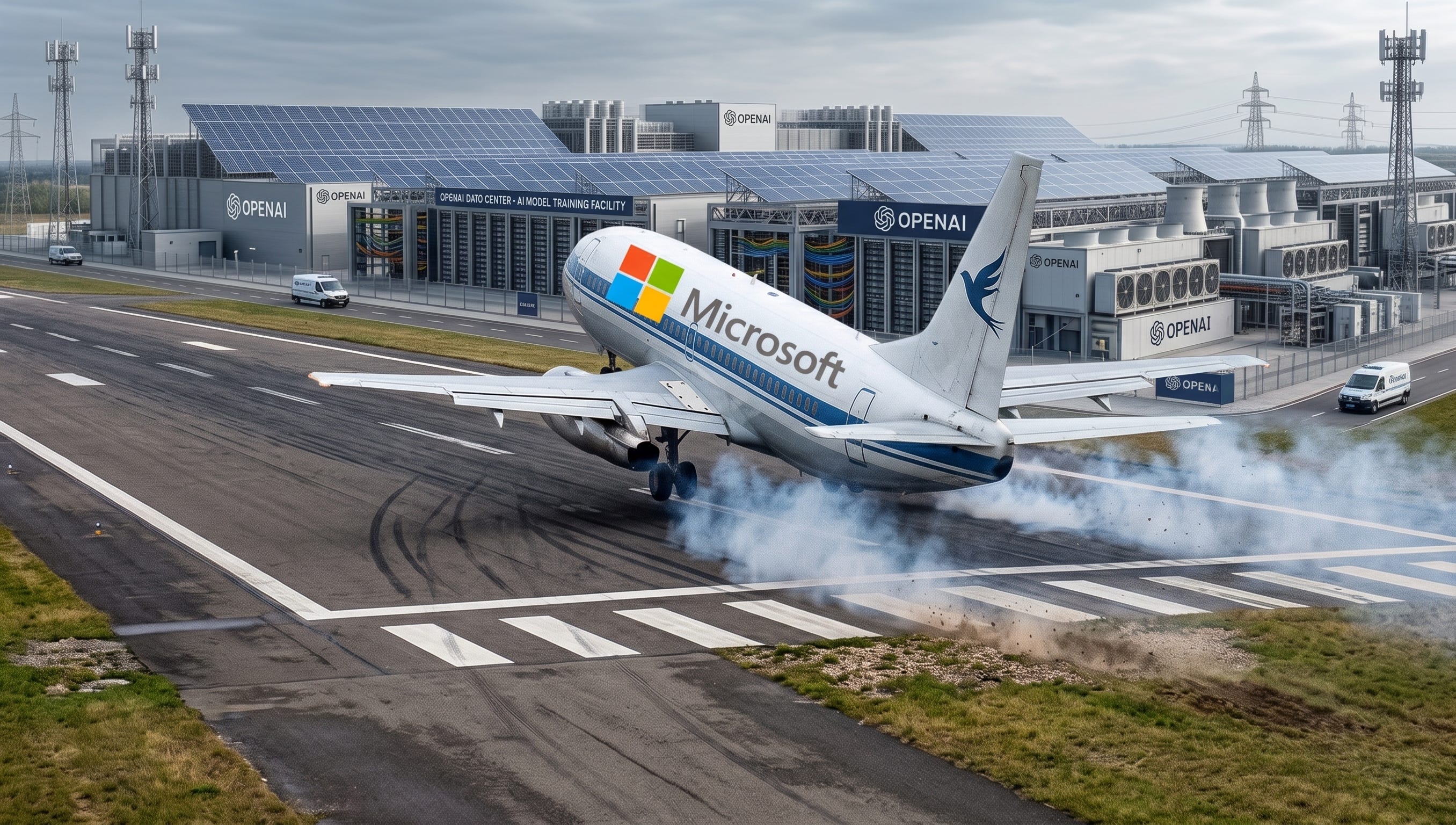
Nine weeks later the company told its own engineers to route to OpenAI, for accounting reasons.
I have spent close to thirty years shipping production software on the Microsoft stack. I build agentic systems on Azure right now, for real customers, with real SLAs. I am not writing this as a short seller. I am writing it because the Parikh memo is the clearest signal we have gotten about what Microsoft actually believes about its own models, and it does not match what Microsoft says about them.
What is actually running out
When people say a company is running out of runway they usually mean cash. That is not the argument here. Microsoft closed fiscal 2026 with $331.8 billion in revenue and $35.8 billion of net income in the fourth quarter alone. Nobody is running out of cash.
What is running out is time, and unlike cash, the schedule is already written down in a contract.
The original bargain was straightforward. Microsoft put in the money, OpenAI ran exclusively on Azure, and if you wanted frontier models at enterprise scale you came to Redmond. That arrangement was structurally dismantled in two stages. In October 2025, the recapitalization gave Microsoft roughly twenty-seven percent of OpenAI Group PBC, extended the intellectual property license to 2032, secured an incremental $250 billion Azure commitment, and quietly stripped Microsoft of its right of first refusal on compute. Then on April 27, 2026, the second restructuring took the rest. Azure exclusivity ended, which means OpenAI can now serve customers on any cloud. The IP license became non-exclusive. Microsoft stopped paying revenue share to OpenAI. OpenAI’s revenue share to Microsoft continues through 2030 but is now subject to a total cap and is no longer tied to technology milestones. The AGI provisions, which had given Microsoft a governance hedge, were deleted outright.
So here is the actual runway, with dates. The contractual moat expired four months ago. The revenue share expires in 2030 and is capped before then. The IP license expires in 2032. The $250 billion Azure commitment gets consumed over roughly six years and then it is gone. Every structural advantage Microsoft holds over its most important customer now has an expiration date on it, and Microsoft has to replace all of them with a product that wins on merit before the last one lapses.
That is the runway. It is not about solvency. It is about whether MAI is good enough, soon enough, that Azure remains the obvious place to run AI workloads when nothing in a contract requires it to be.
The number everybody got slightly wrong
Last week Microsoft disclosed, for the first time, that it recorded $24.1 billion in revenue from OpenAI during the fiscal year ended June 2026. Bloomberg’s analysis put that at roughly seventy percent of Microsoft’s AI revenue, and the internet ran with it.
Be precise about this, because the imprecision is doing Microsoft a favor. It is not seventy percent of cloud revenue and it is not seventy percent of Azure. Azure crossed $100 billion for the first time this year. The $24.1 billion is roughly seven and a quarter percent of total company revenue and roughly a quarter of Azure. Seventy percent is the share of the AI business specifically, and even that figure is derived rather than disclosed. Microsoft has published a total AI revenue number exactly twice and declined to update it at the fourth quarter print. Bloomberg reached thirty-four billion by assuming the 123 percent growth rate reported in March simply continued. The denominator is an estimate.
The part that should actually worry you is not the percentage. It is that nobody outside Microsoft knows what is inside the $24.1 billion. A company spokesperson said it covers all sales and revenue share from OpenAI. KeyBanc’s Jackson Ader said publicly that it is unclear how much of it comes from the revenue-sharing arrangement versus OpenAI paying for Azure like any other tenant. And the revenue share itself is frequently mischaracterized. Microsoft’s cut is a capped share of OpenAI’s profits, not its revenue, and OpenAI is projected to lose roughly fourteen billion dollars this year. A capped percentage of a negative number is worth exactly what it sounds like.
Strip that out and what remains is Azure consumption revenue, booked at Azure margins, from a customer that Microsoft capitalized in the first place. The dollars are real. The disclosure is real. But as a demand signal, that number is doing far less independent work than the earnings call implies.
The spend does not care about the schedule
Microsoft’s fiscal 2026 capital expenditure came in around $116 billion, nearly double the $64.55 billion it spent in fiscal 2025. In the fourth quarter the company put $35.8 billion into property and equipment while generating roughly $19.6 billion in free cash flow. That is the first quarter since well before the AI buildout began in which capital expenditure exceeded free cash flow. Morgan Stanley has modeled a scenario in which 2027 capex reaches $262 billion.
Underneath those numbers sits a depreciation assumption that has not been settled. Hyperscalers depreciate data center GPU fleets over roughly five to six years, consistent with how enterprise server hardware has historically aged. Critics argue that GPUs pinned at sustained training load with heavy thermal cycling are functionally closer to two or three years, and that even a healthy card gets economically retired the moment a new generation delivers better tokens per watt. Neither side has clean public data. But if the shorter estimate is closer to right, the reported cost of running these fleets is understated across the entire sector, and Microsoft’s OpenAI-driven Azure growth is the most visible place that would show up.
So the picture is a company spending at a rate that requires OpenAI-scale demand to make sense, on assets whose useful life is genuinely contested, in service of a customer relationship whose contractual guarantees expire on a published schedule.
Where I could be wrong
I want to make the other case properly, because it is not weak.
Microsoft’s commercial remaining performance obligation stands at $678 billion, up eighty-four percent year over year. That is contracted business roughly twice the size of the company’s entire annual revenue, and a meaningful portion of it is multi-year AI capacity that competitors now have to displace rather than merely win. Microsoft 365 Copilot passed thirty million paid seats, roughly doubling in a quarter, which is the fastest seat growth in the product’s history and the single best piece of evidence that non-OpenAI AI revenue is becoming real. Amy Hood guided forty-five percent Azure growth for the first quarter of fiscal 2027, above consensus. OpenAI is still contractually on the hook for $250 billion of Azure. And Microsoft retains its IP rights to OpenAI’s models through 2032, which is a hedge most competitors would trade a limb for.
There is also a perfectly innocent reading of the Parikh memo. Microsoft already paid for access to OpenAI’s intellectual property. Using it aggressively is rational amortization, not a confession. MAI-Code-1-Flash is a five-billion-active-parameter model built for speed and cost, never positioned as a Sol competitor. Telling engineers to stop tokenmaxxing and route to a model the company has already bought is exactly what a disciplined engineering organization should do.
Why I do not think that holds
Because of what the default used to be.
Before the switch to Sol, Microsoft’s internal GitHub Copilot setup ran an auto-router that defaulted primarily to Anthropic’s Claude. Microsoft engineers, on Microsoft infrastructure, building Microsoft products, were mostly coding with a competitor’s model. Not MAI. Not GPT. Claude.
That detail reframes everything. This was not a company choosing between its own models and OpenAI’s. It was a company discovering that when its engineers were allowed to pick freely, they picked Anthropic, and correcting that not by improving MAI but by mandating OpenAI on cost-of-capital grounds. The seven models announced in June were not in the conversation at all.
The Copilot seat number deserves the same skepticism. Thirty million paid seats is a real milestone, but seats are not usage and they are not revenue. Microsoft does not disclose average revenue per seat, does not disclose weekly active usage, and enterprise Copilot deals have involved heavy discounting in competitive displacement scenarios. Three weeks before the print, internal Microsoft memos describing conversion rates below four and a half percent were circulating publicly. A number that good arriving that fast after a number that bad deserves more than a round of applause.
And the benchmark case for MAI rests substantially on an evaluation Microsoft commissioned itself. I do not say that to be snide. Vendor-run evals are normal and often directionally useful. But when a company publishes its own preference study, then nine weeks later routes its engineers elsewhere, the routing decision is the more honest datapoint.
What this means if you build on this stack
I route models for a living. In the agentic systems I ship, model selection is an architectural decision with cost, latency, and reliability consequences, and it gets revisited constantly. When I evaluate what to put behind a production workflow, MAI is not currently on the shortlist. That is not loyalty to anyone. It is evals.
If you are an enterprise architect making a platform bet right now, the Parikh memo is a procurement signal whether Microsoft intended it as one or not. Microsoft’s own answer to the question every one of your engineers is asking, which model should I use, is not ours. Plan accordingly. Build the abstraction layer. Keep your prompts, your tool definitions, and your evaluation harness portable across OpenAI, Anthropic, and open-weight models, because the financing structure underneath your vendor is one you have no visibility into and no control over. That was good architecture before any of this. It is now also insurance.
None of this means Azure is unsafe to build on. It is not. Foundry is genuinely good, the eleven thousand model catalog is a real advantage, and Microsoft is not going anywhere. But there is a difference between a platform that wins because it is the best place to run your workload and a platform that wins because a contract said so, and Microsoft has spent the last year converting from the second into a race to become the first.
OpenAI is not leaving. That framing is too dramatic and it lets Microsoft off the hook. What OpenAI is doing is worse, because it is quieter and it is already underway. It has committed roughly $1.15 trillion across Oracle, Broadcom, Nvidia, AMD, AWS, CoreWeave, and Microsoft, and Microsoft’s slice of that is $250 billion. It is decoupling on a schedule, with the schedule already public, while remaining a large and profitable-looking customer the entire way down.
Microsoft’s runway is the gap between now and the moment that decoupling finishes. It has roughly four years of contractual cover, about $116 billion a year of spending that assumes the demand holds, seven frontier models it has not yet convinced its own engineers to use, and a stated target of frontier-class general-purpose models by 2027.
They might make it. Suleyman built DeepMind and Inflection and he is not a tourist. Microsoft has more compute, more capital, and more enterprise distribution than anyone attempting this. But the memo on July 29 said the AI investments are paying off, and the memo on August 4 said use the other guy’s model. Both of those things cannot be the whole truth, and only one of them was written for employees to act on.
Sources: Microsoft FY26 Q4 earnings release and investor materials; Microsoft regulatory filings disclosing FY26 OpenAI revenue; Bloomberg analysis of Microsoft AI revenue composition; CNBC and 404 Media reporting on the August 4 CoreAI memo; Microsoft AI announcements from Build 2026; CNBC and Microsoft statements on the April 27, 2026 partnership restructuring.
About the Author
Gal Ratner is the founder and CTO of Inverted Software and WhiteStar Labs, and Chief Architect at Prana Entertainment. He has spent nearly thirty years shipping production software on the Microsoft and .NET stack for clients including Microsoft, Sony, Rockstar Games, 2K Games, Best Buy, and Allegiant Air. His current work is production agentic AI: MCP servers, the Microsoft Agent Framework, RAG pipelines, SQL Server 2025 vector search, and the PLogger observability framework. He is the author of the novel The Archive of Lost Suns, co-hosts Edge Grip Podcast, and trains Brazilian jiu-jitsu in Las Vegas. He writes as the .NET AI guy that ships.