


On the last day of its fiscal year, Oracle did something most corporations only mutter about in the parking lot. It told securities regulators, in writing, that artificial intelligence had been eating its own workforce. By the end of May 2026 the company was down to 141,000 full-time employees, a drop of roughly 21,000 people, about thirteen percent of the company, gone in a single year. Cutting them cost $1.84 billion in severance and restructuring, nearly four hundred percent more than the year before.
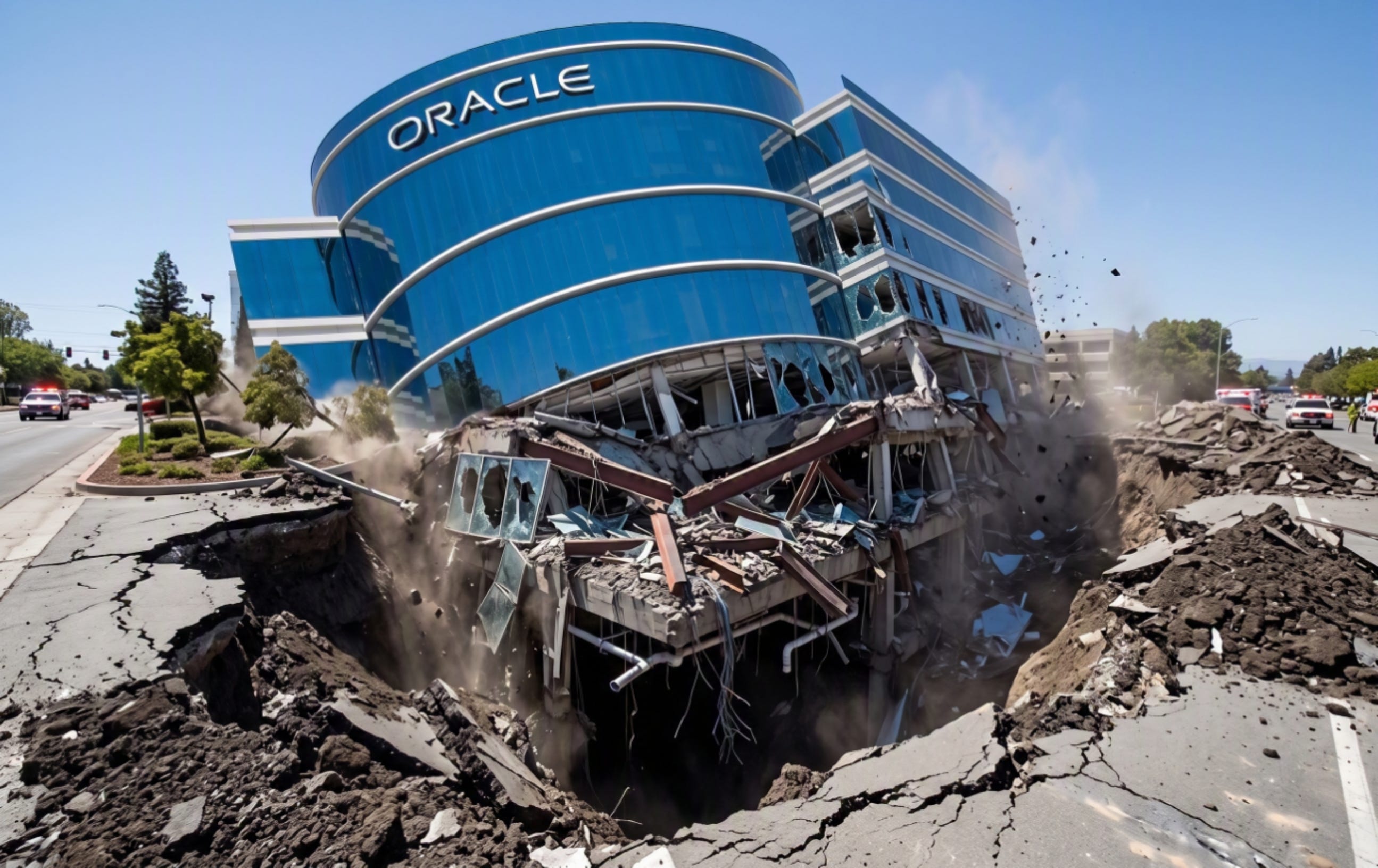
The market did not send a thank-you note. Oracle just closed its worst week since the 2001 dot-com collapse, a nineteen percent slide in five trading days, and the stock now sits roughly fifty-five percent below the $900 billion peak it hit last September. Which raises the question Wall Street keeps tiptoeing around: if Larry Ellison’s instinct in a crisis is to fire people, how many more does he have to fire to actually fix this?
Do the arithmetic and the answer is almost funny. It is more than he employs.
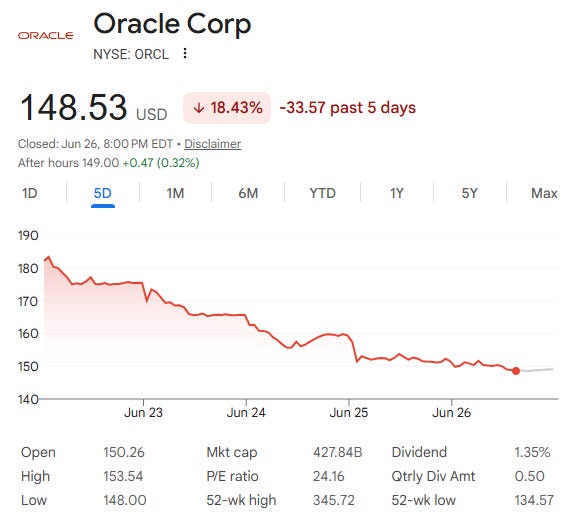
That is the part the layoff coverage keeps missing. Oracle’s instability was never a labor problem, which is precisely why cutting labor cannot solve it. The company is in trouble because of a strategy one man chose and will not question, and the only lever on the board he has not yanked is the one that would actually matter. What follows is the case for why the cut Oracle needs is the one Ellison will never sign himself.
The math nobody at Oracle wants to say out loud
Start with the hole. Oracle burned negative $23.7 billion in free cash flow last year. That is not an accounting abstraction; it is real money leaving the building faster than it comes in. And here is the detail both the bears and the cheerleaders gloss over: Oracle’s software business is still profitable. The company is not losing money on operations. It is hemorrhaging cash because capital expenditure exploded 162 percent to $55.7 billion, nearly all of it datacenters and Nvidia GPUs for the AI build-out. The burn is a bet, not a broken business, which is exactly why you cannot fire your way out of it.
Price the layoffs against the hole and watch the logic fall apart. Oracle runs a heavily offshore workforce, so be generous and assume every person Ellison cuts saves $150,000 a year, fully loaded. Multiply that across the entire surviving headcount, all 141,000 of them, and you free up around $21 billion a year. Set that against a $24 billion cash deficit and the absurdity is plain: Ellison could fire literally everyone, every engineer, every account rep, every database administrator, himself included, and still come up roughly three billion dollars short of breakeven. No headcount number closes the gap, because the cash is not going to people. It is going to silicon. And a GPU does not accept a severance package.
Even the rosiest version of the strategy dies on contact. When TD Cowen modeled cuts of twenty to thirty thousand, the bank estimated it might free up eight to ten billion in cash flow. Take the high end. You have covered less than half of one year’s burn and a sliver of one year’s capex, once, against a spending commitment that comes due again next year, and the year after that. The layoffs are not a turnaround. They are a rounding error wearing the costume of discipline, and the people paying for the costume are the ones who got the six a.m. email.
What the debt is actually buying
So what is all that cash buying? Debt, mostly, and one customer. Oracle carried about $130 billion in debt at the end of May, on top of roughly $248 billion in off-balance-sheet lease commitments, and it has told investors to expect another $40 billion in debt and equity raises this fiscal year. The centerpiece of the spending is a five-year, $300 billion contract to supply datacenter capacity to OpenAI, a company that does not turn a profit and whose ability to pay depends entirely on its continued access to the capital markets. Oracle loves to wave around its $638 billion order backlog, but a backlog is only as good as the counterparty’s checkbook, and a dangerous share of this one rests on a small ring of AI firms funding one another in a loop: Nvidia invests in OpenAI, OpenAI commits to Oracle, Oracle buys Nvidia chips. We have all seen this film. It premiered in 2000, and nobody liked the ending.
You do not have to take my word that the risk is real; the credit markets are saying it out loud. The cost of insuring Oracle’s debt spiked to multi-year highs, and analysts have noted that the OpenAI capacity is being delivered at startlingly thin gross margins. Being OpenAI’s customer is a fine business. Being its leveraged, low-margin landlord is how you end up explaining a negative twenty-four-billion-dollar cash flow to your shareholders. When Oracle tried to steady nerves by pronouncing itself “highly confident in OpenAI’s ability to raise funds and meet its commitments,” the stock dropped anyway, because the only thing that line accomplished was to remind everyone how completely Oracle’s fate is now chained to a startup’s fundraising calendar.
No model, no silicon, just GPUs that rot
Which brings us to the hollow center of the whole gamble. In the entire AI gold rush, Oracle is the one major player that owns nothing. Amazon has its Anthropic relationship and Nova. Microsoft has OpenAI and Phi. Google owns Gemini outright. Oracle owns no frontier model at all. Its strategy, which it markets as being the “Switzerland of AI,” is to rent everyone else’s models, Cohere, Meta’s Llama, xAI’s Grok, Google’s Gemini, OpenAI, and run them on rented-out machines. That is not a technology strategy. It is a real estate strategy with a GPU where the building ought to be.
And here is the irony buried in Oracle’s own history: it did not always have to be a renter. When Oracle swallowed Sun Microsystems in 2010, it inherited SPARC, a real, in-house processor line, along with Sun’s engineering tradition of baking acceleration directly into the silicon, a tradition Oracle itself once marketed as Software in Silicon. It had a chip team. Then, in 2017, Ellison gutted it. Oracle laid off essentially the entire SPARC and Solaris core engineering organization, by some accounts ninety percent of the group, in cuts former engineers called a silent end-of-life, delivered, fittingly, by recorded voicemail and FedEx envelope over a holiday weekend. The last SPARC shipped that year and the roadmap shrank to maintenance. Now look at what everyone who kept their silicon did with it: Google built the TPU, Amazon built Trainium and Inferentia, Microsoft built Maia. Every serious AI-infrastructure operator except Oracle turned in-house chip design into a structural cost-and-control edge in exactly this era, and Oracle is the one company that had that capability and dismantled it to save a few quarters of engineering payroll. The single asset that might have let Oracle run AI on hardware it owned, instead of renting Nvidia’s by the gigawatt, was killed years ago by the same reflex now hollowing out the rest of the company.
The trouble with treating a GPU like a building is that buildings do not shed half their value in two years. Nvidia ships a new architecture roughly every twelve months, and each generation leaves the last one badly behind on performance and power. Michael Burry, the investor who called the 2008 housing crash, has spent recent months arguing that the hyperscalers flatter their earnings by depreciating chips over five and six years when the real economic life is closer to two or three, and he named Oracle directly. By his estimate the industry is understating depreciation by something like $176 billion through 2028, with Oracle’s reported operating income potentially more than twenty percent above economic reality. In fairness, this accounting is legal; useful-life estimates are a matter of judgment under GAAP, and Oracle’s audited financials are signed off accordingly. The point is not that anyone broke a rule. The point is the economic exposure underneath the rules: Ellison is borrowing record sums to buy assets that go obsolete on a chip-release schedule, to serve a customer that loses money, at a margin that barely clears the interest on the debt.
And then comes the twist that ought to haunt Oracle’s bondholders: the customer this entire buildout exists to serve is busy engineering its way out of its dependence on the very chips Oracle is going into debt to stockpile. On June 24 OpenAI unveiled Jalapeño, its first custom AI chip, designed with Broadcom and built specifically for inference, the high-volume work of actually running models for some eight hundred million users. Broadcom’s chief executive says early testing shows it costing roughly half what an Nvidia GPU does for the same job. It anchors a ten-gigawatt commitment OpenAI intends to deploy through 2029, across its own and affiliated datacenters, and the openly stated purpose is to reduce reliance on Nvidia. Sit with the shape of that. Oracle is borrowing record sums to stockpile depreciating Nvidia GPUs, at thin margins, to rent to a company now designing its own silicon precisely so it needs fewer of them. Oracle killed the one chip program that was its own; OpenAI is building one that is theirs. That is the entire strategy in a single sentence. Buy GPUs and pray.
The core franchise is old, and it runs on audits
You might forgive the gamble if Oracle’s core franchise were thriving and could bankroll it. It is not. Go through the crown jewels one at a time, the database, the on-premise application suites, Java, and you find the same story each time: a mature product the market has already started routing around, kept profitable less by winning new customers than by squeezing the ones already locked in.
Start with the flagship, the Oracle Database, the product the entire company was built on. Developers have delivered their verdict, and it is brutal. In Stack Overflow’s 2025 survey of more than 49,000 developers, PostgreSQL, free and open source, was the most-used database on earth at roughly fifty-six percent; Oracle sat near eleven. Postgres has now taken most-used, most-admired, and most-wanted three years running, and the migration data all points one way: off Oracle and onto Postgres, where shops report cutting total cost of ownership by thirty to forty percent and shedding the licensing leash entirely. Even the AI feature Oracle is busy charging for, in-database vector search, ships free in Postgres as pgvector. The high-end analytics crown Oracle once held with Exadata went to the cloud-native upstarts Snowflake and Databricks. Oracle’s database is not dead, but it is a legacy estate being actively migrated away from, not something anyone reaches for to build new.
The application suites tell an even more damning version of the same story, because Oracle did not build them, it bought them, and then let them age. The on-premise E-Business Suite and the PeopleSoft line Oracle swallowed in an eighteen-month hostile takeover that closed in 2005, a campaign that came with public threats to gut PeopleSoft’s staff. The people Ellison displaced did not go quietly. PeopleSoft’s founder Dave Duffield and his chief strategist Aneel Bhusri turned around and built Workday from scratch as a cloud-native HR and financials platform, precisely the thing Oracle’s acquired suites were not. Two decades on, Workday and SAP’s cloud applications are where modern HR and ERP buyers go, while Oracle’s legacy suites coast on installed base and renewal pressure. The pattern is the point: acquire a franchise, harvest the maintenance revenue, under-invest in the product, and watch a competitor build the modern replacement out of the wreckage.
Java completes the picture, and here Oracle does not even have a different product, just the same one with a bill attached. In 2023 it scrapped usage-based pricing and switched to an employee-based subscription that charges for every person in your organization whether they touch Java or not, a change that multiplied bills several times over and that Gartner’s own clients called predatory. By the time the shock wore off, research found that nearly ninety percent of Oracle Java customers were looking to leave, with the anger running deepest in Europe. They are leaving for Amazon Corretto, Azul, and Eclipse Temurin, free builds of the identical OpenJDK source with none of the audit exposure. And in 2026 the gentle “license review” emails are hardening into formal audit letters from Oracle’s renamed enforcement arm, because Oracle logs every download and every update ping and often knows your Java footprint better than your own IT department does. One administrator on Slashdot put the relationship more vividly than any analyst could, recounting how his team ripped Oracle’s “financial malware” off every machine. When customers call your flagship language malware to quarantine and the free alternative is byte-for-byte equivalent, you are not running a growth business. You are running a collections agency with a compiler.
This is the company Ellison is mortgaging to chase AI: an aging software estate kept alive by audits and lock-in, lashed to a capital-devouring landlord business with no model, no moat, and no margin. The old products cannot fund the new bet, and the new bet does not make money. So Ellison reaches, as he always has, for the only lever left.
He reaches for people. At six in the morning.
He reaches for people, and the way he does it is what should make you angry, entirely apart from the spreadsheet. The March 2026 cuts landed as emails around six in the morning Eastern, with workers in Canada and Mexico reportedly notified overnight, before the United States had woken up. No meeting. No conversation. For many, an email and a dead badge. On Blind, where verified employees gather, the threads ran into the hundreds within minutes, and the recurring theme was that performance had nothing to do with who was cut. Employees reported that people with top ratings, people freshly promoted, people with decades of tenure went out at the same rate as everyone else; one widely shared post described a team where every member had earned a high rating in the last cycle and more than half were gone by noon. Workers on visas were reportedly given as little as ten days. One of the earliest Oracle employees, someone said to have given the company more than forty years, was reportedly among the cut.
Read the forums and you find grief and contempt in equal measure. One employee signed off a thread with a line worth more than any analyst note: remember there is more life than your job. Former staff even have a name for the conditioning that kept them loyal through years of mistreatment; they call it the Oracle Doormat Principle. On TheLayoff, the question that keeps surfacing is not about severance math but something simpler: “does anyone actually enjoy working here anymore?”
And if you imagine Ellison’s word is worth anything in moments like these, the record disagrees. When Oracle acquired Sun Microsystems, Ellison stood on a stage and angrily denounced analysts who predicted he would lay off half of Sun’s staff, calling the suggestion irresponsible. Oracle then went on to cut thousands. That is the pattern, and it is decades old: the autocratic, founder-controlled, everything-flows-from-Larry style that built Oracle is the same style that now treats twenty-one thousand people in a single year, deleted in waves of pre-dawn emails, as a financing variable to be zeroed whenever the cash math tightens. Ellison has been strikingly consistent about who pays when his bets get expensive. It has never been him.
The one cut that would actually work
So let us drop the pretense that the next round of layoffs will fix anything, because the arithmetic at the top of this piece already settled it. There is a real solution. It simply is not one Larry Ellison can carry out, because Larry Ellison is the problem any solution has to remove.
Walk through what Oracle actually needs. It needs someone willing to look at a $300 billion bet on a single unprofitable customer and renegotiate it, cap it, or walk away from the parts that do not clear a real margin, and you cannot ask a man to coldly re-price the legacy project he has called the most important infrastructure on earth. It needs someone willing to decide, honestly, whether Oracle should be a debt-fueled GPU landlord at all, or whether it should fall back to the database-and-applications business it actually understands and harvest that for cash while the AI fever breaks, and Ellison has spent forty years proving he would sooner double a bet than admit the table is rigged. It needs leadership capable of rebuilding trust with a workforce it gutted by email, and there is no rebuilding that trust under the man who sent the emails. Every road back to stability runs straight through decisions that Ellison’s ego, his history, and his personal fusion with this strategy make him incapable of making.
The co-CEOs he installed last September, Clay Magouyrk and Mike Sicilia, run the day-to-day, but nobody seriously pretends Oracle’s strategy comes from anyone but Ellison. He is the chairman, the chief technology officer, the largest shareholder, and the center of gravity the whole company bends toward. That is exactly why his stepping back is the only move that changes the trajectory. As long as he holds the controls, Oracle’s answer to every crisis will be the answer it has always been, borrow more, build more, fire more people to make the interest payment, and the math says that road dead-ends at a workforce of zero and a balance sheet that still does not balance.
Larry Ellison cannot fire his way out of this. He has, in his way, already tried, and the market handed him his worst week in a quarter century for the effort. The one cut that would genuinely stabilize Oracle is the only one he will never sign: his own. Until the board finds the nerve to make it for him, every pre-dawn email is just rearranging deck chairs on a ship its captain steered into the iceberg himself, then billed the crew for the lifeboats.
About the Author
Gal Ratner is the founder and CTO of Inverted Software and WhiteStar Labs and the Chief Architect at Prana Entertainment, a Las Vegas enterprise software and AI consultancy. He has spent nearly thirty years shipping production systems on the Microsoft and .NET stack for clients including Microsoft, Sony, Rockstar Games, 2K Games, Best Buy, and Allegiant Air, and now builds agentic AI systems in production: MCP servers, the Microsoft Agent Framework, SQL Server 2025 vector search, and RAG pipelines that have to keep working long after the demo lights go off. He writes about the distance between what AI executives promise and what their companies actually deliver. He is the .NET AI guy that ships.