


In July 2025, Recruit Holdings, the Japanese parent that owns both Indeed and Glassdoor, sent a leaked internal memo to staff announcing it was eliminating roughly 1,300 jobs, about six percent of its HR technology segment, and folding Glassdoor’s operations into Indeed. The stated reason was artificial intelligence. The CEO, Hisayuki Idekoba, wrote that AI is changing the world and the company must adapt. Both companies were profitable. Recruit’s financial guidance for the year didn’t budge. This was not a company in trouble cutting to survive. This was a company posting good numbers deciding that 1,300 human beings were now overhead.
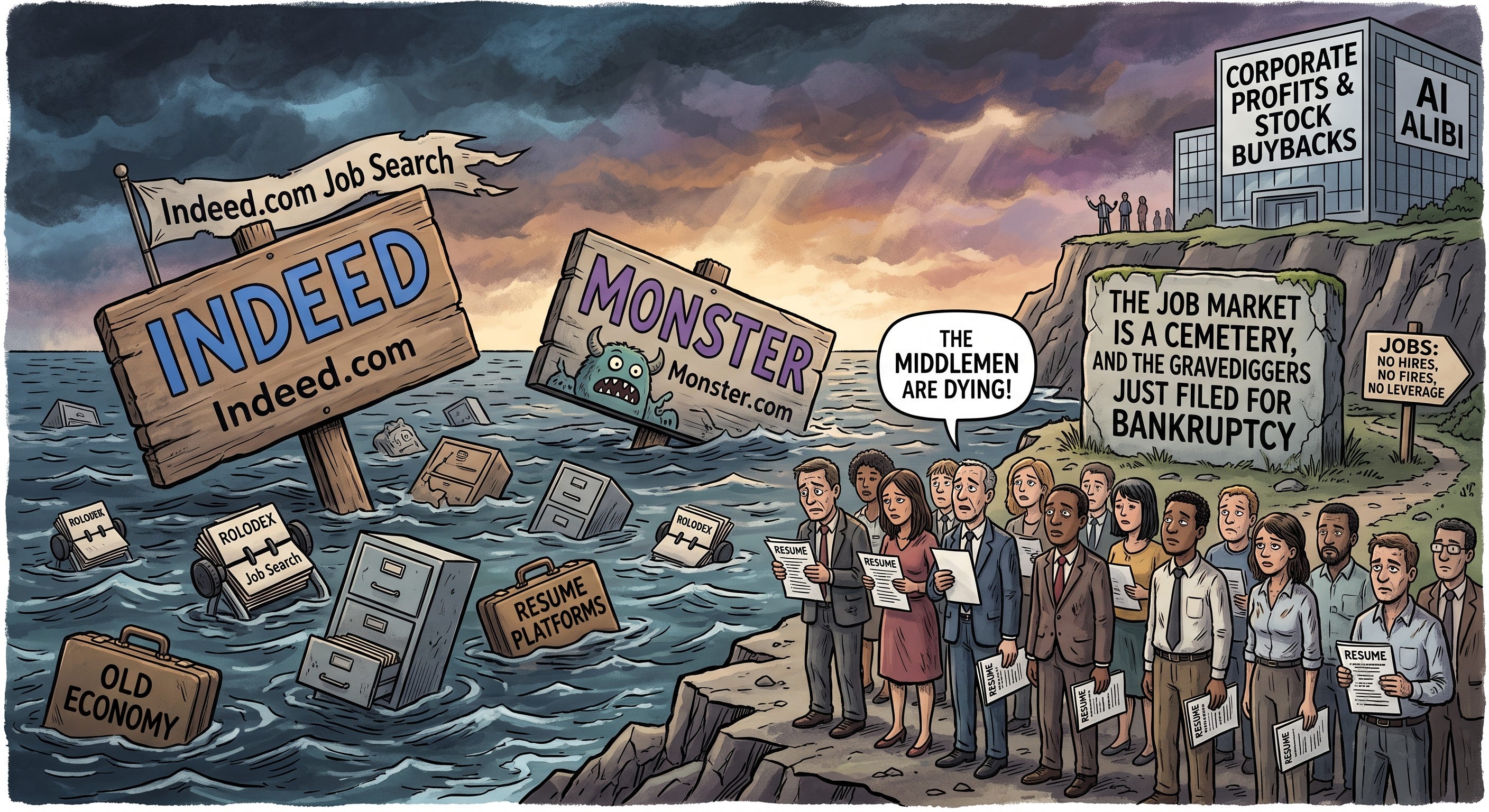
A month earlier, on June 24, 2025, the merged entity CareerBuilder plus Monster filed for Chapter 11 bankruptcy in Delaware. Two brands that defined online job hunting in the 1990s, that ran Super Bowl ads, that were once worth billions, merged in a desperate 2024 joint venture to claw back relevance against Indeed, and then collapsed anyway under a hundred to five hundred million dollars in liabilities. Their core job board business was ultimately auctioned off for about twenty-eight million dollars. Monster, thirty years old. CareerBuilder, twenty-five. Sold for the price of a modest office building.
Here is the irony that should stop you cold: the companies whose entire reason for existing was to connect workers with jobs cannot survive the current job market. The middlemen are dying. And if you want to understand why, you have to stop looking at the platforms and start looking at the economy that broke them, because the same forces that killed Monster are the ones grinding down every worker reading this.
The Middlemen Are Dying
I’ll tell you what I’m seeing from where I sit. Most of my recruiter friends are unemployed. Not underemployed. Not pivoting. Unemployed. These are people who spent fifteen and twenty years building relationships, who knew hiring managers by name, who could actually place a candidate. The entire middle layer of the labor market, the human connective tissue between the person who needs work and the company that needs the work done, is being liquidated. And the platforms that were supposed to replace them with software are themselves going bankrupt or gutting their staff. Something is deeply, structurally wrong, and “AI” is the word everyone uses to avoid saying what it is.
Low Hire, Low Fire, No Leverage
Let me give you the macro picture, because the data is worse than the vibes. In September 2025, Federal Reserve Chair Jerome Powell described the American economy as a low-hire, low-fire environment. It’s a polite phrase for a paralyzed one. Firms have dramatically cut the number of people they’re hiring while also cutting the number they’re firing. The result looks stable on the surface and is quietly catastrophic underneath.
Consider the numbers. In 2024, the U.S. economy added roughly two million jobs. In 2025, total nonfarm payrolls grew by around 584,000, an average of about 49,000 jobs a month, and by some measures the pace from early 2025 into 2026 was closer to 37,000 a month, down from over 200,000 in the preceding three years. A preliminary benchmark revision erased 911,000 jobs the government had previously reported as created in the year through March 2025, nearly a full year of phantom growth, gone. The hiring rate is scraping levels not seen since 2013, outside the one-month pandemic plunge. Job openings fell to around 7.1 million by late 2025, down nearly 900,000 year over year. And the quits rate, the single best barometer of whether workers feel confident enough to walk out the door, dropped to between 1.9 and 2.0 percent, historic lows.
Laura Ullrich, an economist at Indeed’s own Hiring Lab, put it about as plainly as anyone in the business could: workers don’t quit jobs they can’t afford to leave. Sit with that. The engine of wage growth in a healthy economy is job-switching. You leave, you get a raise, your old employer has to pay more to replace you, and the whole ladder rises. That engine has seized. People are staying put not because they’re happy but because they’re terrified.
What a Frozen Market Does to Your Paycheck
When nobody switches jobs, nobody has leverage, and when nobody has leverage, wages stop moving. The pay premium for changing jobs has collapsed to its lowest level in a decade. In tech specifically, my world, the picture is ugly. The co-founder of Levels.fyi, which maintains some of the most granular compensation data in the industry, reported that median software engineer pay declined one to two percent in 2024. Dice’s survey of thousands of tech workers found salaries rose about 1.2 percent that year while inflation ran near three percent, which is a pay cut wearing a raise’s clothing. Silicon Valley salaries fell over seven percent year over year by some measures. And the pain concentrates at exactly the levels you’d assume are safe: senior and mid-level tech leaders have seen compensation drop by ten to forty thousand dollars a year, and even managers overseeing machine-learning teams, the supposed golden geese of this AI moment, have watched their pay shrink as companies decide they’d rather hire practitioners than pay for leaders.
The industry has a euphemism for people clinging to jobs they’ve quietly checked out of: job hugging. Employees stay because the alternative is a market where the average posting draws around 250 applicants and two to six of them get an interview, where more than three-quarters of resumes submitted through job boards are filtered out by applicant tracking systems before a human being ever reads them. You don’t leave that. You hug the desk you have.
Now the honest version, because I don’t do hype in either direction. On a pure inflation-adjusted basis, aggregate real wages have been roughly flat to slightly negative over the post-pandemic stretch rather than in freefall. Depending on which price index and time window you pick, real hourly earnings are down somewhere under a percent since early 2021, and some recent months show wages barely edging ahead of inflation. But averages lie. The things that actually empty a household’s bank account, rent, healthcare premiums, groceries, insurance, have outrun the headline number by a mile. Consumer prices rose roughly a quarter over five years. One regional analysis found real wages fell 3.2 percent between the end of 2020 and the end of 2024 once you weight it honestly, with metros like Baltimore down fourteen percent and Dallas down twelve. The “wages are keeping up” story is a statistical artifact that dissolves the moment you look at what people actually spend money on.
Fear Is the Product
This is where the economics becomes psychology, because you cannot understand this labor market without understanding fear. Ask yourself why the quits rate is at a historic low. It’s not contentment. It’s that people literally cannot afford to be wrong. Look at the balance sheet of the median American household. A 2025 PNC survey found 67 percent of workers now live paycheck to paycheck, up from 63 percent the year before. Goldman Sachs reported that about 40 percent of Americans have no spare savings at all, up from 31 percent in 1997, and projected that number climbing toward 55 percent by 2033. Nearly a quarter of Americans have zero emergency savings, according to Bankrate. Fifty-nine percent couldn’t cover a thousand-dollar surprise expense out of savings. The U.S. Interagency Council on Homelessness has estimated that more than half the country is effectively one crisis away from homelessness. Even among households earning over 150,000 dollars, one in five reports living paycheck to paycheck.
Put those two facts next to each other, a frozen job market and a population with no savings, and you understand the whole system. When losing your job means losing your apartment in sixty days, you don’t negotiate. You don’t push back. You don’t report the broken process or the toxic manager or the illegal thing you saw. You comply. Risk-taking, the entrepreneurial nerve this country mythologizes, is a luxury good, and most people can’t afford it anymore. The economy has quietly converted an entire workforce into people who are too scared to move.
This is corrosive in a way that doesn’t show up in any quarterly report. When Meta announced performance-based layoffs, reporting surfaced something genuinely dark: employees hoping to be cut, because at least a severance package would be a resolution. That’s not a workforce. That’s a hostage situation with a 401(k) match. And morale, once it curdles into that kind of resentment, does not come back with a pizza party.
Ghost Jobs, and a Ten-Dollar Idea
Now let’s talk about the single most demoralizing feature of the modern job hunt, the thing that makes people feel insane: ghost jobs. You are not imagining it. A large share of the jobs advertised online do not exist in any meaningful sense. Analyses of Bureau of Labor Statistics data suggest that roughly 30 percent of job postings never result in a hire. In mid-2025, employers reported 7.4 million openings but made only 5.2 million hires, a gap of more than two million phantom positions. A Clarify Capital survey found nearly one in three employers admit to posting jobs with no real intention of hiring. A MyPerfectResume survey found 81 percent of recruiters had posted listings that were fake or already filled. Surveys of HR professionals found something like 45 percent post ghost jobs regularly and another 48 percent occasionally. Government postings are the worst offenders, with estimates around 60 percent. The ratio of hires to postings has roughly halved since 2019, from about eight per ten to four per ten.
And here’s the part that should make you angry rather than just tired: a documented share of these fake postings exist specifically to hurt the people who already have the jobs. Survey data indicates a majority of companies that posted ghost jobs did so at least partly to make current employees feel replaceable, to remind you there’s a line out the door, so don’t ask for a raise. Others post them to look like they’re growing for investors, or to keep a resume pipeline warm, or to trick overworked staff into believing relief is coming. It is psychological warfare dressed up as recruitment.
Why does this happen? Because there is zero penalty for it. It costs a company almost nothing to post a job it has no intention of filling. The applicant bears the entire cost, the hours tailoring a resume, the cover letter, the hope, the follow-up, the silence. One 2025 analysis found 67 percent of applications got no response at all, not even an automated rejection. The externality is dumped entirely onto the person who can least afford it.
So here’s my proposal, and I want you to notice how modest it is. Charge companies ten dollars per application received on any posting where they hire no one within six weeks. Not per posting. Per application. If you advertise a job, collect four hundred resumes, and hire nobody after six weeks, you owe four thousand dollars, and it should go to the applicants or into a fund that serves them. Suddenly the math of the ghost job inverts. The company that was harvesting free resumes and free hope now has a meter running. The bigger the lie, the bigger the bill.
I know the objection: what about legitimate searches that fall through? Fine. Build in a grace mechanism, let a company attest to a genuine ongoing search and extend the clock, make the penalty apply to patterns rather than one-offs. The point is to put a price on wasting people’s time, because right now it’s free and that’s exactly why there’s so much of it. There are already legislative stirrings here. Kentucky introduced a ghost-jobs disclosure bill in early 2025, New Jersey and California have floated posting-honesty requirements, a proposed federal Truth in Job Advertising and Accountability Act would require disclosure of hiring intent, and the FTC stood up a labor task force in February 2025. But every one of these is about disclosure, making a company say whether a posting is real. Disclosure is a speed bump. A per-application penalty is a toll booth. Only one of them changes behavior, because only one of them costs money.
When Recruiting Was a Craft
To understand how far we’ve fallen, you have to remember that connecting a person to a job used to be a craft performed by human beings who were good at it. The retained executive search business is almost exactly a hundred years old. The first firm dedicated to scouting executives emerged in 1926, and the modern industry took off in the post-war boom, when returning soldiers turned their networks into a profession and earned the wonderfully macabre nickname headhunters. A 1979 New York Times profile described them stalking their quarry through the executive suites. It was a world of retained search, where you paid the searcher a fee whether or not they found your person, which meant the searcher’s incentive was to actually know the market cold.
And the entire business ran on a single physical object: the Rolodex. Invented in 1956, it was by the 1980s so central to a recruiter’s livelihood that people stole them when they left firms, and one was reportedly held for ransom. Think about what that means. A recruiter’s value was the network they carried in their own head and in a wheel of index cards on their desk. They knew you. They knew your work. They knew that the VP of Engineering at some company was quietly unhappy and would take a call. Placement happened because a human being who understood both sides picked up the phone. It was slow and clubby and exclusionary in all the ways that era was, but it connected specific people to specific work, because connection was the whole product.
Now compare that to today’s machine. You upload your resume into a portal. An applicant tracking system parses it for keywords. If you’re missing the right nouns, you’re rejected before any human sees you, and the research says that’s most people. There is no Rolodex. There is no relationship. There is a database matching strings against strings, and on the other end, an exhausted candidate wondering why the void never answers. We replaced a human craft with a keyword filter and called it efficiency. It is not efficiency. It’s the industrialization of not connecting people to jobs.
The Craigslist Cemetery
There was a brief, beautiful window when the internet made this better instead of worse, and its name was Craigslist. Craig Newmark launched it in 1995, and for years jobs were one of the only categories it charged for, a modest fee, as little as seven to twenty-five dollars in most cities and around seventy-five in San Francisco, which funded a service that stayed free for almost everything else. That job-posting revenue was so efficient that Craigslist reportedly did enormous business with a staff you could count on your fingers, one of the highest revenue-per-employee operations in the history of the internet. And it worked. It had almost no friction. A small business owner posted a listing for the price of a couple of lunches, real humans replied, and people got hired fast. It was so effective at matching local buyers and sellers that it is widely credited with gutting the newspaper classifieds business that had funded American journalism for a century.
Go look at Craigslist jobs today. It’s a cemetery. The friction that made it fast also made it a magnet for scams and spam, trust collapsed, the mobile app world passed it by, and the openness that was once its genius became its liability. The listings that remain feel haunted. Here’s what kills me about that arc: we didn’t lose Craigslist because something better replaced it. We lost the thing it did, cheap, fast, human-to-human matching, and got in exchange a landscape of ghost jobs, applicant-tracking black holes, and bankrupt job boards. The friction came back. The connection didn’t.
“Network Yourself” Is a Lie
Which brings me to the advice everyone gives the unemployed, the advice that is somewhere between useless and cruel: network yourself. Let me be precise, because there’s a real thing buried under the bad advice. The so-called hidden job market is mostly a myth in its strong form. The endlessly repeated claim that 70 to 80 percent of jobs are never posted traces back to no rigorous study anyone can actually cite. But the referral economy underneath it is very real. Depending on the source, somewhere between 30 and 50 percent of hires come through referrals, and referred candidates are dramatically more likely, by some estimates four to ten times, to actually get hired than someone applying cold. Referrals are maybe seven percent of applicants and a third to half of hires. That’s the real mechanism.
But here’s what the “get out there and network” crowd refuses to understand: referrals come from people who have already worked with you and seen you deliver. They do not come from strangers at a mixer. When someone refers you, they’re staking their own credibility on your competence, and nobody stakes their reputation on a person they met for ninety seconds at a downtown networking event holding a lukewarm drink. So who actually shows up to those events? Two groups. Other unemployed people exactly like you, all circling the same nonexistent opportunities. And salespeople who see a room full of anxious professionals as a lead list. Nobody at a networking event is there to give you a job. The people who could refer you into a real role are the ones you already worked alongside for years, and no amount of business-card shuffling manufactures that from nothing. “Network yourself” tells a drowning person to make friends with the ocean.
The Arbitrage Machine
Now I want to talk about something I experience personally, every single day, and I want to be careful about where I aim, because the easy version of this argument is wrong and the accurate version is far more damning. I run Inverted Software. Our website says nothing, nowhere, about hiring. And yet I receive multiple resumes a day, many from students and from applicants in India, for jobs that do not exist and were never advertised. My inbox is a spillover valve for a machine operating at a scale most people never see. And the phone calls, the endless low-ball contract offers, recruiters pitching bodies at rates that couldn’t cover rent in any American city, for contracts that make no sense until you understand the business model underneath.
That business model is IT body-shopping, and it is a labor-arbitrage operation, not a talent operation. Here’s how it works, and it’s documented in Department of Labor filings and federal court cases, not rumor. A staffing firm sponsors a worker on an H-1B visa, then rents that worker out to an end client at a hundred to a hundred and fifty dollars an hour while paying the worker a Labor Condition Application wage that data shows frequently runs twenty to forty percent below what a comparable American would make. The firm pockets the spread. It files prevailing-wage paperwork for a low-cost rural location and then deploys the worker to San Francisco or New York, pocketing the geographic difference too. Analysis by the Institute for Progress found that at H-1B-dependent employers, the outsourcing and staffing shops, the median visa worker earns nearly ten percent less than a similarly qualified American, while at normal companies that use the program as intended, H-1B workers actually earn a small premium. When a worker sits on the bench between projects, the firm is legally obligated to keep paying, so the predatory ones simply don’t, forcing unpaid leave or threatening the worker’s visa status. A whistleblower lawsuit against one major outsourcing firm showed systematic underpayment treated as core competitive strategy.
Here is the part that matters, and it’s why the ethnic-grievance version of this argument is both ugly and stupid: the worker cold-calling you for a thirty-five-dollar-an-hour contract is very often a victim of this machine, not its beneficiary. They may have paid fees to get into the lottery. They may have signed a contract that hands over their tax refund and waives their right to sue. Their legal right to remain in the country is controlled by the same firm underpaying them. They are as trapped as anyone. The villain here is not the person on the other end of that phone call. The villain is the arbitrage model itself, the staffing firms that run it, the American corporations that knowingly buy labor this way to cut costs, and a Department of Labor that has spent decades declining to enforce the wage rules and effectively subsidizing the whole scheme. This is not foreigners taking American jobs. This is American executives using a visa loophole to drive down the price of labor for everyone, citizen and immigrant alike, and pitting the two against each other so we blame each other instead of them.
The Interview Designed to Fail You
Which connects directly to a thing that happened to me and that most people assume is a conspiracy theory until it happens to them: the interview designed to fail you. Most real jobs, the good ones, aren’t on the big boards at all anymore. Companies route serious candidates straight to their own career sites and fill through referral, so what’s left on the big aggregators is disproportionately the noise. But some of what’s on those boards is worse than noise. It’s theater. Under the PERM labor certification process, an employer sponsoring a foreign worker for a green card must first prove that no qualified American is available, which means running job ads and interviewing American applicants. The law says you must genuinely consider them. The incentive says otherwise. There is a notorious recorded seminar in which immigration attorneys from the firm Cohen and Grigsby walked employers through how to run recruitment with the goal of not finding a single qualified American, how to construct the process so even strong candidates get disqualified. That’s not a fringe allegation. It’s on video.
And it still happens. In 2026, the Department of Labor reportedly suspended all PERM applications from Cloudera for 180 days after the Justice Department alleged the company used a fake email address to prevent American workers from actually being able to apply. So when I tell you I once sat through an interview that was clearly engineered so that I, a qualified American citizen, could not possibly succeed, so the company could check the box that said no qualified American was available, I’m not describing paranoia. I’m describing a documented, enforced-against, ongoing practice that I happened to be on the receiving end of. Multiply that by every citizen who walked out of an interview knowing in their gut the fix was in and couldn’t prove it.
Record Profits, Disposable People
And now we arrive at the rot underneath all of it, the thing that makes a person radical. None of this is happening because companies are broke. In 2025, S&P 500 companies spent over a trillion dollars on stock buybacks, a record, up eleven percent year over year, with another record projected for 2026. At the same time they cut hundreds of thousands of workers. Median S&P 500 CEO pay rose to around 17.1 million dollars in 2024, up nearly ten percent, while the ratio of CEO pay to median worker pay sits around 285 to one by the AFL-CIO’s count. The money is there. It is simply flowing up and out, to shareholders and executives, while the people who do the work are recategorized as cost.
And AI has become the perfect alibi. Now, I want to be clear about where I stand, because I build this stuff for a living and I don’t traffic in the fashionable AI-doomer narrative any more than the fashionable AI-utopia one. AI is real. It is genuinely useful in production. I ship it. But there is a growing gap between what AI can actually do and what it’s being blamed for, and executives have noticed that “we’re restructuring around AI” is a far more flattering thing to tell Wall Street than “we over-hired during the pandemic and now we’re cutting to juice the buyback.” Even Sam Altman has acknowledged there’s AI-washing happening, layoffs blamed on AI that companies were going to do anyway. An Oxford Economics analysis in early 2026 found that many of the cuts CEOs attributed to AI were actually corrections for pandemic-era over-hiring. AI didn’t take those jobs. A capital-allocation decision took those jobs, and AI got handed the note.
The Breaking Point
So here is where we actually are, stripped of the euphemisms. We have a frozen labor market where nobody can move. We have a workforce with no savings, too frightened to take a risk, hugging jobs they hate. We have wages that have stopped rising in real terms while the cost of everything that matters has kept climbing. We have job boards clogged with fake listings that exist to harvest hope and remind employees they’re replaceable, with no penalty for any of it. We have a human recruiting craft replaced by keyword filters that connect no one to anything. We have a labor-arbitrage machine driving down the price of skilled work and setting citizen against immigrant so neither looks up at who’s actually profiting. We have interviews staged to fail the people they’re ostensibly for. And we have a corporate class posting record profits and record buybacks and record executive pay while it does all of the above and calls it efficiency.
The American worker has figured this out. The resentment I feel in every conversation, in every comment section, in every unemployed friend’s voice, is not envy and it is not irrational. It is an accurate read of a system that has quietly decided that labor is the enemy of the balance sheet. The American worker has come to hate the American CEO, and the CEO earned it, one buyback and one ghost job and one rigged interview at a time.
That is not a stable equilibrium. You cannot run an economy indefinitely on a workforce that is simultaneously essential and disposable, terrified and furious. Something gives. It always does. The only open question is whether the people running these companies choose to notice before it’s chosen for them, before the politics turn, before the regulation lands with teeth instead of disclosure requirements, before the best people simply stop showing up for a game they’ve correctly identified as rigged.
I build the future for a living. I’m not against technology, and I’m not against efficiency. I’m against the lie. And the lie is that what’s being done to the American worker right now is efficiency. It isn’t. It’s extraction, everyone can see it, and the bill is going to come due.
About the Author
Gal Ratner is the founder and CTO of Inverted Software and the Chief Architect at Prana Entertainment, a Las Vegas-based enterprise software and AI consultancy. He has spent nearly thirty years shipping production software on the Microsoft and .NET stack for clients including Microsoft, Sony, Rockstar Games, 2K Games, Best Buy, and Allegiant Air, and was an early employee at Break.com and a Los Angeles Business Journal CTO of the Year finalist. His current work focuses on production agentic AI: MCP servers, the Microsoft Agent Framework, RAG pipelines, and SQL Server 2025 vector search. He writes about the technology industry from the perspective of someone who actually builds and deploys the systems everyone else theorizes about, and describes himself, plainly, as the .NET AI guy that ships. When he isn’t writing or coding, he trains Brazilian jiu-jitsu in Las Vegas, rides motorcycles, and co-hosts edge Grip Podcast.