


On May 15, 2025, the city council of West Memphis, Arkansas, voted to give one of the richest companies on earth a thirty-year tax break. The beneficiary was a limited liability company called Groot LLC, widely reported to be a front for Google. The deal — a payment-in-lieu-of-taxes agreement, or PILOT — hands the project a sixty-five percent abatement on real and personal property taxes, the maximum Arkansas law allows, for three decades. It is backed by an authorization to issue as much as sixty billion dollars in industrial development revenue bonds over that period — ten billion for the real estate and fifty billion for the personal property, the servers and equipment that fill the buildings — which is the machinery that produces, in the words of the deal’s own boosters, the potential for up to fifty billion dollars in personal-property tax abatements. In exchange, according to the agreement itself, the project is expected to create roughly fifty permanent jobs.
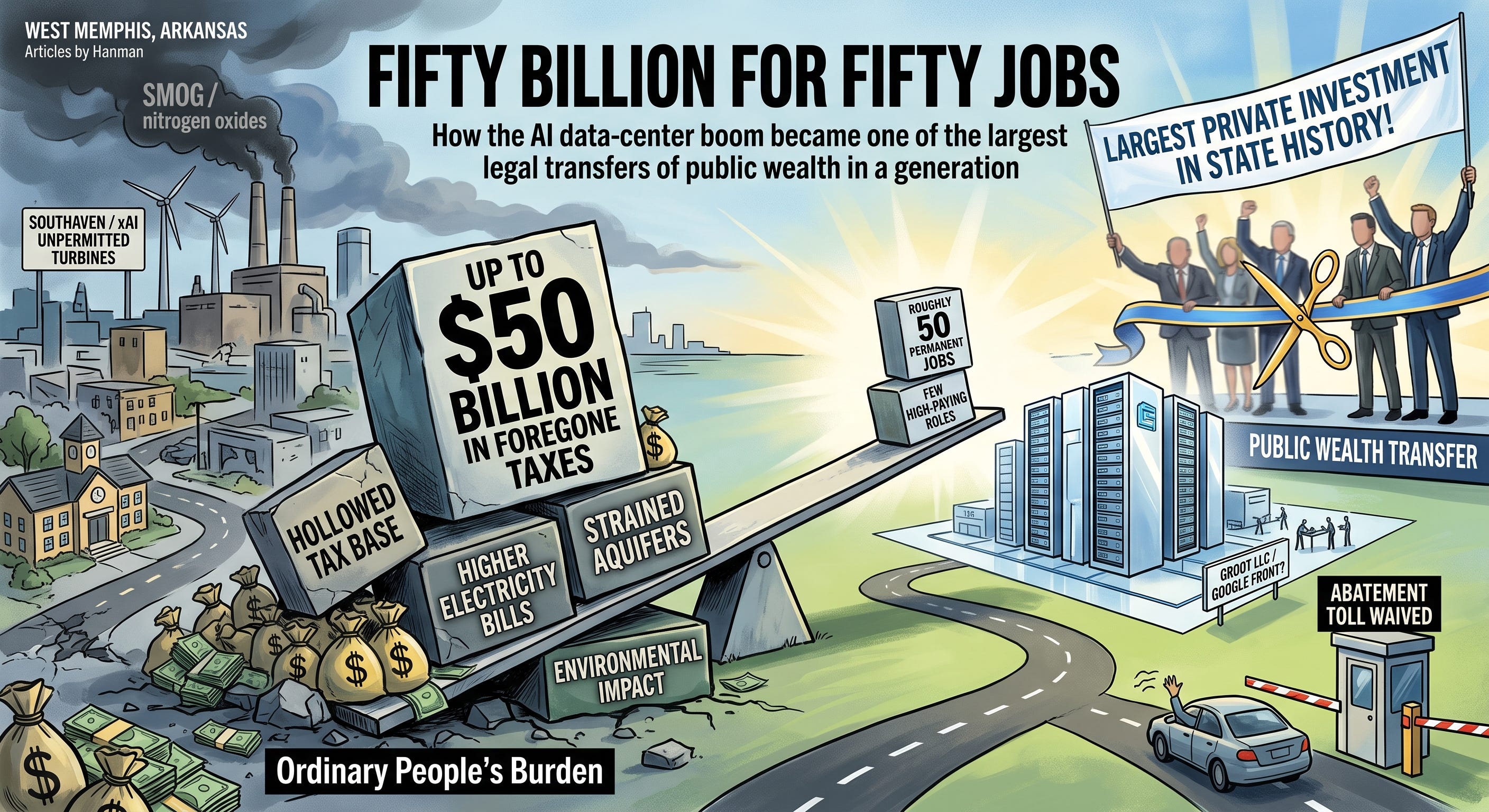
Read that ratio again, because it is the American data-center boom compressed into a single line. Up to fifty billion dollars in foregone taxes. Roughly fifty permanent jobs, at least by the count written into the binding agreement — the developer’s press materials prefer to say “hundreds,” and we will come back to that gap, because it is its own kind of tell. Either way the arithmetic is grotesque: somewhere between a hundred million and a billion dollars of abatement for every job, handed to a company with annual profits in the neighborhood of a hundred billion dollars that did not need a cent of it. This is not a story about a crime. It is a story about a system engineered so that no crime is necessary — where the largest fortunes in human history are subsidized by ordinary people through mechanisms so mundane that most of us will never notice the check being written in our name. That is the argument of this piece, and West Memphis is only where it starts.
The Anatomy of a Giveaway
Start with how a PILOT actually works, because the mechanism is the magic trick. Under Arkansas’s Act 9 of 1960 and the amendments that followed it, a company hands legal ownership of its property to a local government entity, which then leases the property right back to the company. Because the land and equipment are now technically public, they fall off the tax rolls; the company simply makes annual payments pegged to what it would have owed at a steeply reduced rate. In West Memphis, that reduction is the state maximum — sixty-five percent — locked in for thirty years. The city becomes the nominal landlord of a Google data center it will never control, and in return the public agrees to collect a fraction of the taxes the facility would otherwise generate for a generation. The council members who approved it were candid about the theory: as one local official put it, the assumption is simply that the jobs and the spending will more than make up for the taxes forgone. It is a theory worth testing, and this piece will test it.
The physical footprint of what is being subsidized is enormous. Filings with the Army Corps of Engineers describe a campus of roughly five hundred and eighty acres, part of a nearly twelve-hundred-acre site, holding as many as five hyperscale data centers, offices, internal roads, stormwater systems, a water-treatment facility, and a new electrical substation. That substation alone — twenty-six acres, rated at five hundred and two hundred thirty kilovolts — is estimated in grid-operator filings to cost roughly a hundred and forty-two million dollars. Ground broke in October 2025 on the first building, though it is worth being precise about scale: Google’s own spokesperson has said only two of the five possible buildings are currently confirmed, and the company’s initial commitment has been described as closer to four billion dollars. The ten-billion-dollar figure that headlines every account is the ceiling, not a booked number. Google has not detailed the facility’s water use, though cooling at this scale is expected to draw in part on the Memphis Sand Aquifer, the reservoir the region depends on for drinking water. The construction contracts went to Turner and Yates, firms with a track record of building for Amazon and other hyperscalers. To put the scale in perspective, the previous record for private investment in Arkansas history was U.S. Steel’s three-billion-dollar Big River Steel plant; Google’s project, at full build-out, more than triples it.
The structure around the deal is as revealing as the concrete. The same individual, a man named Michael Montfort, appears on the shell-company filings for Google’s data-center projects in West Memphis, Little Rock, and Conway — three deals, one name, and very little daylight for the public to see who is actually being subsidized. Before Groot surfaced, an affiliate called Spark Innovations had floated a three-billion-dollar version of the same West Memphis site. And in Arkansas, a single official — the county judge — holds unilateral authority to authorize these agreements and the bonds behind them, a power confirmed in a recent opinion from the state attorney general. A giveaway on the scale of the largest private investment in the state’s history can be approved without a legislature ever taking a vote. Meanwhile a separate project near Little Rock, developed by a firm called AVAIO, could become the single largest beneficiary of a PILOT agreement in Arkansas history, and the county overseeing it has said the developer has not, at least yet, even requested the tax breaks it is almost certain to eventually explore. The deals are metastasizing faster than the public can track them.
The Deadweight Problem
The standard defense of all this is simple: without the abatement, Google would have built somewhere else, and West Memphis would have gotten nothing. It is a comforting story and it is mostly false. Kasia Tarczynska, a researcher at Good Jobs First, the Washington-based organization that tracks corporate subsidies, put the point bluntly: a sixty-five percent abatement leaves an enormous amount of money on the table, and companies do not really need any public financial support to build and operate data centers. Site selection, she notes, turns on the things a company cannot negotiate away — the cost and availability of power, the speed of the permitting process, the capacity of the grid — and subsidies rank low on that list, arriving at the very end of the process rather than driving it. Which means the abatement rarely buys a facility that would not otherwise exist. It transfers public money to a private balance sheet and files the transfer under economic development.
Economists have a term for a subsidy that pays a company to do what it was already going to do: deadweight loss. And the data-center boom may be one of the purest examples of it in the modern economy, because the demand these facilities serve is not local and not price-sensitive to a county tax rate. A company racing to train frontier models needs power and land at national scale; whether West Memphis collects thirty-five cents on the dollar or a full dollar changes the after-tax math at the margin but almost never changes the decision to build. The abatement is not the reason the data center exists. It is a toll the public agreed to waive for a car that was already on the highway.
And this is not an Arkansas eccentricity; it is a national auction, and the terms are a race downward. At least thirty-six states now offer targeted incentives for data centers. Nevada, where I live and work, lets qualifying projects cut their sales-and-use tax rate to as low as two percent and abate up to seventy-five percent of personal property taxes for as long as twenty years. Ohio waives sales tax for large projects and levies no tax on tangible business personal property at all. Oregon, with no sales tax to give away, leans on enterprise-zone abatements and long-term property-tax deals. Virginia built the largest data-center market on the planet in Loudoun County partly on the back of a sales-tax exemption that has cost the state hundreds of millions in foregone revenue. Arkansas, for its part, went further than most: its 2023 Data Center Act exempted not only equipment and services but the electricity itself from sales tax, and in its original form it stripped local governments of much of their power to impose zoning or noise ordinances on these facilities — provisions lawmakers only partially walked back the following year. In 2025, the legislature revised the thresholds again and added a new category for “large” data centers, and across the country the job requirements attached to these incentives keep falling, with some states dropping the bar from fifty qualifying jobs to as few as twenty. The industry never had to lobby state by state for scraps. States lined up to compete for the privilege of giving the money away.
Fifty Jobs
Return to that number, because it is where the arithmetic becomes indefensible — and where the story’s most revealing gap opens up. The developer that brokered the deal advertises “hundreds of high-paying jobs,” and local coverage has repeated the figure faithfully. The binding PILOT agreement tells a smaller and more honest story: it commits to roughly fifty permanent positions. That gap between the promotional number and the contractual one is not a rounding error; it is the entire genre of these announcements in miniature. “Hundreds” is what a company says at the ribbon-cutting. “Fifty” is what it is willing to put in writing. And even fifty may be generous in the near term, since Google has confirmed that only two of the five possible buildings are so far committed.
None of this should surprise anyone who understands the facilities. A data center is among the most capital-intensive structures in the modern economy and among the least labor-intensive. Ten billion dollars of potential construction, five possible buildings, a private substation, an industrial cooling plant — and, once the concrete cures and the servers are racked, a permanent staff you could seat in a hotel conference room. The construction phase will employ more, perhaps three hundred at its peak, but construction jobs are by definition temporary; they end when the building is done, and the workers move to the next site in the next county that offered the next abatement. What the community is left with, for thirty years, is a fenced compound that hums, draws its power, and pays a fraction of its freight.
Set the subsidy against the payroll and the absurdity survives even the developer’s most flattering count. Up to fifty billion dollars in potential abatements against the fifty jobs in the agreement is a subsidy approaching a billion dollars per position — a figure so far outside any defensible cost-per-job benchmark that economic-development officials avoid stating it in those terms at all. Grant the boosters their “hundreds” — call it three hundred, even five hundred — and the number merely falls to somewhere between a hundred and a hundred and seventy million dollars per job, still one to three orders of magnitude beyond the manufacturing incentives that already draw public scrutiny, where the figures run in the tens or low hundreds of thousands. There is no version of the job count that makes this rational. And the deals keep getting signed anyway, because the incentive facing the officials who sign them has nothing to do with cost per job. It has to do with the ribbon-cutting, the photograph with the governor and the tech executive, the press release announcing the largest private investment in state history. The falling job thresholds written into these state laws are the tell: when a legislature quietly cuts the number of jobs a project must create to qualify, it is conceding that the jobs were never the point. The announcement was.
The Ribbon and the Gift
And here is where the workforce story we are all told to applaud quietly enters. When Governor Sarah Huckabee Sanders announced a partnership to give tens of thousands of Arkansans free access to Google’s AI courses and career certificates, she did not do it at a community college or a job center. She did it at the unveiling of Google’s West Memphis data center. The training and the tax break were the same event, on the same stage — the sweetener handed out alongside the gift. The courses, naturally, certify workers on Google’s own products; “AI skills” in this context means fluency in a particular vendor’s tools, which is to say the program doubles as customer acquisition dressed in the language of opportunity. A public that has just agreed to forgo a generation of tax revenue is offered, in return, the chance to be trained for free on the beneficiary’s platform. Hold that image, because the billion-dollar national version of it is waiting at the end of this story.
The Bill You Cannot See
The abatements are the visible cost. The one that shows up on your own electric bill is harder to see and, in fairness, harder to prove. The mechanism itself is not in dispute. As Ari Peskoe of Harvard Law School’s Electricity Law Initiative explains, a rate case at a public utility commission has two steps: first the regulator sets the total the utility is allowed to collect from all its customers, and then it decides how to divide that total among residential, commercial, and industrial users, guided by a principle called cost causation — the idea that whoever drives a cost should bear it. Data centers scramble that logic in two ways. First, when a utility builds new transmission lines and power plants to serve an industrial-scale facility, it has historically socialized that cost across every customer on the system, the way it would for any grid upgrade. Second, in the wholesale markets where much of the price of power is set, surging demand that outruns supply pushes prices up for everyone drawing from the same grid. PJM, the operator serving all or part of thirteen states, has posted record capacity prices three years running, and average residential electricity prices in the United States have climbed roughly forty-two percent in five years, with far sharper spikes — seventy percent and more — in markets like Maryland and Washington, D.C.
Honesty requires the counterweight, and this is where a careless writer gets himself discredited. The evidence that data centers are the cause of a historical cost-shift onto ordinary households is genuinely mixed. A study prepared for Virginia’s legislature — in the largest data-center market on earth — found no evidence of such a shift, and in a separate facility-level analysis the average Amazon data center actually delivered a multimillion-dollar surplus to its utility, because the payments the facility made exceeded the incremental cost of serving it. Under the right rate design, in other words, a large steady customer can push costs down for everyone else rather than up. Electricity prices are also rising for reasons that have nothing to do with server farms — an aging grid, higher equipment costs, and the expense of the clean-energy transition all feature in a 2026 analysis from Lawrence Berkeley National Laboratory. And the single most alarming figure in circulation, a widely repeated claim that bills near data centers have risen as much as two hundred and sixty-seven percent, describes wholesale prices, not the number on anyone’s residential statement; conflate the two and you will be corrected within the hour.
So the defensible truth is prospective and political rather than settled. The cost-shift is a live risk, not an established fact — and it is real enough that regulators and legislatures are scrambling to head it off. At least thirty-eight new large-load tariffs have been established since 2018, thirty of them in 2025 and 2026 alone, and at least eighteen states have moved to create special rate classes that force the largest energy users to pay their own way. The fights are concrete and occasionally ugly. Georgia’s Public Service Commission wrote rules meant to make data centers cover the upstream generation and transmission costs they cause, and consumer advocates promptly accused the state’s largest utility of trying to skirt them by folding part of the long-term cost of serving data centers back onto residential customers in a pending rate case. Oregon created a new rate structure for large facilities, and advocates leveled the same charge there. Lawmakers in Oklahoma and Alabama have introduced bills conditioning approval on data centers paying for their own infrastructure and demonstrating a benefit to ratepayers statewide. Regulators are experimenting with arrangements like “bring your own generation,” which would require a data center to supply its own new power rather than draw down a shared pool. The story here is not that your bill has definitely gone up because of a server farm. It is that a slow, high-stakes fight over who pays for the grid the buildout demands is underway in statehouses across the country, and the outcome is far from decided.
One more fact belongs here, and I will disclose my interest as I hand it over. In January, Microsoft outlined a broad pledge to cover its own electricity costs, reduce its water use, create local jobs, and forgo tax breaks entirely; and Anthropic — whose Claude I use every day in my own consulting work, and which funds the workforce coalition I am about to reach — made its own promise to cover the electricity price increases tied to its data-center development. Take both commitments at face value and they still tell you something. You do not stand up in public and promise to stop sticking ratepayers and grabbing abatements unless sticking ratepayers and grabbing abatements is the going rate. The pledge is an admission of the default. And a pledge, unlike a statute, is enforced only by the goodwill of the party that made it.
It is worth saying plainly, then, that not every company in this story is playing the same game, and fairness demands the distinction. Back in West Memphis, Google is doing on energy roughly what this piece’s own logic would ask of it. The company has agreed to cover all of the electricity costs associated with its campus — which its utility, Entergy, projects as more than a billion dollars in net benefit over the life of the contract — and the facility is slated to run in part on a six-hundred-megawatt solar project Entergy is building on the site, alongside a twenty-five-million-dollar energy-impact fund. Entergy argues, plausibly, that a large steady customer like this spreads its fixed costs and can push rates down for everyone else. That is the responsible version of a data center, and Google earns the credit for it. The tax giveaway is still a giveaway — covering your own power does not un-forgo fifty billion dollars in taxes — but on the question of who pays for the grid, Google in West Memphis is a model, not a menace. Hold onto that standard, because a few miles away, across the river and the state line, a different company was about to show what happens when a firm decides the standard does not apply to it at all.
Sacrifice Zones
So drive across the river from West Memphis into Memphis proper, and then a few miles south across the state line into Mississippi. This is where the abstraction of subsidy and rate policy turns into something you can smell. To power its Colossus 2 data center, Elon Musk’s xAI — now owned by SpaceX following a merger this year — built what is functionally a private power plant in Southaven: twenty-seven gas turbines operated through a subsidiary called MZX Tech, sprawled across a hundred and fourteen acres, the equivalent of nearly eighty-seven football fields, capable of generating up to four hundred and ninety-five megawatts, roughly the output of a conventional power station. It was erected with no air permit, no public input, and no notice to the families living nearby. In January, the Environmental Protection Agency confirmed what should never have been in question: that methane gas turbines of this size require construction and air permits before they can lawfully run. Where Google agreed to build clean power and pay for its own, xAI simply wheeled in turbines and lit them.
None of this was a first offense. xAI began operating its original Memphis site, Colossus 1, in June of 2024, drawing on as many as thirty-five unpermitted gas turbines. After the Southern Environmental Law Center, on behalf of the NAACP, sent a notice of intent to sue under the Clean Air Act, the company removed some turbines and obtained permits for fifteen of them. Then, according to the litigation, xAI officials described a plan to simply copy and paste that same unpermitted strategy to power Colossus 2 — which is precisely what the twenty-seven turbines in Southaven represent. The company has since obtained a state permit to build out a more permanent forty-one-turbine plant at the site, a permit the NAACP is now asking Mississippi regulators to revoke. On the roof of one of the buildings, visible from the air, the company painted the word MACROHARD, a juvenile taunt aimed at Microsoft. It is a useful detail, because it captures the posture: a company treating the communities around it as a backdrop for an inside joke.
The consequences are not abstract, and they are not evenly distributed. By the accounting in the NAACP’s federal complaint, the Southaven plant can emit more than seventeen hundred tons of smog-forming nitrogen oxides a year — likely the single largest industrial source of that pollutant in a Memphis region that already fails to meet federal smog standards — along with roughly a hundred and eighty tons of fine particulate matter, five hundred tons of carbon monoxide, and nineteen tons of formaldehyde, a known carcinogen, every year. The American Lung Association has given both the Mississippi county and the Tennessee county that share this air an F for ozone. The plant sits about half a mile from homes and a mile from an elementary school, in a community the complaint notes is far more Black than the country as a whole. The NAACP, represented by the Southern Environmental Law Center and Earthjustice, sued in April; when xAI answered by adding still more turbines rather than curing the violation, the plaintiffs went back to court seeking an emergency injunction. The organization’s environmental-justice director refused to let the neighborhoods become, in her words, sacrifice zones for Big Tech’s convenience.
How does a company run an unpermitted power plant in the open for months, in full view of state and federal regulators? By finding officials willing to look away, and by doing all of it on paper. xAI’s legal defense rests on a determination by the state of Mississippi that its turbines are “mobile” sources of pollution rather than stationary ones — a classification that, if accepted, would exempt them from the permitting any ordinary power plant would face. Portable turbines wheeled onto a hundred-and-fourteen-acre site to run a data center around the clock are, by any common-sense reading, a stationary power plant; calling them mobile is a legal fiction handed to the company by a regulator. Internal correspondence surfaced in the litigation describes a rush to finalize the relevant permit and pressure from upper management to turn the application around quickly. This is what regulatory capture looks like at the retail level: not a suitcase of cash, but a state environmental agency choosing the interpretation that lets the richest man in the world keep his turbines spinning.
Paramount National Security
And when a state loophole was not enough, the federal government itself stepped onto the field — on the company’s side. In response to the NAACP’s suit, the Trump administration intervened on behalf of xAI, asking the court to dismiss the case outright. Its argument was not that the pollution is harmless or that the permits were obtained. It was that the operation of Grok, the chatbot the Colossus data centers feed, is a matter of paramount national security. In its filing, the Justice Department described Grok as one of only four AI models capable of supporting national-security applications and one of just three cleared for mission-critical operations across classified networks, and it claimed that during the recent conflict with Iran, Grok enabled the United States to deploy more than two thousand munitions against two thousand distinct targets within ninety-six hours. The message to the court was unmistakable: the chatbot must keep running, and therefore the plant must keep polluting, because the nation’s defense now depends on both.
Sit with the shape of that. A civil-rights organization asks a court to make a company stop fouling the air over a Black neighborhood without the permit the law plainly requires, and the answer from Washington is a national-security brief on behalf of the polluter. Whatever one believes about Grok’s battlefield utility, the precedent is the thing to notice. If a data center can be shielded from the Clean Air Act because the model it trains has been declared essential to national defense, then the most basic environmental protections become negotiable for any company willing to make itself useful enough to the state. That is not a loophole in the tax code or a favorable rate case. That is the machinery of the federal government being enlisted to keep a private, unpermitted power plant running over the objections of the people breathing its exhaust. This is what the instinct to “look the other way” on the buildout actually looks like in 2026 — and the ones looking away are not bribed councilmen but a state permitting office and the Department of Justice.
The Scandal Is the Legality
Line these cases up and the pattern is unmistakable, and it is not the one most people expect. The transfer of public wealth to the AI buildout is enormous, and almost none of it is illegal. It moves through payment-in-lieu-of-taxes agreements and tens of billions in municipal bonds; through sales-tax and electricity exemptions written specifically for this industry; through the quiet socialization of grid costs onto household bills; through mobile-source loopholes handed out by accommodating regulators; and, when necessary, through a national-security claim filed by the federal government itself. There is no envelope of cash to subpoena, because none is needed. The machine subsidizes the responsible and the reckless with equal generosity — Google collects its thirty-year abatement whether or not it builds solar, and xAI collects federal air cover whether or not it ever files for a permit. The scandal is not the corruption. The scandal is the legality.
There is an older phrase for the underlying move, and it predates the AI boom by decades: socialize the costs, privatize the gains. The profits of the data-center era — the models, the cloud revenue, the trillion-dollar market capitalizations — flow to a handful of firms and their shareholders. The costs — the foregone school funding, the strained aquifers, the upward pressure on power bills, the smog over Southaven, the thirty-year hole in a county’s tax base — are distributed across the public, mostly quietly, mostly legally, and mostly among people with far less power than the firms collecting the upside. Every individual piece of this is defensible on its own terms. A tax abatement is a legitimate economic-development tool. A rate case is a routine regulatory proceeding. A permitting classification is a technical determination. It is only when you assemble the pieces that the design becomes visible, and the design is a wealth transfer running in one direction, from the many to the few, with a ribbon on it.
The National Version of the Ribbon
Which brings us back, finally, to where this began. Sitting on top of the whole apparatus is RAISE US, the nonprofit that launched on June 25 to prepare American workers for the disruption these very companies are causing. It is co-chaired by former Commerce Secretary Gina Raimondo, who serves as its chief executive, and former Indiana governor Eric Holcomb, and it has raised more than five hundred million dollars against a one-billion-dollar goal. Its anchor funders are the OpenAI Foundation, Anthropic, Amazon, and Microsoft — names that sit at the center of the same buildout, and, in xAI’s corner of the industry, the same contest over how far the rules will bend. Its strategy runs deliberately through governors rather than Washington, beginning with a bipartisan set of states, on the theory that state capitals control the community colleges, credentialing, and business incentives that decide whether a worker is retrained or discarded. The recommendations, the coalition is careful to note, come from a policy lab funded by philanthropies rather than the corporate donors — a firewall built to answer the conflict-of-interest charge before anyone can raise it.
On its own terms it is hard to be against, and I do not doubt that many of the people involved are sincere. But the arithmetic strips the sincerity of its weight. Set the billion-dollar fund beside the numbers in this story — up to fifty billion in potential abatements from a single Arkansas city, and roughly seven hundred and twenty-five billion dollars in combined capital spending this year across the four largest hyperscalers, Amazon, Google, Meta, and Microsoft, two of which, Amazon and Microsoft, anchor the fund — and it resolves into what it is: barely half a day of that capital expenditure, the sum those four companies spend together roughly every twelve hours, aimed at a displacement crisis whose hard data is still contested, deployed through a retraining model that six decades of federal experience suggests barely works. The most accurate reading is the one a Forbes columnist reached for — a down payment on political permission. A bipartisan nonprofit, blessed by both organized labor and the business establishment, working hand in glove with sitting governors of both parties, is the most efficient insurance a company can buy against the one thing that could interrupt a decade-scale buildout: a political backlash that outlasts an election cycle. It is not an accident that the comparison everyone reaches for is the CHIPS Act. The entire point of that comparison is durability across administrations.
And it is, structurally, nothing more than the West Memphis moment scaled to the whole country. In Arkansas, the free Google certificates were handed out on the same stage as the tax break, the ribbon tied to the gift. RAISE US is that ribbon nationalized and institutionalized — a billion-dollar, bipartisan, labor-endorsed instrument for teaching the public that the companies hollowing out its tax base and straining its grid are, in fact, its partners in the future. The training was always the ribbon. The data center was always the gift. And the gift, as always, is being paid for by the people receiving the ribbon.
None of this requires believing the people involved are villains, and none of it requires a single broken statute. It requires only that we read the frame for what it is. When a town forgoes fifty billion dollars for fifty jobs — or even a few hundred — someone else makes up the difference, in thinner school budgets, higher power bills, dirtier air, and a tax base hollowed out for thirty years. When the law is written so the wealthiest firms on earth can take that much and give back that little, the absence of a crime is not a defense of the system; it is the indictment of it. The buildout has already captured the tax code and the utility commission. In a gas-choked neighborhood south of Memphis, it is now reaching for the Justice Department. The right question was never whether any of this is legal. It is who wrote the laws that made it legal — and who is paying for them tonight.
About the Author
Gal Ratner is the founder and CTO of Inverted Software and WhiteStar Labs and Chief Architect at Prana Entertainment, a Las Vegas–based enterprise software and AI consultancy. Across nearly thirty years on the Microsoft and .NET stack he has shipped production systems for clients including Microsoft, Sony, Rockstar Games, 2K Games, Best Buy, and Allegiant Air. His current focus is agentic AI in production — MCP servers, RAG pipelines, the Microsoft Agent Framework, SQL Server 2025 vector search, and the PLogger observability framework. He writes about the widening gap between executive AI narratives and engineering reality, and he uses the tools he criticizes — including Anthropic’s Claude — every day in his own work. He is the author of the novel The Archive of Lost Suns and can be found at galratner.com.