


The last COMDEX closed at the Las Vegas Convention Center on November 20, 2003. Roughly 40,000 people registered, against more than 220,000 five years earlier. About 500 companies exhibited where 2,100 once had. Sections of the floor sat behind curtains, and Bill Gates delivered his twentieth consecutive keynote at the Aladdin Theatre rather than the convention center, because a smaller room hides empty seats.
On June 23, 2004, MediaLive International canceled that November’s show. Management called it a redesign, not an ending. The company said it had made progress in conversations with IT buyers and vendors, and that considerable work remained to build an industry event that would serve the maturing industry as well as COMDEX had served its infancy. Microsoft, Intel and Dell sat on the advisory panel assembled to design the replacement.
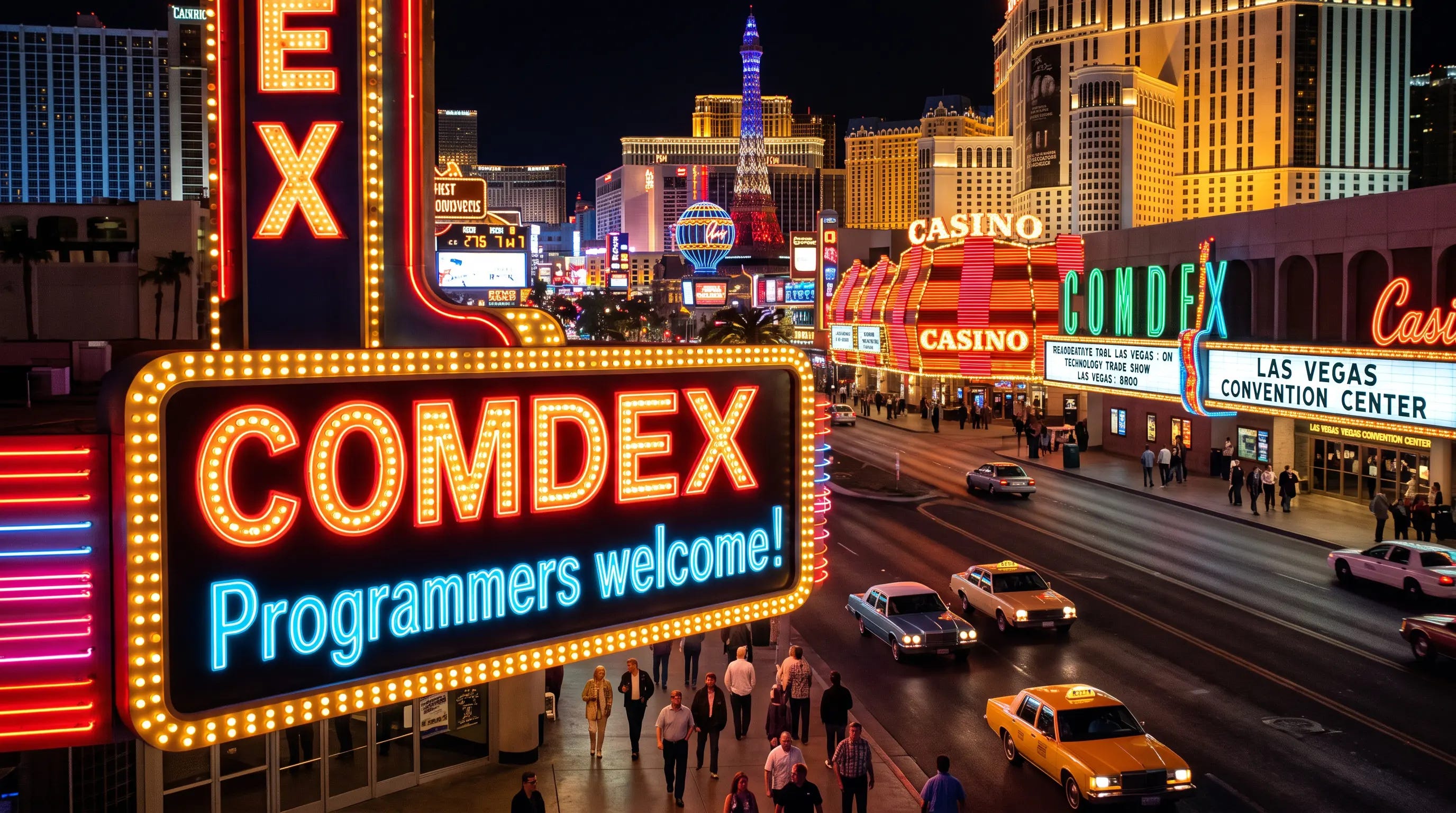
Twenty-two years later, nobody has built it.
The comfortable explanation is mostly wrong
The consensus is that COMDEX died of obsolescence. Technology got too specialized for a show that covered everything, buyers segmented, and vendors moved their money to focused events they ran themselves. Everyone was better off. Progress.
That version flatters the people who made the decision. The record does not.
COMDEX was losing anchor tenants before any of that started. When SoftBank agreed in February 1995 to buy the Interface Group’s seventeen computer trade shows for $800 million, Compaq, Packard Bell, Oracle and Seagate had already walked, over price. The 1994 show still drew 195,000 attendees and 2,200 exhibitors. It was expensive, and the exhibitors said so, and the show kept raising rates anyway.
Then it stopped being a trade show. COMDEX started in 1979 as a dealers’ exposition, closed to anyone who was not a hardware builder, distributor, software developer or reseller. That restriction was the entire product. It guaranteed a booth conversation with someone who had a purchase order. Through the late eighties and nineties the organizers relaxed admission to grow the gate, attendance crossed 200,000, and exhibitors found their sales staff explaining products to hobbyists while dealers complained that show-special buyers were coming back to them for warranty support.
The price complaints were not imaginary. The Interface Group leased exhibition halls from the public convention authority for something in the neighborhood of a nickel a square foot and subleased partitioned, carpeted booths to technology companies for up to twenty-five dollars. When the halls ran short and Strip hotels started inflating midweek rates on his attendees, Adelson bought the Sands for $110 million in 1989 and opened his own 1.15-million-square-foot expo hall next door in 1990, the first large private convention center in the country. Trade shows were never a service business. They were a rent business with a keynote attached.
Which is why the exhibitors eventually did the math and left the floor. By the late nineties Intel, Dell and IBM were cutting their official footprints and renting ballrooms and penthouse suites off-site instead, inviting their real customers to curated meetings and letting COMDEX pay to assemble the crowd. The show kept the cost and lost the revenue.
The last piece was leverage. SoftBank spun the events business into Key3Media in 2001, loaded with buyout debt. Attendance fell from about 211,000 in 2000 to 125,000 in 2001 to under 100,000 in 2002. Key3Media filed Chapter 11 in February 2003. A show with no debt survives two bad years. A show carrying an LBO does not.
Pricing, identity, and debt. Nothing on that list is a fact about software.
Every large software event now belongs to the company being evaluated
What replaced COMDEX is visible in this year’s Las Vegas calendar.
Adobe Summit ran at the end of April. Google Cloud Next took Mandalay Bay from April 22 to 24. Kaseya Connect followed at the MGM Grand. ServiceNow’s Knowledge conference took the Venetian in early May, Dell Technologies World took it two weeks later, and Cisco Live took Mandalay Bay from May 31 to June 4. HPE Discover and Identiverse ran the same week in June, InfoComm the week after that, and Info-Tech LIVE sat at the Bellagio in between. Black Hat opened at Mandalay Bay on August 1 and handed off to DEF CON at the convention center’s West Hall on the sixth, with Ai4 running at the same time. CrowdStrike’s Fal.Con and VMware Explore overlap at the end of August. Then SANS at Caesars Palace, Oktane at Caesars Forum, NetApp Insight at the end of September, TSIA World and HR Tech and Money20/20 in October, Oracle AI World at the Venetian on the 26th, and AWS re:Invent from November 30 through December 4, sixty thousand people across seven properties. Gartner closes the year at the Venetian on December 8. In March there was ISC West, in February Pink and Right of Boom, and Visual Studio Live! ran at Planet Hollywood in the middle of March.
That is not a shortage of software conferences. Las Vegas hosts more of them than any city in the country.
Every one of those events except the security shows is owned by a vendor, staged by that vendor’s marketing organization, and built to sell that vendor’s roadmap to that vendor’s installed base. Adobe does not put Salesforce on the keynote stage. AWS does not run a panel where a customer explains why they moved to Azure. The comparison you actually need before signing a seven-figure contract is the one thing the format structurally cannot produce.
COMDEX produced it constantly, and often by accident. VisiCorp demonstrated Visi On at the 1982 show and Gates walked the floor, saw a graphical environment running on an IBM PC, and went home to accelerate a project then codenamed Interface Manager. Mitch Kapor announced Lotus 1-2-3 at the same show. Compaq showed the reverse-engineered Portable the same week. In 1999, Linus Torvalds keynoted to an overflow crowd with Red Hat and VA Linux in a pavilion down the hall, inside a show whose largest exhibitor was Microsoft. None of those things happen at a conference somebody owns.
The vendor shows also inherited the disease that killed the host. During re:Invent week the Strip fills with companies that are not exhibiting, running suites and dinners and rented lounges for customers who flew in on Amazon’s gravity, which is the same off-floor arbitrage Intel and Dell ran on COMDEX in 1999 with the roles reassigned. Sixty thousand people arrive in one city, and the market immediately organizes a second, unofficial, vendor-neutral conference in the hallways and steakhouses around the first one. The demand for that room is not theoretical. It is being met badly, in private dining rooms, by people who had to buy a badge to a competitor’s marketing event to get through the door.
The developer conference is shrinking while the developer population explodes
GitHub’s Octoverse report counted more than 180 million developers on the platform, with 36 million added in a single year. Whatever fraction of that number you accept as professional, the direction is not in dispute.
Microsoft Build 2026 ran two days. It was held at Fort Mason Center in San Francisco, a waterfront arts complex, after a decade in Seattle convention halls and stadiums. Attendees put the in-person count around 2,700. Admission cost $1,099 and required an application, because capacity was limited. This is the flagship developer event of the company that owns GitHub, Visual Studio, .NET, Azure and Copilot. Microsoft Ignite ran digital-only in 2025 and returns to Moscone this November.
The pattern is not confined to Redmond. CeBIT, which was larger than COMDEX, was canceled outright by Deutsche Messe in 2018 after 33 years and folded into a manufacturing show. E3 was permanently canceled in December 2023 after the console makers stopped showing up. Splunk’s user conference left Las Vegas for Denver.
What remains at scale and vendor-neutral in this industry is CES, which is consumer hardware, and Black Hat and DEF CON, which are security. CES drew an audited 148,392 attendees in January 2026 with 4,100 exhibitors across 2.6 million square feet, and it is a fine show. It is also not where anyone evaluates an agent framework or an observability platform or a database. Enterprise software has no equivalent.
What I actually cannot do at any of these
I build agentic systems in production. MCP servers, the Microsoft Agent Framework, RAG pipelines against SQL Server 2025 vector search, an observability framework called PLogger that exists because the tracing I needed did not. Selecting an agent runtime in 2026 means choosing between a Microsoft stack, an AWS stack, a Google stack, and a half dozen independent frameworks, and the decision commits a client for years.
There is no room in which I can ask all of them the same question on the same day.
I can fly to re:Invent and get the AWS answer. I can fly to Build and get the Microsoft answer. Both answers are competent, both are delivered by people who know their own product deeply, and both dissolve on contact with the comparative question, because at a vendor conference the response to “how does this compare” is a slide the competitor never saw. The industry standardized on the Model Context Protocol precisely so tools from different vendors could talk to each other without a translator. We built the neutral protocol. We never rebuilt the neutral room.
The irony is that COMDEX was invented to solve exactly this problem, for exactly this reason. Manufacturers had products and no channel. Dealers had customers and no catalog. Sheldon Adelson put them in a ballroom at the MGM Grand from December 3 to 5, 1979, with 167 exhibitors and 3,904 registered delegates, and charged admission for the privilege of solving each other’s problem. The bottleneck today is different in content and identical in shape.
Las Vegas has a hole in November and a building that just got renovated
Now the part that is about the city.
In 2025, Las Vegas hosted 38,545,700 visitors, down 7.5 percent from 41,676,300 the year before, and well off the 2019 record of 42,523,700. Hotel occupancy fell to 80.3 percent. Airport traffic dropped. International visitation dropped harder, and the LVCVA’s board spent the spring debating a five-year, six-million-dollar campaign aimed at winning Canadians back.
Convention attendance in 2025 was 5,988,200. In 2024 it was 5,994,800. Group business fell six thousand seven hundred people in a year when leisure travel fell by more than three million.
That is the whole tourism argument and it does not require enthusiasm to make. Conventions are the load-bearing wall. Steve Hill has put average convention-visitor spending around $1,600 a trip against $1,200 for leisure, and the LVCVA counted $10.1 billion in direct spending from convention visitors in 2024. Convention attendance is still roughly ten percent below the 6,649,100 of 2019, so the recovery everyone keeps describing has not actually happened in the segment that matters most.
This year has made the dependency embarrassingly obvious. Through June, visitor volume was up two tenths of a percent and convention attendance was up 12.6 percent, which is the entire story of a flat first half. In July, visitation rose 2.7 percent while convention attendance fell 5.6 percent to 262,700, and the authority attributed the drop to one show relocating and another sliding into August. Two trade shows moving on a calendar swings the number. That is not resilience. That is a city whose business travel economy rests on a few dozen large events and has no replacement for any of them.
November is where the gap is widest. In November 2025 the city ran 79.4 percent occupancy overall and 75.0 percent midweek, with downtown at 66.4 percent, and that was a month containing the Formula 1 Grand Prix, three Raiders home games, and SEMA with roughly 153,000 attendees. Convention attendance for the month came in around 547,000 and slightly down year over year. Vegas throws its two biggest annual events at November and the midweek rooms still do not fill.
This is precisely the trough COMDEX was built to fill, and Adelson chose the date for that reason. Cheap winter rooms, a dead pre-Thanksgiving week, and a hotel inventory desperate for midweek bodies. It worked so well it rebuilt the city. Las Vegas hosted 637,862 convention delegates in 1979 and 3.3 million by 1998, with COMDEX alone accounting for about seven percent of that year’s total in a single week. The LVCVA put COMDEX’s 1998 non-gaming impact at roughly $341 million, which is close to $700 million in today’s dollars. CES 2025, the largest show in the city, generated $381.2 million.
The infrastructure argument answers itself. The convention center finished a $600 million renovation of its legacy campus in time for CES this January, on top of the $1 billion West Hall that opened in 2021. The campus is 4.6 million square feet with about 2.5 million of exhibit space, second in the country only to McCormick Place, and it is booked for 48 shows and a projected 1.23 million trade show attendees this year. The building Adelson’s show forced into existence is now the finest facility of its kind in North America, and every November it hosts an automotive aftermarket show while the software industry splits itself across two dozen conferences in a dozen hotels.
The objection worth taking seriously
It came from Computerworld in June 2004, in an editorial titled “Death to Comdex.” The argument was that the brand itself was the problem, that vendors and IT buyers heard the name and thought PC era, and that every revival attempt was therefore doomed. Build a new show, the editorial said, and give it a new name. That prediction has aged well in one direction. MediaLive’s 2003 attempt to relaunch COMDEX around enterprise IT drew barely half the 80,000 it projected, and UBM’s virtual COMDEX, launched in 2010 with avatars and a digital replica of Las Vegas, quietly stopped after 2012.
The counterargument is that the name is doing work the objection undervalues. Every trade show that ever mattered had a founding constraint, and COMDEX’s was B2B credentialing. That is the asset worth reviving, and it survives being renamed. If Informa, which absorbed UBM in 2018 and inherited the brand with it, wants to license the word, fine. If not, call it something else and copy the 1979 rulebook.
A trade show does not close Koval Lane
The other answer Las Vegas gave to November was Formula 1. The race arrived in 2023, runs the weekend before Thanksgiving, and the city has now committed to it through 2037. That commitment is worth reading closely.
The LVCVA sponsored the first three races at $6.5 million a year, restructured to $10 million a year for 2026 and 2027, and on July 14 its board voted unanimously to spend $10 million a year for the ten races from 2028 through 2037. That is $139.5 million of public tourism money committed to a private racing company, with $2.5 million of each year’s payment going to buy tickets the authority hands out to clients. Clark County commissioners approved the matching extension in May, also unanimously. Separately, in June 2023, F1 asked the county to cover $40 million of the $80 million cost of repaving the circuit, which runs on public road. Commissioner Marilyn Kirkpatrick voted against even opening those negotiations and said what forty million buys instead. Somebody’s park. Somebody’s recreation center. Some building with duct tape on the carpet.
The operating math on the first race is a matter of public record. Clark County staff logged more than 17,000 hours of race-related work at a cost of $4.4 million, against $3.8 million the county collected in tax revenue. Commission Chair Tick Segerblom said it plainly afterward. At the end of the day, it was a net loss.
The rest of the bill went to the businesses on Koval Lane. Ellis Island sued F1 and Clark County in April 2024 over the inaugural race, alleging losses in the millions, and its complaint described paving schedules that shifted through the summer of 2023 with closures appearing daily and without notice, forcing the property to pay its own flaggers twelve to fourteen hours a day. Wade Bohn of Jay’s Market put his losses near $3.5 million and said he doubted the store would survive another one. Battista’s Hole in the Wall, Stage Door Casino and Ferraro’s Ristorante filed their own claims. A petition to stop the 2024 race collected more than 2,500 signatures.
Most of those cases are gone. Ellis Island’s was dismissed in September 2024, and by May 2025 the casino was an official venue of the Las Vegas Strip Circuit. Battista’s and Stage Door were partially dismissed and then settled. Plaintiff to sponsor in twelve months.
Two things in fairness, because the argument does not need overstating. The LVCVA runs on hotel room tax, roughly $350 million a year paid mostly by visitors, so no resident’s property tax bill carries a line item for Formula 1. And the 2025 race reportedly generated $43 million in state and local tax revenue, $15 million of it directed to Clark County schools.
Neither one disposes of anything. Room tax is public money with other claims on it, and ten million dollars a year is ten million dollars a year no matter who handed it over at check-in. The staff hours were real. The road is ours. The revenue those businesses lost during construction did not come back when the cars left.
The ticket prices finish the thought. General admission for Thursday practice at the first race opened at $500 and Saturday race-day general admission ran past $1,700, in a town where most of the people watching from the overpass work inside the resorts those grandstands are parked in front of. Organizers have since cut prices hard, handed complimentary tickets to teachers and small business owners, and opened sales to locals ahead of the general public. Those are real concessions. They are also an admission. Nobody builds a local access program for an event the locals could already afford.
Set the two models beside each other against the one thing that actually matters in November, which is whether the midweek rooms fill. A trade show does not close Las Vegas Boulevard for a season. It does not repave Koval Lane, build a bridge over Flamingo, or bill the county 17,000 staff hours. It does not ask for a sponsorship, and it does not need one, because 200,000 people who eat three meals a day in the resort corridor are the product. COMDEX paid rent for the halls and the county collected room tax on every one of them. The businesses along Koval got customers instead of flaggers.
Las Vegas can have a race and a trade show in the same month. It used to have a race-sized trade show without the race.
The rules a revival would have to accept
Three of them, and all three are the ones COMDEX broke.
Credentialed attendance, permanently. No general admission, no enthusiast day, no consumer track. If the badge does not represent budget authority or channel participation, the badge does not exist. This is the constraint that made the show valuable and abandoning it is what started the decline.
Nonprofit or association ownership. CES survived the same decade that killed COMDEX partly on the calendar and partly because the Consumer Technology Association is a trade body that answers to members rather than a private equity structure that answers to a debt schedule. Key3Media went bankrupt in fourteen months. Structure is not a detail.
No purchased keynotes. The main stage exists for the comparative conversation nobody else will host, which means the operator has to be able to tell its largest exhibitor no. That is a governance question, and it is the one that decides whether the thing is a trade show or a very expensive advertisement with a coat check.
I have watched this industry standardize on open protocols so that competing systems can interoperate. We did that work. We can find a ballroom.
About the Author
Gal Ratner has spent nearly thirty years building and shipping production software on the Microsoft and .NET stack, for clients including Microsoft, Sony, Rockstar Games, 2K Games, Best Buy, and Allegiant Air. He is Chief Architect at Prana Entertainment and the founder and CTO of Inverted Software and WhiteStar Labs, an enterprise software and AI consultancy based in Las Vegas, where he has watched the convention calendar from the inside for years. He was the sixth employee at Break.com during its run as one of the largest entertainment sites on the web, and a finalist for the Los Angeles Business Journal’s CTO of the Year.
His current work is agentic AI in production: MCP servers, the Microsoft Agent Framework, SQL Server 2025 vector search, and the open-source diagnostics tooling behind PLogger. He writes about AI the way a practitioner sees it, bullish on what the tools can actually do and allergic to the marketing wrapped around them.