


Here is a date worth remembering: April 14, 2026.
That is the day Mike Krieger, Anthropic’s Chief Product Officer and the co-founder of Instagram, resigned from Figma’s board of directors. The same afternoon, The Information reported that Anthropic’s next model would ship with design tools aimed squarely at the core of what Figma sells. Figma’s stock dropped three percent that day, and nobody in the industry had to ask why.
Three days later, on April 17, Anthropic launched Claude Design powered by Claude Opus 4.7. A month before that, Google rolled out what it called Stitch 2.0 — a complete rewrite of its AI-native design canvas. Both products are now generally available to paying users, and between them they cover roughly eighty percent of the jobs a working designer opens Figma to do.
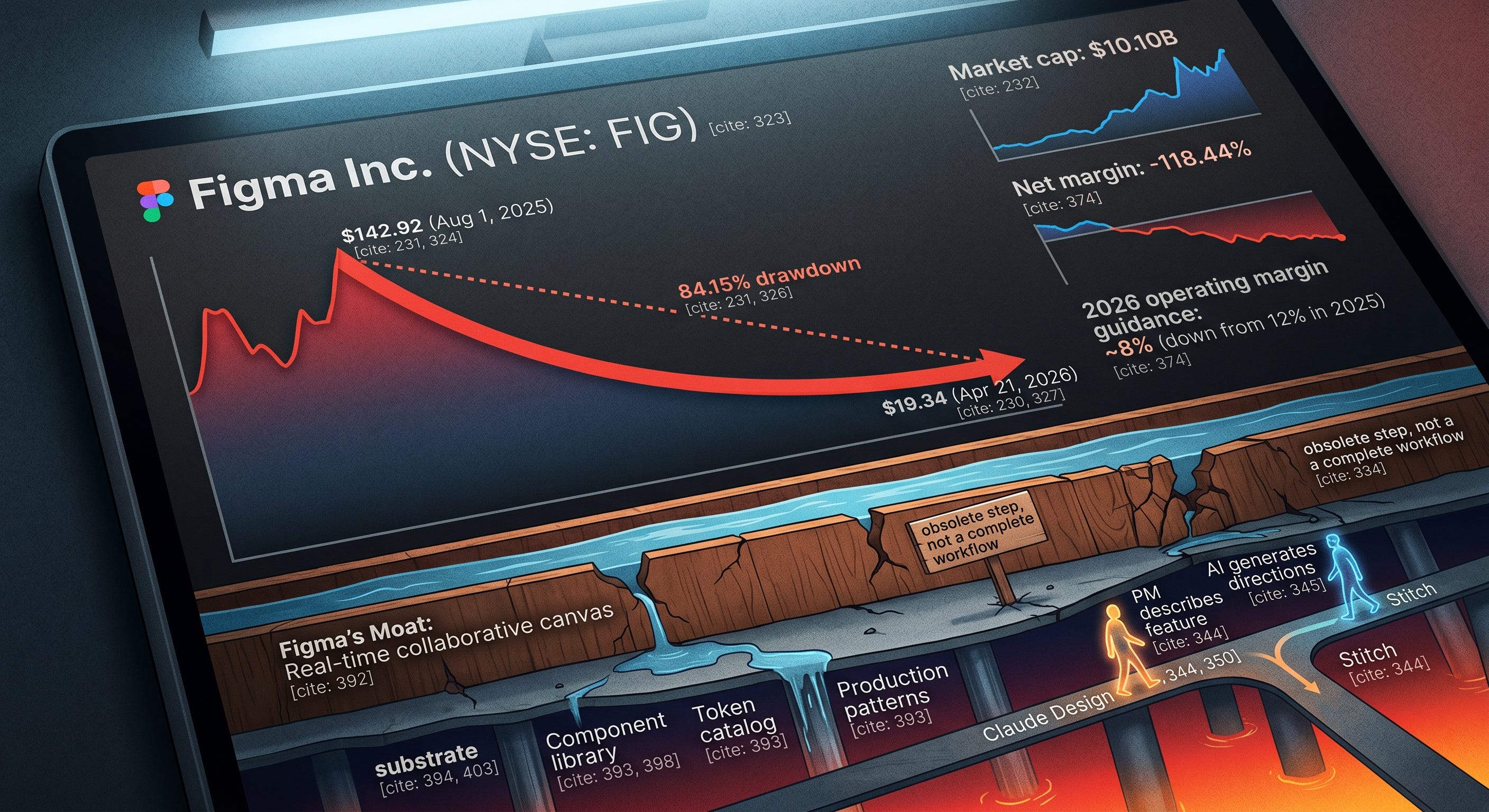
As I write this at 12:51 PM Pacific, Figma (NYSE: FIG) is trading at $19.34 a share. That is down 84.15% from its all-time high of $142.92, set on August 1, 2025 — the second day after its IPO. Market cap: $10.10 billion. In July 2025 it was $68 billion. Roughly $58 billion in paper value has vaporized in eight and a half months.
I have been paying subscriptions to Figma for years. I have shipped products with it. I still think Dylan Field is one of the better founder-CEOs in SaaS. And I am going to make the case, in this piece, that unless Figma does something structural and fast, the company as a stand-alone public equity is finished.
Then I am going to tell you what that structural move looks like. Not because I think Figma cares what a CTO in Las Vegas has to say about it, but because the playbook is sitting in plain sight, and somebody on their executive team ought to pick it up.
Let us start with the two tools that are doing the damage.
What Claude Design actually is
Anthropic shipped Claude Design on April 17, 2026. I have been inside it for the last three days.
The product is a split-pane interface — chat on the left, canvas on the right. You describe what you want, Claude builds a first version, and from there you iterate: through conversation, through inline comments you drop directly on elements in the canvas, through custom sliders Claude itself generates for the specific design (spacing, color, layout), or through direct text editing. It is powered by Claude Opus 4.7, Anthropic’s most capable vision model, which also launched this week.
What makes it materially different from every AI design tool that came before it:
• It reads your code. During onboarding, Claude ingests your codebase and existing design files and builds a design system from what it finds. Every subsequent project auto-applies your colors, typography, and components. No separate import-tokens step. No manual library upkeep.
• It ingests real documents. DOCX, PPTX, XLSX, images, PDFs. Drop in a spreadsheet of metrics, it builds a dashboard mockup. Drop in a PowerPoint, it redesigns it. This is where Opus 4.7’s multimodal bandwidth (images up to 2576 pixels wide) actually starts to pay.
• It hands off to code. When a design is ready to build, Claude packages everything — the design, the intent behind decisions, the component structure — into a handoff bundle for Claude Code. One instruction, and you have a working frontend.
• It exports to Canva, PPTX, PDF, HTML, or a shared folder. Not hostage data. You can walk the output anywhere.
• It does frontier design. Voice, video, shaders, 3D, built-in AI. Things no traditional vector design tool was ever structurally capable of producing.
John Voorhees at MacStories spent a week with it and wrote that iterating between chat, canvas, and revisions felt noticeably faster than doing the same loop in Claude Code. VentureBeat called it the most visible expression of Anthropic moving from model provider to full-stack application company. Banani, an AI design review outlet, called it the most capable AI design tool available to anyone with a Claude subscription on launch day.
A few honest caveats. It is a research preview. Pricing is included in the Claude Pro, Max, Team, or Enterprise subscription, but usage counts against your tier limits and can burn through tokens fast with Opus 4.7’s large image inputs. Enterprise admins must opt in explicitly — Anthropic ships it off-by-default on Enterprise plans, which is a conservative and correct choice. And like every Labs product, features will change and break before it hits GA.
But the product works today, and the work it produces is shareable with non-designers without making your company look amateurish. That is the bar, and Claude Design clears it.
What Google Stitch actually is
Stitch is an older story. Google acquired Galileo AI in May 2025, rebranded it as Stitch, and shipped it at Google I/O 2025 as a Google Labs experiment. The original version was a text-to-UI generator powered by Gemini 2.5 Flash (fast mode) and Gemini 2.5 Pro (experimental mode), with a focus on mobile and web app UIs. It was free, generous on limits, and handed off to Figma or clean HTML and CSS.
The original Stitch was fine. A faster Galileo with Google branding.
The version that matters is Stitch 2.0, which shipped in March 2026. That is the release that kicked Figma stock down 12% in two trading days.
Stitch 2.0 is a complete product rethink. The old screen-at-a-time generator is gone. In its place sits an AI-native infinite canvas, a design agent that can reason across the entire project’s history, an agent manager that lets you run multiple ideation threads in parallel, voice input for real-time design critique, and an MCP server and SDK that lets other tools call Stitch’s capabilities as a service. You can export to AI Studio, Antigravity, Firebase Studio, or back to Figma.
What Stitch does well that Claude Design does not do as well:
• It is free, full stop. No subscription, no paywall, no Pro tier on top.
• The multi-screen consistency on app flows is excellent. Generate five screens, they share the same design language without you having to wrangle it.
• Exported code (Tailwind, Flutter, HTML) is structurally solid enough to be a real starting point, not a div-soup wireframe.
• Voice commands in Live Mode feel genuinely conversational.
What Stitch does not do:
• It is a UI design tool. Full stop. It does not make pitch decks, one-pagers, social graphics, marketing collateral, illustrations, or presentations. Claude Design covers all of that.
• It does not read your production codebase to build a design system. You get theming — light/dark, corner radius, palette, typography — but not your actual component library.
• It lives inside Google Labs. Google sunsets Labs products that miss internal metrics. There is no SLA, no uptime guarantee, no commitment to keep it alive past the next fiscal year.
• No real team collaboration surface. No org-scoped sharing, no granular permissions.
And the monetization story is a black box. The usage limits cannot be raised. There is no paid tier. When you run out, you stop for the month. For a company serious about shipping, that is a non-starter.
Reviews are mixed but coherent. Index.dev called it a significant step forward in AI-assisted UI design. UX Pilot said the layouts tend to look generic and need manual editing before they feel production-ready. Moda said the free tier is enough for real work for individuals and small teams. The consensus is: fast, impressive, narrow.
Head to head
Launched. Claude Design shipped April 17, 2026 as a research preview. Stitch shipped in May 2025 as a Galileo AI rebrand, with Stitch 2.0 landing in March 2026.
Underlying model. Claude Design runs on Claude Opus 4.7. Stitch runs on Gemini 2.5 Flash and 2.5 Pro, with Gemini 3 on its experimental tier.
Output scope. Claude Design produces prototypes, decks, one-pagers, marketing pages, 3D, voice, and video. Stitch does mobile and web app UIs only.
Codebase ingestion. Claude Design reads your repo and builds a design system from it automatically. Stitch does not — you get theming, not your actual components.
File imports. Claude Design takes DOCX, PPTX, XLSX, images, and can capture directly from a live site. Stitch takes images and sketches, and only in experimental mode.
Real-time iteration. Claude Design gives you chat, inline comments on specific elements, generated sliders for spacing and color, and direct edits. Stitch gives you chat, annotations on screens, and voice commands in Live Mode.
Code export. Claude Design produces a handoff bundle for Claude Code plus HTML. Stitch exports Tailwind, HTML, Flutter, and JSX, and hands off to Figma, AI Studio, Firebase Studio, or Antigravity.
Team collaboration. Claude Design has org-scoped sharing with view, comment, and edit roles. Stitch has no real permissions surface.
Pricing. Claude Design is included in Pro, Max, Team, and Enterprise subscriptions, with extra usage metered. Stitch is free — 350 standard generations plus 200 experimental per month, with no paid tier to raise the ceiling.
Enterprise posture. Claude Design is off by default on Enterprise plans, requires admin opt-in, and has a full SOC/SSO path. Stitch is a Google Labs experiment with no SLA and real sunset risk.
Best at. Claude Design: end-to-end design to code handoff across many artifact types. Stitch: fast app-screen ideation with clean multi-screen consistency.
Weakest at. Claude Design: burns tokens fast on large images, and it is still a preview. Stitch: narrow scope, no design system integration, uncertain future.
The short version:
• Pick Claude Design if you are producing more than app screens — decks, one-pagers, marketing pages, interactive prototypes with code — and especially if you are already in the Claude / Claude Code ecosystem. The codebase ingestion and the Claude Code handoff are what make this a workflow, not a novelty.
• Pick Google Stitch if your job is specifically mobile or web app UI, your budget is zero, and you do not mind being on a Labs product with no long-term commitment. If you ship from Firebase Studio or use AI Studio as your IDE, the integration is tight.
• Pick both if you are honest. Stitch for early app-screen exploration because it is free and the multi-screen consistency is genuinely good. Claude Design for anything you will actually put in front of a customer, because it is inside a productized subscription and it handles the long tail of visual work.
I have not opened Figma in nine days. That is the longest stretch since I started paying for it.
How Figma got here
Figma was a good idea executed beautifully for more than a decade. It is important to say that before I spend the next two sections arguing it is now obsolete.
Dylan Field and Evan Wallace started building Figma in 2012 while studying computer science at Brown. Field ran the CS Departmental Undergraduate Group; Wallace was a graphics TA. Their original pitch, per an early Brown Daily Herald article, was a technology startup that would let users creatively express themselves online. They burned through a meme generator and drone software before landing on a browser-based graphics editor.
The seed round (June 2013) was $3.8M from Index Ventures. Series A ($14M, Greylock) in 2015. Series B ($25M, Kleiner Perkins) in 2018. Series C ($40M, Sequoia) in 2019. Series D ($50M, Andreessen Horowitz) in April 2020 at a $2B valuation. Series E ($200M, Durable Capital Partners) in June 2021 at $10B. That is a canonical Silicon Valley runway: two founders, one good product insight, seven years, five rounds, $330M raised, no dilution disasters.
The product insight was real: design collaboration should work like Google Docs, not like Photoshop. Multiplayer vector editing in the browser. Comments on frames. Real-time cursors. Version history. This seems obvious in retrospect. It was not obvious in 2016 when Figma was trying to convince Adobe XD users to switch.
By 2021, Figma was the de facto standard for product design. Sketch had lost. Adobe XD was terminal. Framer and InVision were niche. Figma had the designers, the students (free for education), the enterprise contracts, and the network effect that matters most in design: your collaborator cannot open your file unless they also use your tool.
Then, on September 15, 2022, Adobe announced it was acquiring Figma for $20 billion in cash and stock. Adobe’s stock dropped 17% on the announcement. The design community reacted somewhere between skepticism and grief. The DOJ opened an investigation in November 2022. The European Commission formally reviewed the deal in February 2023. On December 18, 2023, Adobe and Figma mutually terminated the deal. Adobe paid a $1 billion reverse termination fee — nearly triple the total capital Figma had ever raised.
That billion dollars, paid by a regulator-spooked Adobe, is why Figma had the runway to build out its AI products — Figma AI, Figma Make, Figma Sites, Figma Buzz, Figma Draw, Figma Weave — and file an S-1 by April 2025.
Figma went public on July 31, 2025 under the ticker FIG. Priced at $33. Opened at $85. Closed day one at $115.50. Touched $142.92 intraday the next morning. Market cap peaked near $68 billion. It was, briefly, the cleanest tech IPO in years.
Then, the reversal. The stock was at $21 by late January 2026. An 85% drawdown in six months. As of today, $19.34.
The stock reversal is a symptom. The underlying disease is that the thing Figma sells — a real-time collaborative canvas where humans draw boxes together — is no longer where product design happens. That transition is what the next section is about.
Why I think Figma is obsolete
I do not mean obsolete in the fanboy way, as in dead, finished, over. Figma still has $1.06 billion in trailing revenue, 82.43% gross margins, and $1.6 billion in cash. It is not going bankrupt next quarter. It is not going bankrupt next year.
What I mean is that Figma’s core product — the real-time multiplayer canvas — is now a step in the workflow instead of the workflow itself. And as soon as a product becomes a step, it becomes a commodity that the AI layer above it is incentivized to swallow.
Here is the actual shift. In 2023, the workflow was:
1. PM writes a spec.
2. Designer opens Figma.
3. Designer explores five directions, picks one, refines it.
4. Designer hands off to developer via Dev Mode or Zeplin.
5. Developer implements it.
6. Designer QAs the implementation.
In 2026, for a growing share of work, the workflow is:
1. PM describes the feature to Claude Design or Stitch.
2. AI generates five directions in parallel.
3. PM or designer picks and refines in chat.
4. AI hands the design to Claude Code (or another agent) as a bundle.
5. Agent ships the code.
6. Humans review and merge.
Steps 2 through 4 happen in Claude Design. Step 5 happens in Claude Code. Figma is not in this loop anywhere.
That is not speculation. That is the Brilliant case study in Anthropic’s launch post (20+ prompts to recreate their most complex pages elsewhere, 2 prompts in Claude Design). That is the Datadog case study (a week-long cycle compressed into a single conversation). That is the Tech Startups analysis of why the stock is down 85%: for the millions of Figma users who were never designers to begin with, the shortcut matters. If a product manager can generate a prototype through text, the need to open a shared canvas fades.
Then there are the self-inflicted wounds.
In June 2024, Figma shipped Make Designs at Config. Within days, designers on X demonstrated that the tool was producing near-replicas of Apple’s iOS weather app. Field admitted on X that he had pushed the team to hit the Config deadline and that they had relied on off-the-shelf models with a bespoke design system that was not varied enough. Figma disabled the feature. The damage to the AI-native Figma narrative was done. When you are a collaborative design company and your first headline AI feature reproduces someone else’s copyrighted UI, the entire market assumes the rest of the stack has the same problem.
More quietly, Figma’s own MCP server is, per multiple indie developer analyses, designed to control access, not accelerate it. An indie developer wrote a piece literally titled A Better Figma MCP showing that Claude got more capability by opening a browser and driving the Figma plugin API directly than by using the official MCP. If you are a designer, that posture protects your workflow. If you are an agentic AI, that posture is a reason to route around you.
Gross margins have fallen from 91% to 83% over the last 18 months as AI infrastructure costs have climbed. Management guided 2026 revenue to $1.366 to $1.374 billion — about 30% growth, down from 41% in 2025 — and operating margin to around 8%, down from 12%. BTIG initiated coverage at Hold on April 7 with three specific concerns: AI monetization is unproven, Google competition is real and growing, and platform competition at scale is structural. Cramer, on the January 27 Mad Money, called competing with Google an uncomfortable position and said he would rather avoid the design software category entirely.
And then, April 14, 2026. Mike Krieger resigns from the board. Three days later, Claude Design ships.
This is what a ceiling getting lower in real time looks like.
The stock story
Let me put the numbers in one place, because the full picture is harsher than any single headline.
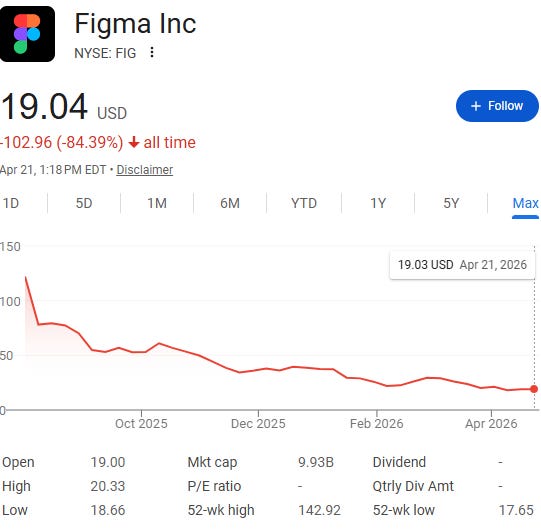
Figma (NYSE: FIG) — Max range. Source: Google Finance, April 21, 2026, 12:51 PM EDT.
Current price (Apr 21, 2026, 12:51 PM EDT)
$19.34
All-time high (Aug 1, 2025)
$142.92
Drawdown from peak
84.15%
Market cap
$10.10 B
52-week low (Apr 14, 2026)
$17.65
TTM revenue
$1.056 B
TTM gross margin
82.43%
TTM net margin
-118.44%
TTM EPS
-$3.14
Cash and short-term investments
~$1.6 B
2026 revenue guidance
$1.366 B – $1.374 B (~30% YoY)
2026 operating margin guidance
~8% (down from 12% in 2025)
Q4 2025 beat
+23.67% EPS, +3.62% revenue
Some of that is actually healthy. $1.6B in cash and low debt gives Figma multi-year runway even with the losses. The 30% guided growth rate is well above the median software company. The Q4 2025 earnings beat was real.
But the market is not pricing Figma on trailing numbers. The market is pricing Figma on the question: in 2028, when a PM can go from idea to shipped code in an agentic pipeline that does not require opening a canvas, who opens the canvas?
Six months of public trading was enough time for that question to form. The remaining VC lockup releases through mid-2026 are not going to help.
There is one more structural pressure worth calling out. Insider buying in February was $36.5 million (a director buying; stock jumped 11% on the print). Cathie Wood bought $8M in late March. Those are contrarian signals, not trend confirmations. The base case from here depends on Figma doing something different, not on the market changing its mind.
I am a CTO, not a financial advisor or a lawyer, and nothing in this article is investment advice. Do your own research and talk to a real advisor before you move money.
The pivot plan, because I actually want Figma to survive
I am not writing this to dunk on Figma. The design community is better off with a credible independent design platform than with a world where Adobe, Google, and Anthropic divide the spoils. Dylan Field is still at the wheel. The engineering team is still one of the best in SaaS. There is $1.6B in cash. There is time.
Here is what I would do if I were in the room.
1. Stop defending the canvas. Make Figma the design system of record.
Right now, Figma’s moat is the real-time collaborative canvas. That moat is draining. What cannot drain in the next three years is that every serious product team has a component library, a token catalog, and a set of production patterns that are the source of truth for what our product looks like. Figma already hosts most of those. Reposition from the place where designers work to the place where design systems live — the substrate that every AI design tool writes against.
2. Open the MCP server. Fully.
Not the current version, which is rate-limited and permission-gated in ways that throttle agentic use. Publish an MCP surface that lets Claude, Stitch, Cursor, Windsurf, and anyone else read and write Figma files, components, and tokens in real time, with delegated auth and enterprise controls. Charge by tokens consumed, not by seat. The thing Figma has that the AI labs do not have is the installed base of enterprise design systems. Monetize that access instead of gating it.
3. Ship a true agentic workflow, not a prompt-to-design toy.
Figma Make is fine. It is not the product. The product is Figma Agent — an agent that reads your product, your code, your design system, your analytics, and your user research, proposes specific UX changes with rationale tied to data, and ships the code via a Dev Mode pipeline into your GitHub repo. That is the loop Claude Design plus Claude Code is starting to own. Figma has the design data to own it better if it stops trying to be the surface and starts being the substrate plus the agent.
4. Buy an AI team. A real one.
Payload CMS was a smart acquisition for owning the data layer. It is not an AI team. The $1.6B in cash on the balance sheet can buy a serious twenty-person research team anchored by one top name. There are founders who have shipped model infrastructure and multimodal research who would take that offer. Move fast.
5. Compete on enterprise compliance, not on AI magic.
Claude Design requires enterprise admins to explicitly enable it. Stitch is a Labs product with no SLA. Figma has SOC 2, enterprise SSO, audit logs, and a decade of contracts with Fortune 500 legal and security teams. Every Fortune 500 is going to adopt AI design, and every Fortune 500 legal and security team is going to require the boring things. Lean into being the boring, trusted, compliant AI design platform. That positioning is available and nobody else wants it.
6. Radical pricing on the design system itself.
Make Figma design system hosting free for teams up to some reasonable size. Charge on AI credit consumption and on enterprise features. Flip the pricing from per designer seat to per AI generation against your system. That monetizes the shift instead of fighting it. It also makes the design system stickier the more the team uses AI, which is exactly the direction the industry is going.
7. Do the Krieger-resignation call honestly on the next earnings call.
Investors are not stupid. Field needs to stand up on the Q1 2026 call in early May and say, explicitly: the competitive landscape has changed in the last quarter, here is specifically how, and here is what we are doing about it. Not a deflection. A plan. The stock is priced for a structural disruption scenario right now. The way back is not reassurance; it is clarity about what the 2027 and 2028 Figma actually looks like.
Where that leaves us
I will keep my Figma subscription for another quarter. There are still files I have to open. There are still clients whose designers live in it. Installed base does not vanish overnight. Lotus Notes ran for twenty years after the email client war was over.
But I am not betting my workflow on Figma being the center of product design in 2028. I moved my new prototypes to Claude Design the day it launched. I am using Stitch for throwaway app-screen exploration. I am using Claude Code to ship. Figma is a stop on the handoff, not a place I start anymore.
If you run a design team, you have a decision to make in the next ninety days. Stitch and Claude Design are not previews of the future. They are the present. The question is whether you get ahead of the tooling transition or get dragged behind it.
If you are long FIG, I am not going to tell you what to do with your position — again, I am not a financial advisor, and none of this is financial advice. I will tell you what I am watching: the next two earnings calls, what Figma ships at Config 2026 (usually in June), and whether the MCP server gets a real rewrite. If those three check out, there is a turnaround thesis. If they do not, the 84% drawdown may not be the bottom.
If you work at Figma, or you know someone who does, forward this up. The pivot is available. The cash is there. The runway is there. The talent is there. What is not there, yet, is the willingness to stop defending the canvas.
The window to do it is open. It will not be open in 2027.
Gal Ratner writes about technology, architecture, and what is actually happening in the industry at galratner.com and on Substack. He is a CTO, a motorcyclist, and does not take product announcements from Figma, Anthropic, or Google at face value.