


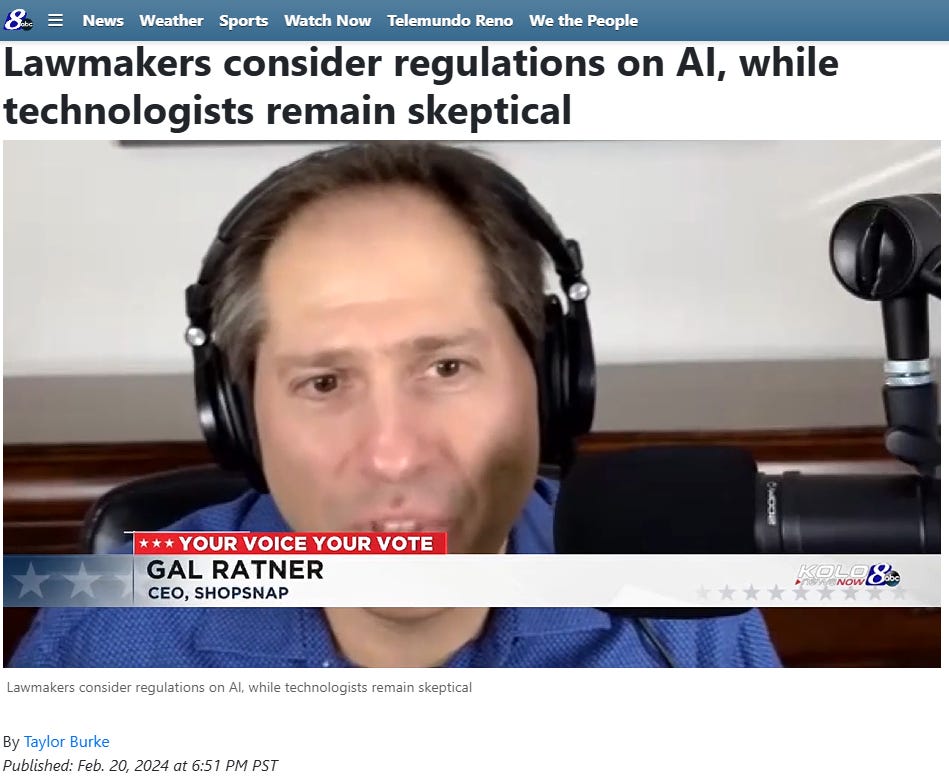
In February 2024, KOLO 8 in Reno asked me on camera what I thought about lawmakers regulating AI. My answer was the same one I’d given for twenty years on every other piece of technology: don’t. Technology moves forward, and what matters is who is running it, not what new statute Congress passes to look busy. I still believe that. I am not asking for a new regulation. I am asking the courts to enforce the laws that already exist, the same way they would enforce them against anyone else who took someone else’s property, repackaged it, and sold it back to them at a markup.

Because here is what has happened in the eighteen months since that interview aired. Anthropic agreed to pay $1.5 billion to settle a class action after a federal judge ruled it had downloaded roughly seven million pirated books from LibGen, Books3, and the Pirate Library Mirror to train Claude. The settlement covers approximately 465,000 works at $3,000 per book and is, as far as anyone can tell, the largest publicly reported copyright recovery in United States history. Bartz v. Anthropic is not an outlier. The Copyright Alliance is currently tracking more than seventy infringement lawsuits against AI companies in U.S. courts. A 2026 research paper documented that nearly every frontier language model was trained on copyrighted books obtained from pirated sources. Universal and Warner have both settled with Udio. The New York Times case against OpenAI is grinding through discovery. Getty’s case against Stability AI is still alive in two countries, in part because the AI-generated images keep coming out with corrupted Getty watermarks visible in the output, which is the legal equivalent of a burglar leaving his wallet on the kitchen counter.
None of this is a gray area. It is theft, and the companies doing it knew it was theft when they did it. The internal Anthropic emails surfaced in the Bartz litigation showed executives discussing whether to license books legally and concluding that piracy was faster and cheaper. That is not a fair use argument. That is a cost-benefit analysis.
The Open Source Problem No One in San Francisco Wants to Talk About
Books and news articles are only half the story. The other half, and the half that matters most to anyone who writes code for a living, is what happened to open source. Every frontier coding model on the market today, Claude, GPT, Gemini, Copilot, Codex, was trained on billions of lines of source code scraped from public repositories on GitHub and elsewhere. That code did not come without strings attached. It came with licenses. MIT. Apache 2.0. GPL. AGPL. BSD. Eleven popular open-source licenses, all of which require, at minimum, attribution of the original author, preservation of the copyright notice, and inclusion of the license text when the code is reused or redistributed.
The Doe v. GitHub class action, filed by Matthew Butterick and the Joseph Saveri firm in late 2022 and still grinding through the Northern District of California, alleges exactly this. The plaintiffs are not asking for the moon. They are asking the court to recognize that an open-source license is a contract, and that if you train a commercial model on GPL’d code and then ship that model without attribution, copyright notice, or license preservation, you have breached the contract. The court has already let the breach-of-contract and DMCA Section 1202 claims survive a motion to dismiss. Section 1202 is the part of the DMCA that forbids the removal of copyright management information, and stripping author names and license headers during training is, in plain English, the removal of copyright management information at an industrial scale.
This is the legal lever. Open source is not public domain. It never was. The deal has always been: take this code, build with it, ship it, just give credit and pass the license forward. Every developer who ever published a repository under GPL or Apache or MIT did so on that condition. The AI labs cashed the check and skipped the conditions. The proper remedy in contract law when you have taken something under a license whose terms you refused to follow is straightforward: you give it back, or you comply with the terms. In the case of a derivative work trained on copyleft code, complying with the terms means publishing the derivative under a compatible license. In the case of a model trained on GPL-licensed code, that means open weights. The viral provisions of GPL exist precisely so that no one can take from the commons and close the door behind them.
The courts already have everything they need. They do not need Congress to pass an AI bill. They need to apply the same principles to weights that they would apply to any other compiled derivative of licensed source. If you trained Codex on GPL’d code without attribution and now sell it as a closed API, you are violating the license. The remedy is to comply, and compliance means opening the weights.
“But Humans Learn From Code Too”
Whenever I make this argument in public, someone, almost always someone selling AI for a living, fires back with the same comeback. A human reads open-source code, learns to program from it, and goes on to write a closed-source product for a living. That is legal. So why should an AI be held to a different standard? The answer is that the analogy is wrong at the level of physics, not just at the level of law.
A human who learns from a GPL’d repository forms abstractions. He internalizes concepts, idioms, design principles, mental models of how concurrency works or why a particular data structure beats another for a given access pattern. When he sits down two years later to write his own product, he is not regurgitating a buffer. He is applying transferred understanding. The proof that this is what is happening is that he can answer questions about why his design choices are correct, defend them to a reviewer, and modify them in response to constraints that did not exist in the original training material. If he ever did paste a hundred lines of someone else’s GPL’d code verbatim into his commercial product, the law would treat him exactly the way it should treat a non-compliant model. The question has never been whether learning is allowed. The question is what the output actually is and how it got there.
A large language model does not learn the way that human learns. Mechanically, an LLM is a statistical compression of its training corpus. The weights are a high-dimensional encoding of token-level patterns extracted from the data. At inference time, the model performs a stochastic decompression of those patterns conditioned on the prompt. With a sufficiently specific prompt, the decompression returns the original near-verbatim. This is not a theoretical complaint from a copyright maximalist. A peer-reviewed paper published earlier this year demonstrated that frontier models can be coaxed into outputting near-verbatim copies of copyrighted books from their training set, including titles from the same shadow libraries that Bartz hinged on. Stable Diffusion’s outputs sometimes contain corrupted versions of the Getty watermark, which is what happens when a model marketed as transformative has not transformed anything at all and is, in that moment, performing lossy retrieval. The safety filters the labs cite as a defense are, as the IBTimes coverage of that paper put it, paper-thin.
This is the point the labs’ lawyers do not want explained to a jury in plain English. An LLM is closer to a very sophisticated copy-paste machine than to a person who read your blog and got inspired. It does not abstract. It compresses. It does not generalize across concepts the way a human does. It generalizes across token sequences. And anything it has compressed, it can decompress, given the right prompt. The right prompt being whatever sequence happens to activate the region of the latent space where your code is encoded.
Once you internalize the mechanics, the legal analysis falls out cleanly. The “I just learned from it” defense applies to a human who internalized concepts and produced original work. It does not apply to a system whose entire architecture is, at its core, retrieval over a compressed corpus. Every token an LLM emits is a probabilistic sample over a distribution shaped by its training data. When that training data was licensed under terms requiring attribution and license preservation, those terms attach to the weights, and through the weights, to every output sampled from them. The fact that an emission may happen to look novel, because the prompt happened to sample from a region of the distribution that is not directly traceable to a single source file, does not cleanse the underlying derivative. The weights are the derivative work. The license travels with them. The output is, at best, a lossy quotation of the input, and lossy quotations do not enjoy a special exemption from the license you ignored on the way in.
The China Race Is the Single Biggest Lie in Washington
Every time the frontier labs walk into a Senate hearing, they bring the same prop with them. China. Sam Altman, Brad Smith from Microsoft, Lisa Su from AMD, every one of them sat in front of Ted Cruz’s committee in 2025 and warned that any meaningful regulation would hand the AI race to Beijing. Ted Cruz dutifully repeated it back. The press dutifully repeated it after that. And it is, top to bottom, a lie.
China is not racing the United States for closed-source AI supremacy. China is giving its frontier models away. Alibaba’s Qwen family has been the most-downloaded model series on Hugging Face for two years running and has now passed Meta’s Llama in cumulative downloads. DeepSeek’s V4 Pro currently scores 87 on BenchLM’s leaderboard against GPT-5.4 at 88, at roughly one-twentieth the cost. Moonshot AI’s Kimi K2.6 became the first open-weight model to beat GPT-5.4 on SWE-Bench Pro, the industry’s hardest software engineering benchmark, and it shipped under permissive weights with a terminal coding agent comparable to Claude Code. Zhipu’s GLM-5 was trained entirely on Huawei Ascend silicon without a single Nvidia chip, scored 77.8 percent on SWE-bench Verified, and is open weight. The most-followed organization on Hugging Face is DeepSeek. The fourth-most-followed is Qwen. Chinese labs occupy four of the top five positions on the open-weight leaderboard.
You cannot lose a race to an opponent who has handed you a copy of their playbook, their training recipe, their weights, and the inference engine to run them on. The race that Altman and Smith warned Cruz about is a fiction designed to extract subsidies, export controls favorable to incumbents, and a federal preemption shield against state and copyright liability. China is not racing. China is publishing. And every week another American developer chooses Qwen or DeepSeek over a closed American model because the Chinese model is faster, cheaper, can be run on his own hardware, and does not require him to ship his proprietary code to a third-party API endpoint that may or may not retain it for training.
If there is a national security argument here, it cuts the other way. The country that depends on open weights its developers can audit, modify, and run on sovereign infrastructure has the more resilient stack. The country whose entire AI economy is gated behind four hyperscaler APIs has a single point of failure. Closed weights are not a strategic asset. They are a strategic liability dressed up as a moat.
The Data Center Tax Heist
Now connect this to your own city council. Every state in the country, with maybe four exceptions, has rolled out the red carpet for hyperscale data centers in the form of sales tax exemptions, property tax abatements, and infrastructure subsidies. The math on these deals is publicly catastrophic where anyone has bothered to publish it. A single Microsoft data center in Illinois pulled in $38 million in sales tax exemptions and created twenty permanent jobs. Microsoft’s data centers in Washington took $333 million in sales tax exemptions between 2015 and 2023. Virginia, which now hosts more than six hundred data centers and calls itself the data center capital of the world, is losing close to $2 billion a year in tax revenue to the abatements. In the PJM grid region serving sixty-five million people across thirteen states, power supply costs jumped from $2.2 billion to $14.7 billion in a single year, and the data center load is the reason.
Read that sentence again. Your county is forgoing tens of millions in tax revenue, your electric bill is going up, your water table is being drained, to build a facility whose explicit purpose, according to the people who run it, is to replace your neighbors’ jobs. Entry-level postings in the United States are down thirty-five percent since 2023. Senator Mark Warner of Virginia, of all people, has started talking publicly about taking a pound of flesh from the data centers to fund worker transition programs after a venture capitalist told him he is writing down software investments to zero because of Claude, and a major law firm told him it is no longer hiring first-year associates because Claude can do the work.
This is the deal local governments are signing. Subsidize the construction. Eat the rate hikes. Watch your long-term taxpayers, the white-collar workers who anchor your school district and your property tax base, get laid off by the very thing you subsidized. And when the next Compass Datacenters walks away from a 2,100-acre, 37-building corridor, as Compass just did in Prince William County, you are left with the transmission infrastructure and none of the tenants. Phoenix, Hillsboro, Northern Virginia, and Maine are already revolting. The polling is unambiguous. Seventy-one percent of Americans now say AI is moving too quickly. Sixty-three percent of American workers believe AI will decrease overall job availability. Sixty-four percent doubt the benefits will be widely shared. Only eight percent think it is very likely that everyone will benefit. The Milken-Harris poll out this week shows eighty percent of Americans want a federal workforce transition program. Washington has not delivered one. The public is watching.
Energy Is a Separate Question, and Nuclear Is the Right Answer to It
I want to draw a line under something that the AI labs love to blur. We do need more energy. We need a lot more of it, and we need it clean, and the only clean source that can scale to the load we are about to put on the grid is nuclear. Modular reactors, advanced light water designs, eventually fusion. The fact that I support more nuclear has absolutely nothing to do with whether the data centers consuming that energy should run closed-source frontier models. Those are two separate policy questions, and the AI industry deliberately welds them together so that anyone who criticizes closed weights gets accused of being anti-energy or anti-progress.
Build the reactors. Modernize the grid. And then notice that consumer hardware has been quietly catching up to what closed-source frontier APIs can do. A Mac Studio with 128 gigabytes of unified memory will run a seventy-billion-parameter model today at usable speed. A single RTX 4090 runs Qwen 3 30B-A3B or DeepSeek R1 32B at four-bit quantization and gets you within two or three percent of cloud frontier quality. Apple Silicon’s unified memory and the maturing ROCm and Vulkan stacks mean you are no longer locked into CUDA, and you are no longer locked into a hyperscaler. The hardware curve and the model curve are converging in a way that should make every honest observer ask the obvious question: if a developer can run frontier-class inference on a workstation under his desk, what exactly is the public-policy justification for a $500 billion data center buildout dedicated to keeping the same model behind a paywall?
What the Courts Should Order
Here is the legal posture I want to see, and it is conservative, not radical, because it asks the courts to enforce settled contract and copyright doctrine rather than invent new doctrine. First: where a frontier model has been trained on copyrighted works obtained from pirated sources, the courts should treat the resulting weights as proceeds of infringement and order disgorgement. Bartz already moved in this direction. Future cases should follow. Second: where a model has been trained on code released under open-source licenses requiring attribution and license preservation, the courts should treat the weights as a derivative work and require compliance with the license, which for copyleft licenses means publishing under a compatible open license. Third: where a model has been trained on a mixture of legitimately licensed data and pirated data, the burden should fall on the lab to prove the provenance, not on the plaintiff to prove the negative.
This is not a regulatory regime. It is the same contract law and copyright law that has applied to every other piece of software for forty years. The AI industry’s position is that the rules that applied to every previous generation of software should not apply to it because the stakes are too high. That argument is not law. It is lobbying.
On Tools, and What I Actually Use
I want to be precise about one thing because I do not want this misread. I use Claude Code every day. It is, with Codex, the best agentic coding platform on the market. I have built production systems with both. The agentic platform layer, the harness, the file editor, the planner, the tool-use machinery, all of that is real engineering and the companies that built it deserve to charge for it. Keep the harness closed. That is a product. What I am calling for is the opening of the underlying model weights, because the weights are the part that was built on the commons. You can sell the agent. You cannot sell my code back to me wrapped in a closed binary you trained on it without attribution.
Anyone who builds with frontier models for a living already knows that the open-weight ecosystem is good enough for the vast majority of production workloads. Qwen, DeepSeek, GLM, Kimi, and the better Llama derivatives cover code generation, reasoning, RAG, long-context document processing, and most agent workflows at a small fraction of cloud API spend. The closed frontier labs hold a real but shrinking edge on the hardest reasoning tasks and on certain agentic capabilities. That edge is worth paying for at the application layer. It is not worth handing them a federal preemption shield, a permanent data center subsidy regime, and a green light to launder copyrighted training data through closed weights.
The Message to Anyone Reading This
Corporate America is not entitled to weaponize a technology built on your code, your books, your articles, and your stack overflow answers against your own job. The people selling this technology have been very clear in their own marketing about what it is for. Read the deck. The pitch to investors is workforce replacement. The pitch to Congress is a national security race that does not exist. The pitch to your county commissioner is jobs that will not be there in five years. The pitch to you is a chatbot.
If you are a developer reading this and you have ever published code under MIT, Apache, GPL, BSD, or any of the other licenses in that Saveri appendix, you are a class member in a case that will define what the open-source commons means for the next thirty years. If you are a writer, you are watching Bartz get extended to your work. If you are a county commissioner reading this, you should be asking the data center developer in front of you exactly how many of your constituents’ jobs depend on the white-collar work this facility exists to automate, and whether the tax abatement you are about to vote on accounts for the property tax base you are about to lose. If you are a senator reading this, the China argument is a lie. The leading open-weight models on every benchmark that matters are Chinese, and they were given away for free. There is no race to lose. There is a public to protect.
Enforce the licenses. Enforce the copyrights. Let the agentic platforms compete on the harness, the tooling, the integrations, and the developer experience. And let the weights, the part of the system that was built from our commons, return to the commons. That is not regulation. That is the rule of law, applied evenly, to an industry that has spent three years arguing it should be exempt from it.
I have not changed my mind about regulation. I have changed my mind about pretending that the largest theft of intellectual property in American history is something we should let go because the people who did it told Congress they were doing it for our own good.
Original interview: https://www.kolotv.com/2024/02/21/lawmakers-consider-regulations-ai-while-technologists-remain-skeptical/