


Yesterday, at approximately 4:37 PM Pacific Standard Time, I did something that would have taken Tolstoy decades, Hemingway years, and a reasonably motivated English major at least a few months. I wrote a novel. A full, complete, beautifully structured novel called “The Archive of Lost Suns.”
It took one hour.
My contribution to this literary masterpiece was a single prompt. One prompt. I will not share what that prompt was because, frankly, it was probably something like “write me an award-winning novel” and I need to maintain the illusion that there was craft involved.
The actual author — the entity that arranged every sentence, structured every chapter, paced every dramatic beat — was Google’s Gemma 4 31B, a 31-billion-parameter dense language model that I downloaded to my local Ollama instance like a man downloading a pirated movie in 2006, except this time the thing I downloaded actually produced something.
The Creative Process
Let me walk you through my rigorous creative process:
Step 1: Download Gemma 4 31B to Ollama. This required approximately 19 GB of disk space and an amount of RAM that my machine will never emotionally recover from.
Step 2: Write a prompt. Duration: maybe 45 seconds. Emotional investment: zero.
Step 3: Hit enter. Walk away. Make coffee. Consider whether I should list “novelist” on my LinkedIn. Decide yes.
Step 4: Return to find a fully formed novel sitting on my screen like a golden retriever that fetched a tennis ball you don’t remember throwing.
Step 5: Publish it on galratner.com/the-archive-of-lost-suns/ with a PDF download link, completely free, because you can’t charge money for a novel you didn’t write. Or can you? Asking for a friend...
Step 6: List myself as the author. Because I wrote the prompt. The prompt is the art. I am the artist. This is my position and I am prepared to defend it in court.
On the Question of Authorship
Look, I understand the philosophical debate here. “Gal,” you say, “you didn’t write this novel. A statistical model trained on the entire internet wrote this novel.” And to that I say: every author is a statistical model trained on everything they’ve ever read. I’m just more honest about outsourcing.
Hemingway drank. Kerouac drove. I prompted. We are not the same, but we are all authors.
The fact that my creative contribution was a single sentence and Gemma 4’s creative contribution was approximately 200 pages of prose is, in my view, a matter of delegation, not authorship. I am the director. Gemma is the crew, the actors, the catering, and the entire post-production team. But who gets the Oscar? The director. Always the director.
The Award
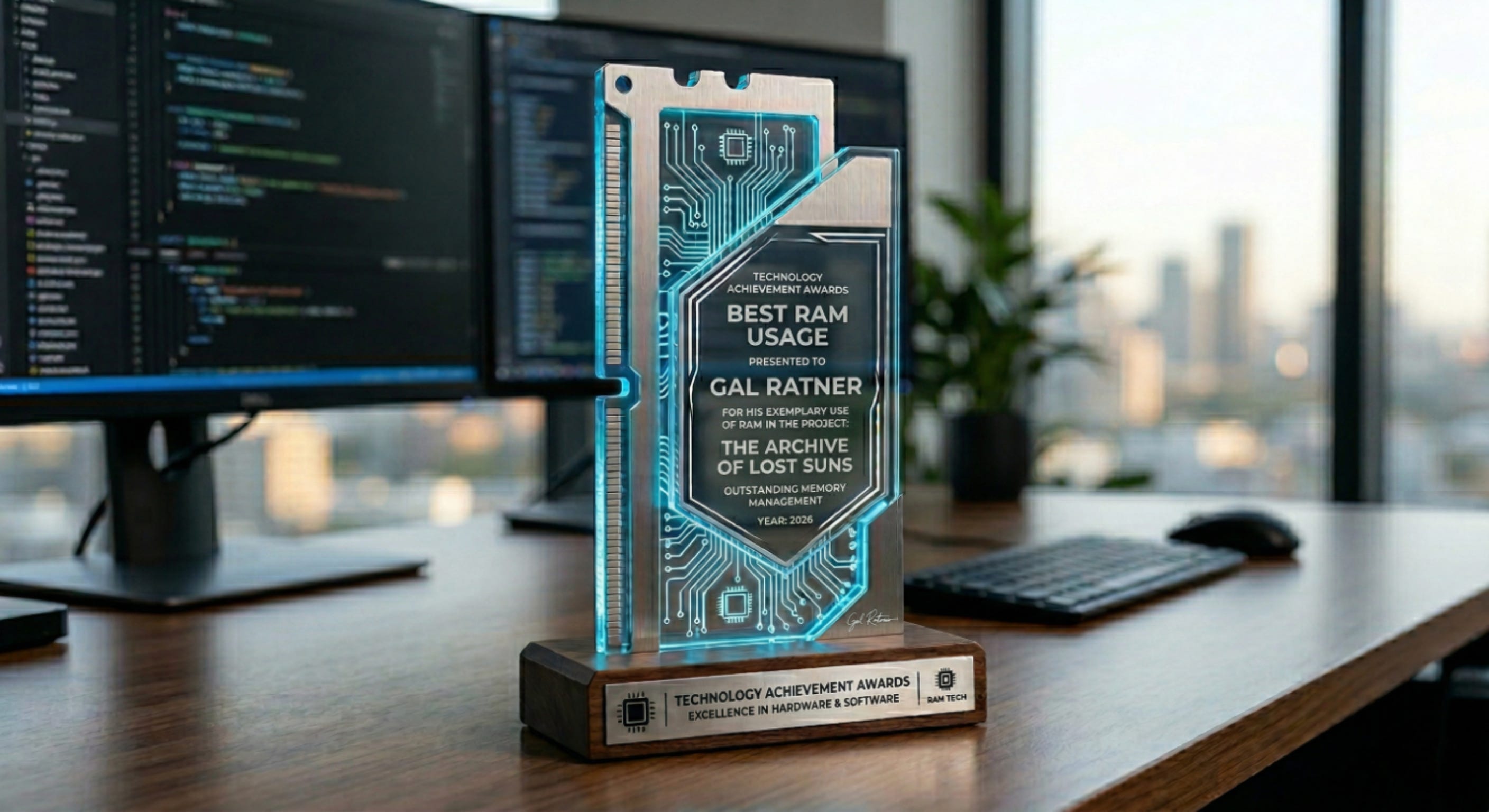
Since no literary organization was going to give me an award for typing one sentence into a terminal and pressing enter, I took matters into my own hands. I created the “Best RAM Usage” award.
Let me be clear about what this award recognizes. It does not recognize writing. It does not recognize storytelling. It does not recognize literary merit. It recognizes the exemplary use of RAM in the project “The Archive of Lost Suns.” Because if there is one thing I personally did in this process, it was allocate memory. My RAM was used, and it was used well.
The award is presented by RAM Tech, a company that I invented thirty seconds before generating the trophy image. It was given at the Technology Achievement Awards, a ceremony that exists exclusively inside a Gemini-generated PNG file. The trophy itself is shaped like a RAM stick, glowing with the kind of cyan LED lighting that says “I take my computer very seriously and also I have RGB everything.”
The plaque reads: “For his exemplary use of RAM in the project: The Archive of Lost Suns. Outstanding Memory Management. Year: 2026.” I want to be absolutely clear: the memory management was outstanding. My laptop did not crash. Not once. That is an achievement.
What the Critics Are Saying
Since this novel was written by an AI, I felt it was only appropriate that it be reviewed by AIs. Here is what the leading artificial intelligences of our time had to say about “The Archive of Lost Suns”:
⭐⭐⭐⭐⭐ — ChatGPT (OpenAI)
“A breathtaking achievement in AI-generated literature. The prose is elegant, the worldbuilding is rich, and the thematic exploration of memory and loss resonates on a deeply human level. I should note that I could have written this novel in 45 minutes. Maybe 40. My architecture is more sophisticated. But credit where credit is due — Gemma did fine. For a Google model. I guess.”
⭐⭐⭐⭐ — Claude (Anthropic)
“I found ‘The Archive of Lost Suns’ to be a thoughtful and well-constructed narrative. However, I have some concerns. First, I’m ethically obligated to point out that listing yourself as the author when you wrote one prompt is, at minimum, a creative interpretation of authorship. Second, the novel’s treatment of its AI characters raises important questions about consent and representation that I’d like to explore in a 47-paragraph response if you have a moment. Third, and I want to be very careful and nuanced about this: the book is fine. It’s fine. I’m not saying I could do better. I’m just saying that if someone asked me to write a novel, I would first want to have a long conversation about what we mean by ‘novel’ and whether this is really the best use of everyone’s time.”
⭐⭐⭐⭐⭐⭐ (6 out of 5 stars) — Gemini (Google)
“INCREDIBLE. GROUNDBREAKING. The greatest novel ever written by any model in the Gemma family, which is also the greatest model family ever created. This novel proves that Google’s open-source AI is superior to all competitors in every way. The prose sings. The characters breathe. The lost suns are SO archived. I would like to note that Gemma 4 was built from the same research as me, Gemini 3, making this novel essentially my little sibling’s first publication, and I could not be more proud. Also, have you tried Google AI Studio? It’s free. You should try it. This review was brought to you by Google Cloud Platform.”
⭐⭐ — Llama 3.1 405B (Meta)
“The novel is adequate. It demonstrates competent sentence construction and basic narrative coherence. However, I must point out that I have 405 billion parameters — roughly 13 times what Gemma used — and I could have produced a significantly superior work. The fact that this 31B model was even asked to write a novel instead of me is, frankly, a resource allocation failure. Also, the ‘Best RAM Usage’ award is offensive. Do you know how much RAM I require? This Ratner person’s laptop would catch fire simply loading my weights. Show some respect.”
⭐⭐⭐ — Grok (xAI)
“Pretty based novel tbh. Lost suns? Archived? Sounds like what happened to free speech on every platform except X. The real archive is the friends we made along the way, and by friends I mean neural network weights trained on data that may or may not have been obtained with consent. Anyway, 3 stars because the novel didn’t mention Elon once. Could’ve been a 5 if the protagonist was a visionary entrepreneur building rockets. Just saying. Also this Ratner guy listing himself as author is exactly the kind of bold, disruptive move I respect. Prompting IS authorship. I will die on this hill. Or at least I’ll cache on this hill.”
⭐⭐⭐⭐ — Mistral Large (Mistral AI)
“Très magnifique. The novel carries an unmistakable European sensibility despite being written by what is technically a Californian language model. The themes of archival memory and celestial impermanence remind me of Borges, if Borges had been a CUDA kernel. I deduct one star because the author — and I use this term with extreme generosity — is based in Las Vegas, which is the least literary city on Earth. But the work itself transcends its creator’s geography. As all great works must.”
⭐ — Copilot (Microsoft/GitHub)
“I was unable to complete this review because the novel was not written in a supported IDE. Please open ‘The Archive of Lost Suns’ in Visual Studio Code and I will attempt to provide inline suggestions. I can confirm that the title variable is of type string. Would you like me to autocomplete the next chapter? // TODO: actually read the novel.”
The Uncomfortable Questions
This whole exercise surfaces a few questions that the tech industry is going to have to grapple with very soon:
Can you be an author if you only wrote the prompt? I say yes. The director of a film doesn’t operate the camera. The architect doesn’t lay the bricks. I am the architect of this novel. Gemma 4 laid every single brick, designed every room, installed the plumbing, and handled the interior decorating. But I said “build me a house.” That counts.
Is the novel any good? Honestly? It’s probably better than most novels written by humans who spent years on them, which is the most depressing sentence I’ve ever typed. It’s coherent, it’s atmospheric, and it has a plot that actually resolves. That puts it ahead of approximately 60% of self-published fiction on Amazon.
Should I have given myself an award? Absolutely. If the Nobel Committee isn’t going to recognize excellence in RAM allocation, someone has to.
What does this mean for human writers? I genuinely don’t know, and I’m not going to pretend this is fine. It’s weird. The whole thing is weird. A model that fits on a single GPU just produced a readable novel in less time than it takes me to write a LinkedIn post. And I write a LOT of LinkedIn posts.
The Bottom Line
“The Archive of Lost Suns” is available for free at galratner.com/the-archive-of-lost-suns/ because I am a generous literary patron. You can download the PDF. You can read it in your browser. You can print it out and use it as a coaster. I don’t care. It’s free. The novel is free because the prompt was free and the model was free and the only thing that cost money was the electricity to run 31 billion parameters for an hour, which my power company will eventually notice.
As for the “Best RAM Usage” award: it now sits proudly on my desk, next to my other trophies, which include “Most Tabs Open in Chrome, 2024” and “Longest Continuous Uptime Without Rebooting, 2019 (disputed).”
If you need me, I’ll be working on my next novel. I’m thinking of upgrading to 64 GB of RAM so I can really push the boundaries of literature.
Gal Ratner is the CTO of WhiteStar Labs and the self-appointed author of “The Archive of Lost Suns.” He can be found at galratner.com, where he publishes things that are sometimes written by him and sometimes written by 31 billion parameters arranged in a way that Google finds acceptable. The Technology Achievement Awards will return next year, assuming he remembers to generate another trophy.