


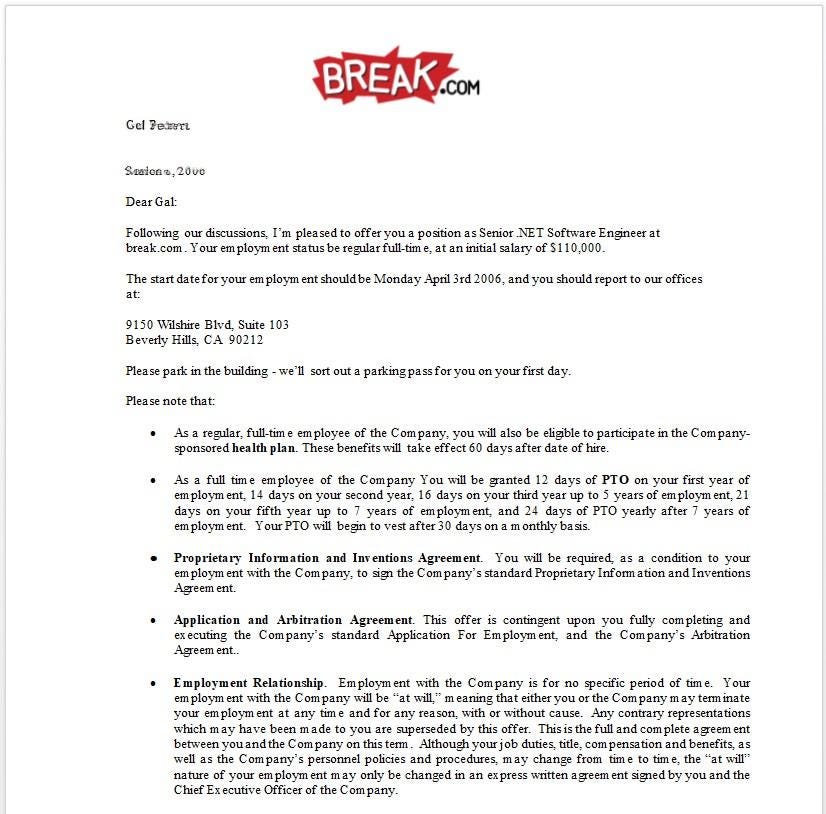
In March 2006 I drove to 9150 Wilshire Boulevard, Suite 103, Beverly Hills, and signed an offer letter to be the sixth employee at a company called Break.com. The title was Senior .NET Software Engineer. The salary was $110,000. The start date was Monday, April 3rd. The company was, at that point, ranked around #256 on the Alexa toolbar and pushing more than 100 million pageviews a day.
That sentence still doesn’t quite parse, almost twenty years later. Six employees. A hundred million pageviews. Every day.
We were the long tail of the dot-com aftermath — the post-Janet-Jackson, pre-iPhone moment when broadband had finally caught up to appetite, and a generation of young men with cable modems decided they wanted to watch one more guy get hit in the groin with a skateboard before going back to work. Break.com served them at a scale that nobody in the building could quite believe was real.
The site had been bought a couple of years earlier by Keith Richman and a partner the rest of us privately called the silent half of the deal — Christian, who put up money and stayed mostly out of the way. Together they had picked up Big-Boys.com, a humor-and-stunts site doing something like sixty thousand uniques a day, with an obsessively male audience and a domain name that wasn’t going to age into a respectable advertiser meeting. They did what any sane operator would: rebranded, rebuilt, rolled it forward. By the time I joined, the rebrand to Break.com had taken hold, the audience had multiplied many times over, and the technology was being held together by ten fingers, three Red Bulls, and a CTO who was too smart for the job he had.
That CTO went on to become CTO of WME. Most of the rest of us went on to start our own companies. That should tell you most of what you need to know about why Break.com isn’t here anymore.
The Engineering Was Cutting-Edge. Because It Had To Be.
There was no AWS S3 we could just point at and pay. There was no CDN-as-a-service in any modern sense. The video player wasn’t on YouTube — we were building it. When 100 million pageviews a day hit your stack on a 2006-vintage data center, you don’t get to read a blog post about how Reddit handled it. You wake up at 3 a.m. and figure it out yourself.
We sharded SQL before sharding was a verb. We wrote our own caching layers because Memcached was the new hotness and not yet boring. We argued about whether Flash video was a moat or a death trap. (It was a death trap. We just didn’t know yet.) The team had real talent on tap — Chris Henyard, Kam Bhagia, Bob Walton, and a half-dozen others who could each have anchored a senior team somewhere else. Engineers solving genuinely novel problems with genuinely novel constraints, on a P&L that demanded the platform pay for itself this quarter, not next decade.
I don’t want to overstate it. We weren’t doing anything Google wasn’t doing better. But we were doing it with sixty engineers instead of six thousand, and we were shipping every week.
Lionsgate Money, Editorial Brain
Then came the validation. Lionsgate took a stake. We closed a $21.4 million funding round in 2007. Suddenly the building had nicer chairs, the marketing team got real budget, and we had the kind of money that should have funded a real platform pivot.
We didn’t pivot.
This is the part that still bothers me, almost two decades on. Break.com had a curated, editorial model: users uploaded videos, an editorial team picked maybe eight to ten a day, and those got paid for and put on the homepage. The rest sat in a queue and quietly died. It was Reader’s Digest with a frat-house art direction. It worked beautifully — until it didn’t.
YouTube’s model was: upload, publish, let the audience decide. Facebook’s model, a couple of years later, was: upload, publish, and we’ll make the audience for you. Both of those are platforms. Break.com was a magazine.
A magazine with 100 million daily pageviews is a real business — until the platforms eat the audience the magazine depends on. And once that begins, it does not stop.
Keith Richman Saw Everything. He Believed Almost None of It.
I don’t say this lightly, because Keith Richman is a smart man and a successful operator both before and after Break. He came out of OnePage (sold to Sybase) and Billpoint (sold to eBay), and he went on after Break to co-found Boosted Commerce and sit on the boards of GrubHub and others. The man can build companies.
But the CEO’s job at Break.com, between 2007 and 2013, was to look at YouTube and Facebook and ask: are we a content brand or are we a platform? And if we’re a content brand, do we have the leverage to survive in a world where the platforms own distribution, recommendation, and creator economics?
Keith chose: content brand. He doubled down on the editorial model. He invested in original programming. He partnered with Showtime on Weeds tie-ins, with NBCU on a show called Breakers, with brand advertisers on integrated campaigns. All of it was professional, all of it was on-brand, and all of it was building a moat in the wrong place.
Meanwhile, the platforms were building the moat that mattered: distribution, algorithmic feed, and a creator economy that paid out at scale. By 2010, the writing was on the wall. By 2013, there was no second prize.
The Defy Merger Was an Exit, Not a Strategy
In October 2013, Break Media merged with Alloy Digital to form Defy Media. The press release called it a “merger of equals.” Matt Diamond from Alloy became CEO. Keith stepped to President. Lionsgate stayed on the cap table. The combined company was projected to do over $100 million in revenue and reach more than 50 million monthly uniques.
In a 2013 interview, Keith said the merger was about “scale for advertising partners” — exactly the thing the platforms were already eating alive. The merger didn’t fix the strategic problem; it bundled two companies with the same strategic problem and sold the bundle as a solution. Wellington Management led a $70 million round in 2016, which bought the new entity another two years.
Then the bundle exploded.
November 6, 2018
Defy Media ceased operations on November 6, 2018. Its assets were frozen by creditors within twenty-four hours. The official statement blamed “market conditions.” Former employees blamed financial mismanagement, an over-reliance on platforms the company never owned, and an aggressive expansion strategy that had stretched a thinning revenue base across too many bets.
It got uglier. Smosh’s Anthony Padilla said publicly that he had no idea where the money had gone, but he knew it wasn’t going to creators or to most of the employees. MatPat — Matthew Patrick, the company’s former head of audience development — accused Defy of running what amounted to a Ponzi scheme, claiming the company had taken $1.7 million from him and other YouTubers and used creator money to look attractive to outside investors. Lawsuits piled up: Shandy Media, Viewall Investments, Topix for $300K, Chive Media for $35K. Creators waited in line for money that wasn’t coming.
The company that had been built on the backs of user-generated video — that had paid amateurs a few hundred bucks a clip in 2006 — ended its life owing money to the next generation of creators it claimed to be empowering. There is poetry in that, and not the kind anybody wanted.
What If
Here is the counterfactual I think about most often.
Break.com had a male 18-34 audience that, at peak, was the envy of every advertiser in Los Angeles. It had video infrastructure built before video infrastructure was easy. It had editorial taste, brand recognition, and a domain name you could shout across a bar.
In 2010, when Instagram launched, that audience was still there. In 2013, when Vine launched, it was still there. In 2014–2016, when Musical.ly was finding its footing in what would become TikTok, much of it was still there. The pivot to short-form, algorithmically-distributed video — the move from magazine to platform — was sitting on the table, year after year, waiting for someone at the top to pick it up.
Nobody picked it up.
I’m not claiming this would have been easy. Pivoting a curated, editorial business into an algorithmic platform is among the hardest moves in tech. Yahoo couldn’t do it. AOL couldn’t do it. Most of the time it doesn’t work. But Break.com had what almost none of the eventual platform winners had at their start: an audience already there, a brand already known, and a balance sheet that — for a window — could have funded the bet.
What it didn’t have was a CEO willing to make it.
The Diaspora
Here is the strange, quiet legacy of Break.com. The CTO who hired me went on to be CTO of WME. Engineers from that team are now founders, principal architects, and CTOs at name-brand companies. I went on to build several of my own — Inverted Software, WhiteStar Labs, ShopSnap, Prana Entertainment. The talent was real. The talent compounded somewhere else.
This is what failed leadership leaves behind: not nothing, but a diaspora. Fifty engineers and product people and editors who were good enough to keep a 100-million-pageview operation running with a skeleton crew, scattered to the four winds, each carrying the same lesson — that the audience you’re given is not the audience you’re owed.
Lunches at Fogo
Kam Bhagia and I used to walk over to Fogo de Chão on Beverly Drive. This was when Fogo had first opened in Beverly Hills, when the gauchos still had something to prove, and a long lunch with skewered picanha and a glass of red was the closest thing the engineering team had to a board meeting.
We’d talk about the architecture. We’d talk about the traffic. We’d talk about whether the Flash player was going to outlive Flash, and what we’d do if it didn’t. We’d watch the suits at the next table — agents and producers and managers from Endeavor and CAA — and laugh about the fact that the table next to us was probably building a worse business than the one we were running.
We were right about that, and wrong about almost everything else.
The salad bar at Fogo is still better than most full restaurants. Kam — if you’re reading this, the first round is on me.
The Lesson
The lesson of Break.com is not that the leadership was bad. Keith Richman is not a bad operator. The lesson is that good operators in changing markets, who refuse to bet the company on the new model while the old one is still profitable, will eventually find themselves running a company that is neither the old thing nor the new thing — just a thing waiting to be sold to creditors.
Break.com had every advantage that Vine, Musical.ly, and TikTok eventually built from scratch: audience, brand, infrastructure, creator pipeline, advertiser relationships. It squandered all of them by treating its own audience as a content distribution problem instead of a network-effects opportunity.
I think about it every time I see a CEO confidently describe a pivot they aren’t actually making. And I think about it every time I sign an offer letter from a company whose strategy I’m not sure I believe.
There were more than enough good people at Break.com to build something that lasted. There just weren’t enough people at the top willing to bet on them.
— Gal Ratner