


In 2002 I sent away for a free audio CD from a man nobody had heard of. Perry Marshall had left Synergetic Micro Systems the year before, when Lantronix bought it, and he was working out of an address on Ridgeland Avenue with a fax number printed on the letterhead. No Google book. No 80/20. No Facebook book. He had an electrical engineering degree from Nebraska, a story about being fired from five jobs, and a claim I have never seen another marketer put in writing. A while later the same disc cost five dollars. Today he sells it as a download and tells you it comes to less than a movie ticket.
The claim was about expiration dates. Marshall opens the material by separating a technique from a principle. A technique is a trick that works in one specific situation. A principle holds across every company and every circumstance. He says the twenty-one ideas on the disc are the second kind, and that they will be as true twenty years out as they were the day he recorded them. Businesses fail, he argues, because they keep reaching for the first category when they need the second.
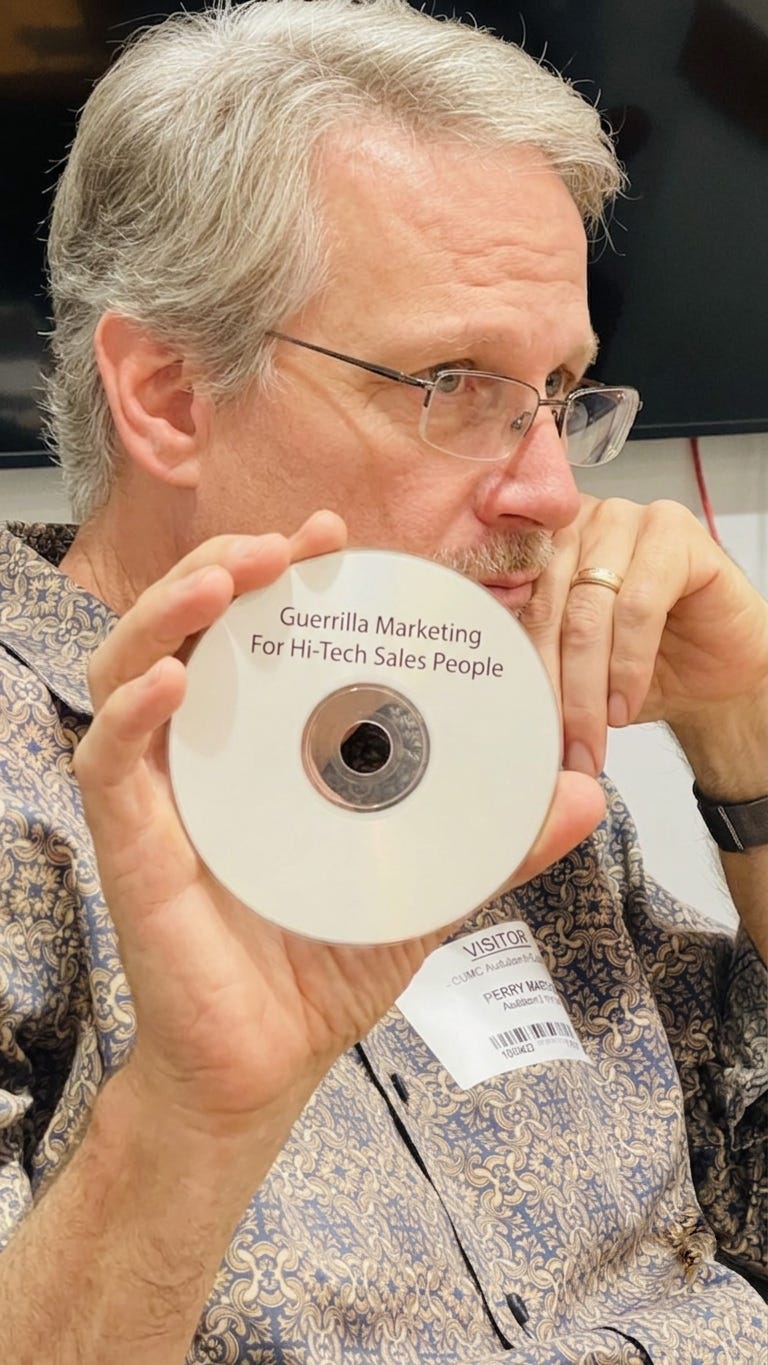
That is a testable statement with a clock attached to it. The clock ran out in 2022. I am writing this in 2026, four years past the warranty, and the discipline he described has been rebuilt twice since he pressed the disc, once by search and once by whatever we are calling the current thing.
So let’s grade it.
What was actually on the disc
Twenty-one numbered ideas, in roughly six clusters.
On positioning: cold calling is obsolete technology, a prospect who finds you is worth about double one you found, a real marketing system delivers predictable lead flow so salespeople only meet people who already understand the offer, and you hold maximum leverage only when deal flow exceeds capacity, because whoever has more options sets the terms.
On message: your marketing must answer why someone should read you, believe you, act at all, and act now, and that answer is your unique selling position, reinforced on every single contact. Concrete promises and specific calls to action rather than slogans. A conversational voice aimed at trust rather than impressiveness, since trying to impress raises the customer’s guard.
On marketing as engineering: it is far more systematic and formulaic than creative, advertising is selling in print, and you have to know your numbers, meaning what a customer is worth, what you can afford to pay to acquire one, and the return on every line in the mix.
On credibility: what other people say about you outperforms what you say about yourself, people are cynical and will believe only what you can prove, and you raise your standing enormously by authoring, speaking and publishing, appointing yourself the expert rather than waiting to be anointed.
On psychology: buying decisions are emotional and logic shows up afterward to justify them, you capture attention by entering the conversation already running inside the prospect’s head, and you earn trust by talking the way the subculture talks to itself.
On assets: the customer database outranks the product, existing customers cost less than new ones, and you repackage until an apples-to-apples comparison becomes impossible, because living by lowest price means dying by it.
Then the capstone, number twenty-one. Lead with information about solving the problem rather than information about the product. Nobody who bought a drill wanted a drill.
Where AI turned the volume up
Start with twelve and thirteen, because they read now like a man describing a technology that would not exist for another twenty years.
Twelve says you capture attention by entering the conversation already taking place in the prospect’s head, and Marshall’s example is the search query. The phrase somebody types into Google, he says, is a fragment of their internal monologue leaking onto a keyboard. That was a sharp metaphor in 2002 and also a modest one, because a search query is two or three words. A prompt is the entire monologue. People type paragraphs into these systems. They explain the constraint, the budget, the politics at their company, the thing they tried last quarter that failed. The conversation inside the customer’s head is now being transcribed, at length, voluntarily, by the customer.
Thirteen says you earn trust by talking to people the way they talk to each other, and that every profession and hobby and geography runs its own dialect. That is a plain-English description of embedding space, written before anyone was selling embeddings. Semantic retrieval operates on position in a vector space rather than on shared vocabulary, so Marshall’s intuition, that fluency in the dialect is what dissolves resistance, turns out to be mechanically true in a sense he could not have meant.
Twenty-one became infrastructure. Every retrieval system on earth now enforces it as a matter of physics: a model asked how to solve something retrieves and cites the document that solves it, and leaves your capabilities page where it found it. The generative-engine-optimization industry that sprang up over the last two years is principle twenty-one with a new acronym and a pricing page, and many of the people selling it were in middle school when the disc shipped.
Nineteen has aged into the most important of the twenty-one, and Marshall gave it the least airtime. People are cynical and will believe only what you can prove. In 2002 that was an observation about Watergate, Clinton, and a general decline in institutional trust. In 2026 it is the central economic fact of the discipline, because the cost of producing plausible text fell to zero and the cost of producing verifiable proof did not move at all. Everything that was expensive to fake in 2002, meaning the case study and the white paper and the testimonial and the bylined article, is now free to fake. What stayed expensive is a named client who will take a phone call, a number that reconciles to a financial statement, and a system somebody else can run.
There is a small artifact on Marshall’s own website that makes this point better than the argument does. A customer testimonial for one of his AI programs ends with the man insisting he is a real person and, in his words, “not an AI testimonial created by chatGPT,” then offering his site so you can go verify him. A satisfied customer, on a marketer’s own sales page, discovering in real time that social proof has stopped proving anything.
Six and ten held for structural reasons rather than technological ones. Six says you are in the best negotiating position when deal flow exceeds capacity. Ten says know your numbers. When the marginal cost of producing marketing collapses toward zero, every competitor’s output volume rises and the only surviving discriminator is arithmetic. Marshall was writing that for people who believed the answer was working harder. He was right for the wrong era.
And sixteen, the customer database, the most contrarian claim on the disc in 2002 and now the entire strategy deck of every company staring at an intermediated traffic layer. If a model sits between you and the buyer, the list of people who already bought from you is the only channel nobody can deprecate out from under you.
What I would actually build
Principles are cheap to admire. Here is what I would do with the surviving ones, as somebody who spends his week building this kind of plumbing.
For twelve and thirteen, stop treating your prompt logs and support transcripts as exhaust. They are the highest-fidelity voice-of-customer corpus that has ever existed and most companies delete them on a retention schedule. Put them in a vector store, cluster them, read the clusters. You are hunting phrasing, not topic. You already know the topic. Phrasing is what determines whether a retrieval system considers your content responsive to the question, which is now the same thing as whether you exist.
For twenty-one, write for retrieval, which in practice means writing in answer units. A model ingests chunks rather than articles. If the answer to a question lives in your document only as an argument spanning four paragraphs and leaning on earlier setup, it will not survive chunking and it will not get cited. Put the claim and its support in the same neighborhood. That is a formatting constraint, not an intellectual one, and it is the current version of what Marshall meant by advertising being selling in print: the shape has to match how the medium actually consumes.
For nineteen, instrument something. If you sell a service, publish the numbers from your own deployment. If you sell software, ship a tool people can run against their own data and get a result you did not control. Hardly anyone reads the repository attached to a post. Its value is that its existence makes the claim checkable by anyone who decides to, which is the only property left that a language model cannot manufacture.
For sixteen, the modern customer database is a private corpus, and this is where most teams are getting it wrong. Almost everyone is building retrieval over public documentation, which means building retrieval over exactly the substrate their competitor also has. The defensible version runs over material nobody else holds: deployment history, support tickets, failed projects, the transcript of every discovery call you ever ran. That corpus is Marshall’s customer list with twenty-four years of compound interest on it, and unlike a mailing list it improves the quality of the answers instead of merely reaching people.
For ten, the AI-specific version of knowing your numbers is measuring what a generated artifact cost against what it contributed, and almost nobody does it. Teams are producing forty times the content at a tenth of the unit cost and calling that a win without checking whether total contribution moved. Marshall’s stockbroker analogy still lands. If you cannot say what a lead cost, you are being managed by whoever can.
Where it broke
Three of the twenty-one did not survive, and one of them was load-bearing.
Twenty is the casualty. Authoring, speaking and publishing conferred credibility in 2002 for a reason Marshall states plainly and then never examines: they were expensive. A book took months. A trade journal placement required an editor’s judgment. The signal worked because producing it cost something and the cost was visible. That cost is now approximately zero. I can generate a competent-looking two-hundred-page book on industrial Ethernet before lunch, and it will be wrong in ways that take a specialist to find. The credential has not become worthless so much as uninformative, which is worse, because the market has not repriced it and people are still buying the signal. The thing that carries information now is exposure: having said something specific enough, early enough, that it can be checked against what actually happened.
Nine goes down with it. Testimonials outperformed self-praise because obtaining them cost something. You had to genuinely satisfy somebody, and in business-to-business, as Marshall notes, they were hard to get because customers do not want competitors knowing what makes them work. Synthetic praise is now indistinguishable at the sentence level. The instrument still functions, but only when the attestation is attached to a person who can be contacted, which is a far smaller and more expensive object than a quote block.
Seven is the one that matters, and it is the one that turns on him. Marketing, he says, is far more systematic and formulaic than creative, a claim he makes to reassure engineers that they can learn it. It was true. It is still true. And it is precisely why the discipline is being eaten, because anything formulaic is compressible and anything compressible is a weight matrix waiting to happen. Marshall’s own account gives away where the moat actually sat. He learned his methods from direct-response books that had been out of print for thirty and forty years, which means the formulas were sitting in public the entire time and almost nobody ran them. Access was never the constraint. Willingness was.
Which leaves the strangest result of the exercise, principle one. Marshall filed cold calling in 2002 alongside vinyl, carburetors and Disco. The industry spent the following twenty-four years and a great deal of venture capital making it cheaper instead. The largest outreach platform published its 2026 benchmark in January, drawn from billions of sends across its own customer base, and put the average reply rate at 3.43 percent, with the top decile above ten. Twenty-nine cold emails out of thirty now produce nothing at all.
Then read the advice that same report gives for escaping the average. Lead with the problem rather than your solution. Keep the first email under eighty words. Use one clear ask. Segment tightly enough that the message is actually about the person receiving it. That is principle twenty-one, then fourteen, then twelve, rediscovered by a company selling AI sales agents and published as a finding. Nobody involved appears to notice it is twenty-four years old and was given away for free.
The trap
Here is the part that complicates the essay, and it complicates it for Marshall specifically.
He is not sitting this out. His current flagship is a system called SuperConductor, which his own site describes as a private AI trained on twenty-five years of his frameworks, architected by a longtime client named Scott Schang. The pitch is explicit: because those frameworks are not public, the system does things ChatGPT and Gemini cannot. Strip the language and you have a proprietary-corpus retrieval system with domain-specific diagnostic lenses, sold as consulting leverage. It is a good product and, I think, the correct strategic move.
It is also an admission. The man who spent twenty-four years arguing that principles beat techniques because principles are universal has concluded that in this environment, a principle you publish is a principle you have handed over. Universality was the entire reason the ideas were worth anything. Universality is now the reason they are extractable. Every framework he ever put in a book is already inside these models. The only ones with pricing power left are the ones he kept off the page.
I do not read that as hypocrisy. I read it as the first honest response I have seen from anyone in his generation of marketers to what actually happened. But it means the warranty expired in a way nobody anticipated. The principles held. The business of teaching them did not.
The part I cannot be objective about
By the time that disc arrived I was already several years into shipping software on Microsoft’s stack, and I had sent for it for the reason every technical person eventually reaches for a sales book, which is that selling looks like a black box operated by people who cannot explain what they are doing. Marshall’s promise was that it was a system with documented behavior. Engineers will take that pitch every time.
What I actually did with it was play it on a loop in the car. Not once through. For months. My wife at the time found the twenty-one principles of high-impact, low-cost marketing considerably less transformative than I did, and said so, repeatedly, from the passenger seat. We are no longer married. I want to state clearly, for the record, and in the interest of the historical accuracy this entire essay depends on, that the CD had nothing to do with it.
What I did not know in 2002 was that I would spend the next several years inside a live demonstration of principle twenty-one. I was employee number six at Break.com, and the entire economic engine of that business was leading with the thing people actually wanted and monetizing the attention afterward. Nobody there had heard of Perry Marshall. We were not executing anybody’s framework. We had discovered the expensive way that the audience shows up for the hole and not the drill, and that if you get the hole right you can sell almost anything downstream of it.
Twenty-four years later I build retrieval pipelines and MCP servers, which means my actual job is writing the layer that decides which document a model considers responsive to a buyer’s question. I went from sending away for a free CD about how to get found to building the machinery that determines who gets found. I would like to report that this feels like mastery. Most days it feels like being handed the other end of the same rope.
What the disc was really selling
The twenty-one principles are not the valuable part of that recording, and I suspect Marshall knew it. Most of them are recognizable to anyone who has read Claude Hopkins or Eugene Schwartz, and he never pretends otherwise. He says on the disc that he learned his most valuable methods from books that had been out of print for thirty and forty years.
The valuable part was the argument about categories. A technique is bound to a situation. A principle is bound to human nature. If you cannot tell which one you are holding, you will rebuild your business every time the platform changes, and the platform changes every four years.
That distinction is the thing worth carrying into this cycle, because the current discourse has almost no capacity to make it. Every week produces a new prompting trick presented as a revelation, and close to none of it will survive the next model release. The people still standing in 2030 will be the ones who can look at a clever prompt and a positioning argument and correctly say which is which.
There is one more thing about that disc, and I left it for the end because it took a week of research before I saw it properly. I never paid for it. In 2002 the CD was free. You gave the man an address and he mailed you an hour of audio explaining, among other things, that you should lead with information about solving the problem and never with information about the product. The disc was not a product. It was principle twenty-one, executed on me, in the medium it was describing, at his expense.
It worked. Twenty-four years later I am still carrying the argument around, and I have just spent a week writing several thousand words about the man without being asked. He raised the price to five dollars eventually, then to a download, and today the front end of that same funnel is a membership with a private AI bolted to it. The mechanism has not changed once. Only the cost of delivery.
That lesson cost me nothing in 2002 and it has not depreciated since. Which is, I suppose, exactly what he said would happen.
About the Author
Gal Ratner is the founder and CTO of Inverted Software and WhiteStar Labs, and Chief Architect at Prana Entertainment in Las Vegas. He has spent nearly thirty years shipping production software on the Microsoft stack for clients including Microsoft, Sony, Rockstar Games, 2K Games, Best Buy and Allegiant Air, and was employee number six at Break.com during the first wave of the user-generated content economy. His current work is production agentic AI: MCP servers, Microsoft Agent Framework, RAG pipelines, SQL Server 2025 vector search, and the PLogger observability framework. He is the author of the novel The Archive of Lost Suns, co-hosts Edge Grip Podcast, and trains Brazilian jiu-jitsu in Las Vegas.