


Last month I finished evicting a tenant from a rental property I own in Chatsworth, at the northwest edge of Los Angeles. They left behind a unit that needed work and an unpaid water bill. The account had been in the tenant’s name, which is how Las Virgenes Municipal Water District prefers it. When I called to open an account in my own name so the renovation could start, I was told I could have water as soon as I paid the balance the tenant walked away from.
So I asked what authority they were operating under.
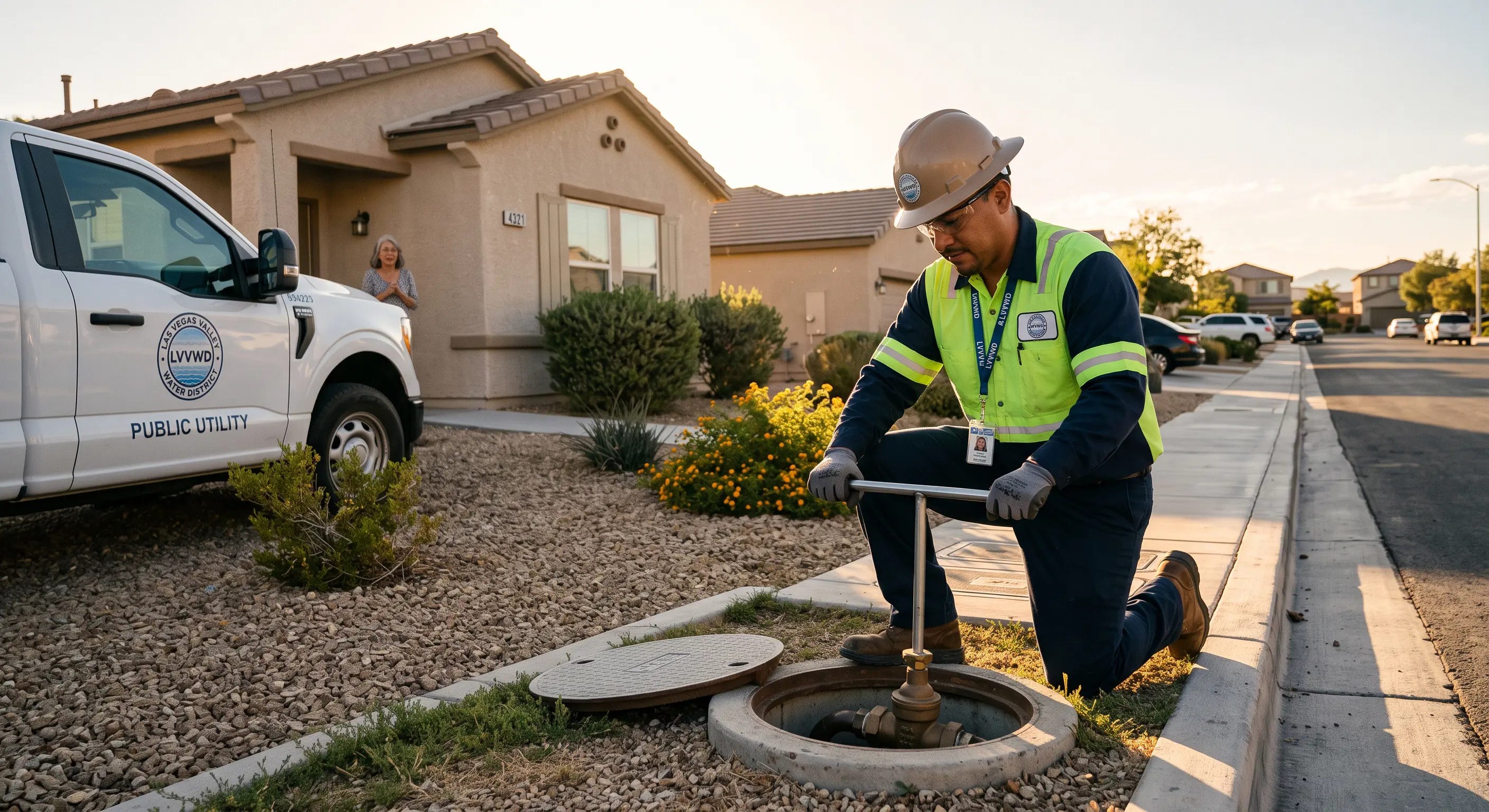
They pointed to section 3-2.103(d)(4) of their own code, which lets a tenant with a valid lease apply for service and be billed directly, and then makes the property owner responsible for any unpaid service fees and charges of that tenant. Real rule. Says exactly what they said it says. You can read it yourself on the residential application form the district hands to every applicant.
Which is where it falls apart for them, because the same paragraph keeps going. The owner, it says, will be notified as soon as possible if the account becomes past due, and that notification will include the amounts owed and the due dates. It then requires the district, on the owner’s request, to disclose whether a tenant’s account is in good standing and what is owed. The liability they were asserting against me and the notice duty they owed me sit two sentences apart in a document they wrote, printed, and handed to my tenant.
They had been enforcing the first sentence for months. They had never performed the second one.
I did not know any of that when I called. I knew it about two hours later, because I had a model read the code.
What that afternoon was worth
Let me put a number on this before going further, because the number is the argument.
The water went on. The tenant’s balance was never charged to me. Nothing was conceded on the record; they simply stopped, which is what an institution does when continuing costs more than dropping it. What I avoided was the balance itself plus the legal bill I would have run up proving I did not owe it. Reading the administrative code, tracing the enabling statute, checking whether the 1996 owner-protection statutes reach a municipal water district, and turning all of that into a letter is six to ten hours of skilled work. ConsumerShield put the 2026 California average for real estate matters at $465 an hour. LegalMatch puts the typical range at $250 to $350, with the full spread running from $150 to north of $500. Call it three to five thousand dollars to be told what I found out over an afternoon.
Then there is the part nobody itemizes. Every week that unit sat dry was a week I was not renovating and not renting. Had I done the sensible thing — paid under protest, kept the receipt, sued the former tenant later for money I would never see — I would have absorbed all of it and called it the cost of doing business, which is exactly what most owners in that position do.
I did not have to, because a twenty-dollar-a-month subscription read four public documents faster than I could have found the right ones. That is the save. Everything below is why I think it matters beyond my water meter.
The math that used to protect them
The district’s code is on ecode360. The California Water Code is on leginfo. The Public Utilities Code is a few clicks past that. None of it is secret, none of it is paywalled, and none of it is even hard once you are looking at the right four documents. It is long, densely cross-referenced, and drafted by people working from an assumption that held for a century: nobody on the other side is ever going to sit down with it.
That assumption was economic rather than legal. The balance in dispute was smaller than the fee to fight it. That ratio is not a quirk of my case, it is the load-bearing structure under most consumer disputes in this country. Utilities, councils, insurers and telecoms rarely win these on the merits. They win because being right costs more than being wrong.
When I wrote back citing their own notice failure, the matter went to their counsel, and it got more interesting. Counsel replied with an actual statutory argument: Public Utilities Code section 10009.6, the provision barring a municipal corporation from recovering a previous tenant’s charges from either a subsequent tenant or the property owner, did not apply here, because the district is not a “municipal corporation” as that term is defined in section 2904.
There is a hole in that, and it is not subtle. Section 2904 sits in Division 1, Part 3, Chapter 1, in an article headed General Provisions and Definitions. One section earlier, 2903 states that those definitions govern the construction of this chapter. Not the code. That chapter. Section 10009.6 lives in Division 5, several hundred sections and an entire subject away. The definition they were leaning on announces in its own text that it does not travel that far.
The letter also never did the thing that actually mattered, which was to identify affirmative authority for refusing to open an account in my name at all. Water Code section 71618, the enabling statute for municipal water districts, says a district may not chase a previous tenant’s unpaid charges from a subsequent tenant, then adds that the district may, however, require that service to subsequent tenants be furnished on the account of the landlord or property owner. That is the whole of it. It permits billing the owner going forward. It does not authorize collecting a former tenant’s arrears from that owner, and it says nothing whatsoever about refusing the owner service.
Underneath all of it sat Chapter 6-2, the district’s residential discontinuation policy, running 6-2.101 through 6-2.106, which by its own terms prevails over conflicting district rules and provides a written appeal to the General Manager and then to an elected Board. I filed a Public Records Act request for the itemized ledger and for every notice they claimed to have sent me.
One detail matters more than any of the citations. I never sent them a single section I had not opened and read in full myself. That is not modesty about the tool. It is the reason the letter worked.
Nineteen to twenty-seven pages about bins
The BBC reported last month that AI-assisted complaints are substantially increasing the workload of British councils, schools and other public bodies. Deborah Evans, who runs Lawyers in Local Government, a body representing 5,600 lawyers working inside local authorities, described a complaint that used to be one side of A4 about a missed bin collection now arriving at nineteen to twenty-seven pages, quoting case law and Acts of Parliament. Meeting that with staffing alone, she said, would mean doubling the complaint-handling workforce. The Local Government and Social Care Ombudsman reports a rise in AI-assisted legal challenges to its own decisions. In May the Information Commissioner’s Office published guidance on AI-generated Freedom of Information requests, warning of delays and errors if FOI teams got no support. School leaders tell the same story about parents.
The American numbers are steeper. Anand Shah at MIT and Joshua Levy at USC examined 4.5 million federal civil cases going back to 2005. The share of suits brought by self-represented people rose from eleven percent in 2022 to just under seventeen percent in 2025, and the number of filings inside those cases more than doubled from pre-2023 levels. They ran sixteen hundred sampled court documents through a commercial detector, and the proportion flagged as containing AI-generated text went from one percent in 2023 to eighteen percent in 2026. In Vermont, after a viral guide walked immigration applicants through drafting a writ of mandamus, self-represented filings went from roughly forty-five a year to more than eleven hundred in 2024.
The workload is real. I am not going to pretend a council complaints officer is enjoying any of this, and Deborah Evans is not a villain for saying so out loud.
What the judge actually said
Judge Maritza Braswell, a federal magistrate in Colorado, told MIT Technology Review she attributes the jump in self-represented filings partly to AI. She recognizes the prose. She catches the hallucinated cases. Then she says something that got left out of nearly every summary of the story: the pleadings are better. She moves through AI-drafted motions faster than the ones litigants wrote unaided, because she can follow what they are arguing. When she understands the argument, she said, she can help more.
Anyone who has read pro se filings knows why that matters. They arrive as handwritten scrawl. Judges are obligated to read them charitably, which in practice means decoding them first. What changed is that someone who cannot draft a legal argument can now state one clearly. The volume complaint and the clarity benefit are the same development, described by people with opposite incentives.
The remedies do not match the stated problem
The stated problem is accuracy. Invented citations, misquoted legislation, confident authority a handler has to spend an afternoon disproving before reaching the actual grievance. Fine, and a good part of the response goes straight at it. Miami-Dade and Broward circuit courts now require attorneys and self-represented litigants alike to disclose generative AI use and certify they checked the output. Judge Nina Wang in the District of Colorado requires an AI certification from every filer confirming human review and non-fictitious citations. The Northern District of Texas has mandated disclosure on the first page of a brief since September 2025. I would sign any of those without complaint. Verify what you file is not a controversial position, and it is the position I took in my own correspondence before anyone required it of me.
Now the rest. Councils are weighing complaint forms that cap length, and a length cap detects nothing at all. It stops a correct twenty-page complaint exactly as efficiently as a fabricated one. The Davis Wright Tremaine advisory published in August, addressed to consumer-facing businesses on handling AI-assisted claimants, is worth reading in full for what it recommends: fee-shifting under consumer protection statutes, vexatious-litigant designation requiring judicial leave before any new filing, Rule 11 sanctions, dismissal under the in forma pauperis frivolousness standard, and training intake staff to flag AI markers in incoming complaints. To the firm’s credit, the memo says plainly that neither AI assistance nor self-represented status is evidence a claim lacks merit, and that vexatious-litigant remedies need a documented pattern rather than the mere fact that someone showed up without a lawyer. Those caveats read as sincere. They are also advisory, and the tools are not.
One line stopped me cold. The memo observes that a fee award carries deterrent value even where the plaintiff is judgment-proof and will never pay it. Somebody sat down and worked out what a corporate defendant gets from sanctioning a claimant with no money, and the answer they arrived at was that other people will hear about it.
A detail in the BBC piece completes the picture. A listener at a global company described feeding fifty-page AI-generated complaints into AI to compress them into a one-page response, which they reported has been very effective at closing things down. The institution gets the tool for shrinking your complaint. You get a length cap for writing it.
New York, fairly
New York is where I have to be careful, because the easy version of this argument is wrong.
Senator Kristen Gonzalez’s S7263 would make a chatbot operator liable for impersonating a licensed professional, with a private right of action for damages plus costs and fees on willful violations. It cleared the Internet and Technology Committee six to one and advanced to a third reading in March. As amended, it targets impersonation rather than use. Gonzalez has said directly that nothing in it prevents you from asking a chatbot a question or receiving general information, and that it does not stop licensed professionals from using AI in their own work. That is a defensible bill and it grew more defensible as it moved. Anyone telling you New York is banning legal chatbots is overselling it.
Watch the direction of travel anyway. The original text reached further, barring substantive responses that would constitute unauthorized practice if a person gave them, which is a fair description of what happened at my kitchen table. Virginia’s HB 669 proposed something comparable across professions with a private cause of action and died in committee. In January 2025 the Federal Trade Commission entered a consent order requiring DoNotPay to stop claiming its service operates like a human lawyer. Bills in Congress would prohibit chatbots from posing as lawyers, doctors and other licensed professionals. The narrow versions survive scrutiny. The broad ones keep getting introduced.
The accuracy standard runs one direction
Go back to that letter from the district’s counsel. It contained a legal argument that does not survive contact with the code: a definitions section that limits itself, in writing, to its own chapter, stretched across three divisions to reach a statute it was never drafted to touch. A licensed California attorney produced that, put it on letterhead, and mailed it to a member of the public who was expected not to check.
No standing order covers that. There is no certification requirement obliging a public agency’s counsel to confirm they read the statute they cited before sending it to a ratepayer with no water. When an institution misstates the law at a citizen, we call it a legal position. When a citizen misstates the law at an institution, we call it an abuse of process.
I do not think this needs a conspiracy and I am not going to write one into it. Just look at who drafts the rules governing whether you may use AI to challenge a decision. Judges, who are lawyers. Bar associations, which are lawyers. Local authority legal departments, which in Britain alone put 5,600 of them inside a single membership body. Defense firms publishing advisories for corporate clients. Every person in that room is a professional whose workload rises when more people push back competently, and not one of them is the person whose water is off. Institutions optimize their own throughput. Throughput improves when fewer decisions get challenged. No coordination is required to produce the result you would expect, only that the people on the receiving end are never in the room, and they never are.
Where the critics are right
The hallucination problem is real and I am not waving it off. Judge Allison Goddard in California describes self-represented plaintiffs arriving at settlement conferences with numbers a chatbot handed them; one wanted seven hundred thousand dollars for a slip and fall worth a fraction of that. Dr. Google went to law school, is how she puts it. In March, Nippon Life sued OpenAI alleging that ChatGPT practiced law without a license and helped a woman reopen a case that had already settled. OpenAI moved to dismiss on the theory that ChatGPT is not a person and has no legal knowledge or skill, which is an odd thing to say about a product people are visibly using as counsel, and probably true.
A school governor made the sharpest observation in the whole BBC piece: chatbots are built to agree with you, so they never tell you the complaint is not worth filing. That is a genuine defect and it cuts against the user hardest. Someone who files a hopeless twenty-page grievance has spent credibility they will need the next time something real happens to them. Levy, the USC co-author, notes that self-represented litigants still lose far more often than represented ones and that AI has not moved that number, because running a case is a multi-part job and drafting text is one part of it.
All of that is true. None of it argues for the remedies on the table.
We already know how to fix this failure mode
I build agentic systems in production for a living. A model emitting fluent, well-formatted output containing assertions that are not true is the most heavily studied failure in the field, and nobody serious proposes solving it by banning the model. You solve it with retrieval against authoritative sources, citation to the specific retrieved document, and a human review gate before anything reaches a system of record. No competent engineering organization merges AI-written code unreviewed. None of them answers that risk by trying to outlaw the code generator.
My water dispute was a retrieval problem, not a generation problem. Four public documents and a careful reading. The model’s contribution was not eloquence or advocacy. It was noticing the second half of a paragraph the district had stopped quoting. Everything after that was me opening each cited section and confirming the text before it left my outbox. Twenty minutes. That review gate is the entire difference between a letter that wins and a letter that gets you sanctioned.
The people filing twenty-seven pages of invented case law skipped it. Real problem, proportionate remedy: a certification requirement, which several courts have already adopted and which I support. It is not an argument for length caps, pre-filing review regimes, or a statute making it unlawful for software to help you understand a rule that was written to govern you.
The test
Here is the question I would put to anyone proposing a new gate. Every merit filter now being invoked already existed. Rule 11 has been in the Federal Rules since 1938. Vexatious-litigant designation, in forma pauperis dismissal, demurrer, summary judgment, fee-shifting, all of it predates generative AI by decades. If those filters are adequate, the new rules are redundant. If they are inadequate, they were inadequate the whole time, and the inadequacy was tolerated for a century because it only ever fell on people who could not afford to be heard.
The Legal Services Corporation’s 2022 study found that low-income Americans received no or inadequate legal help for ninety-two percent of the civil legal problems that substantially affected their lives. Three in four low-income households hit at least one such problem in a year. Nearly half of those who never sought help cited cost, and more than half doubted they could find a lawyer inside their budget. Stanford researchers put the national figure at roughly fifteen million civil cases a year in which at least one party has no representation. That was the steady state for decades and no emergency working group was ever convened about it.
The crisis was declared the week the gap started closing.
My water is on, the renovation is finished, and I paid a former tenant’s bill exactly zero times. The law did not change. The code did not change. My rights under either did not change. The only thing that changed is that reading their rulebook stopped being expensive, and they folded the same week it did.
One last thing, and I mean it as instruction rather than disclaimer. I am not an attorney and nothing above is legal advice. The reason that letter worked is that every proposition in it pointed at a published section I had opened and read before I sent it. If you take one thing from this piece, take the discipline, not the outcome. The tool will find you the paragraph. Checking it is still your job, and it is the only part that has ever mattered.
About the Author
Gal Ratner is the founder and CTO of Inverted Software and WhiteStar Labs, and Chief Architect at Prana Entertainment, a Las Vegas enterprise software and AI consultancy. He has spent nearly thirty years shipping production systems on the Microsoft and .NET stack for clients including Microsoft, Sony, Rockstar Games, 2K Games, Best Buy and Allegiant Air, and was a finalist for the Los Angeles Business Journal’s CTO of the Year. His current work is production agentic AI: MCP servers, the Microsoft Agent Framework, RAG pipelines over authoritative document sets, SQL Server 2025 vector search, and the PLogger observability framework. He is also the author of the novel The Archive of Lost Suns. He writes about the gap between what executives say about AI and what practitioners actually ship at galratner.substack.com, and he owns a rental property in Chatsworth that has running water again.