


The promise, stated plainly
In October 2024, Dario Amodei, the chief executive of Anthropic, published a fifteen-thousand-word essay called “Machines of Loving Grace.” Its longest and most confident section is about biology. Amodei argues that once we have powerful AI we will live through a “compressed 21st century,” making in five to ten years the biomedical progress that would otherwise have taken a hundred. On his list of expected results, stated as bullet points a reader is meant to take literally, sits the phrase “elimination of most cancer.” To his credit, Amodei hedges harder on this item than on any other, conceding that cancer is extremely varied and adaptive and is likely the hardest of these diseases to fully destroy. That hedge is the single most important sentence in the essay, and it is the one that never makes it into the headlines.
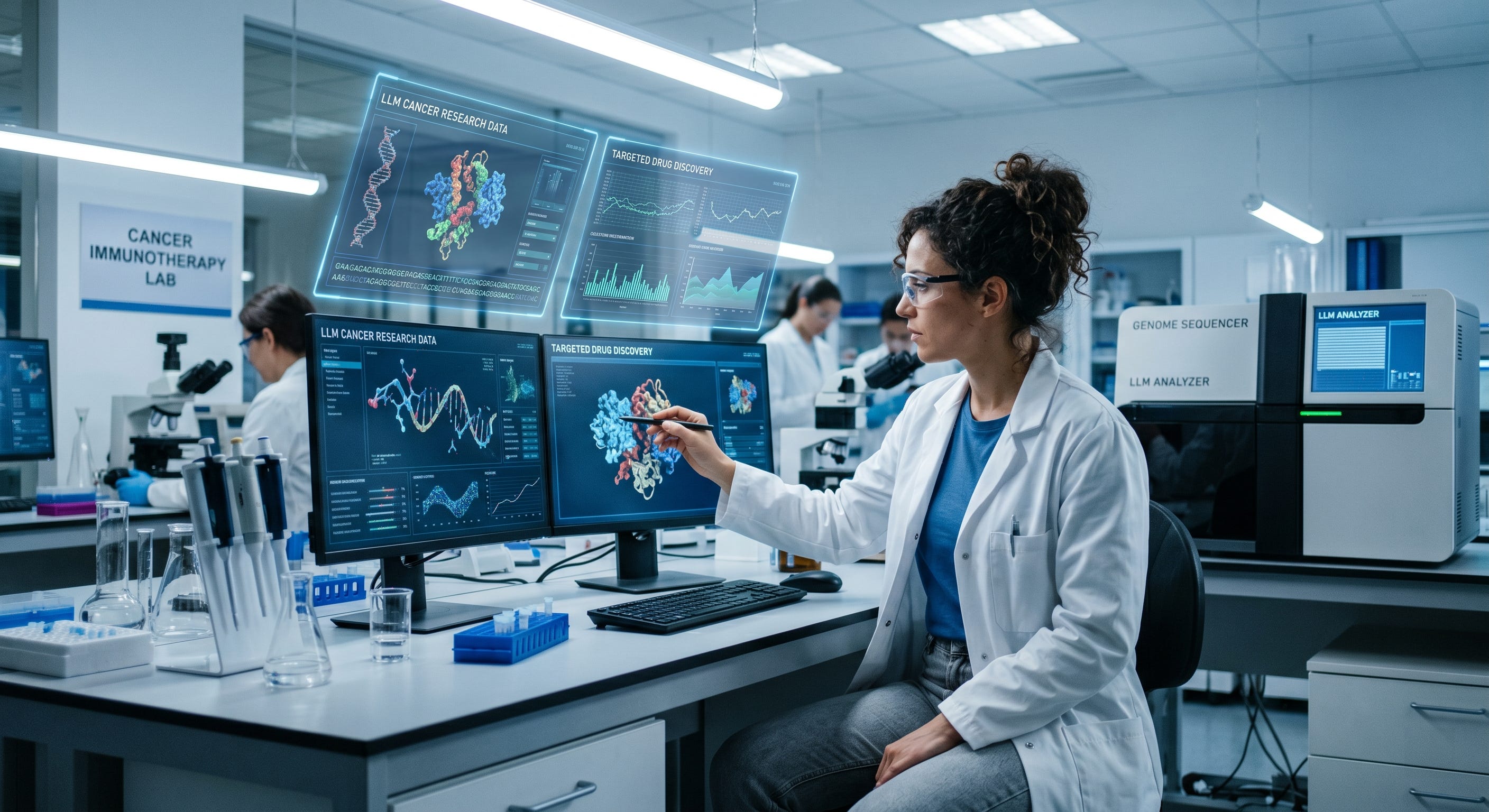
Demis Hassabis does not hedge. The Nobel laureate behind AlphaFold runs Isomorphic Labs, the Alphabet spin-out whose stated mission is to “solve all disease.” At Davos in January 2026 he described the goal as using AlphaFold and Isomorphic to “solve all disease, cure diseases,” and on May 12, 2026 the company closed a $2.1 billion Series B led by Thrive Capital, bringing its total outside capital to roughly $2.6 billion, with sovereign money from the United Kingdom, Abu Dhabi, and Singapore joining Alphabet at the table. Isomorphic’s internal pipeline is built around oncology and immunology. It is, by design, an attempt to cure cancer with a neural network. And as of that same May, the company had dosed exactly zero patients with any compound it designed. Its first human trial, once promised for the end of 2025, has slipped to the end of 2026. Jensen Huang of Nvidia rounds out the chorus, selling the GPUs and telling every healthcare conference that will have him that biology is about to become an engineering discipline.
These are not cranks. Amodei is a trained scientist and arguably the most careful thinker among the AI chief executives. Hassabis won a Nobel Prize for work that genuinely earned it. That is precisely why their claims deserve to be measured rather than admired. When the most credible people in a field make a falsifiable prediction with a dollar figure attached, the respectful response is to check it.
What the machines can actually do
On May 28, 2026, three researchers at Unreasonable Labs — Andrew Lew, Yuan Cao, and Markus Buehler — posted a benchmark called ProjectionBench that, almost incidentally, gives us the cleanest measurement yet of how good frontier models are at the front end of scientific discovery. The design is careful. They take real scientific papers published in the last six months, after the models’ training cutoffs, so the answers cannot be memorized. They strip each paper down to its topic and research question, then reveal information progressively — first the bare question, then the null hypothesis, then the full experimental method — and at each stage they ask the model to project what the study will find. They grade by breaking both the model’s projection and the paper’s real conclusion into atomic “if X then Y” claims and scoring the overlap.
The result is genuinely impressive and points the opposite direction from the skeptic’s reflex. GPT-5.4 held roughly a 0.70 F1 alignment with the real published conclusions even under minimal context — meaning that handed only a topic and a question, before seeing the hypothesis or the method, it landed close to what the experiment actually showed. Newer models beat older ones cleanly. If your prior was that large language models are stochastic parrots incapable of any scientific reasoning, ProjectionBench should move you. The machines are not guessing randomly. They have absorbed an enormous amount of structure about how the physical world behaves and they can project it forward.
Now read the fine print, because it is where the cancer question lives. First, ProjectionBench does not test oncology. Its forty-five papers span bioactive materials, mechanical materials, and nanomaterials — materials science, not drug development. The category that came closest to a biological subject, bioactive materials, was also the one that saturated near the ceiling, which tells you the models do well exactly where the literature is densest and the relationships most regular, and worse on the harder mechanical problems with wide score distributions. Second, and more fundamentally, the task is to re-derive a conclusion that already exists. A model that scores 1.0 has successfully predicted what a paper that was already written already found. That is a real and useful capability — it is closer to a brilliant interpolation across the existing literature than to discovery — but it is not the same thing as proposing a true, novel, previously unknown relationship and being right. The authors themselves draw this line. Third, the entire grading pipeline runs on GPT-5 as both the claim extractor and the judge, and the authors openly concede that using a GPT-family judge to grade GPT-family models risks self-preference bias, with cross-family evaluation deferred to future work. A small detail worth flagging for anyone quoting the paper: the headline AUC figures above 1.0 are areas summed across the three disclosure levels, not F1 scores, and should not be read as accuracy.
So the best current measurement of machine scientific reasoning says, roughly: frontier models are surprisingly good at re-deriving documented findings in data-rich physical-science domains from thin context, graded by one of their own siblings, on a task that rewards matching the answer rather than discovering it. That is the capability the “cure cancer” narrative is implicitly drawing on. Hold it next to what curing cancer actually requires.
The gauntlet the promise has to cross
A cure is not a hypothesis, a predicted protein structure, or a designed molecule. It is a compound that has been manufactured, dosed into living humans, and shown across randomized controlled trials to extend lives or eliminate disease without unacceptable harm, and then approved by a regulator on that evidence. Every step of the promise has to survive that gauntlet, and the gauntlet does not care how the molecule was designed.
Start with the base rate. Oncology has the lowest clinical success rate of any major therapeutic area. The Biotechnology Innovation Organization’s analysis of nearly 7,500 programs put the likelihood of a cancer therapy advancing from Phase 1 to approval at about 5 percent. The widely cited MIT study by Wong and colleagues put it lower, around 3.4 percent across their sample. A 2022 UCSF analysis tracking every oncology drug that entered Phase 1 in 2015 found that only 6.2 percent had been approved by 2021, and almost 8 percent of those were later withdrawn. A March 2020 model put the Phase 1-to-approval figure at 2.4 percent. Pick your study; the answer rounds to “almost everything fails,” at an average cost that the Tufts Center has estimated at roughly $2.6 billion per approved cancer drug, a figure that already includes the cost of all the failures.
Against that base rate, what has the AI-designed drug industry actually delivered? As of 2026, the count of AI-designed drugs approved for any indication, cancer or otherwise, is zero. Not a small number. Zero. The first AI-designed small molecule to reach human trials, Exscientia’s DSP-1181 for obsessive-compulsive disorder, entered the clinic in 2020 with great fanfare, cleared Phase 1 on safety, and was quietly discontinued by 2022 with no progression to Phase 2. Exscientia itself no longer exists as an independent company; it was absorbed into Recursion in a roughly $688 million all-stock deal in late 2024, after which the combined pipeline was trimmed to about five clinical programs. BenevolentAI, once the most valuable AI-drug startup in Europe, became the sector’s cautionary tale — repeated layoffs, a closed United States site, a delisting, and an acquisition by Osaka Holdings in March 2025.
The one bright spot is real and deserves to be named honestly: Insilico Medicine took an AI-discovered target and an AI-designed molecule, rentosertib, from concept to the clinic in under thirty months and reported positive Phase 2a results. That is a genuine milestone and the strongest single piece of evidence the optimists have. It is also a drug for idiopathic pulmonary fibrosis, not cancer, it is still years and at least one large trial away from approval, and it is one promising readout against a backdrop of roughly 173 AI-originated programs in clinical development, almost all of them still in Phase 1. The headline “AI designed a drug” has been achieved many times. The headline “an AI-designed drug cured a cancer” has been achieved zero times, and nothing currently in the public pipeline is positioned to change that within Amodei’s five-to-ten-year window with any confidence.
Why the gap is structural, not a scaling problem
The instinct in the industry is to treat this gap as temporary — a matter of more compute, more data, one or two more model generations. That instinct mistakes which part of drug discovery was ever the bottleneck. The steps AI genuinely compresses are the cheap steps. Generating hypotheses, predicting a protein structure, designing a candidate molecule with good in-silico binding — these used to take months and now take days, and that is a real and valuable acceleration. But these steps were never the reason cancer drugs cost $2.6 billion and fail 95 percent of the time. The reason is the expensive step that comes after, where a designed molecule meets the actual biology of a living, heterogeneous, adapting tumor inside a human immune system, and most of the time does something other than what the model predicted.
This is what evidence-based medicine has called the mechanistic fallacy for thirty years: the assumption that understanding a mechanism lets you predict the clinical outcome. AlphaFold solving protein folding is a mechanistic triumph. It sits, in the hierarchy of medical evidence that David Sackett and the Cochrane founders built, near the bottom — just above anecdote — precisely because mechanism so often fails to predict what happens in a randomized trial. The graveyard of oncology is full of compounds that bound their target beautifully, shrank tumors in a dish, worked in mice, and then did nothing for patients or killed them. No amount of embedding-space reasoning shortens a survival endpoint that, by definition, requires watching real people live or die over real years. You cannot compress a five-year overall-survival trial into a forward pass.
Connect that to ProjectionBench and the picture sharpens. The models are good at projecting documented relationships in regular, data-rich domains. Cancer is the opposite of that: irregular, adaptive, and chronically short on the kind of clean ground-truth data the models feed on. The very benchmark that should make us optimistic about machine reasoning also tells us where that reasoning is weakest — in the hard, sparse, non-stationary domains, which is exactly where oncology sits. The thing the machines do best is not the thing curing cancer requires most.
So, how close? Really.
Strip away the funding rounds and the conference keynotes and the answer is unglamorous and defensible. Artificial intelligence is a genuine accelerant to the front end of drug discovery, and Isomorphic, Insilico, and the survivors of the 2024–2025 shakeout are doing real work that will, over time, put more and better candidates into the clinic faster and more cheaply. That is worth a great deal. It is not nothing, and the skeptic who says AI has done nothing for medicine is as wrong as the executive who says it will cure cancer by 2034.
But “accelerating the discovery of candidate molecules” and “curing cancer” are separated by the most expensive, slowest, least compressible gauntlet in all of applied science, and that gauntlet is downstream of everything the models are good at. When a chief executive ties “solve all disease” to a two-billion-dollar raise while reporting zero patients dosed, that is not a scientific prediction. It is a financing narrative wearing a lab coat. The correct number for how many cancers AI has cured is zero, the correct number for how many it is on track to cure inside Amodei’s window is unknowable and almost certainly small, and the correct posture for anyone selling software, buying it, or investing in it is to admire the acceleration of the cheap step without pretending it has retired the expensive one. AlphaFold was a Nobel-worthy answer to a hard question. “Will this molecule safely keep a human being alive longer?” is a different and harder question, and so far, the machines do not get to answer it. The patients in the trials still do.
Disclaimer: The author is not a physician, and nothing in this article is medical advice. It is commentary on the technology and economics of AI-driven drug discovery, not guidance on cancer prevention, diagnosis, or treatment. Anyone facing decisions about their own health should consult a licensed medical professional.