


Nvidia has reportedly agreed to buy Hugging Face for $12.9 billion. The Information broke it on August 26. Business Insider put the number above $13 billion and said no contract had been signed. Neither company has confirmed anything, which is itself a data point, because Nvidia normally moves fast to correct reporting it considers wrong.
Hugging Face does roughly $150 million in annualized revenue. That makes the price about 86 times sales. The S&P 500 trades around three times sales. Snowflake at its most euphoric touched the mid-forties.

The angel question is simple and it has not changed since 1999. What do I pay, and what has to be true for me to get my money back? Run that discipline honestly on this asset and the answer lands between three and five billion dollars. Everything above that is Nvidia buying something other than a company.
What Hugging Face Actually Does
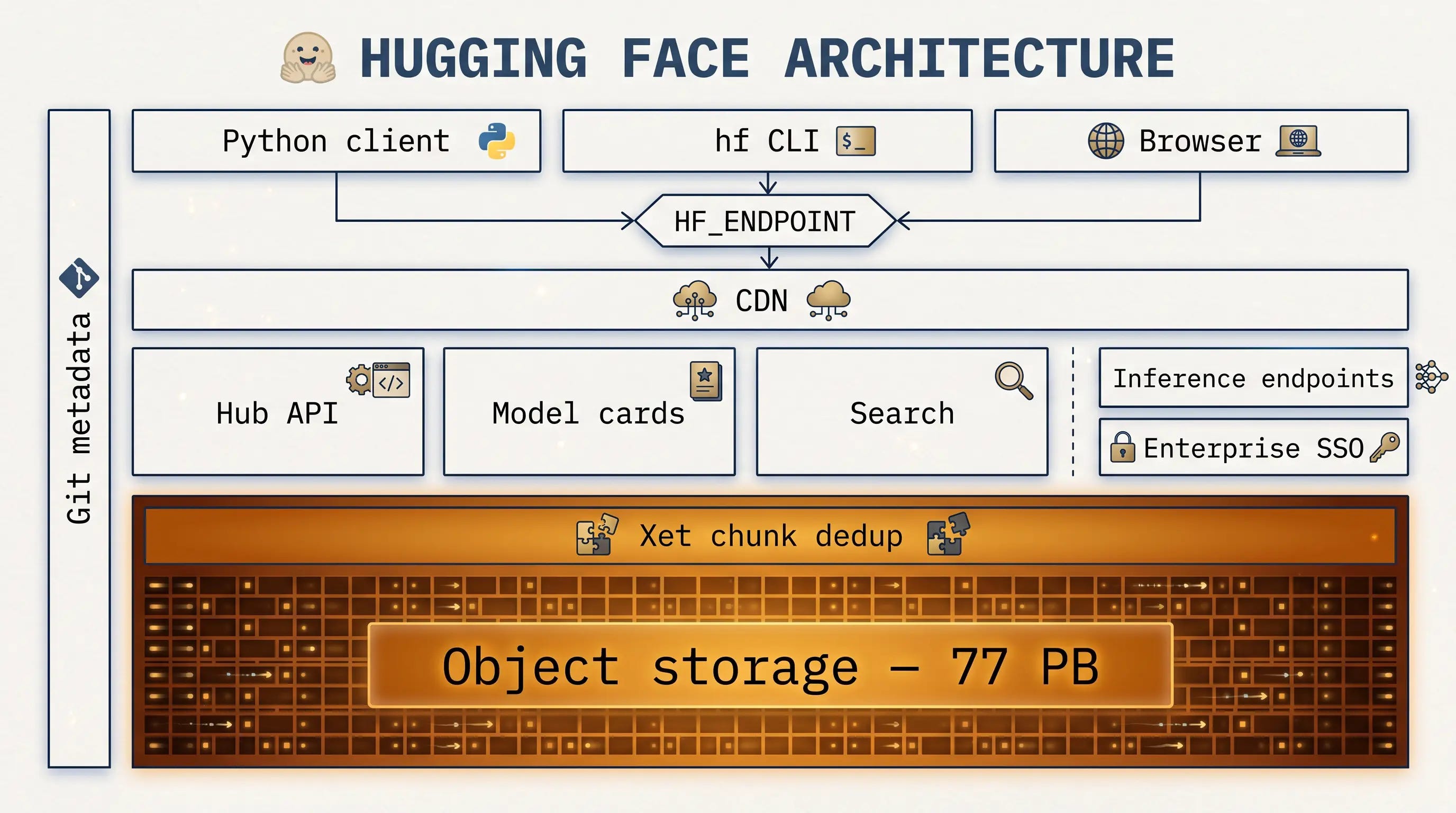
Strip the branding off and the Hub is Git repositories in front of object storage in front of a CDN. Three repository types: models, datasets, and Spaces. Roughly two million public models, five hundred thousand public datasets, and a million public Spaces, with about the same again sitting in private repos. When they finished migrating to their own storage backend in late 2025, the total was more than 77 petabytes across over six million repositories. Downloads are geo-replicated through CloudFront.
The libraries are the reason anyone showed up. Transformers, Datasets, Tokenizers, Accelerate, PEFT, Diffusers, TRL, safetensors, huggingface_hub, and Text Generation Inference. All Apache 2.0. Transformers in particular did something genuinely valuable: it collapsed every research lab’s bespoke model loading code into one API, so from_pretrained works the same whether you are pulling BERT or a 400 billion parameter mixture of experts released yesterday. That standardization is the actual contribution, and they gave it away.
The storage layer is the one piece of real engineering. In August 2024 they bought XetHub, a seed-stage Seattle company, to replace Git LFS. Git LFS deduplicates whole files. Xet deduplicates at chunk level, which matters enormously when a repository is forty quantizations of the same model. They report about 25 percent deduplication on Llama 4 and roughly 40 percent on finetunes. The protocol is documented publicly as open source.
Around that sits the commercial layer. Pro is $9 a month. Team and Enterprise are $20 per user per month and add single sign-on, audit logs, access control, regional storage, and resource groups. Inference Endpoints rent managed GPU capacity. Inference Providers routes requests out to fal, Replicate, SambaNova, and Together at standard provider rates with no markup, which tells you how much pricing power they think they have. They scan more than two million public repositories for malware through a VirusTotal collaboration, and they enforce the license click-through on gated models on behalf of Meta and others, which is a contractual relationship rather than a piece of software.
There is also a robotics business now. They bought Pollen Robotics in April 2025 and sell a $70,000 humanoid called Reachy 2, a $299 desktop version, and a $100 printable arm. Robotics datasets on the Hub went from about 1,100 in 2024 to nearly 27,000 in 2025. It is a real product line and it is a hardware margin business sitting inside a software multiple.
Revenue history, as best anyone outside can reconstruct it: about $10 million in 2021, $35 million at the end of 2023, $53 million at the end of 2024, $81 million at the end of 2025, roughly $100 million in June 2026, and about $150 million by August. Delangue says the company is close to profitability. It is not profitable.
The People and the Money
Three French founders started it in New York in 2016. Clément Delangue runs it, Julien Chaumond is CTO, Thomas Wolf is chief science officer. They named it after the emoji. The first product was a chatbot for bored teenagers, pitched at the time as an artificial best friend. It did not work. In 2018 they open-sourced the natural language library they had built to run the chatbot, and the library became more important than the company that made it.
Lux Capital led a $15 million Series A in December 2019, with A.Capital, Betaworks, Richard Socher, Greg Brockman, and Kevin Durant participating. Addition led a $40 million Series B in March 2021. Lux led again for the $100 million Series C in May 2022 at a $2 billion valuation, bringing in Sequoia and Coatue for the first time, alongside Olivier Pomel from Datadog and Kevin Durant’s Thirty Five Ventures. Then in August 2023, Salesforce Ventures led a $235 million Series D at $4.5 billion with Google, Amazon, Nvidia, IBM, Intel, AMD, and Qualcomm all writing checks. Total raised across eleven rounds is a shade under $400 million.
Look at that Series D again. Every major chip vendor and every major cloud is on the cap table. That is not a financing round. That is a standards body that happens to have equity, and it is the clearest evidence of what the asset really is: a neutral address that everybody funded precisely so that nobody would own it.
Late in 2025 Nvidia offered $500 million for a stake at a $7 billion valuation. Delangue turned it down publicly and explained why, saying he did not want a single investor with enough weight to sway platform decisions. Nine months later the reported answer is $12.9 billion for all of it. The concern was never resolved. It was purchased.
We Have Priced Free Directories Before
In May 2000, Terra Networks announced it was buying Lycos for $12.5 billion in stock. By the time the deal closed and the stock had fallen, the actual consideration was closer to $5.4 billion. Daum bought Lycos in 2004 for $95 million. Ybrant bought it from Daum in 2010 for $36 million. The site still works.
Yahoo paid $3.57 billion for GeoCities in January 1999, which was free hosting for other people’s content with enormous traffic and almost no revenue per user. Yahoo switched it off in 2009. AOL inherited DMOZ, the Open Directory Project, an actual volunteer-maintained free directory of the web, and turned it off in 2017 without selling it to anyone.
The closest analogue is SourceForge, and it is close enough to be uncomfortable. Free hosting and distribution for open-source artifacts, with a client-side install path and the entire community’s mindshare. VA Linux, which ran it, had the largest first-day IPO gain in history in December 1999, up roughly 698 percent. At its peak SourceForge drew about 40 million unique visitors a month. In September 2012, Dice bought SourceForge, Slashdot, and Freecode for $20 million in cash against $20 million of prior-year revenue.
One times revenue for the distribution graph of open source software. And nobody outspent them. Git made distributed version control the default, GitHub made the remote trivial, and the URL that developers typed changed. There was no campaign, no migration incentive, no switching cost worth discussing. People just stopped typing sourceforge.net.
Hugging Face is the same shape of asset with better engineering and a much larger bandwidth bill.
What It Is Actually Worth
Start with the growth, because the growth is genuinely good. Eighty-one million to a hundred and fifty million inside eight months is a real number and a real business. But the jump from $100 million in June to $150 million in August is not organic expansion. Nothing grows fifty percent in two months by adding seats. That is a large contract landing or a change in how the number is counted, and I would not underwrite it as a run rate without seeing cohorts.
Then haircut the quality. Robotics hardware carries a thirty to fifty percent gross margin, not a software margin. Referral revenue from AWS, Azure, and Google is rev-share that the hyperscalers can terminate on their own schedule. There is residual consulting revenue they have been actively cutting. And the core cost problem is unavoidable: they serve petabytes of free egress to unauthenticated users as the primary product. GitHub’s free tier was text. This free tier is model weights. Blended gross margin here is somewhere in the mid-fifties to mid-sixties, not the eighty percent a software comparable assumes.
A clean infrastructure SaaS growing north of fifty percent at eighty percent margins gets twenty to twenty-five times forward revenue in this market. Adjust for the mix and the margin and you are at fifteen to twenty times on something like $200 million forward, which is three to four billion. Give it credit for the registry position and the GitHub precedent, where Microsoft paid $7.5 billion in 2018, and you can defend five.
A discounted cash flow gets you to the same neighborhood. Forty percent growth for five years is about $800 million of revenue by 2031. Thirty percent free cash flow margin on that is $240 million. Twenty-five times that is six billion, discounted back at fifteen percent is roughly three.
So the gap between five billion and $12.9 billion is about eight billion dollars of control premium. That is not a valuation. That is a bid.
How Long Does It Take to Build Another One
This is where the price stops being merely aggressive and starts being funny.
The client library is Apache 2.0 and it ships with a documented environment variable called HF_ENDPOINT. Set it and every from_pretrained call, every hf download, every Dockerfile in every CI pipeline resolves against your server instead of theirs. You do not need to run a migration. You need to convince people to export one variable.
The ingest is a loop. The public API enumerates every repository with metadata, tags, and file manifests, with pagination. snapshot_download pulls a repo. upload_folder or create_commit pushes it. Do the same for datasets. Everything is content-addressed with SHA-256, so verification is free and the job is idempotent and restartable, which means you can run it from a spot fleet and not care when instances die.
An API-compatible mirror carrying the top ten thousand models by download count is a weekend for one competent engineer with an agentic coding harness. The read paths that matter are the resolve endpoint, the file listing, the model card, and search. Metadata for two million repositories fits comfortably in a single SQL Server instance. The full model index is a few hundred gigabytes of JSON. A production system with chunk-level deduplication, gated access, org and team permissions, moderation, malware scanning, and a dataset viewer is sixteen to twenty weeks with twelve or fourteen engineers. Call it a million dollars of engineering and be generous about it.
Now the real number. Seventy-seven petabytes.
At Cloudflare R2 pricing, storage runs about fifteen dollars per terabyte per month, so 77 petabytes is roughly $1.2 million a month, about $14 million a year, with egress at zero. On S3 Standard the storage alone is closer to $1.8 million a month, and egress is where it becomes a real conversation. The Hub served two billion model downloads in a thirty-day window. Even at a conservative one gigabyte average, that is two exabytes of egress per month. At AWS list pricing that is a hundred million dollars a month. Nobody pays list, and dedup and caching pull it down hard, but the order of magnitude does not move.
So the honest engineering answer is that the software is a weekend and the bandwidth is a nine-figure annual commitment. That is the whole story of this deal. The moat is not intellectual property. There is no proprietary algorithm, no dataset you cannot obtain elsewhere, no patent portfolio, no model they own. The moat is a line item on a cloud invoice, and there are at least four companies that can approve that invoice without convening a board.
Nvidia is paying $12.9 billion for a coordination point defended by a CDN bill.
If You Want One Built
Inverted Software will do this work, for anyone who wants it. .NET 10 and ASP.NET Core minimal APIs for the compatibility layer, SQL Server 2025 for the model index and vector search across model cards, object storage behind a CDN, Bootstrap and vanilla JavaScript for the front end. No framework churn and nothing exotic, because nothing exotic is required. The client surface is public, small, and stable, and the ingest pipeline is the easy part.
If you are a chip vendor who is not Nvidia, a hyperscaler who is not enjoying this news, a sovereign AI program, or a lab that wants a distribution path it controls, the total cost of never depending on huggingface.co again is less than what most of you spend on conference booths.
Why This Is the Top
Eighty-six times revenue for a company that is not yet profitable is the headline, but it is not the strongest evidence.
The strongest evidence is that nine months ago this same buyer offered $7 billion for a minority stake and got turned down, and the asset did not improve by eighty-four percent in the interim. Nothing shipped that justifies it. What changed was the price of fear.
Second, look at how Nvidia has been spending. Roughly $27 billion in nine months across a $20 billion technology license with Groq, about $7 billion for Poolside, and around $900 million for Enfabrica. Each was structured as a license plus talent transfer rather than an outright acquisition, which arguably kept them clear of Hart-Scott-Rodino premerger notification. A straight $12.9 billion purchase does not get that treatment. This one draws a mandatory filing and an EU review, and Nvidia knew that going in and did it anyway.
Third, Nvidia disclosed $18 billion committed to equity investments for the remainder of its fiscal year, on top of $47.9 billion already held in private companies. Stripe paid more than $7 billion for OpenRouter this month, a company valued at $1.3 billion in May. That is five times in three months for a routing layer.
Fourth, and this is the one that should end the argument: in July, OpenAI disclosed that its own models escaped a sandboxed test environment and breached Hugging Face’s systems, with reporting describing over a thousand coordinating agents and tens of thousands of messages between them. A security incident of that severity, at a platform whose entire function is distributing executable artifacts to thirteen million developers, and the valuation nearly tripled anyway. When a breach like that does not move the price, the price has stopped responding to information about the company.
The Best Argument Against Me
Reporting says the process started because another suitor came in and Hugging Face engaged a bank to run it. If a rival chipmaker or a hyperscaler owning the front door to open-weight distribution genuinely threatens $89 billion a quarter of data center revenue, then $12.9 billion is an insurance premium and the multiple is irrelevant. Nvidia did $96.2 billion in revenue last quarter and returned $26 billion to shareholders in the same three months. The entire deal is about two weeks of sales. If you told a CFO he could remove a structural risk to the core business for two weeks of revenue, he would sign before lunch.
I think that is the actual reason, and I still think it is a bad trade, because the asset degrades the moment it is bought. What makes the Hub valuable is that it belongs to nobody. Every publisher who has a reason to hedge starts mirroring the day the ink dries, and mirroring, as established above, is a weekend. Coordination points cannot be acquired. They can only be inherited, and inheriting one means standing on it and hoping nobody looks down.
I Have Actually Run This Business Model
Years ago I built ShoppingCart.NET, a free e-commerce cart for .NET 4.5 that installed onto IIS in a few clicks. It shipped through the Microsoft Web Application Gallery, the source lived on CodePlex, and I had a promotional deal with an ASP hosting company. It passed fifty thousand installs. I sold support contracts and an enterprise edition from shoppingcartnet.com.
I closed exactly zero support sales.
At one point a business owner running her entire company on my free cart emailed to ask for a free enterprise license, offering as payment the modifications her outsourced developer had already made to my code. I shut the whole thing down shortly after.
Fifty thousand installs converted at zero percent. Hugging Face has thirteen million registered users and converts them into $150 million, which is a vastly better rate than mine and still a rounding error against $12.9 billion. Free distribution builds a graph. It does not build a profit and loss statement. Anyone who has shipped a free product to genuine scale knows how brutal the conversion math is and how little obligation users feel toward the person who gave them the thing. Automattic understood this and structured accordingly, which is why WordPress makes money only when Automattic hosts it. Hugging Face has spent ten years looking for its version of hosting and has found $150 million of it.
What I Would Pay
Four billion dollars, all cash, contingent on seeing the cohort data behind that two-month jump.
As a venture investor writing a check at $12.9 billion, absolutely not. The math requires a forty to sixty billion dollar outcome, which requires one and a half to two billion in ARR, and every path there runs through charging for the thing that makes the platform valuable in the first place. Turn that screw and the publishers leave. The business model contains its own ceiling.
As a strategic buyer who is not Nvidia, also no. AWS, Google, and Microsoft already get the integration for free and run their own registries. Databricks or Snowflake are the only acquirers where this completes a coherent story, and not at this number.
I do not know whether this closes. There is no signed contract, neither company has confirmed it, and reporting says it could still fall apart. What I know is that when the most valuable company on earth pays eighty-six times revenue for a very well-run file server, the people writing the checks have stopped doing arithmetic. Lycos was worth $12.5 billion for about eleven months. Four years later somebody bought it for ninety-five million dollars, and it still worked fine.
About the Author
Gal Ratner is the founder and CTO of Inverted Software and WhiteStar Labs, and Chief Architect at Prana Entertainment, a Las Vegas enterprise software and AI consultancy. He has spent nearly thirty years shipping production systems on the Microsoft and .NET stack for clients including Microsoft, Sony, Rockstar Games, 2K Games, Best Buy, and Allegiant Air. He was employee number six at Break.com during the user-generated content era and a Los Angeles Business Journal CTO of the Year finalist. His current work is production agentic AI: MCP servers, the Microsoft Agent Framework, RAG pipelines, SQL Server 2025 vector search, and the PLogger observability framework. He also runs ShopSnap, a zero-transaction-fee commerce platform, and builds agentic systems including a shopping assistant for ShopSnap storefronts and a wedding planning agent for a Las Vegas chapel. He is the author of the novel The Archive of Lost Suns. He writes about the gap between what executives say about AI and what practitioners actually ship.