


Pink surveyor’s tape flutters from the pine trees behind Ansley Brown’s childhood home in Coweta County, Georgia. The tape marks a line. Everything on one side of it — the house her mother bought in 2003 through a federal loan program for single mothers, the yard, the animals, the quiet — is scheduled to be cleared. Not for a highway. Not for a school. For a five-hundred-thousand-volt transmission line whose electricity, by the utility’s own admission, will overwhelmingly serve artificial intelligence data centers owned by some of the richest corporations on the planet.
“To us it’s theft,” Brown told CBS News. “It’s literally a billion-dollar company stealing land from smaller people, people who can’t fight back.”
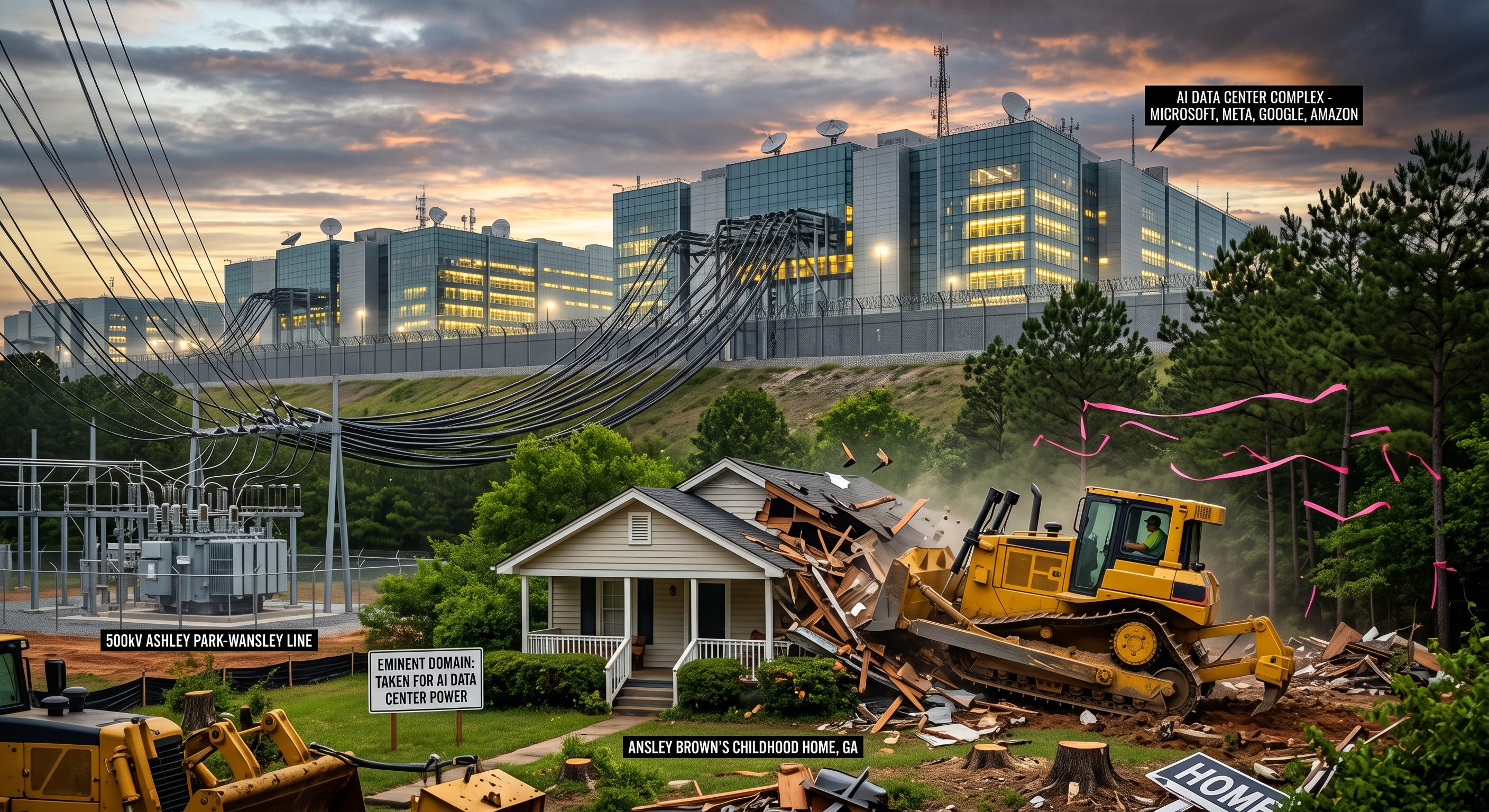
She is right about the theft. She is just being too generous about the size of the company.
The project carries a bland bureaucratic name, the Ashley Park–Wansley line, and it runs roughly thirty-five miles from a substation near Newnan south to Georgia Power’s Plant Wansley. Along that corridor, the utility is acquiring easements from more than three hundred and thirty homeowners. Somewhere between twenty and thirty homes will be demolished outright. Georgia Power executives have testified, in public, that about eighty percent of the roughly ten gigawatts of new generating capacity the company is racing to build will go to data centers. This is not a rumor whispered by frightened neighbors. It is the stated business plan.
And it is only the opening move. Georgia Power’s ten-year transmission blueprint, already blessed by state regulators, contemplates as much as a thousand miles of new power lines. Thirty-five miles of condemned backyards is the pilot program.
To understand who is responsible — and people are responsible, with names and titles and campaign-finance filings — you have to stop thinking about electricity and start thinking about the machine that generates the profit. Because the dirty secret of this entire affair is that Georgia Power does not get rich selling you power. It gets rich pouring concrete.
The Machine That Prints Money by Building Things
Georgia Power is a regulated monopoly. In exchange for the exclusive right to sell electricity across most of the state, it submits to a regulator that caps its profit. But here is the part almost no one outside the industry understands: that profit is not a slice of what you pay for electricity. It is a guaranteed percentage return on the total value of everything the company builds and owns — the power plants, the poles, the wires, and yes, the transmission lines. Regulators call this pile of assets the rate base. The company earns a fixed return on it, and the arithmetic is brutally simple. Grow the rate base, grow the profit. Build more, earn more.
For Georgia Power, that guaranteed return runs somewhere between 10.5 and 11.9 percent, comfortably above the national industry average of roughly 9.7 percent. An energy-finance analysis put the incentive in plain language: for a utility executive, every dollar of shareholder money sunk into the rate base converts into about two dollars of stock-market value. That is not a business. That is alchemy, and it is entirely legal.
Now watch what happens when you hand a company like that a reason to build. Georgia Power’s parent, Southern Company, is projecting eighty-one billion dollars in capital spending through 2030 — a thirty-one percent jump from its estimate just a year earlier. The company itself has said the main driver of that increase is new electricity generation, precisely the kind of buildout regulators approved for the data center wave. The transmission line eating Ansley Brown’s backyard is not a cost Georgia Power reluctantly absorbs. It is a revenue opportunity it is thrilled to seize.
The money is already flowing. Southern Company reported 2024 earnings of $4.4 billion, up about ten percent. Georgia Power alone kicked $2.5 billion in profit up to the parent on roughly $11.3 billion in revenue. The people who run this machine have names. Kim Greene is chairman, president, and chief executive of Georgia Power. Chris Womack is chairman, president, and chief executive of Southern Company, with former chief executive Tom Fanning still installed as executive chairman. When you see a headline about a family being bulldozed to power AI, these are the executives whose compensation and whose shareholders benefit from every mile of line that gets built. Remember them the next time a Georgia Power spokesperson describes eminent domain as a painful last resort. Painful for whom?
The Regulators Who Took the Money and Voted Yes
A guaranteed-profit machine still needs someone to sign the permission slip. In Georgia, that someone is the Public Service Commission, five elected officials who decide how much Georgia Power can build and how much of the cost lands on your monthly bill. On December 19, 2025, the commission voted five to nothing to approve an agreement letting Georgia Power add 9,885 megawatts of new capacity, most of it to serve large customers like data centers. The Southern Environmental Law Center estimated the plan could cost customers fifty to sixty billion dollars over the life of the resources, and warned that if Georgia Power’s demand forecast turns out to be wrong, the bulk of that staggering bill could fall on ordinary ratepayers.
Here is where the timing turns the stomach. Six weeks before that vote, on November 4, 2025, Georgia voters had thrown two of those very commissioners out of office. Republicans Tim Echols and Fitz Johnson were defeated by Democratic challengers who campaigned explicitly against soaring power bills and the giveaway to data centers. But the defeated commissioners had not yet vacated their seats. So the outgoing Republican majority rammed the approval through in a lame-duck session, days before the newly elected commissioners were sworn in. Environmental groups petitioned to delay the vote until the winners took office. The petition was denied. Echols, on his way out the door after being fired by the electorate, voted yes. So did Chairman Jason Shaw, Lauren McDonald, and Tricia Pridemore.
Why would commissioners defy the voters who had just removed them? Follow the money — literally, into their campaign accounts. According to an analysis of state filings by the Energy and Policy Institute, Commissioner Fitz Johnson took more than eighty-seven percent of his campaign contributions — $174,500 out of $200,325 — from donors tied to the utilities he was supposed to regulate. Commissioner Echols took more than sixty-one percent of his funding from the same well.
And the receipts get more specific than a percentage. Troutman Pepper, the law firm that argues Georgia Power’s cases before the commission, and its attorneys sent the commissioners $18,750 across six contributions — including checks from the very lawyers who represent Georgia Power at the PSC: Steven Hewitson, Brandon Marzo, Allison Pryor, and Michael Wooldridge. Employees of Georgia Power and its Southern Company affiliates chipped in another $6,750, including a thousand-dollar contribution from Southern Company Gas chief executive Jim Kerr. Gas South, a gas marketer, added $3,650 more. The Georgia Chamber of Commerce’s political action committee endorsed both incumbents.
This is what regulatory capture looks like once you strip the euphemism off it. The company being regulated funds the campaigns of the people doing the regulating, and then those people vote — in a session the voters tried to end — to let the company build tens of billions of dollars of infrastructure it will profit from for decades. No one has to be handed a briefcase of cash. The system is engineered to reach the outcome without one.
The two Democrats who won those seats, Alicia Johnson and Peter Hubbard, inherited a done deal. Hubbard has since published an analysis estimating that the discounted rates handed to data centers shift more than a billion dollars in infrastructure costs onto residential customers, and he has called for an independent audit of Georgia Power’s profits. He is now outvoted three to two.
The Governor Who Kept the Spigot Open
None of these data centers would be swarming into Georgia without a tax break, and the tax break survives because of one man. After the legislature created a sales-tax exemption for data centers in 2018, the giants came — Microsoft, Meta, Google. By 2024, lawmakers across both parties had seen enough of the strain on the grid to pass House Bill 1192, a modest two-year pause on new exemptions so the state could actually study what these facilities were doing to the power system. It was the only meaningful reform to emerge from a months-long review of Georgia’s corporate tax giveaways.
Governor Brian Kemp vetoed it. He did so on May 7, 2024, after what reporters described as an intensive lobbying campaign to preserve the break — a campaign led by the Data Center Coalition, whose members include Amazon, Meta, CloudHQ, and CyrusOne, and cheered on by the Georgia Chamber of Commerce. The coalition publicly thanked Kemp for the veto.
What did Kemp protect? A subsidy that loses money for the state on its own terms. A University of Georgia analysis projected that from 2024 through 2030 the exemption will cost the state $307 million more in forgone revenue than it collects, returning roughly twenty-four cents on the dollar. Kemp shielded a program that pays out four dollars for every one it brings in, so that trillion-dollar corporations could pay less tax while their electricity demand forced a utility to condemn single mothers’ homes. He called the pause a threat to investments made by high-technology data center operators. He did not mention the investments Georgians had made in their own backyards.
The Customers Who Won’t Sign Their Names
Ask Georgia Power who all this is for, and the company will tell you it does not publish a list of its customers, citing safety and security. It is a remarkable thing to say to a family losing their home: the power is essential, the taking is unavoidable, and no, you may not know who benefits. But reporters have already pulled back the curtain.
The largest project in the affected zone is a 615-acre campus in Fayetteville envisioned to hold up to seven million square feet of data centers — floor space rivaling four shopping malls — built by QTS, a company owned by the private-equity giant Blackstone. QTS’s first building there is leased to Microsoft as part of Microsoft’s artificial-intelligence superfactory effort. Microsoft has separately confirmed a second Fayette County project near Tyrone. Meta operates data centers elsewhere in Georgia that have already generated complaints about water runoff. Google has run server farms in the state for over a decade. Amazon sits on the very coalition that lobbied to keep the tax break alive.
So when Georgia Power invokes the state’s power to seize private land, it is doing so, in the end, on behalf of Satya Nadella’s Microsoft, Mark Zuckerberg’s Meta, Sundar Pichai’s Google, Andy Jassy’s Amazon, and Stephen Schwarzman and Jonathan Gray’s Blackstone. These are among the most valuable enterprises in human history. They are not asking permission to build in your neighborhood. They have arranged for a regulated monopoly, a captured commission, and a compliant governor to arrange it for them, while their names stay off the paperwork the sheriff hands to the homeowner.
But They Promised You Wouldn’t Pay
Georgia Power and its commissioners have an answer to all of this, and honesty requires stating it. They insist the agreement is structured so that data center customers, not existing ratepayers, will cover the cost of serving them, and they point to a base-rate freeze the commission approved through the end of 2028. On paper, it sounds like protection.
Look closer and the protection dissolves. The math behind the company’s promise of downward pressure on bills has been kept from the public as a trade secret — the same designation Georgia Power’s own attorney invoked to shield the demand projections that justify the entire buildout. The base-rate freeze conveniently excludes fuel costs, which pass straight through to customers separately and which spiked by two billion dollars in 2023 alone, adding sixteen dollars a month to the average bill. And the whole ratepayer-protection scheme rests on the assumption that the data center demand actually materializes. If the AI buildout proves to be the bubble that a growing chorus of investors fears, Georgia Power will have built fifty billion dollars of gas plants and transmission lines for customers who never showed up — and the law of the regulated monopoly is clear about who covers a stranded investment. It is not the shareholders.
The claim that ratepayers are protected also has to survive contact with what Georgians are already living. Since 2022, Georgia Power’s rates have climbed more than forty percent through a series of increases the commission approved. Roughly ten billion dollars in cost overruns from the Plant Vogtle nuclear expansion were pushed onto ratepayers. And in 2025, according to the company’s own bad-debt report, nearly 280,000 Georgia Power customers had their electricity shut off for nonpayment — about ten times the industry average. That is the human ledger behind Southern Company’s record profits: hundreds of thousands of families who could not keep the lights on, in a state where the utility is spending eighty-one billion dollars to keep Microsoft’s servers cool.
This Is the Beginning, Not the End
Do not mistake Coweta County for an isolated tragedy. It is a template. The same collision is already playing out in Northern Virginia, where counties are rejecting substations, and in Texas, where communities are suing over water drawdowns and rate spikes. The ingredients are identical everywhere: an explosion of AI compute demand, a utility that profits from building whatever serves it, regulators who answer to the utility’s money, and a public that finds out only when the surveyor’s tape appears in the trees.
Georgia Power has told you what comes next. A thousand miles of new transmission line. Nearly ten gigawatts of new generation, most of it burning methane gas the company will keep building for decades. And a legal doctrine — the same one the Supreme Court blessed in Kelo v. City of New London — that lets the state take your property and hand its benefit to a private corporation, as long as someone can call it a public use. The corporations creating the demand have the market power to build anywhere on earth. They are choosing to build here, on land that isn’t theirs, powered by plants you will pay for, approved by officials they funded, protected by a tax break that loses money, and delivered by a monopoly that grows richer with every home it erases.
Ansley Brown’s mother has one demand left. Not the house — she knows that’s gone. She wants an apology. She will not get one, because in this system no one who matters believes they did anything wrong. They followed the money. Now you know exactly where it leads. Watch your own backyard.
About the Author
Gal Ratner is the founder and CTO of Inverted Software and WhiteStar Labs and Chief Architect at Prana Entertainment, with nearly thirty years of production software experience on the Microsoft and .NET stack. He has delivered systems for clients including Microsoft, Sony, Rockstar Games, 2K Games, Best Buy, and Allegiant Air, was employee number six at Break.com, and was a Los Angeles Business Journal CTO of the Year finalist. His current work centers on production agentic AI systems — MCP servers, the Microsoft Agent Framework, retrieval pipelines, and SQL Server vector search. He writes about the AI industry from the perspective of someone who actually ships it, and he is unsentimental about both the hype and the people cashing in on it. His readers know him as the .NET AI guy that ships.