


It Starts With a Sound
In 2006 I walked into a Ford dealership and drove out in a brand-new F-150. Twenty thousand dollars. It was the truck a working man was supposed to be able to buy: simple, capable, the kind of machine you pay off and then keep, because keeping it is the entire point. I am not a casual owner. I have spent nearly thirty years shipping production systems for companies whose names you know, and I treat my equipment the way I treat my code — I expect it to do the job, and I expect the people who built it to stand behind it when it doesn’t.
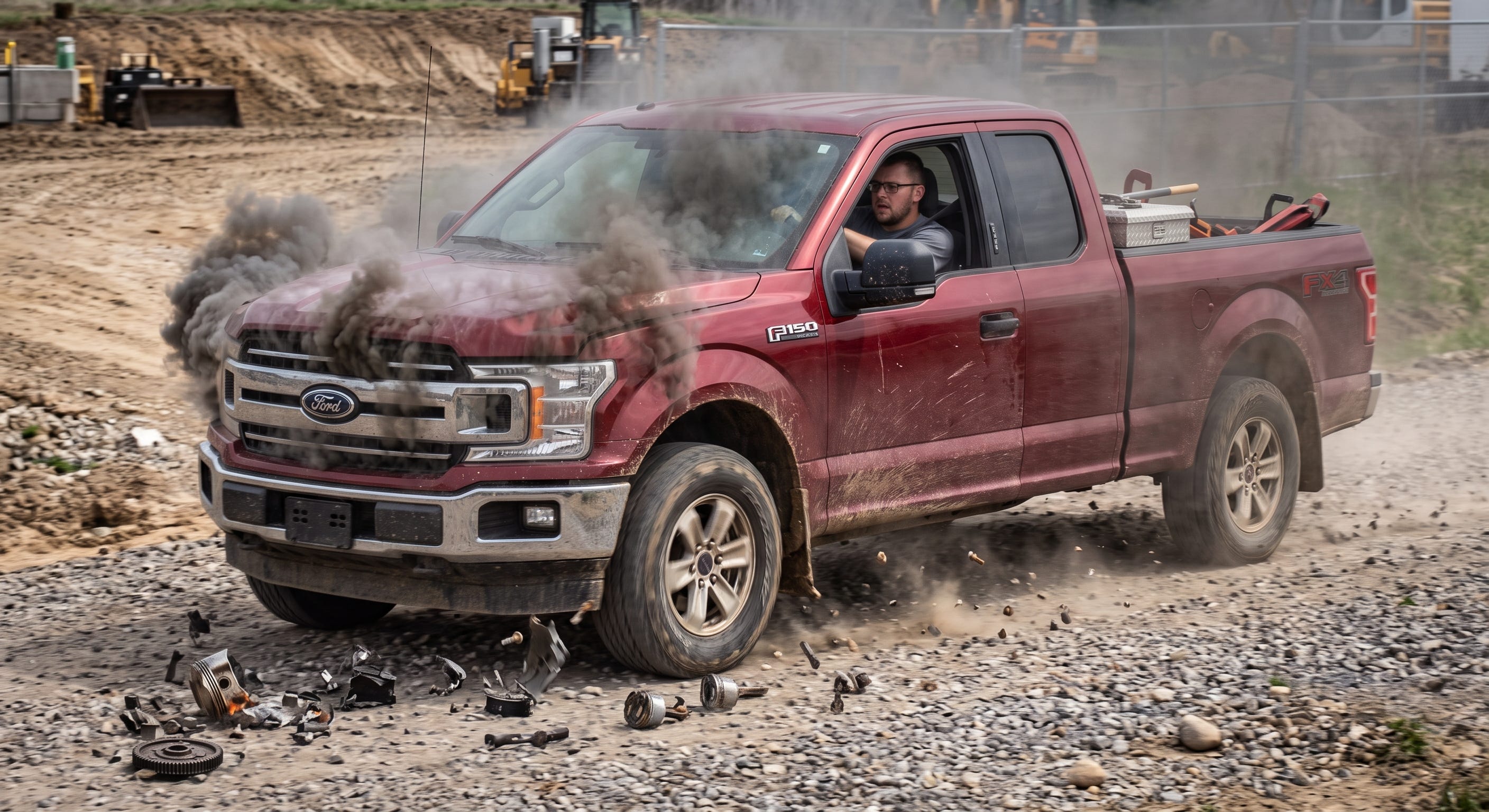
That first F-150 made it to about a hundred and twenty thousand miles before its timing system gave out. The cam tensioner let go, the engine ate itself, and a truck I had bought precisely because Fords were supposed to last forever became a paperweight in my driveway. It is, as it turns out, a famous way for that generation of Ford V8 to die: the plastic timing components fail, the chain goes slack, and one morning the motor simply stops being a motor. I was annoyed. I was also loyal. So in 2018 I did the exact thing Ford counts on people like me to do — I bought another one.
The 2018 F-150 cost me forty-six thousand dollars, more than double the 2006, and it carries Ford’s celebrated 3.5-liter EcoBoost V6, the engine the company parks at the top of its lineup and now forces on its most expensive trucks. At twenty thousand miles — barely broken in — it began to rattle on cold starts: the cam phaser knock, a sound like the engine is shaking a fistful of loose bolts before the oil pressure catches up. At thirty thousand miles the oil pan started to leak. Ford declined to cover the leak, and what I learned later is that it was not bad luck at all. It was a known factory defect on this exact engine — a warping plastic oil pan and a factory sealant job that Ford itself quietly revised on later trucks. As for the rattle, the dealer’s answer was a cam phaser program with no parts available, paired with the suggestion that I wait. So I waited, the way you wait when a company with a hundred and twenty years of accumulated goodwill tells you to. I waited right up to the edge of my coverage — at which point the same company decided that the problem it had told me to sit on was now mine to pay for. I called Ford directly. More than once. They told me, in the polite corporate dialect of it, to pound sand.
I am telling you this not because my trucks are special, but precisely because they are not. Two F-150s, a decade apart, two completely different engines — a Triton V8 and an EcoBoost V6 — and the very same family of timing failure, met both times with the very same corporate shrug. One owner’s bad luck is an anecdote. The identical failure twice, on the company’s flagship product, handled the identical way, is a policy.
The Rattle Was Never a Secret
The rattle in my 2018 is one of the most thoroughly documented engine defects of the past decade. The cam phasers on Ford’s second-generation 3.5-liter EcoBoost — the 2017 through 2020 F-150, along with the Expedition and Navigator that share the engine — fail in enormous numbers, producing exactly the cold-start knock I heard and, in the worst cases, damaging the variable-timing system and the engine around it. Ford knew. It put inferior parts into the engine, took years to acknowledge the problem, and took longer still to supply replacements that actually held. The federal safety regulator was concerned enough to open an investigation into power loss and engine failures on this very engine family. None of this is obscure. It is one of the defining stories of the modern F-150.
Here is the part that should send your blood pressure up. Ford did not issue a recall for the cam phasers. It issued a “customer satisfaction program” — a softer, quieter instrument that let the company cap coverage at roughly seventy to eighty thousand miles and characterize a failing engine component as a harmless “noise” that, in Ford’s telling, would not cause damage. Owners then watched their own extended-warranty companies cite that exact language to deny their claims, and watched four-thousand-dollar repair bills — the job requires lifting the cab off the frame — land in their laps for a defect Ford had known about for years. The oil leak followed the same script: a technical service bulletin instead of a recall, a quiet redesign of the part for future trucks, and coverage that conveniently evaporates the instant your powertrain warranty does. A bulletin fixes the next buyer’s truck on Ford’s terms. It does nothing for the owner whose warranty just expired on a defect that was built in at the factory.
And this is not some new failing that a chastened modern Ford has outgrown. The engine in my 2006 — the one whose timing components killed it at a hundred and twenty thousand miles — came from a generation of Ford V8s so notorious for timing failures that a class-action suit alleged Ford had known about the defects as early as 2005 and stayed quiet to avoid the warranty costs. Twelve years apart, two different engines, the identical posture: a known defect, a quiet fix for the next buyer, and a customer-facing strategy of deny, delay, and outlast the clock.
If you suspect that characterization is unfair, consider November 2024, when the National Highway Traffic Safety Administration fined Ford one hundred and sixty-five million dollars — one of the largest penalties of its kind ever levied — for failing to recall vehicles with defective rearview cameras in a timely manner. A federal safety regulator formally concluded that Ford sat on a known defect. What happened to me, twice, at the scale of one oil pan and two engines, is the same thing the United States government fined Ford a hundred and sixty-five million dollars for doing at the scale of millions.
A Recall Every Two and a Half Days
If the corporate posture is “don’t stand behind it,” the product is generous enough to keep that posture busy. In 2025 Ford issued one hundred and fifty-three recalls — the most any automaker has ever issued in a single calendar year, obliterating the old record of seventy-seven that General Motors set back in 2014. Those campaigns swept up nearly thirteen million vehicles, more than the next nine automakers combined. The F-150 and F-250 alone accounted for more than three and a half million of them. Run the arithmetic and Ford added a vehicle to a recall list roughly every minute of the year, around the clock, all year long.
To be fair, because being unfair is how you lose an argument you should win: Ford has a defense, and parts of it are real. A growing share of the volume is software that can be patched over the air, modern manufacturing tracks defects more granularly than the old methods could, and Ford was in fact the only major automaker to reduce its warranty costs last year. Fine. But better record-keeping does not explain a hundred-and-sixty-five-million-dollar fine for delay. And “the whole industry has this problem” is not a sentence you are entitled to say to the man whose engine is grenading itself in his own driveway after you told him to wait. A company is not the press release it issues about quality. It is what it does when the part fails and the phone rings.
The Price of Admission
Now hold my 2006 receipt up against the window stickers Ford prints today. Twenty thousand dollars in 2006. In 2018 I bought another F-150, brand new, for forty-six thousand. Today the King Ranch and the Platinum — the trucks that used to sit at the aspirational top of a working man’s ladder, the ones you worked your way up to — crested seventy-four thousand dollars. The average F-150 now carries a monthly payment north of nine hundred dollars. This is not happening in a vacuum: there is no longer a single new car sold in America under twenty thousand dollars, the average new vehicle runs around fifty thousand, new-car prices have climbed more than eleven thousand dollars since 2019, and nearly one in five new vehicles now carries a payment over a thousand dollars a month. The truck that was supposed to be the floor of American ownership has quietly become a luxury good.
Here is the part that should make every owner’s teeth itch. Even Ford’s price cuts are price hikes wearing a disguise. When Ford trimmed the sticker on some recent F-150s, it did it by taking the truck apart: smaller wheels, the deletion of the surround-view camera, the loss of Pro Trailer Backup Assist, a manual seat where a power seat used to live. When the 2026 King Ranch and Platinum stickers appeared to drop by thousands, it was because Ford had made four-wheel drive a thirty-eight-hundred-dollar option instead of standard equipment and slipped in a cheaper base seating package. You pay a little less for noticeably less. That is not a discount. That is shrinkflation with a tailgate, and they are counting on you to read the number and not the spec sheet.
They Took the V8 Out of the Truck
For three generations, the recipe for a high-end American pickup required a naturally aspirated V8 the way a steak requires fire. Ford has quietly pulled the 5.0-liter Coyote V8 from the King Ranch and the Platinum. Go to the configurator and try to order a V8 in either of Ford’s top half-tons; the answer is no. A Ford spokesperson confirmed it on the record. If you want eight cylinders, you are now sent down-market to the XL, the STX, the XLT, the Lariat, or the Tremor — anywhere but the trims with the cowboy names and the cattle-brand badges.
What makes the choice so revealing is the direction of the herd. Ram killed its Hemi and the backlash was so fierce it brought the engine back. General Motors is rolling out a fresh generation of small-block V8s for its trucks. Ford, alone, walked the other way. The V8 take rate did slide — from nearly sixty-five percent of registrations in 2020 to somewhere around thirty-eight percent — but a company that believed in its product would have fought for that engine. Ford instead used the slide as cover to delete the V8 from its halo trucks entirely, a decontenting-and-emissions maneuver dressed up in the language of consumer choice. The most American thing about the most American truck, gone from the most expensive versions of it, and not because a single customer asked.
The Thirteen-Billion-Dollar Lightning
Then there is the electric truck, which is the part of this story where you can actually watch the leadership miss by an order of magnitude in real time. Ford tooled the Rouge to build a hundred and fifty thousand F-150 Lightnings a year. In October 2025 it sold roughly fifteen hundred of them — against something like sixty-six thousand gasoline F-Series in the very same month. Ford’s Model e division lost three and a half billion dollars in 2025 and roughly thirteen billion since 2023. The company wrote off nearly two billion canceling a three-row electric SUV, and it has now simply ended production of the current-generation Lightning altogether.
I want to be careful here, because betting on electric vehicles was not a sin. Plenty of serious people misjudged that market. The sin is in who was made to pay for the miss. Not the executives who placed the bet. The workers paid, in jobs and shifts. The customers paid, in a gasoline truck that grew more expensive and less generous while the company chased a forecast that never materialized, and in the simple fact that the institutional attention which should have been lavished on the truck people actually buy was instead poured into the one they didn’t. When you bet the ranch and lose, an honorable company eats the loss at the top. Ford served it to the bottom.
They Replaced the Workers Before the Machine Worked
Here is where this stops being a story about my truck and becomes a story about the country. This month Ford admitted something genuinely extraordinary, and then tried to dress the admission up as hard-won wisdom. Over the past three years it has rehired, newly hired, or promoted some three hundred and fifty veteran engineers — the people the company itself nicknames the “gray beards” — because the artificial intelligence and the automated quality systems it had leaned on could not match human expertise. The hiring push helped Ford take the top spot among mainstream brands in the J.D. Power Initial Quality Study for the first time since 2010, and Ford now expects the effort to shave roughly a billion dollars off its costs this year through lower warranty and recall spending.
The executives’ own words are the most damning part. “Mistakenly,” Ford’s vice president of vehicle hardware engineering told reporters, “we thought that by just introducing artificial intelligence and ingesting the design requirements that we had, that would produce a high-quality product.” And then, the line that should be cross-stitched and hung in every boardroom in America: “Artificial intelligence is a fantastic tool, but it’s only as good as the information you use to train it.” The company’s chief operating officer described leaning more and more on automated quality systems with disappointing results, and then bringing back technical specialists to, in his phrase, hunt for failure points before a part ever reaches the plant floor.
I build AI systems for a living. I ship them into production. So allow me to translate the executive dialect into plain English. The model is only ever as good as the data — and the data, in this case, was the accumulated judgment of the people who had spent entire careers learning how a truck actually breaks. Ford was so eager to automate those people away that it let them walk out the door before it had captured what they knew. Then it was shocked, shocked, to discover that the machine could not conjure expertise that no one had bothered to write down. That is not an artificial intelligence failure. The AI did exactly what AI does. It is a contempt-for-workers failure, and the contempt came first. They torched the institutional knowledge to chase the machine, and the machine was only ever a mirror of the knowledge they torched.
And now the detail that turns embarrassment into something closer to indictment. In June 2025, on a stage at the Aspen Ideas Festival, Ford’s own chief executive Jim Farley declared, with no hedge and no caveat, that “artificial intelligence is going to replace literally half of all white-collar workers in the U.S.” Twelve months later his company was quietly paying to bring back the workers that artificial intelligence had failed to replace. The man who stood up and told America that half of its knowledge workers were obsolete was, at that very moment, presiding over the single most expensive live experiment proving the opposite — inside his own factories, on his own assembly lines, with his own gray beards. He simply neglected to mention that part from the stage.
What Henry Ford Understood
There is a reason the name on the building is Ford. In January 1914, Henry Ford did something his peers thought was insane: he more than doubled his workers’ pay to five dollars a day and cut the workday to eight hours. He did it in no small part to stop the ruinous turnover that was bleeding his assembly lines, and I am not going to pretend it was an act of pure benevolence. Let it be said plainly that Henry Ford was also a vicious antisemite who published hate by the volume and accepted a medal from Nazi Germany, and not one thing about the man deserves to be romanticized. But even Henry Ford, carrying all of that, grasped a single truth that his well-tailored successors have managed to forget: a company that does not pay its own workers enough to buy its own product is quietly strangling itself. The five-dollar day turned Ford’s laborers into Ford’s customers. The factory and the driveway were two ends of the same economy.
Now look at the arithmetic that has replaced that idea. In 2024 — a year in which Ford achieved exactly none of its own internal quality targets — Jim Farley took home roughly twenty-five million dollars, about two hundred and fifty-three times the pay of the median Ford employee. The following year, after the gray beards he had been so willing to let walk out the door came back and fixed the quality with their hands and their memory, his compensation rose to twenty-seven and a half million, the highest of his entire tenure. The workers repaired the truck. The chief executive collected the bonus. And the median Ford employee, earning around ninety-eight thousand dollars a year, is supposed to buy a seventy-four-thousand-dollar King Ranch — the one they took the V8 out of — how, exactly? The factory and the driveway are no longer two ends of the same economy. They are not even on the same map.
This Is the Strategy, Not the Accident
You might be tempted to tell yourself that all of this is just drift — a great old company getting sloppy and arrogant the way great old companies do. It is not drift. It is a plan, and the plan has a thesis. This very week the consultancy Bain & Company published a forecast that the United States auto market could shrink by more than two million vehicles a year by 2040, driven by falling birth rates, prices ordinary families simply cannot carry, and younger Americans who increasingly reach for a ride-hailing app instead of a car payment. Buyers over fifty-five already account for nearly half of new-vehicle registrations; the share going to anyone under thirty-five is sliding below ten percent. The people who will turn sixteen in 2040 have already been born, which means the shrink is, in the cold language of demography, already locked in.
When the pie stops growing, a company faces exactly two choices: fight to feed more people, or feed fewer people more expensively. Ford has chosen the second, and once you see it, you cannot unsee it. Every single thing in this essay — the seventy-four-thousand-dollar cowboy trucks, the decontented “price cuts,” the V8 pulled from the halo trims, the workers traded away for machines that were not ready, the warranty stonewalling that outlasts the customer — is what it looks like when a company quietly decides that the American working man is a declining, low-margin demographic and repositions itself around the affluent retiree who will happily pay for quilted leather and a driver-assistance subscription. It is a coherent strategy. It is also, unmistakably, a bet against the very people who built the company, placed in the hope that they will not notice until the financing renews.
The Sound the Company Makes
So let me answer the question I started with. Is this how an American company acts? The honest answer is that this is how a company acts once it has stopped believing it owes anything to the people who made it. It outlasts their warranties. It prices out their children. It guts the engine that gave the truck its character and its voice. It torches its own workers’ knowledge to chase a machine it bought before the machine could do the job, and when the machine fails, it brings the workers back to clean up the mess and hands the executive who showed them the door a raise. It stands on a stage and tells the country that half of us are obsolete, and then quietly demonstrates that it cannot build a quality truck without us.
The rattle in my 2018 — a truck that should still be in its prime — is the sound of an engine running on borrowed time, held together by the expertise of people Ford no longer wishes to pay. It turns out the company makes precisely the same sound. The death rattle was never coming only from under the hood. Listen closely, past the press releases and the J.D. Power trophy and the talk of tailwinds, and you can hear it coming from Dearborn.
About the Author
Gal Ratner is the founder and CTO of Inverted Software and WhiteStar Labs and Chief Architect at Prana Entertainment, with nearly thirty years of production engineering experience across clients including Microsoft, Sony, Rockstar Games, 2K Games, Best Buy, and Allegiant Air. He builds agentic AI systems in production — MCP servers, the Microsoft Agent Framework, SQL Server 2025 vector search, and RAG pipelines — and writes adversarial, practitioner-first commentary on technology, business, and the widening gap between what executives promise from a stage and what actually ships off a line. He is the author of the novel The Archive of Lost Suns. He has owned two Ford F-150s. He is not buying a third.