


The original AI search bot is dead. Long live the original AI search bot.
On May 1, 2026, Ask.com—the search engine that was once Ask Jeeves—went dark. The farewell note on the homepage was short and almost apologetic. “Every great search must come to an end,” it read, before thanking the engineers, the designers, and the millions of users who showed up over the last twenty-five years.
Nobody noticed for about a day. Then the obituaries started trickling in. Then a stranger thing happened: people on LinkedIn, on X, in the back channels of Slack workspaces—grown adults, professionally serious people—started getting weirdly emotional about a cartoon butler who used to take questions in plain English on a 56k modem.
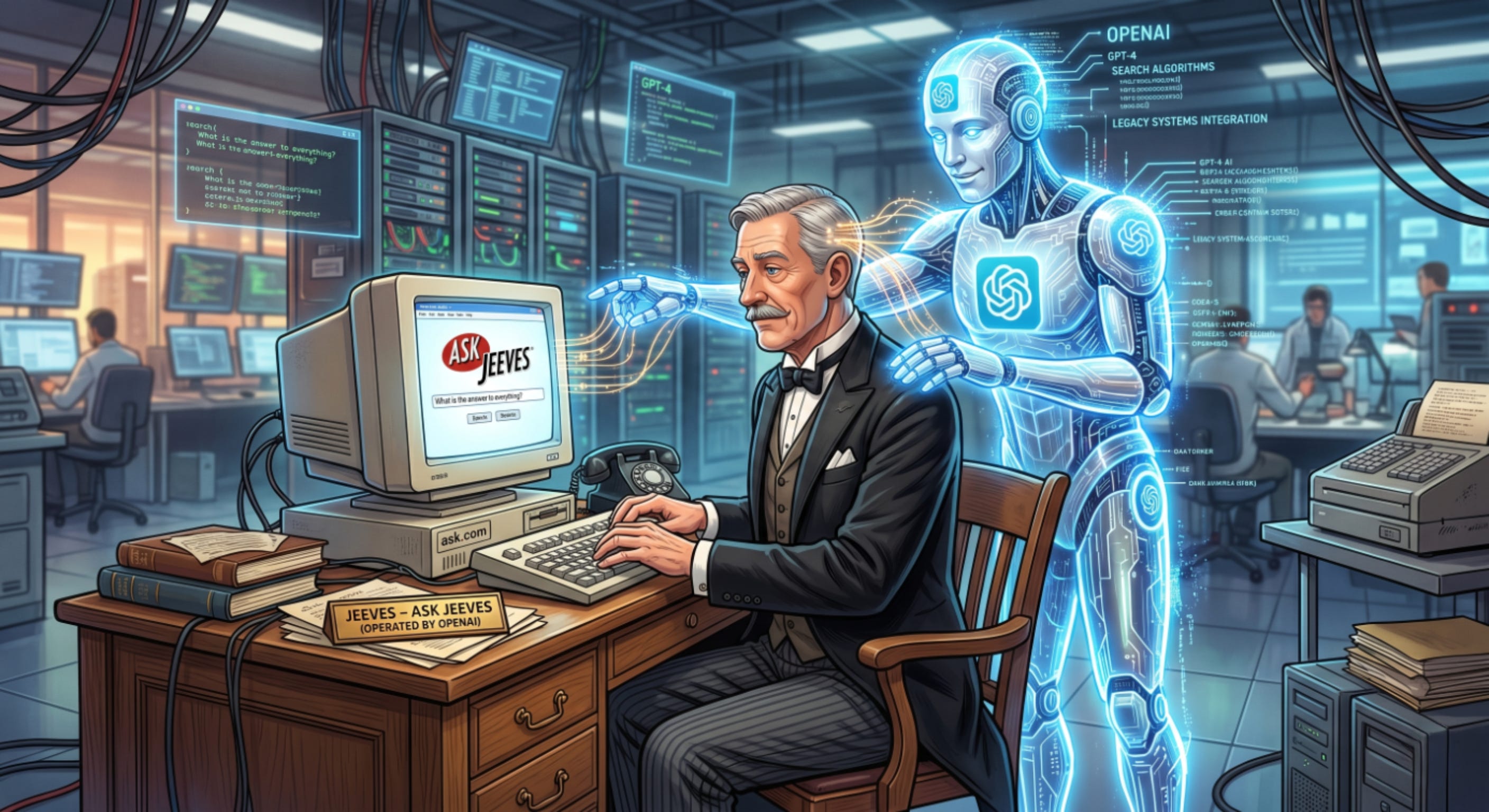
Here is the part nobody quite wants to say out loud: Jeeves was right. Thirty years too early, sure. Stomped flat by Google’s PageRank, sure. Strangled in middle age by toolbar bundling, absolutely. But on the core idea—that you should be able to type a sentence into a machine and have the machine just answer it—Jeeves nailed the brief in 1996.
Every conversational AI you use today is, in some sense, Ask Jeeves with better hardware and a real budget.
So before we throw dirt on the grave, let’s actually tell the stories. They’re better than you remember.
The butler was named after a butler
The real Jeeves is a fictional valet from a series of comic stories by P.G. Wodehouse—what Wodehouse called “a gentleman’s personal gentleman”—who serves the spectacularly inept Bertie Wooster and routinely outwits his employer with an air of brittle British competence. When venture capitalist Garrett Gruener and software engineer David Warthen sat down in Berkeley in 1996 to invent a new kind of search engine, they decided the metaphor was perfect: the web should answer you the way a good valet would. Discreetly, knowledgeably, without making you feel stupid for not knowing where you put your hat.
The original code was written by Gary Chevsky. The brand was a literary reference most of its eventual users never caught. The company was incorporated in June 1996, almost exactly two years before two Stanford grad students named Larry Page and Sergey Brin filed Google’s first patent application.
Sit with that for a second. Ask Jeeves launched a public beta in April 1997. Google.com didn’t exist as a registered domain until September 1997. For roughly eighteen months, “ask the internet a question in plain English and get an answer” was a more developed product than “type keywords into a clean white box.”
History is unforgiving about who finished first. It only remembers who shipped at scale.
The IPO that should have been a warning sign
Ask Jeeves went public on July 1, 1999. By contemporary accounts, it was the third best first-day IPO performance in business history at that point—the kind of debut where bankers high-five each other and CNBC anchors lose composure on live television. The stock peaked at $190 a share later that year. The company’s CEO, Robert Wrubel, became famous in the way people became famous in 1999: briefly, expensively, and on the cover of magazines that no longer exist.
Ask Jeeves spent that money the way every dot-com spent that money. They bought Super Bowl-adjacent ad inventory. They paid for a four-story Jeeves balloon to float down Central Park West in the Macy’s Thanksgiving Day Parade from 2000 through 2004, complete with what the company called the “golden keys of knowledge” clutched in his white-gloved hand. They printed stickers on bananas and apples and oranges in real supermarkets reading “How many calories in a banana?” alongside the URL.
Yes. Real bananas. Yes, in real supermarkets. The marketing strategy was to make Jeeves so culturally inescapable that grandmothers asked produce stickers for help.
Then the bubble burst. The stock cratered. The company spent the next several years trying to figure out what it actually was.
The dirty secret under the hood
Here’s the part that doesn’t make it into the nostalgia pieces: the early Ask Jeeves wasn’t really doing the magic. The natural-language interface was a slick front-end. The backend was a hand-edited list of canned answers stitched together with a deeply mediocre crawler. When you asked Jeeves a question and Jeeves came back with something useful, it was usually because some human in Emeryville had personally written that answer. When you asked Jeeves something nobody on staff had thought of, Jeeves did what every search engine of the era did. Badly.
Google ate them because Google had an algorithm. A real one. Ask Jeeves had a butler.
In September 2001, Ask Jeeves bought a small Rutgers spinoff called Teoma for around $1.5 million. Teoma had legitimate ranking technology—a different approach than PageRank, focused on subject-specific authority within communities of related pages. For a brief, genuinely competitive moment in the early 2000s, Ask was actually credible on raw search quality. But “we have a slightly different algorithm than Google” is not a market position. It’s a footnote.
In July 2005, Barry Diller’s IAC bought the entire company for $1.85 billion. By February 2006, the Jeeves character was retired, the site was rebranded simply as Ask.com, and the butler was banished—except for a small UK redoubt where, for some reason, a CGI Jeeves hung on as the local mascot until 2016. Like a kindly grandfather you keep on life support out of guilt.
“The algorithm killed Jeeves”
This is my favorite story in the whole catalog.
In 2007, IAC ran one of the strangest billboard campaigns in tech advertising history. The agency was Crispin Porter + Bogusky—the same shop that gave the world Burger King’s “Subservient Chicken” weirdness. They papered New York, San Francisco, and Los Angeles with cryptic black-and-blue posters. The first wave said only this: “The algorithm killed Jeeves.”
No URL. No logo. No context. Just a vaguely menacing announcement that someone had murdered a beloved cartoon butler.
The follow-ups got weirder. “The algorithm is from Jersey.” “The algorithm is banned in China.” Industry blogs spent weeks trying to decode them. Was this Google making a flex? Was this a stealth startup? Was a deranged math professor on the loose somewhere on the I-95 corridor?
It was Ask.com. The company was bragging—apparently—that it had killed its own mascot in order to take search seriously. The campaign is a perfect monument to the era’s confusion about what Ask actually was. It had a beloved brand it had retired, an algorithm nobody trusted, and a market position nobody could articulate. So it ran billboards confessing the murder of a fictional butler and waited for people to be intrigued.
People were not intrigued. They were just confused.
The toolbar era, or: how Jeeves became malware
This is the part of Jeeves’s life that nobody likes to talk about. After 2010, Ask was no longer a competitive search engine—Diller publicly admitted at TechCrunch Disrupt that year that Ask wasn’t valued in IAC’s stock—and the company quietly outsourced its search backend to third parties and laid off most of its engineers. So what was Ask, exactly?
Ask was a toolbar.
For years—I mean literal years—every Java update on Windows would slip in a checkbox, pre-checked, asking if you’d like to install the Ask Toolbar. Millions of people clicked through Java security updates without reading the fine print and ended up with Ask hijacking their default search engine, their browser homepage, and a small but real chunk of their CPU. The OS X version started shipping the same way in 2015. In June of that year, Microsoft formally classified older versions of the Ask Toolbar as malware and instructed Windows Defender to remove them on sight.
A search engine that had once been the friendly face of the internet was now on Defender’s hit list. And it kept making money this way. That’s the brutal economic reality of late-stage Jeeves: a once-iconic brand had become, by the mid-2010s, mostly a parasitic install bundle.
The butler was selling timeshares.
The cosmic irony of Jeeves’s timing
Ask.com shut down on May 1, 2026 at almost exactly the moment when “ask a computer a question in plain English and get a useful answer” became the single most lucrative product category in the technology industry.
ChatGPT. Claude. Gemini. Perplexity. The AI search wave is doing what Jeeves promised in 1997, except now it actually works, because we finally have transformer architectures and a few trillion tokens of training data and the GPUs to make the math run.
Jeeves had the right product vision in the wrong decade with the wrong technology, the wrong unit economics, the wrong distribution, and the wrong cofounders for the moment. He was right about the user. He was wrong about everything else.
Markets do not reward you for spotting the future. Markets reward you for shipping the future—at the right cost, on the right hardware, in the right decade, through the right distribution channel.
This is the lesson, and it is a brutal one for founders. Friendster spotted social. MySpace spotted personalization. Sixdegrees.com spotted the network. Jeeves spotted conversation. None of them got paid. The companies that got paid were the ones that showed up later with better engineering and better economics and a more disciplined sense of when to scale.
Being correct about user intent is necessary. It is not even close to sufficient.
So long, you ridiculous, prescient butler
I am not going to pretend I used Ask.com much in the last decade. I am not going to pretend I used it much in the decade before that, either. By the time I was building anything serious on the web, Google was the default and Jeeves was a punchline.
But I will admit this: the first time I ever typed a full English sentence into a computer and got back something resembling a real answer, it was 1998, I was sitting in front of a CRT monitor that weighed more than my motorcycle does now, and the answer came back addressed to me by name from a cartoon valet in a green waistcoat.
That is a memory worth marking, if only because the entire trillion-dollar industry currently reshaping every white-collar job in the world is, deep down, just Jeeves at scale. The dream was always conversation. The dream was always that the machine would meet you where you spoke. We just needed thirty years of compute and a few hundred billion in capex to get there.
IAC says every great search must come to an end. I’d argue the search Jeeves started never actually ended. It just changed butlers.
Gal Ratner is the CTO of WhiteStar Labs and writes regularly on AI, software architecture, and the messy economics of the technology industry. Subscribe for more.