


In 1995, a man who sold pillows for a living wrote the first check into Amazon.com.
That is not a rhetorical device. Nick Hanauer had a philosophy degree from the University of Washington and a job at Pacific Coast Feather Company, his family’s bedding manufacturer in Seattle. He had also co-founded a picture-framing franchise. On the day he decided to fund what would become the largest retailer in human history, his track record as a startup investor consisted of no startup investments. He was the first money into Amazon that did not share Jeff Bezos’s last name, and the reason he mattered was not his wealth or his network. It was that nobody else in the round would move until somebody moved, so he wrote his own check to break the logjam.
The second man was a lawyer. The third was a stockbroker who thought the valuation had been invented out of thin air. The fourth asked his father — a man who had spent an entire career in book publishing, the only person in this story with genuine domain expertise — whether he should put money into an online bookstore. His father told him not to. He invested anyway.
That is the founding syndicate of Amazon.com. Not Sand Hill Road. Not a hedge fund. A pillow executive, a telecom lawyer, a skeptical broker, and a quant whose dad said no.
I went looking for this story because I suspected something else entirely. I assumed Bezos got funded because he had spent four years at D. E. Shaw and could call in favors from Wall Street until the internet caught up to him. It is a tidy theory. Amazon took years to turn a profit while better-known names died in the wreckage, and the obvious explanation is that Bezos simply had deeper pockets to raid than everyone else. The theory is wrong, and the way it is wrong is more interesting than the theory.
The Round That Almost Didn’t Happen
Bezos has been unusually blunt about this. He took sixty meetings to raise a million dollars. Roughly twenty investors eventually wrote checks of about fifty thousand dollars each, in exchange for twenty percent of the company. It took the better part of a year. He has called it, flatly, the hardest thing he has ever done, and has said the whole enterprise could have ended before it started. The first question most investors asked him was what the internet was.
Forty of those sixty meetings were rejections. Lots of people passed, including a couple of small Seattle venture firms that looked at it and decided it was too risky. His original ask was a six million dollar valuation. He got talked down to five.
If connections were the mechanism, this is the easiest million dollars in American business history. Instead it is a year of grinding, a forty-out-of-sixty rejection rate, and a founder telling his own mother she would probably lose everything.
Consider what did not happen. D. E. Shaw did not fund Amazon. David Shaw, who had personally discussed the concept of an internet store selling nearly everything with Bezos inside DESCO’s offices — and who confirmed as much to the New York Times Magazine in 1999 — did not write a check. Shaw had capital, a firm full of quants, and the same idea in the same room in the same year. What he actually built out of his internet exploration was Juno and a financial services subsidiary called FarSight, which he sold to Merrill Lynch. The man best positioned in the world to fund the everything store, who understood exactly why it would work, built an online brokerage instead.
Bezos’s Wall Street network did not fund Amazon. His Wall Street network was, for this purpose, worth almost nothing.
Who Actually Wrote the Checks
Start with the family, because it is the largest single piece and the part most people skip. Mike and Jackie Bezos put in $245,573 in 1995. Mike was an Exxon engineer who had arrived in the United States from Cuba at sixteen. Jackie had been a teenager when Jeff was born. That check was roughly a quarter of the entire round, and it represented a serious portion of their savings. Their son told them there was a seventy percent chance they would never see the money again. They wrote it anyway. Bloomberg later estimated the position at around thirty billion dollars.
Bezos himself seeded it with ten thousand dollars and followed with roughly eighty-four thousand more in interest-free loans over the following year.
Nick Hanauer, the pillow man, came next. He was the first non-family investor and served as an advisor until 2000. He is also the connective tissue of the whole round — he is the one who helped Bezos get in front of the sixty people, and, per the accounts, the one who finally converted commitments into money by going first himself.
Tom Alberg is the name that ended up on the S-1. He was born in 1940, went to Harvard and Columbia Law, practiced at Perkins Coie in Seattle, and became president of McCaw Cellular. In 1995 he had just opened Madrona with Bill Ruckelshaus, Paul Goodrich, and Jerry Grinstein, and it is worth hearing how he described that operation at the time: they were going to invest in companies, do some consulting, look at private equity and big things, and none of it ever worked out. Madrona was an office with some accomplished men in it. It was not yet a fund.
The way Alberg got to Bezos is the detail that should end the connections theory permanently. Another lawyer in town called him and said, in substance, you are the internet expert — which Alberg says he was not — and asked him as a favor to evaluate this Bezos kid on behalf of a small angel group that had already met him and did not understand this internet thing. Alberg took the meeting reluctantly. He liked physical bookstores. He did not decide on the spot; he said let us see how it goes when you launch, and later made his investment contingent on Bezos closing the entire million. Part of what moved him was that he had recently gone to his own neighborhood bookstore looking for a Peter Drucker title and could not find it. And the angel group that sent him in to do the diligence? They passed anyway, over the valuation. Alberg went on to sit on Amazon’s board from 1996 until 2019.
Eric Dillon was a Seattle stockbroker. He thought six million dollars was a number Bezos had pulled out of the air, and said so, until Bezos sat him down and walked him through what other internet companies were asking for. Dillon negotiated him to five million and invested.
And then there is Bob Gelfond, who is the one genuine D. E. Shaw thread in the entire round. Gelfond was DESCO’s director of international trading and one of the colleagues who flew to Bezos’s 1993 wedding. He was a first-round Amazon investor. He later founded MagiQ Technologies, and Bezos returned the favor as an angel. Gelfond is also the man who consulted his father — a book publishing veteran — and was told this was a bad idea, and wrote the check regardless. One DESCO friend, out of sixty meetings. That is the entirety of the Wall Street pipeline into Amazon’s cap table.
The Kleiner Perkins money everyone remembers arrived in June 1996, a full year after launch, and it was eight million dollars for thirteen percent at a sixty million dollar valuation. Trivial money by the standards of the era. It came after Amazon had already gone from $511,000 in 1995 to $15.7 million in 1996, and John Doerr had to outbid General Atlantic for the privilege. The traction bought the capital. It did not work the other way around.
Why There Were No Professionals in the Room
Here is the part that should matter to anyone who has ever tried to raise money without a warm introduction. The reason Amazon’s founding investors look like a bowling league instead of a venture syndicate is that in 1995, in Seattle, there was no professional early-stage internet investor to get to. Sand Hill Road was in California and was not looking north. Seattle capital was Microsoft alumni, McCaw alumni, and old family businesses. The couple of small local venture firms that did exist looked at Amazon and said no.
So the mechanism was not a network activating. It was one friend from the old job, a family that could absorb a total loss, and then serial cold referrals through a mid-sized city’s business community, where a lawyer vouches to a lawyer, a bedding executive primes the pump, and a stockbroker haggles you down a million dollars in valuation. Sixty meetings. Forty noes. A year.
What Bezos had was not access. It was an anchor investor, a credential that bought him a second meeting, and one number that a skeptic could check.
That number is the whole pitch, and it is the reason Alberg moved. Bezos projected that Amazon could turn the equivalent of an average bookstore’s inventory twenty times a year, against 2.7 turns for a physical store, and he had the details to support it. He did not sell the internet. He did not sell vision. He sold a single structural asymmetry, expressed as arithmetic, to a man who did not want to believe him.
The Path to Profit Was Longer and Weirder Than the Legend
Amazon’s unprofitability is real and it is the load-bearing beam of every cynical account of the company. It is also almost always misdescribed. Amazon lost $5.78 million in 1996 on $15.7 million of revenue. That is not a bonfire; that is a rounding error at a mid-sized consultancy. The company went public in May 1997, twenty-two months after launch, at eighteen dollars a share, raising fifty-four million dollars at roughly a $438 million valuation. From that point forward Amazon was funded by public shareholders and bondholders, not venture capital. Its only pre-IPO institutional round was Kleiner’s eight million.
Then there is the mechanism nobody wants to talk about because it is unglamorous. Amazon charged the customer’s card the moment the order went through, and settled with book distributors on terms measured in weeks or months. The result was a persistently negative cash conversion cycle, in the neighborhood of negative thirty days, meaning suppliers financed Amazon’s growth rather than investors. Bezos told Alberg about the inventory turns; what he was really describing was float. When people say Amazon burned other people’s money for years, a meaningful share of that money belonged to Ingram and Baker & Taylor, and the arrangement was structural, deliberate, and legal.
The actual near-death is a narrower window than the folklore suggests, and it comes down to about four weeks. Barron’s ran the famous “Amazon.bomb” cover in May 1999. In June 2000, Lehman’s Ravi Suria published a credit analysis arguing Amazon was going to run out of money, and the bonds traded down toward twenty cents on the dollar. But on February 11, 2000, Amazon had already priced roughly €690 million of 6.875% convertible subordinated notes — about $672 million — through Morgan Stanley, CSFB, and DLJ, in London, on worse terms than any prior raise. The NASDAQ peaked on March 10. Harvard Business Review has been blunt about what that means: had the bubble burst a few weeks earlier, one of the most successful companies in history might simply have died. Bezos’s own framing is unsentimental — they did not need to go back to the capital markets, because they already had the money.
Four weeks is inside the noise band. Anyone telling you Amazon’s survival was foreordained is selling something. But notice what the edge actually was. It was not a phone call to a friend. It was knowing how convertible subordinated debt works, knowing the European market would take paper the American market would not, and knowing to do it in February instead of June. That is transferred expertise from a quant fund, and it is the single most valuable thing Bezos carried out of D. E. Shaw. It is talent. It is just not the kind anybody puts in the hagiography.
Then he executed. January 2001: thirteen hundred jobs cut, about fifteen percent of the workforce, distribution centers closed. Q4 2001 produced the first profit, five million dollars on $1.12 billion of revenue. The first full profitable year was 2003, $35.3 million on $5.26 billion. Free cash flow went from negative $170 million in 2001 to positive $135 million in 2002. It took six and a half years from launch and four and a half from IPO. That is not an outrage. For a capital-intensive retail buildout, that is roughly on schedule.
The Pivot That Actually Built the Company
In November 2000, at the worst possible moment, Bezos put third-party sellers directly onto Amazon’s own product detail pages, over internal objections that it would cannibalize the retail business it was designed to compete with. It did cannibalize it. By the third quarter of 2025, third-party sellers accounted for sixty-two percent of units sold on Amazon.
And in 2006 came AWS, which has no relationship whatsoever to outlasting Pets.com. Here is the number that should reframe the entire Amazon story: in fiscal 2025, AWS produced $45.6 billion of segment operating income against $29.6 billion for all of North America retail, out of roughly $80 billion in total operating income on $716.9 billion of revenue. Roughly eighteen percent of Amazon’s revenue generates about fifty-seven percent of its profit. Amazon did not win by being the last e-commerce site standing. It won by becoming a landlord and a utility company while everyone was arguing about books.
Your Margin Is My Opportunity, Applied to You
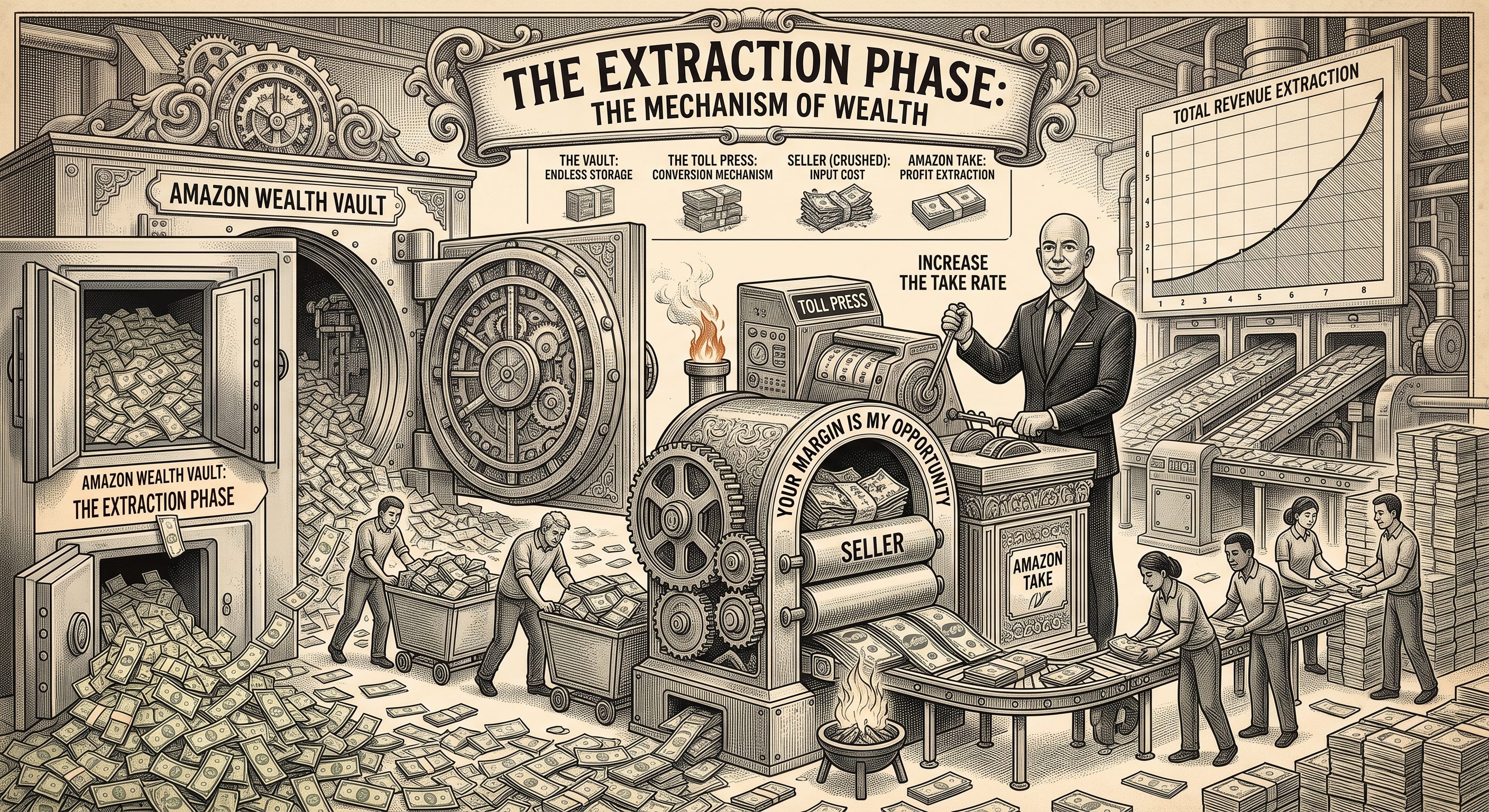
Bezos’s most famous line was that your margin is my opportunity. It was aimed at incumbent retailers, and for twenty years it read as a promise to consumers. It has since been redirected at the people who sell on his platform, and the numbers are not ambiguous.
Marketplace Pulse has tracked the total cost of selling on Amazon for a decade. In 2016 the average seller handed Amazon 35.2 percent of every sale. By 2022 the figure crossed half for the first time, at 51.8 percent. Today a typical private-label seller pays somewhere between fifty and sixty percent of revenue back to Amazon across referral fees, fulfillment, storage, and advertising. Bloomberg’s illustration is a two hundred dollar fire pit of which Amazon takes a hundred and twelve. In 2024 Amazon booked more than $150 billion in revenue from seller fees alone, up seven percent year over year — a business substantially larger than AWS.
Amazon’s defense is that advertising and fulfillment are optional. In practice, the Buy Box is where roughly ninety-eight percent of Amazon sales happen, Prime eligibility has historically been conditioned on using Amazon’s own fulfillment, and search placement is bought. Optional in the sense that breathing is optional.
Watch what that extraction is doing to the seller base. Active sellers on Amazon.com fell from 584,000 in January 2025 to 500,000 by March 2026. New seller registrations came in at 165,000 in 2025, the lowest since Marketplace Pulse began tracking in 2015 — down forty-four percent year over year and down seventy-three percent from the 2021 peak. Fewer than eight thousand sellers now generate half of Amazon’s estimated $300 billion in U.S. third-party GMV, down from fifteen thousand less than three years ago. Half of surveyed sellers name platform fees as their top margin pressure. Only about a quarter are doing anything to reduce their Amazon dependence, because Amazon controls thirty-six percent of U.S. e-commerce and seventy percent of marketplace commerce, which makes it less a channel than a condition of existence.
And the fees keep finding new surfaces. In November 2025 Amazon announced it would charge third-party software developers $1,400 a year starting January 31, 2026, plus usage-based API fees from April 30 — a toll on the tools sellers need to operate on the toll road. Those costs land on sellers through their vendors’ price increases. Amazon has now monetized the software layer of its own ecosystem.
The Price Floor
Here is where it stops being a story about margins and starts being a story about everyone’s prices.
In September 2023 the FTC and seventeen state attorneys general — now nineteen — sued Amazon for illegal monopoly maintenance. The agency’s own description of the core allegation deserves to be read slowly: anti-discounting measures that punish sellers and deter other online retailers from offering lower prices, keeping prices higher for products across the internet. Not on Amazon. Across the internet.
The alleged mechanism is simple and brutal. If Amazon detects that a seller is offering the same item cheaper on Walmart, Target, eBay, Chewy, Best Buy, Home Depot, or the seller’s own website, Amazon can bury that seller in search results until they are effectively invisible, or strip them of the Buy Box. Faced with that, sellers do the only rational thing: they raise their prices everywhere else to match Amazon. The complaint describes sellers who raise prices on rival platforms to avoid punishment, sellers who never attempt a discount out of fear, and sellers who abandon rival marketplaces entirely. One seller, of a cat toy called the Ripple Rug, was reportedly given the choice and chose to raise the price.
In April 2026, California Attorney General Rob Bonta secured the public release of a largely unredacted injunction filing in the state’s own 2022 case. It alleges Amazon flagged rival prices as little as one cent lower and told sellers to fix, correct, increase, or raise their prices on competing sites, and that Amazon enforced parity at the wholesale level through minimum-margin arrangements — the effect being that Amazon’s platform fees translate into higher prices everywhere, including at retailers that charge no such fees. California’s complaint calls the result a vicious anticompetitive cycle in which everyone except Amazon loses.
Then there is Project Nessie, the internal algorithm the FTC alleges identified products where rivals were likely to follow a price increase, raised those prices, and waited for the market to move up behind it — overcharging shoppers both on and off Amazon. The FTC alleges Amazon switched Nessie off during periods when the press was paying attention to its prices, and back on when the attention faded. Amazon says it was a tool to prevent price-matching spirals and that it was discontinued in 2019.
The bodies are real. Jet.com abandoned its low-price strategy within months of launch. Zulily, which had the audacity to display Amazon’s prices next to its own lower ones, watched its traffic collapse and liquidated in 2023. A federal judge in Seattle let the core claims proceed in 2024, ruling that systematically tracking and matching rivals’ prices can plausibly violate the Sherman Act even without collusion, if done with anticompetitive intent. The bench trial is scheduled for early 2027.
So did Amazon cause inflation? No — inflation is a monetary phenomenon and blaming one retailer for it is the kind of claim that gets you dismissed by anyone who has read an economics textbook. But the honest version of the charge is worse than the sloppy one. What Amazon is credibly accused of doing is installing a floor under retail prices across the entire internet, and then collecting fifty percent of what sits on top of that floor. Merchants cannot discount to compete, because discounting on any channel is punished on the channel that determines their survival. Their Amazon costs are therefore baked into what you pay at Walmart, at Target, and on the seller’s own site. That is not inflation. That is a private tax with an enforcement mechanism, and unlike inflation, it does not come down when the Fed raises rates.
The company’s own words on the subject are worth savoring. In its 2026 fee announcement, Amazon reassured sellers that its fee changes are significantly less than inflation. The toll booth would like you to know that it raises its rates responsibly.
The Iliad Flow
On September 25, 2025, three days into trial, Amazon agreed to pay $2.5 billion to settle FTC claims that it tricked customers into Prime subscriptions and made cancellation deliberately punishing. One billion in civil penalties — the largest ever in an FTC rule-violation case — and $1.5 billion in refunds, the second-largest restitution award in the agency’s history. Roughly thirty-five million consumers were affected. Two executives were personally named in the settlement.
The discovery record is the part that should stop you. Amazon’s internal name for the Prime cancellation process was the Iliad Flow, after Homer, because it was long. Employees described Prime enrollment as a bit of a shady world and unwanted subscriptions as an unspoken cancer. An internal email referred to an executive as the chief dark arts officer. Amazon initially withheld seventy thousand documents under attorney-client privilege claims and withdrew ninety-two percent of them when forced to actually review them; in June 2025 Judge John Chun sanctioned the company for bad-faith conduct that appeared motivated by a desire for tactical advantage.
The 1997 shareholder letter has a section called “Obsess Over Customers.” Twenty-eight years later the company paid a billion-dollar penalty for the design of its cancel button, and someone inside it had been nicknamed the chief dark arts officer.
Eleven Minutes
On April 14, 2025, Blue Origin’s New Shepard flew NS-31 out of West Texas with six women aboard, including Katy Perry, Gayle King, and Lauren Sánchez, who organized the flight and who was at the time Bezos’s fiancée. They married in Venice that June. The flight reached 107 kilometers and lasted ten minutes and twenty-one seconds. It was the first all-female spaceflight since Valentina Tereshkova flew solo in 1963, which is a genuinely notable fact, and the reception was nonetheless predominantly negative. Jessica Chastain circulated a Guardian op-ed arguing the flight showcased the utter defeat of American feminism. Sánchez told critics she got really fired up and invited them to come meet Blue Origin’s employees.
Set aside the culture war. The thing worth noticing is the shape of it. Blue Origin’s founding mission is millions of people living and working in space. What it delivered that morning was ten minutes and twenty-one seconds of parabola for a celebrity crew assembled by the founder’s fiancée, broadcast as an event. Bezos is reportedly having difficulty booking celebrities for the follow-up.
Compare the man in the room with Eric Dillon. That man had one number, and it was checkable, and the number was the entire argument.
The Other Half of the Cap Table
There is a control group for Jeff Bezos, and she was in the car.
MacKenzie Scott met Bezos at D. E. Shaw in the early nineties. They married in 1993, drove to Seattle in 1994, and she helped start Amazon directly — she was there for the garage, the sixty meetings, and the four weeks in February 2000. When the marriage ended in April 2019 she took roughly four percent of Amazon, about 19.7 million pre-split shares worth somewhere between thirty-six and thirty-eight billion dollars, the largest publicly documented divorce settlement in history. She did not fight for the voting rights. Bezos kept control. She took the equity and started giving it away.
Since then she has donated roughly $26.4 billion to more than 2,700 organizations through Yield Giving, which operates on a trust-based model: large unrestricted grants, no lengthy applications, no strict reporting requirements, frequently the largest check the recipient has ever seen. She has averaged more than five billion dollars a year since 2019. In 2025 alone she gave away an estimated $7.2 billion — the most by any individual on earth since Forbes began tracking it in 2012. Forbes now ranks her the third most generous philanthropist alive, having given away about forty-six percent of her net worth.
Bezos is worth somewhere in the neighborhood of $270 billion. His lifetime charitable giving is roughly $4.7 billion — about 1.7 percent of his net worth, and less than his ex-wife gives away in a typical year. The Bezos Day 1 Families Fund has disbursed more than $850 million against a two billion dollar commitment. The Earth Fund pledge is ten billion, but the verified disbursements remain low and much of it is earmarked rather than spent. Announced money and moved money are different things, and Bezos has always been better at the first.
His lifetime philanthropy is smaller than a single year of hers, from a fortune roughly seven times larger, built by the same company, started in the same house, by two people who drove out to Seattle in the same car.
And here is the part that should end the argument that giving it away is somehow hard. Scott is richer now than the day she got the money. Amazon’s market capitalization went from about $830 billion in January 2019 to roughly $2.24 trillion today, and Bloomberg puts her at more than $39 billion. She gave away twenty-six billion dollars and the stock handed it back faster than she could sign the checks. The constraint on Bezos’s philanthropy was never the money. It was the wanting to.
Did He Lose His Way?
The evidence for yes is that contrast, and it is not a small one. Two people started the same company in the same house. One of them spends five billion dollars a year putting money into the hands of food banks and community colleges without making them fill out a form. The other spent his year on a ten-minute parabola for a celebrity crew and is reportedly struggling to book the sequel.
But I think “lost his way” is the sentimental read, and it is wrong. Go back to the 1997 letter — the one he attached to every annual letter for two decades, the one he told shareholders to read every single year. It does not say be nice. It says that a fundamental measure of success is long-term shareholder value, that this value comes directly from extending and solidifying market leadership, and that the stronger the market leadership, the more powerful the economic model — translating into higher revenue, higher profitability, greater capital velocity, and stronger returns on invested capital. It says that when forced to choose between the appearance of GAAP accounting and the present value of future cash flows, they will take the cash flows.
A fifty-percent take rate on a captive seller base is not a betrayal of that letter. It is the letter, fully compounded. Market leadership was never the goal; it was the instrument. Customer obsession was the strategy for acquiring the leadership. Once the leadership is total — thirty-six percent of U.S. e-commerce, seventy percent of marketplace commerce, a Buy Box that decides who eats — the obsession has done its job and the extraction phase begins, exactly as promised, in writing, in 1997, to anyone who read past the inspirational part.
Bezos handed the CEO title to Andy Jassy in 2021. The machine did not change course afterward, because it did not need him to steer. It was built to do this. The pillow salesman and the toll road are the same story; you are just reading it at different points on the curve.
What actually changed is smaller and more human. In 1995 Jeff Bezos was a man who had to convince a stockbroker with a number, tell his mother she would probably lose her savings, and hear the word no forty times in a year. Everything good about that story is downstream of him having no leverage. Today he has nothing but leverage, and what leverage produces is a ten-minute parabola and a hundred and twelve dollars out of every two hundred.
He did not lose his way. He arrived.
What This Means If You Actually Sell Things
I run an e-commerce platform, so treat the next four paragraphs with the skepticism they deserve. But I have spent years watching this from the wrong side of the market share, and there is an argument here that does not depend on you liking my product.
Be honest about the trade first, because anyone who is not is selling you something. Amazon’s bargain is that you rent demand. You get the Buy Box, Prime, and a hundred million shoppers who never have to learn your name, and in exchange you hand over somewhere between half and sixty percent of every dollar. Running your own store inverts it: you own the customer, the list, the data, and the relationship, and you pay for traffic yourself. Neither of those is free. Anyone promising you free is lying.
The difference is who sets the price of the bargain, and whether it can be renegotiated. On Amazon it cannot. The take rate went from 35.2 percent in 2016 to 51.8 percent in 2022 to fifty and sixty today, and none of those increases were put to a vote. When Amazon decided in November 2025 to start charging your software vendors $1,400 a year plus API usage fees, nobody asked you, and you will pay it anyway through your tooling bill. And per the FTC, if you try to be cheaper on your own website — the one you built, on infrastructure you pay for — Amazon can bury you in search until you are invisible. That is the part that should genuinely alarm you. It means owning your own storefront does not actually get you out from under the take rate, because your Amazon costs follow you home and set the floor on your own prices.
So the honest pitch for ShopSnap is not that it is cheaper, although it is: zero transaction fees, a cloud platform we build and support ourselves in the United States, and a cost structure that does not quietly ratchet every January while a press release explains that the increases are less than inflation. The honest pitch is structural. On a platform you do not own, your margin is somebody else’s opportunity — Bezos said so himself, and then spent twenty years proving he meant it about your margin too. Every dollar of the fifty percent is a dollar you are not spending on your own demand generation, your own brand, or your own customers. At some point the arithmetic on renting versus owning flips, and the only question that matters is whether you notice before the take rate does. If you want to run that math, come talk to me.
About the Author
Gal Ratner is the founder and CTO of Inverted Software and WhiteStar Labs, and Chief Architect at Prana Entertainment. He has spent nearly thirty years shipping production software on the Microsoft and .NET stack for clients including Microsoft, Sony, Rockstar Games, 2K Games, Best Buy, and Allegiant Air. He was employee number six at Break.com and a Los Angeles Business Journal CTO of the Year finalist. He also runs ShopSnap, an e-commerce platform that charges merchants zero transaction fees — which means he has spent the last several years watching, up close and from the wrong side of the market share, exactly what a fifty percent take rate does to a small business. His current technical work is in production agentic AI: MCP servers, the Microsoft Agent Framework, RAG pipelines, and SQL Server 2025 vector search. He writes about the AI industry, enterprise architecture, and the gap between what executives announce and what actually ships. He is the .NET AI guy that ships.